
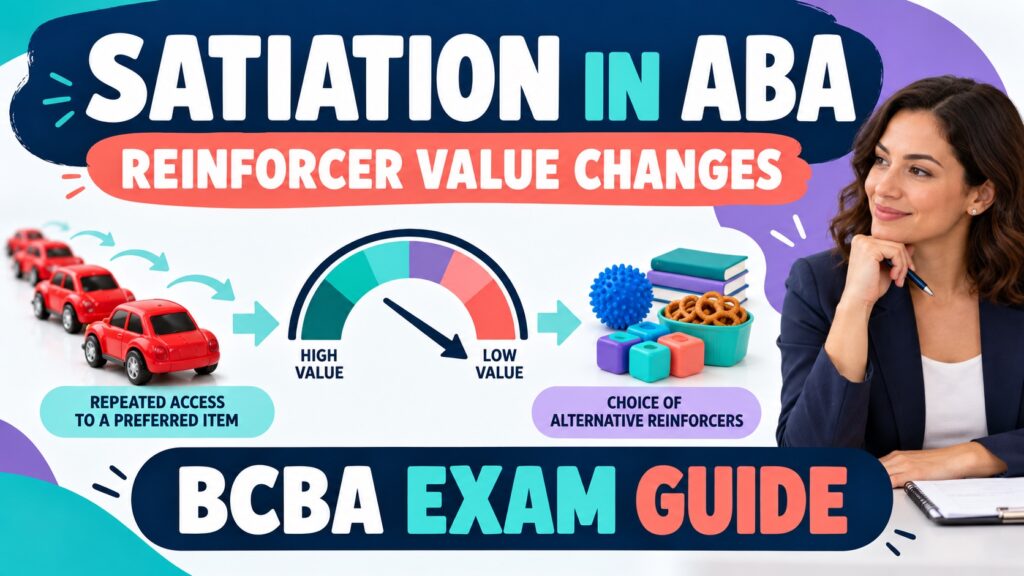
Satiation in ABA is a temporary decrease in a reinforcer’s effectiveness after substantial or repeated access. It may reduce behavior that previously produced it and is commonly analyzed as an abolishing operation.
Satiation is not extinction or punishment. Define the behavior and consequence, record recent access, and check delay, preference, illness, effort, or extinction as alternatives.
This guide defines satiation ABA, compares motivating operations and related processes, and covers ethics, data, and BCBA exam decisions. See the BACB BCBA Test Content Outline.
What Is Satiation in ABA?
Satiation occurs when recent access reduces a consequence’s reinforcing effect. If crackers once increased responding but no longer do so after repeated consumption, satiation is plausible.
The definition is functional, not based on appearing full or bored. Ask whether access changed reinforcement value, identify the response and consequence, and examine conditions.
| Term or statement | Meaning | What the analyst should check |
|---|---|---|
| Satiation | Recent access decreases the effectiveness of a reinforcer. | Access history, delivery, later responding, and alternative explanations. |
| Reinforcer | A consequence that increases a behavior under defined conditions. | Whether behavior actually increased after the consequence. |
| “The learner is not motivated.” | A broad label that does not identify the changed variable. | Reinforcer value, task effort, delay, choice, and current establishing or abolishing operations. |
| Preference | Selection or engagement under an assessment procedure. | Whether the selected item functions as a reinforcer for the target response. |
| Abolishing operation | A variable that decreases consequence value and abates related behavior. | Whether the consequence’s value and behavior effect changed together. |
Exam clue: a consequence works, extensive access occurs, and behavior for it decreases. If delivery simply stops, consider extinction; a selection without behavior data does not prove satiation.
Satiation as an Abolishing Operation
A motivating operation changes consequence value and related behavior. Satiation is an abolishing operation when access lowers value and abates behavior; state both effects.
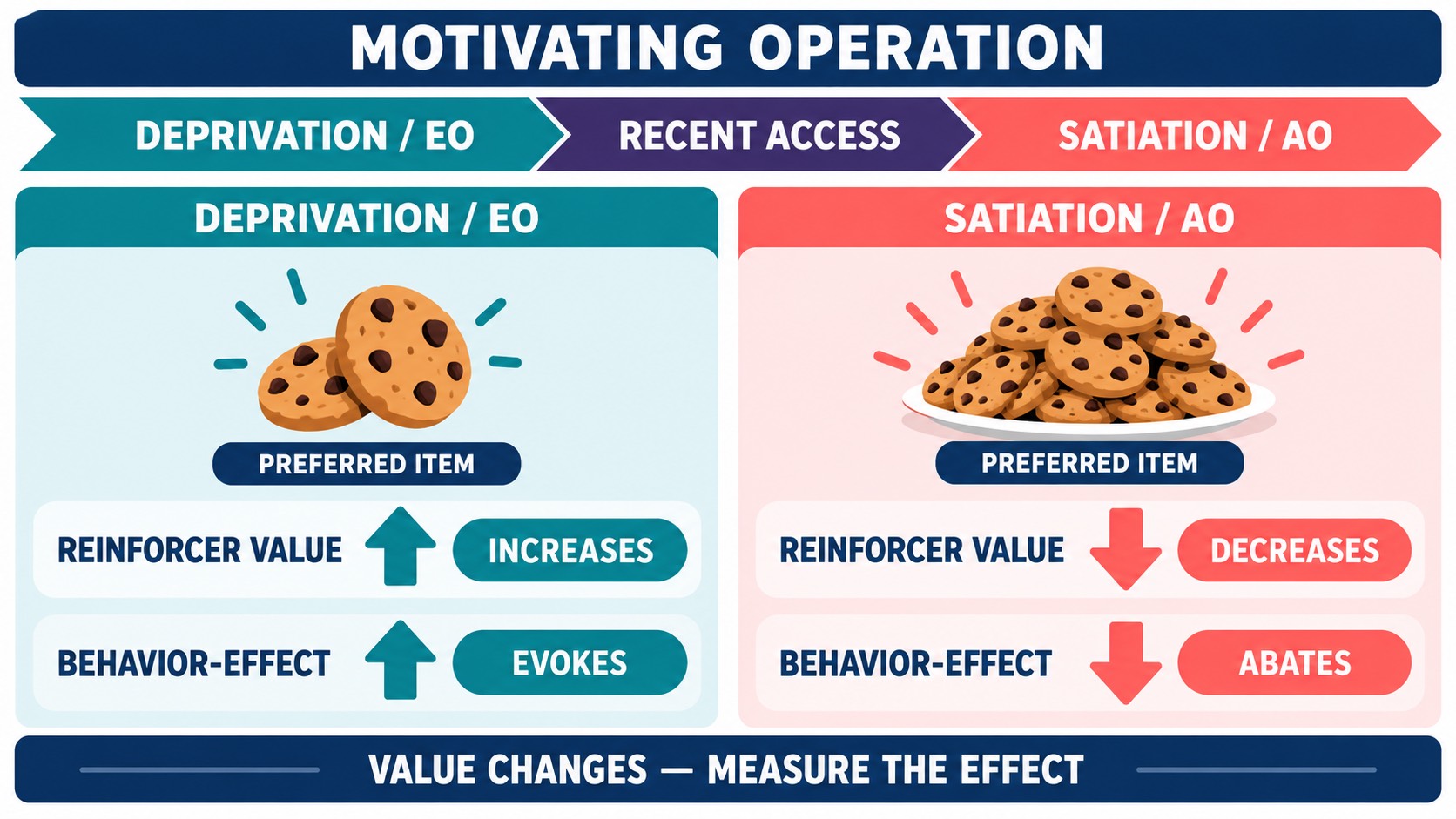
If unlimited access to a token backup precedes teaching, its value may temporarily fall. Do not conclude tokens never work; name the access effect under current conditions.
| AO effect | Question | Satiation example |
|---|---|---|
| Value-changing effect | Did the consequence become less effective as a reinforcer? | Crackers no longer increase responding after repeated consumption. |
| Behavior-altering effect | Did behavior that previously produced the consequence decrease? | Correct responses decline when crackers are the planned consequence. |
| Relevant history | Does the response have a history of contacting that consequence? | Completing tasks previously produced small portions of the snack. |
| Temporal relation | Did the value change after recent access? | Responding is stronger before snack access than after it. |
| Functional test | Would a different consequence or reduced access change responding? | Responding returns with a valid alternative reinforcer or later session. |
“AO” does not prove the effect. Poor pairing, delay, task difficulty, competing events, or an invalid consequence may explain responding; name the evidence.
Satiation vs Deprivation and Establishing Operations
Deprivation or EO can increase a consequence’s value and evoke related behavior; satiation or AO can decrease value and abate behavior. Apply this comparison safely.
“Establishing” describes increased value, not a moral judgment; “abolishing” describes a temporary decrease, not permanent loss.
| Feature | Deprivation or EO | Satiation or AO |
|---|---|---|
| Recent access | Limited or absent access to the relevant consequence. | Substantial, frequent, or immediate access to the relevant consequence. |
| Reinforcer value | Temporarily increases. | Temporarily decreases. |
| Behavior effect | Evokes behavior that previously produced the consequence. | Abates behavior that previously produced the consequence. |
| Example | No tablet access makes tablet time more valuable for a completed task. | Long tablet access makes additional tablet time less valuable for a while. |
| Clinical limit | Do not create unsafe deprivation or withhold basic needs. | Do not force consumption or restrict food, water, comfort, or communication. |
Individualize access. Do not casually manipulate food, fluids, medication, sleep, sensory comfort, or social connection; use choice, assent, and socially valid goals.
Satiation vs Extinction, Habituation, and Punishment
Satiation reduces reinforcer value through access; extinction stops the consequence after a response; punishment adds a consequence that reduces behavior; habituation reduces responding to repeated exposure. Inspect the contingency.
If a toy was freely available all morning, satiation is possible. If requests no longer produce it, extinction; if response cost reduces asking, punishment. Identify time and contingency.
| Process | Defining change | Common exam clue |
|---|---|---|
| Satiation | Recent access decreases the value of a reinforcer. | The same item loses effect after extensive access. |
| Deprivation | Limited access increases the value of a reinforcer. | Restricted access makes related responding more likely. |
| Extinction | Previously reinforcing consequence no longer follows the response. | Responding persists or bursts while the consequence is withheld. |
| Punishment | A consequence following behavior reduces its future frequency. | The response decreases after a specified punishing consequence. |
| Habituation | Responding to repeated stimulus exposure decreases. | Orienting or engagement drops without evidence of reinforcement change. |
Processes can interact. Document each variable rather than forcing one label; on exams, follow the most direct contingency.
Examples of Satiation Across Reinforcers and Settings
Satiation can affect food and conditioned reinforcers such as tokens, praise, attention, toys, activities, or screen time. Backup access, delay, and history matter.
Examples include a snack losing effect after eating, music losing value after long listening, praise losing impact, or tokens losing value when no meaningful backup is available. Measure each case.
| Setting | Possible satiation pattern | Data to collect |
|---|---|---|
| Discrete-trial teaching | Food consequence loses effectiveness after repeated consumption. | Correct responses, delivery amount, consumption, and alternative reinforcer response. |
| Natural environment training | Free access to a toy reduces later toy-mediated responding. | Pre-session access, engagement, requests, and time to re-engage. |
| Token economy | Tokens lose value because the backup menu is unavailable or already accessible. | Token exchange rate, backup selection, delay, and task responding. |
| Social reinforcement | Continuous praise becomes less effective or competes with the task. | Response rate under different praise schedules and learner preference. |
| Classroom break | Extended break access reduces the value of another break during work. | Work initiation, break duration, return latency, and task completion. |
Do not assume primary items reinforce or conditioned items resist satiation. Confirm future behavior change and check preference, pairing, and program feasibility.
How to Check When a Reinforcer Stops Working
Before changing a program, check access, delivery, choices, response effort, and data; then compare satiation with other explanations.
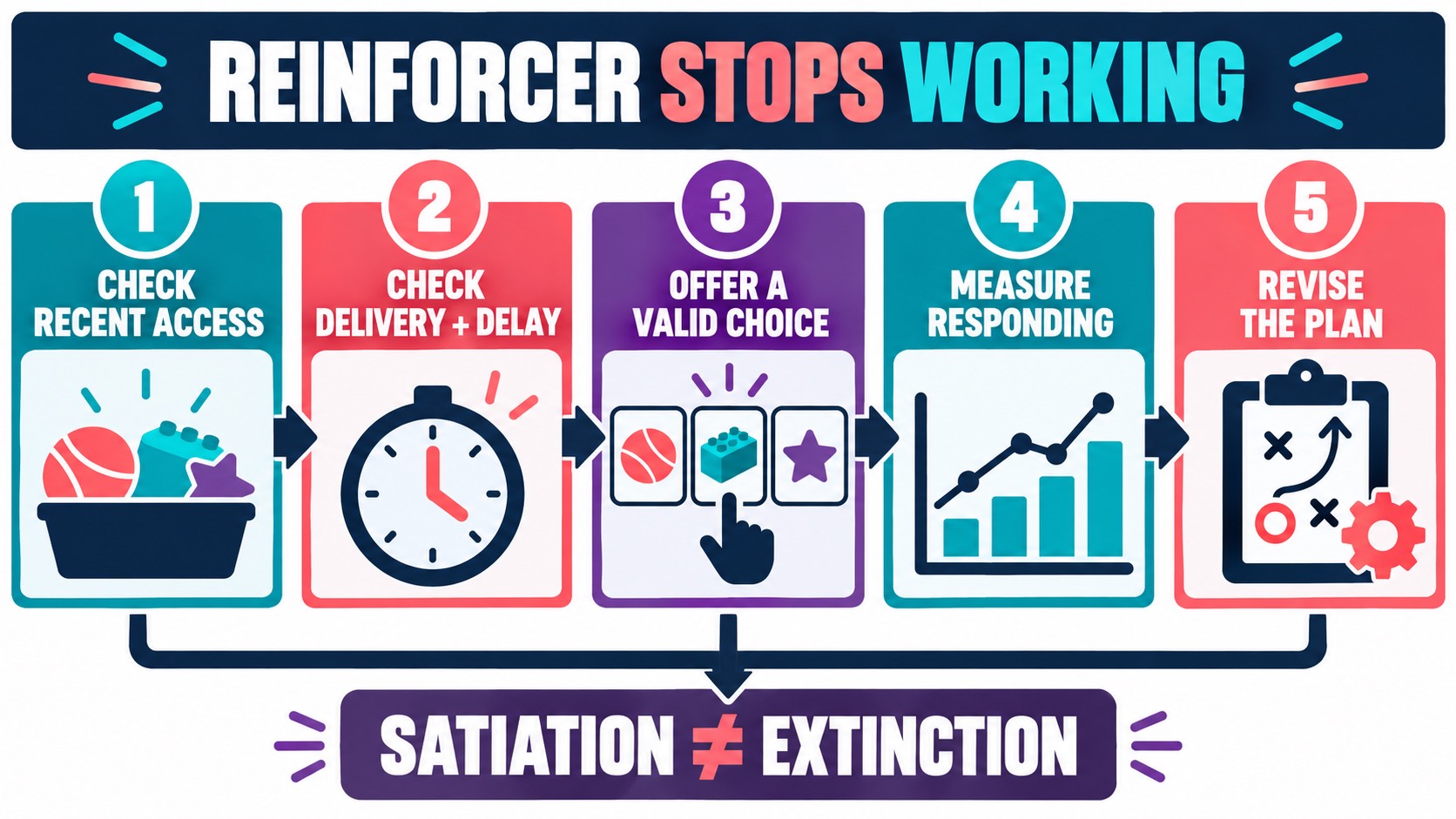
If correct responding drops after a token exchange begins, check delivery, menu, task difficulty, prompts, and competing events. Recent free access followed by later recovery makes satiation more plausible.
| Check | Question | Action if the answer is yes |
|---|---|---|
| Recent access | Did the person receive substantial access to the same consequence? | Record the access and compare responding before and after it. |
| Delivery | Was the consequence delivered as planned and actually contacted? | Correct delivery or consumption problems before interpreting value. |
| Delay | Did the time between response and consequence increase? | Measure delay and consider whether delay, not satiation, changed behavior. |
| Choice | Does the person select or engage with an alternative item? | Offer a valid choice and record selection and response effects. |
| Demand | Did task effort, prompting, or schedule change? | Compare matched conditions and adjust the teaching plan if needed. |
| Trend | Does the effect replicate across opportunities or sessions? | Use repeated data before naming a temporary AO effect. |
Do not preserve a reinforcer at all costs. Honor “no,” discomfort, or a different choice; provide options without coercive deprivation.
Measuring Reinforcer Value and Behavior Change
Test both value change and behavior change. Record rate, accuracy, latency, engagement, choice, amount consumed, and time since access.
Compare responding before and after access while holding demands and delivery stable when safe. Never manipulate food or basic needs merely to demonstrate satiation.
| Measurement | Operational definition | What a satiation pattern might look like |
|---|---|---|
| Response rate | Responses per unit of time under the same opportunity conditions. | Rate drops after recent access to the consequence. |
| Latency | Time from instruction or opportunity to the target response. | Latency increases when the consequence has lost value. |
| Engagement duration | Time actively contacting the item or activity. | Engagement shortens after extended access. |
| Choice allocation | Selections among available reinforcers. | Selection shifts away from the recently available item. |
| Access history | Amount, frequency, and timing of prior access. | Higher recent access covaries with weaker responding. |
| Reinforcer check | Change in future responding after the consequence. | Alternative or delayed access produces a different response effect. |
Preference is not reinforcement. Low selection may reflect satiation, fatigue, competition, or preference change; use direct data and state limits.
Designing Ethical Reinforcement Plans
Plan for changing value with menus, choices, varied materials, paired conditioned reinforcers, and gradual thinning. Preserve “no,” “break,” and “different choice.”
Do not remove meals, fluids, medication, rest, safety, or communication to increase value. Consult qualified professionals when health, feeding, trauma, or medical issues matter.
| Plan element | Why it helps | Safety or dignity check |
|---|---|---|
| Choice menu | Allows the learner to select a currently valuable option. | Include refusal and nonselection as valid communication. |
| Reinforcer rotation | Reduces overreliance on one consequence. | Do not rotate arbitrarily when predictability or comfort matters. |
| Natural reinforcement | Connects the response to meaningful outcomes in the routine. | Preserve access to essential needs and functional communication. |
| Schedule thinning | Builds tolerance for less frequent reinforcement after skill acquisition. | Use data, gradual steps, and a plan for errors or distress. |
| Preference checks | Detects changes in current choices and engagement. | Do not treat selection as consent to all program procedures. |
| Assent and collaboration | Includes the learner and supporters in decisions. | Review goals, barriers, culture, and quality-of-life impact. |
See the motivating operations guide and conditioned reinforcer guide. Aim for safe, meaningful, independent behavior.
Common ABA Assessment and Intervention Mistakes
Do not call every decline satiation. Check extinction, effort, delay, task difficulty, illness, sleep, pain, sensory overload, competing activity, and coercion.
Satiation may recover after time, but not always; preferences, backups, and contingencies can change. Record events and let data guide revision.
| Mistake | Why it is a problem | Better practice |
|---|---|---|
| “The reinforcer stopped working, so it is satiation.” | Other variables may produce the same outcome. | Check access, delivery, delay, task effort, choice, and replication. |
| Using food restriction to increase responding | Creates health, ethics, and consent risks. | Use safe natural opportunities, choices, and a varied menu. |
| Confusing extinction with satiation | Changes to the contingency are missed. | Verify whether the consequence was still delivered for the response. |
| Calling selection proof of reinforcement | Preference does not guarantee a future response increase. | Measure the effect of the consequence on behavior. |
| Ignoring communication | Refusal or discomfort may be misread as a problem to overcome. | Teach and honor “no,” “break,” and alternative communication. |
| Changing several variables at once | The source of behavior change cannot be identified. | Document changes and use a simple, interpretable comparison. |
Supervision asks whether the plan works for the learner. Review task quality, response effort, naturalness of outcomes, and learner priorities.
BCBA Exam Traps, Checklist, and FAQ
For satiation ABA, look for recent access followed by reduced reinforcer value and related behavior. No delivery suggests extinction; a response-reducing consequence suggests punishment; repeated exposure without reinforcement suggests habituation.
| Exam clue | Likely concept | Reasoning move |
|---|---|---|
| The learner has had unlimited access to the same item. | Satiation or an abolishing operation. | Ask whether the item’s value and related responding decreased. |
| Limited access makes the item more effective. | Deprivation or an establishing operation. | Look for increased value and evoked behavior. |
| The item is withheld after the response. | Extinction. | Identify the discontinued consequence rather than access history. |
| A consequence follows behavior and behavior decreases. | Punishment. | Focus on the future behavior effect of the consequence. |
| Responding to a repeated stimulus decreases. | Habituation may be relevant. | Do not call it satiation without a reinforcer-value relation. |
| The learner chooses a different item. | Preference shift or possible satiation. | Measure whether the new item increases the target response. |
Checklist:
- Define the target response.
- Identify the consequence.
- Verify prior reinforcement.
- Record recent access.
- Check delivery quality.
- Check delay and response effort.
- Compare behavior under stable conditions.
- Test a safe alternative.
- Consider health, assent, and communication.
- Revise for culture and quality of life.
What is satiation in ABA?
Satiation is a temporary decrease in reinforcer effectiveness after substantial or repeated access; related behavior may decrease.
Is satiation an abolishing operation?
Yes. It is commonly analyzed as an abolishing operation when access lowers consequence value and abates related behavior.
What is the difference between satiation and extinction?
Satiation changes value through access; extinction stops the consequence after the response. Both can reduce behavior, so inspect the arrangement.
Can praise become satiating?
Repeated praise or attention can lose effectiveness, but measure behavior and preference rather than assuming all social reinforcement is ineffective.
How should a BCBA respond when a reinforcer stops working?
Check access, delivery, delay, effort, competing events, and data. Offer choices, protect essential needs and communication, and revise from evidence.
Satiation means recent access temporarily reduced a consequence’s value, making related behavior less likely; support the conclusion with functional data.
Use the free BCBA mock exam to distinguish satiation, deprivation, extinction, punishment, and habituation from each contingency.



