
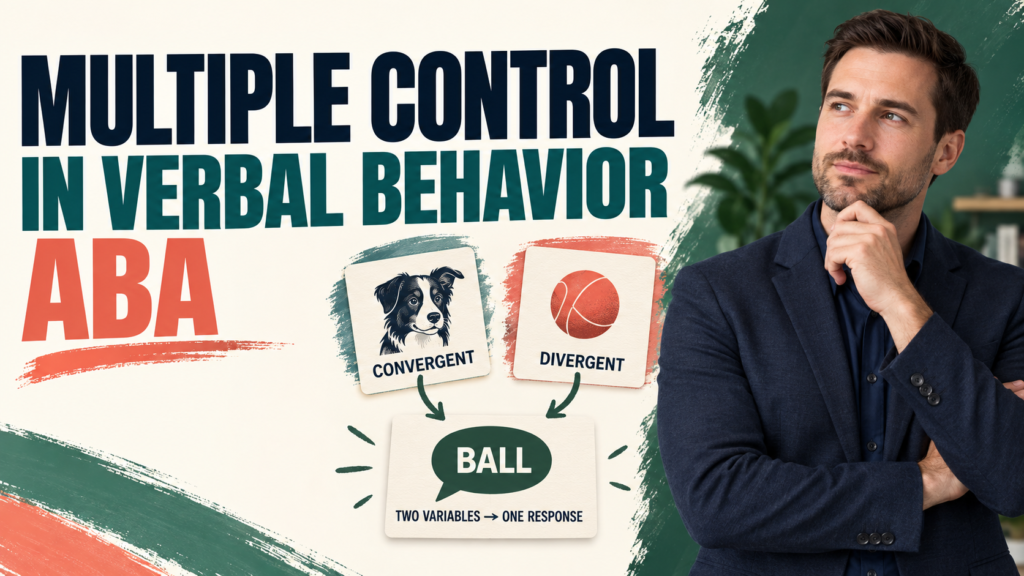
Multiple control in verbal behavior ABA means that a verbal response is influenced by more than one controlling variable at the same time. The most useful distinction is between convergent multiple control, in which several variables strengthen one response, and divergent multiple control, in which one variable affects several possible responses.
Table of Contents
- What Is Multiple Control in Verbal Behavior ABA?
- What Is Convergent Multiple Control?
- What Is a Convergent Multiple-Control Example?
- What Is Divergent Multiple Control?
- How Do Convergent and Divergent Control Differ?
- How Should a BCBA Analyze Multiple Control?
- How Does Multiple Control Affect Language Teaching?
- How Is Multiple Control Tested on the BCBA Exam?
- What Boundaries Matter in Practice?
- Multiple Control in Verbal Behavior ABA FAQ
- Quick Review Checklist
- Take the Free BCBA Mock Exam
This concept helps explain why the same word can serve different functions in different contexts, why a learner may respond correctly only when several cues are present, and why verbal behavior should not be analyzed from response form alone. A BCBA-style answer identifies the relevant motivating operations, discriminative stimuli, verbal prompts, audience variables, and consequences before assigning a label.
This guide uses the current BCBA Test Content Outline for study context and the peer-reviewed literature on multiple control for the technical explanation. The examples are simplified study illustrations, not a universal language program or individualized clinical advice. Table of Contents
What Is Multiple Control in Verbal Behavior ABA?
Multiple control means that one verbal response is controlled by more than one variable, or that one variable strengthens more than one response. It is not a separate verbal operant that replaces the mand, tact, echoic, or intraverbal. Instead, it describes how controlling relations combine around an actual response.
The term matters because “What did the learner say?” is only one part of the analysis. Ask what was present before the response, what the learner wanted or needed, what verbal stimulus was provided, who the audience was, what response history was relevant, and what consequence followed. A response can have a familiar topography while its function changes with the context.
Michael, Palmer, and Sundberg describe multiple control as the ordinary condition of complex verbal behavior. Pure examples of elementary verbal operants can be useful for teaching concepts, but naturally occurring language is often affected by several variables at once. The goal is not to force every utterance into one exclusive category; it is to identify the variables that actually control responding.
What Is Convergent Multiple Control?
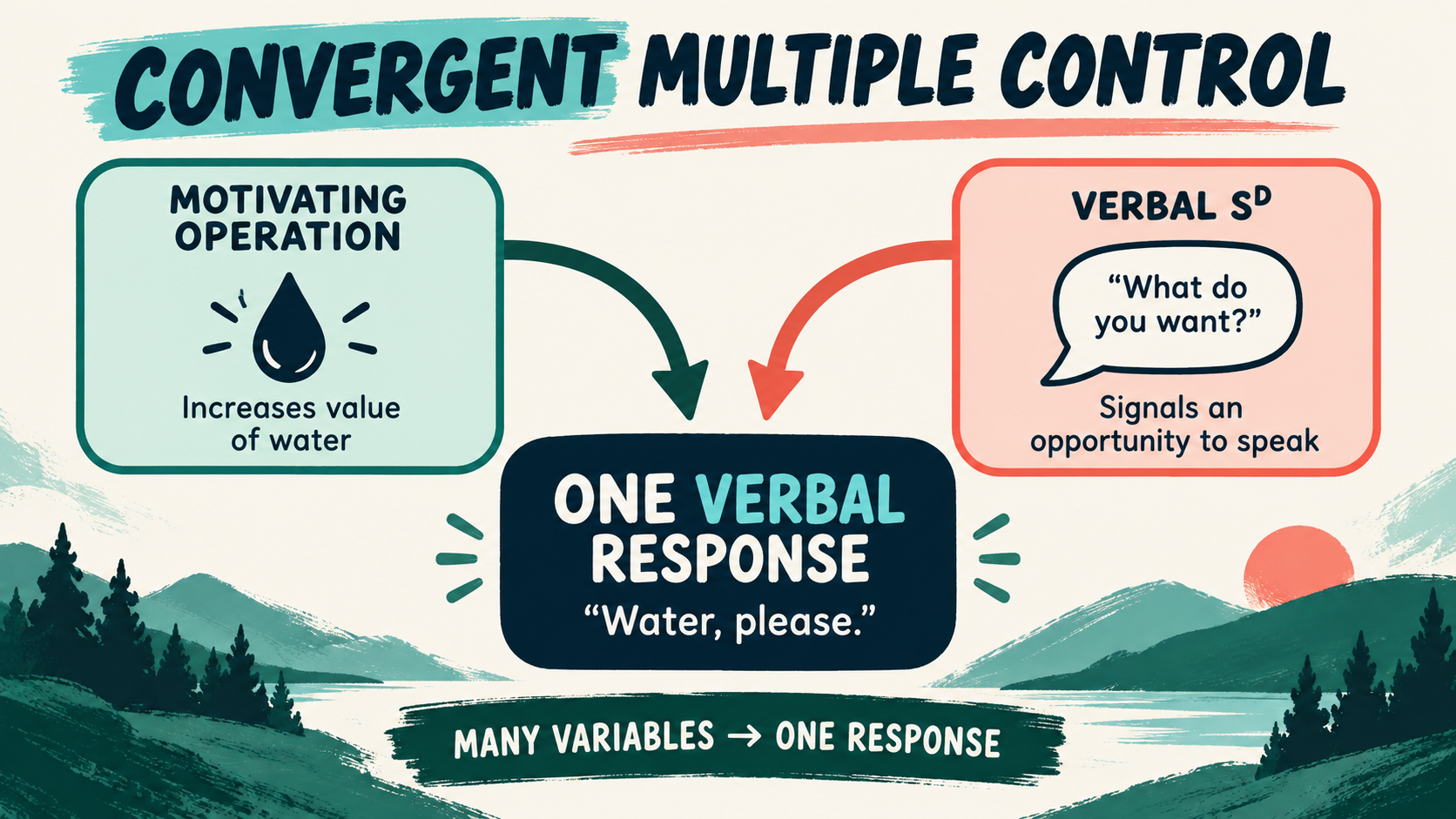
Convergent multiple control occurs when two or more variables converge on one response. Each variable may strengthen a set of responses, and the overlap between those sets makes one response especially likely. In a simple diagram, multiple arrows point toward one verbal response.
For example, thirst may increase the value of water, a visible cup may make water relevant, and the question “What do you want?” may signal an opportunity to request. The response “water, please” is then influenced by more than one variable. The motivating operation gives the request value; the verbal SD helps specify the response form; the audience and reinforcement history also matter.
Convergent control does not mean that every variable is equally strong, or that the response could not occur when one variable is absent. It means the analysis should not pretend that one isolated antecedent explains the full event. A learner may say “water” when thirsty and seeing a cup, but fail to say it when only shown a picture or asked a different question. That pattern gives information about stimulus control and generalization.
What Is a Convergent Multiple-Control Example?
Imagine a learner who is thirsty during a teaching session. A cup of water is visible, the adult asks “What do you want?”, and the learner says “water, please.” The response may be under convergent control from:
- Motivating operation: deprivation or another condition increases the value of water.
- Nonverbal stimulus: the visible cup provides relevant environmental information.
- Verbal SD: the question signals that a spoken request is likely to contact reinforcement.
- Audience: the adult is a person who has historically honored the request.
The response form alone does not reveal which variables are operating. If the adult removes the question and the learner stops requesting, the verbal SD may have been doing important work. If the cup is hidden and the learner still asks for water when thirsty, the motivating operation and verbal context may be sufficient. If the learner says “water” only to one adult, audience control may also be relevant.
This example is simplified. In practice, do not create deprivation or manipulate access to necessities casually. The point is to show how several variables can converge on one response, not to prescribe a teaching procedure.
What Is Divergent Multiple Control?
Divergent multiple control occurs when one variable affects multiple possible responses. A single stimulus may evoke a range of verbal and nonverbal responses depending on the learner’s history, the available repertoire, and the context. In a diagram, one input branches toward several outputs.
Suppose a learner sees a small green ball. The same nonverbal stimulus may evoke “green,” “ball,” “small,” “throw,” “my turn,” or a signed or AAC response, depending on the current question, motivating operation, response history, and audience. The stimulus does not force one response in isolation; its effects are distributed across a repertoire.
Divergent control is useful when analyzing why a learner responds in several ways to one event. It can also explain why a broad prompt produces inconsistent or overly varied responses. The analyst asks which response is being selected by the current task and whether the instructional arrangement makes the desired response more likely without suppressing meaningful communication.
How Do Convergent and Divergent Control Differ?
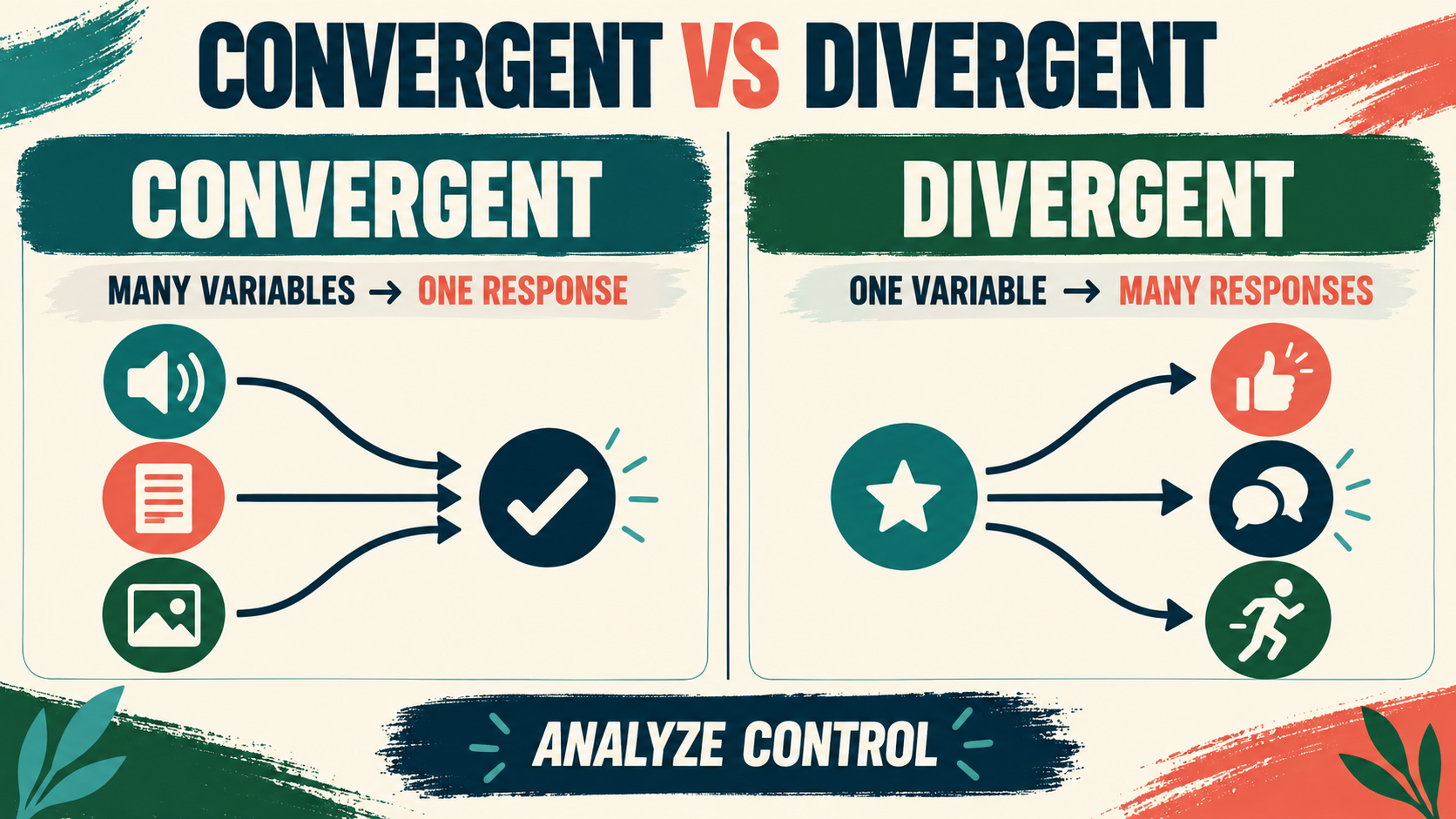
The shortest distinction is “many variables to one response” versus “one variable to many responses.” Both describe relations among variables and responses; neither is a list of verbal operants.
| Feature | Convergent control | Divergent control |
|---|---|---|
| Relation | Several variables strengthen or select one response. | One variable affects several possible responses. |
| Visual map | Many arrows converge on one response. | One arrow branches toward several responses. |
| Example question | Why did “water” become likely right now? | What responses can this ball or question evoke? |
| Teaching risk | A response may fail when one supporting cue is removed. | A broad cue may evoke responses that do not meet the current goal. |
In real behavior, the two patterns can interact. One stimulus can affect many responses, and one selected response can be strengthened by several concurrent variables. The distinction is an analytic lens, not a claim that human language stays inside two sealed boxes.
How Should a BCBA Analyze Multiple Control?
Start with a specific response and a specific opportunity. Write down the exact antecedent or stimulus change, the learner’s current motivating conditions, the response topography, the audience, the prompt, and the consequence. Then ask which variables are necessary, supportive, competing, or irrelevant. A useful analysis sequence is:
- Describe the response. Quote or define what the learner said, signed, selected, or wrote.
- Map the variables. Separate motivating operations, nonverbal stimuli, verbal SDs, prompts, and audience effects.
- Check the consequence. Identify what followed and whether it changed future responding.
- Vary one feature carefully. Compare a new person, material, question, setting, or prompt while keeping the decision relevant and ethical.
- Plan generalization. If the response depends on one cue, program varied exemplars and measure transfer.
Do not infer a controlling variable from a single trial. Multiple control is a reason to collect representative data across people, materials, instructions, and contexts—not a reason to invent a mental explanation. The BACB framework emphasizes observable, measurable behavior and data-based decisions.
How Does Multiple Control Affect Language Teaching?
When a learner performs only under a compound set of cues, the skill may be narrower than the overall score suggests. A learner may label a picture when asked “What is it?” but not spontaneously comment, or may answer “water” only when a cup is visible. The teaching team should specify which relation is being taught and which transfer is expected.
Instruction can begin with supportive prompts and carefully arranged examples, but the team should plan prompt fading, varied stimulus control, and opportunities for independent responding. A response that is correct only after a verbal model is not equivalent to an independent response under natural conditions. Record prompt level and context instead of reporting one undifferentiated percentage.
Multiple control also protects against overly narrow verbal-operant labels. A phrase can function as a mand in one context and a tact or intraverbal response in another. The analyst should consider the variables and consequences in the actual episode. Teaching a flexible repertoire means making relevant sources of control available while honoring the learner’s communication mode and preferences.
How Is Multiple Control Tested on the BCBA Exam?
For the query multiple control in verbal behavior ABA, look for the direction of the relation. If several antecedent variables combine to strengthen one answer, select convergent multiple control. If one stimulus or variable strengthens several possible responses, select divergent multiple control. Exam questions may hide the distinction inside a scenario:
- “The learner is thirsty, sees a cup, and answers a request question with ‘water’.” This points toward convergent control.
- “A green ball evokes ‘green,’ ‘ball,’ ‘small,’ or ‘throw’ depending on the context.” This points toward divergent effects.
- “The learner responds only when a specific prompt and material appear together.” Analyze compound stimulus control and prompt dependence before choosing a verbal-operant label.
Do not choose an answer because it contains a familiar word such as “intraverbal.” Identify the controlling variables first. If a question asks for the role of multiple control, the correct reasoning usually recognizes that complex verbal behavior is multiply determined and that pure, single-source examples are simplified teaching cases.
What Boundaries Matter in Practice?
Multiple control is an analytic concept, not permission to manipulate a person’s motivation, withhold communication, or create unnecessary deprivation. A qualified professional must consider assent, consent, access to effective communication, medical and contextual variables, social validity, and the least intrusive arrangement that supports the person’s goals.
Be precise about what the data show. If a learner stops responding when a prompt is removed, the data show a change under that condition; they do not automatically prove why. Review stimulus control, prompt history, reinforcement, response effort, and the learner’s preferences. When a plan does not generalize, revise the teaching arrangement and consult the responsible supervisor rather than blaming the learner. Use the free BCBA mock exam as a study checkpoint for identifying controlling variables. It is a study aid, not an official BACB product and not a substitute for supervision or individualized assessment.
Multiple Control in Verbal Behavior ABA FAQ
What is the simple definition of multiple control?: Multiple control means that a verbal response is influenced by more than one variable, or that one variable affects more than one possible response. The two common forms are convergent and divergent multiple control.
What is an example of convergent multiple control?: A learner says “water, please” when thirsty, sees a cup, and hears “What do you want?” The motivating operation, nonverbal stimulus, verbal SD, and audience history may converge on one response.
What is an example of divergent multiple control?: A green ball may evoke “green,” “ball,” “small,” “throw,” or another response depending on the question, motivation, audience, and learning history. One stimulus affects multiple possible responses.
Is joint control the same as multiple control?: Joint control is commonly discussed as a special case of convergent multiple control, but the terms should not be treated as interchangeable in every question. Read the scenario and identify the exact relation it describes.
Multiple control in verbal behavior ABA asks the analyst to look beyond the surface form of an utterance. Convergent control is many variables influencing one response; divergent control is one variable influencing many responses. Map the variables, measure the actual conditions, plan generalization, and keep the learner’s communication access and preferences at the center of the analysis.
Quick Review Checklist
Use this final checklist to turn multiple control in verbal behavior ABA into exam-ready reasoning. The goal is not to memorize a label in isolation; it is to identify the relevant evidence and explain why the best answer fits the scenario. Key ideas to review:
- State the central definition or decision point for multiple control in verbal behavior ABA in your own words.
- Identify the detail that makes multiple control in verbal behavior ABA different from its closest related ABA term.
- Separate the observable facts in a scenario from assumptions that are not supported by the facts.
- Write one example and one nonexample so you can recognize the concept in a new setting.
Exam application checks:
- Ask what the question is actually requesting before comparing the answer choices.
- Mark the antecedent, response, consequence, or other evidence that supports the selected answer.
- Look for a distractor that describes a related process but does not answer the specific question.
Final self-check:
- Explain how you would verify the interpretation with clear observations or data.
- Change one detail in the scenario and decide whether your answer should change.
- Give a one-sentence rationale that a supervisor or study partner could evaluate.
Take the Free BCBA Mock Exam
If you want a low-pressure way to check your recall, use the free practice resource below. Take the Free BCBA Mock Exam



