
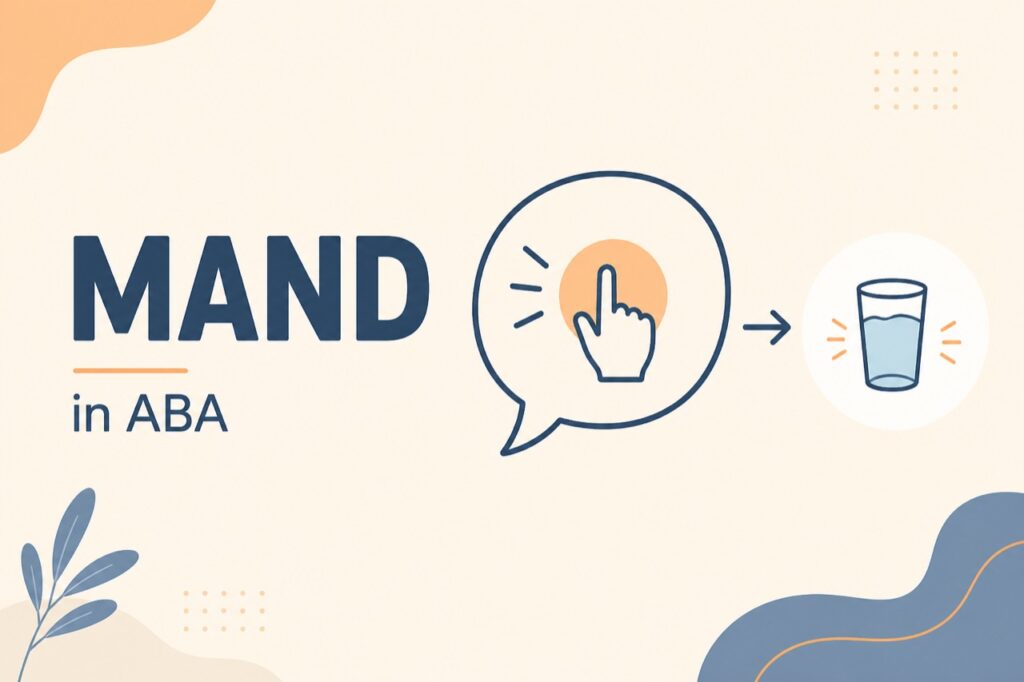
The mand is the first and arguably most important verbal operant in Skinner’s analysis of verbal behavior — and a guaranteed topic on the BCBA exam. This guide explains what a mand is, how it differs from the other verbal operants, the types of mands, and how to teach them, with the exam distinctions that trip candidates up.
Short answer: a mand is a request — a verbal operant under the control of a motivating operation (MO) and reinforced by the specific consequence it asks for. Memory hook: a mand commands or demands what the speaker wants.
Table of contents
- What is a mand?
- Why mands are taught first
- Mand vs tact and the other operants
- Types of mands
- Pure vs impure mands
- How to teach a mand
- Common exam traps
What is a mand?
A mand is a verbal operant evoked by a motivating operation and reinforced by a specific consequence. The defining feature is that the form of the response is controlled by what the speaker wants in that moment, and the reinforcer is exactly that thing — not generalized praise.
If a learner is hungry (MO), says “cookie” (mand), and receives a cookie (specific reinforcer), the request is a mand. The MO both makes the cookie valuable and evokes the response — which is why mands are said to benefit the speaker directly.
Why mands are taught first
In early language programs, mands are usually the first verbal operant targeted, for good reasons:
- They are naturally motivating. The learner is asking for something they actually want, so reinforcement is built in.
- They give the learner control. Manding lets a learner influence their environment appropriately — a powerful, dignifying skill.
- They reduce problem behavior. When a child can ask for a break or an item, they have less need to escalate to challenging behavior to get it (the logic behind functional communication training).
Mand vs tact and the other operants
The exam loves to test whether you can tell the verbal operants apart by their antecedent control and reinforcement:
- Mand — antecedent: MO; reinforcement: the specific thing requested. (“water” → gets water)
- Tact — antecedent: a nonverbal stimulus present in the environment; reinforcement: generalized (social praise). (sees a dog → “dog” → “Yes!”)
- Intraverbal — antecedent: a verbal stimulus; reinforcement: generalized. (“How are you?” → “Fine”)
- Echoic — antecedent: a verbal stimulus with point-to-point correspondence; the response repeats it. (“say ball” → “ball”)
The single most-tested distinction is mand vs tact: a mand is driven by an MO and gets the specific item; a tact is driven by something present and gets social reinforcement. See the full verbal operants guide for all of them side by side.
Types of mands
Mands are not just requests for tangible items. Learners can mand for:
- Items (“juice”), actions (“push me”), and attention (“look!”);
- Removal of something aversive (“stop,” “break”) — a mand to escape;
- Information (“where?”, “what’s that?”) — a mand for information, evoked by an MO for that information.
Pure vs impure mands
A pure mand is under the control of the MO alone. An impure mand is under the control of both an MO and a discriminative stimulus at the same time — for example, asking for a cookie when you are hungry and can see the cookie. On the exam, if a request is partly prompted by the item being visible, think impure mand.
Video Study: Verbal Operants
Watch: BCBA Exam Prep Podcast | B19 Verbal Operants Explained | 6th edition
Use this lesson as a visual study companion, then return to the definitions and examples below to apply the same concept to BCBA® exam questions.
Prefer a second pass? Open this lesson on YouTube.
How to teach a mand
- Find or contrive the MO. Identify what the learner wants right now, or arrange the environment so they want it (e.g., place a preferred item in sight but out of reach).
- Prompt the response (echoic, sign, or picture exchange), then immediately deliver the specific reinforcer.
- Fade the prompt across trials so the MO alone evokes the mand.
- Capture and contrive many opportunities across the day so manding generalizes and maintains.
Effective mand training leans on the MO: teach when the learner is actually motivated, and reinforce with exactly what they asked for.
Common exam traps
- Mand vs tact confusion. Ask: is the response driven by wanting something (MO → mand) or by something present (stimulus → tact)?
- Reinforcement type. Mands get the specific reinforcer; tacts/intraverbals get generalized reinforcement.
- “Please/thank you” are not automatically mands. Classify by the controlling variable, not the politeness.
Verbal behavior is part of a heavily weighted domain — see which sections matter most in the hardest BCBA domains guide.
Real-world mand examples
Mands show up constantly once you know what to look for:
- Tangible: a child reaches and says “ball” to get the ball.
- Action: “push me” on the swing; “open” for a closed container.
- Attention: “look at me!” when wanting a parent to watch.
- Escape/removal: “all done” or “break” to end a hard task.
- Information: “where is it?” when the location is unknown and needed.
In every case the response is driven by a current want (the MO) and is reinforced by getting that exact thing.
Mands and problem behavior (FCT)
One of the most powerful clinical uses of the mand is functional communication training (FCT). If a learner screams to escape demands, the screaming is doing the job of a mand. FCT teaches an appropriate mand that serves the same function — for example, handing a “break” card or saying “break” — and reinforces it, so the appropriate request replaces the problem behavior. This is why building a strong mand repertoire is both a language goal and a behavior-reduction strategy.
Mand training mistakes to avoid
- Teaching when there is no MO. Drilling “say cookie” when the learner does not want a cookie is not mand training — there is no motivation to capture.
- Reinforcing with the wrong thing. A mand must be reinforced with the specific item requested; giving a different reward weakens the mand relation.
- Over-prompting. If the learner only responds after a full verbal prompt, fade prompts so the MO alone evokes the request.
- Too few opportunities. Manding has to be practiced across many natural moments to generalize and maintain.
Bottom line
The mand is the request of verbal behavior: evoked by a motivating operation and reinforced by the specific thing the speaker asks for. It is taught first because it is motivating, gives learners control, and underpins functional communication training. On the exam, classify a response by its controlling variable: if a current want drives it and the speaker gets exactly that, it is a mand — not a tact (driven by something present) or an intraverbal (driven by words). Master that distinction and the verbal-operant questions become straightforward. For the full set side by side, see the verbal operants guide.
Test yourself on verbal behavior
Mands, tacts, and intraverbals are heavily tested. Check your grasp with a free, full-length BCBA mock exam — instant scoring and explanations.
Frequently Asked Questions
What is a mand in ABA?
A mand is a verbal operant under the control of a motivating operation (MO) and reinforced by the specific consequence it requests — in plain terms, a request. If you are thirsty and say “water,” getting water reinforces the mand.
What is the difference between a mand and a tact?
A mand is controlled by an MO and reinforced by the specific item requested (you get what you ask for). A tact is controlled by a discriminative stimulus (something present) and maintained by generalized social reinforcement (like praise).
Why are mands taught first?
Mands give the learner immediate control over their environment, are naturally motivating, and often reduce problem behavior by providing an appropriate way to ask for what they want.
What is an impure mand?
An impure mand is under the control of both a motivating operation and a discriminative stimulus at the same time (for example, asking for a cookie when you both want one and can see it).
References
- Skinner, B. F. (1957). Verbal Behavior.
- Cooper, J. O., Heron, T. E., & Heward, W. L. (2020). Applied Behavior Analysis (3rd ed.) — verbal behavior.
Next step for BCBA exam prep
Turn this topic into exam-day practice
Use this topic as a focused review, then test it in exam-style conditions with a free mock before deciding whether five full-length mocks are the right next step.
Start the Free BCBA Mock ExamContinue with Five Full-Length Mocks — $99
Review the included materials and access details before ordering. No pass guarantee is implied.



