
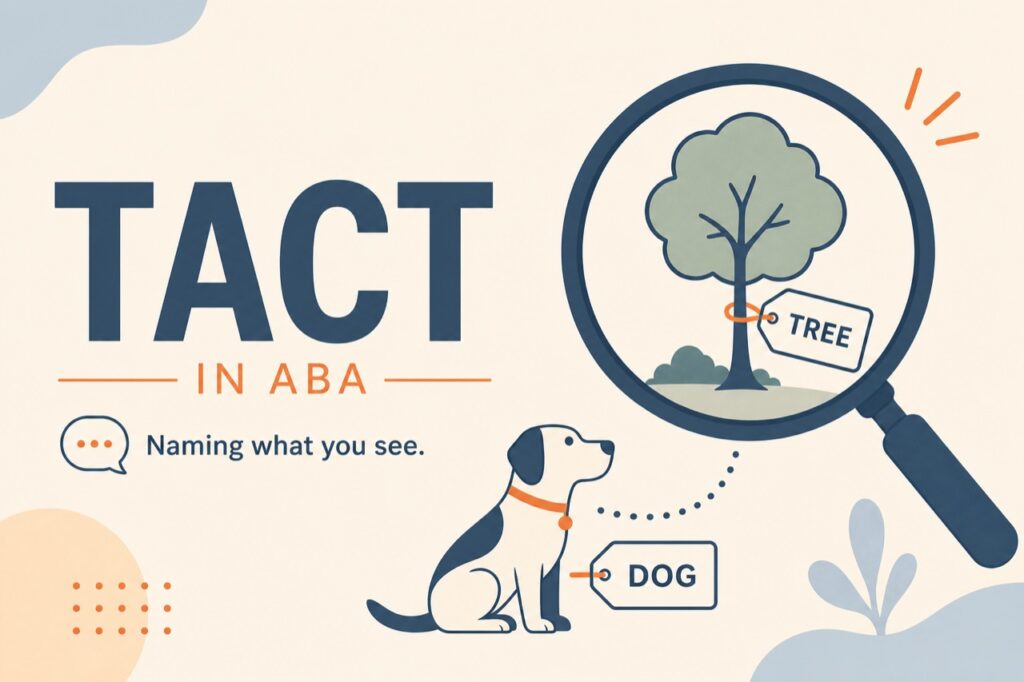
The tact is the “labeling” verbal operant — how we name and comment on the world around us. It is one of the most heavily taught operants in early language programs and a reliable BCBA exam topic. Here is what a tact is, how it differs from the mand and intraverbal, and how to teach it.
Short answer: a tact is a verbal operant evoked by a nonverbal stimulus (something you see, hear, feel) and maintained by generalized (social) reinforcement. Memory hook: a tact makes contact with the environment — it names what is there.
Table of contents
What is a tact?
A tact is evoked by a nonverbal discriminative stimulus — an object, action, event, or property present in the environment — and is reinforced by generalized reinforcement such as praise or acknowledgment, not by getting a specific item. When a child sees a dog and says “dog,” and an adult responds “Yes, a dog!”, that is a tact.
The key is the controlling variable: the response is under the control of what is present, and the reinforcement is social/generalized — the speaker is not asking for anything. This is what makes a tact fundamentally different from a mand.
Tact vs mand vs intraverbal
- Tact — antecedent: a nonverbal stimulus that is present; reinforcement: generalized. (sees a dog → “dog”)
- Mand — antecedent: a motivating operation; reinforcement: the specific thing requested. (wants water → “water” → gets water)
- Intraverbal — antecedent: a verbal stimulus; reinforcement: generalized. (“a dog says…” → “woof”)
On the exam, the giveaway for a tact is that something is physically present and the speaker is commenting/labeling, not requesting. Compare all operants in the verbal operants guide.
Types of tacts
Tacts are not just object labels. Learners can tact:
- Objects (“ball”), actions (“running”), and people (“mom”);
- Properties — color, size, shape, texture (“red,” “big,” “soft”);
- Relations — “on,” “under,” “next to”;
- Private events — internal states like “hot,” “tired,” “happy.”
How to teach a tact
- Present the nonverbal stimulus (show or point to the item/picture).
- Prompt the label — often by transferring from an echoic (“say dog” → fade), then deliver generalized reinforcement (praise), not the item.
- Fade prompts so the stimulus alone evokes the tact.
- Expand to features, functions, and classes, and across many exemplars so tacting generalizes.
Crucially, reinforce tacts socially — if you hand over the labeled item, you may accidentally turn the tact into a mand.
Common exam traps
- Tact vs mand: is the response driven by something present (tact) or by wanting something (mand)?
- Reinforcement: tacts earn generalized/social reinforcement; mands earn the specific item.
- Tact vs intraverbal: a tact is evoked by a nonverbal stimulus; an intraverbal by a verbal one.
Verbal behavior sits in a heavily weighted domain — see the hardest BCBA domains guide.
Quick comparison: the four main verbal operants
Every verbal-operant question comes down to two things: what controls the response (the antecedent) and how it is reinforced. Here is the whole picture at a glance, with Tact highlighted:
| Operant | Antecedent | Reinforcement | Example |
|---|---|---|---|
| Mand | Motivating operation (a want) | Specific item requested | “water” → gets water |
| Tact | Nonverbal stimulus present | Generalized (social) | sees dog → “dog” → praise |
| Intraverbal | Verbal stimulus (words) | Generalized (social) | “how are you?” → “fine” |
| Echoic | Verbal stimulus (repeat it) | Generalized (social) | “say ball” → “ball” |
If you can place a scenario into the right row by spotting its antecedent and reinforcer, you can answer almost any verbal-operant item. For the complete walkthrough of all operants (including the echoic, textual, transcription, and autoclitic), see the verbal operants guide.
Where this fits in language development
Verbal operants are taught roughly in an order that follows their difficulty and usefulness: mands first (motivation is built in), then tacts and a listener repertoire, and later intraverbals, which depend on the earlier skills. Each operant is functionally independent — teaching a word as one operant does not guarantee the learner can use it as another. That independence is a core insight of Skinner’s analysis and a frequent exam point: a child who can tact “cookie” may not yet be able to mand “cookie,” and vice versa, so each function is taught and tested in its own right.
Bottom line
A tact labels the world: it is evoked by a present, nonverbal stimulus and maintained by social reinforcement. Keep it distinct from the mand (driven by a motivating operation, reinforced specifically) and the intraverbal (driven by words), and tact questions become easy points. Teach tacts with present stimuli, fade from echoic prompts, and reinforce socially.
Why teaching tacts matters
Tacts are the backbone of expressive language. A learner who can tact richly can comment on the world, share observations, and connect socially — not just request things. Strong tact repertoires also support later, more complex operants: many intraverbals and academic skills are built on a foundation of solid tacting. Clinically, expanding tacts moves a learner from getting needs met (manding) toward genuine communication and interaction.
Tact extensions (advanced, exam-relevant)
Skinner described ways tacts “extend” to new stimuli — worth knowing for the exam:
- Generic extension: tacting a novel stimulus that shares the defining features (calling a new breed of dog “dog”). This is essentially stimulus generalization and is desirable.
- Metaphorical extension: tacting based on a shared but non-defining feature (“the snow is a blanket”).
- Metonymical extension: tacting based on an associated feature (“the White House said…” to mean the administration).
- Solecistic extension: an extension based on an irrelevant or loosely related property — generally an error.
Real-world tact examples
- A toddler points at a truck and says “truck”; parent says “yes, a big truck!”
- A learner feels the radiator and says “hot.”
- A student labels a picture’s color: “blue.”
- Someone comments on an event: “it’s raining.”
In each, a present, nonverbal stimulus evokes the response and social acknowledgment maintains it.
Tact training mistakes to avoid
- Reinforcing with the item. Handing over the labeled object can convert a tact into a mand — reinforce socially.
- Teaching too few exemplars. One picture of a dog won’t generalize; use many varied examples.
- Leaving prompts in. Fade echoic/other prompts so the stimulus alone controls the tact.
- Skipping properties and relations. Go beyond nouns to colors, actions, and prepositions for a flexible repertoire.
Putting tact training into practice
In day-to-day teaching, the most effective tact programs are woven into natural moments rather than confined to a table. When a learner is engaged with a toy, an instructor can comment and prompt a label, then respond warmly when the learner names it; when walking outside, the same approach turns trees, cars, and animals into dozens of natural tact opportunities. The goal is for the learner to label spontaneously because contacting and describing the world has become reinforcing in its own right, supported by consistent social responses from the people around them.
Progress is easiest to judge against a clear definition of mastery: the learner tacts the target accurately, without prompts, across different examples, different people, and different settings, and continues to do so over time. If a learner only labels a single picture in a single room with one therapist, the tact has not really generalized. Strong programs therefore plan for variety from the start, rotate exemplars, involve multiple communication partners, and probe maintenance after teaching ends. Done well, tact training gives a learner the power to share their experience of the world, which is one of the most meaningful outcomes language instruction can produce.
Test yourself on verbal behavior
Verbal operants are heavily tested. Check your grasp with a free, full-length BCBA mock exam — instant scoring and explanations.
Frequently Asked Questions
What is a tact in ABA?
A tact is a verbal operant evoked by a nonverbal stimulus that is present (an object, action, or property) and maintained by generalized social reinforcement, such as praise. In plain terms, it is labeling or naming.
What is the difference between a tact and a mand?
A tact is controlled by something present and reinforced socially (labeling). A mand is controlled by a motivating operation and reinforced by the specific item requested (a request).
What is an example of a tact?
A child sees a dog and says “dog,” and an adult responds “Yes, a dog!” The dog (present stimulus) evokes the label, and praise reinforces it.
How do you teach a tact?
Present the stimulus, prompt the label (often transferring from an echoic), reinforce with praise rather than the item, fade prompts, and expand across many examples.
References
- Skinner, B. F. (1957). Verbal Behavior.
- Cooper, J. O., Heron, T. E., & Heward, W. L. (2020). Applied Behavior Analysis (3rd ed.).
Complete BCBA Exam Prep
Turn this topic into exam-day practice
Practice concepts in context with five full-length 6th Edition mock exams, two bonus practice exams, a 6th Edition study guide, and key-term flashcards—all in one $120 USD package.
Get the $120 All-in-One Prep Pack
Review everything included on the product page before ordering. No pass guarantee is implied.



