

A changing criterion design in ABA is a single-case experimental design in which the performance criterion changes in planned, successive steps while the target behavior is measured continuously or repeatedly. Experimental control is supported when behavior changes to match each new criterion and the pattern is replicated across several criterion levels.
The design is useful when behavior should change gradually: completing 5, 10, 15, and 20 problems; reducing cigarettes per day; or increasing exercise duration. The criterion is more than a treatment goal: its repeated changes create a phase sequence evaluated against the data.
The BACB Test Content Outline, 6th edition asks candidates to distinguish changing criterion from reversal, multiple-baseline, and multielement designs. This guide covers phase logic, implementation, shaping, validity, and exam traps.
What Is a Changing Criterion Design?
A changing criterion design evaluates an intervention by changing the acceptable-performance criterion in steps. The target behavior is measured in each phase, and the analyst examines whether the data path follows the stepped criterion.
| Design element | What it means | Example |
|---|---|---|
| Target behavior | The measurable response dimension being changed | Problems completed, minutes of exercise, or rate of requests |
| Criterion | The current performance level required or used as the phase target | Complete at least 5, then 10, then 15 problems |
| Criterion phase | A period during which one criterion remains in effect | Sessions 1–5 use the five-problem criterion |
| Step change | A planned increase or decrease in the criterion | Raise the target by five problems after stable performance |
| Replication | Repeated behavior changes that correspond to successive criteria | Data track each new criterion across multiple phases |
It is sometimes called a “stepwise” design because the criterion line changes in steps. Step size and timing depend on the learner, behavior, intervention, and question; each criterion should be attainable yet meaningful to evaluate.
Core Components and Phase Logic
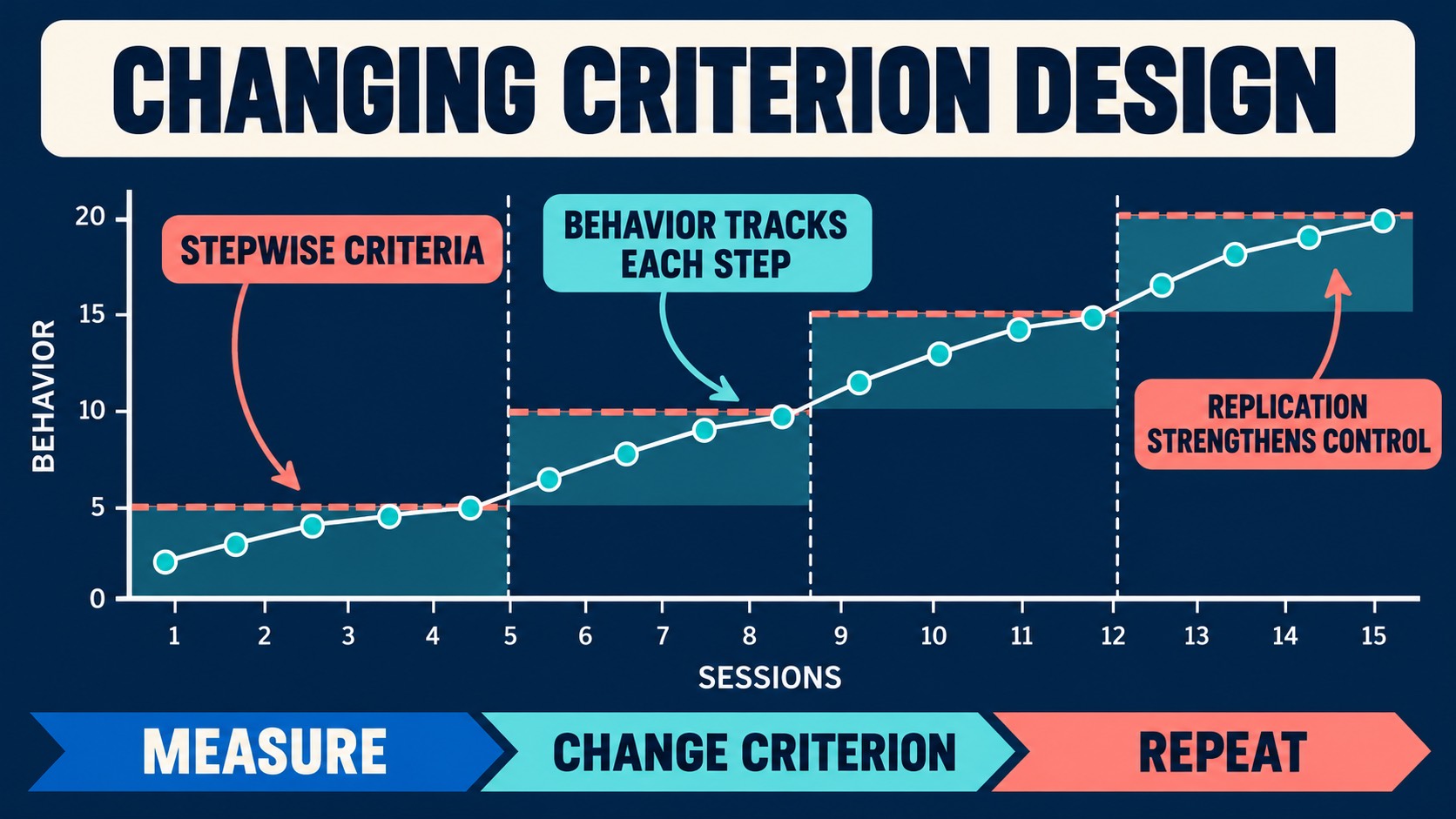
The graph shows the logic: each phase has a criterion line, data are measured against it, and the next phase begins under the planned phase rule. The strongest pattern shows behavior approaching and stabilizing at each criterion, then changing again after the next shift.
| Graph feature | What to inspect | Why it matters |
|---|---|---|
| Criterion lines | Are the levels planned, visible, and ordered? | They define the phases the behavior is expected to follow |
| Data path | Does responding move toward the current criterion? | Tracking supports the design’s prediction |
| Phase changes | Does the behavior change near each criterion shift? | Immediacy at multiple steps strengthens the interpretation |
| Stability | Is the response sufficiently stable before the next shift? | Unstable data make it harder to know whether the new criterion mattered |
| Replication | Does the same relation appear across several steps? | Repeated correspondence reduces the likelihood that one outside event explains the pattern |
A single rise from baseline to the final goal is not enough. The defining evidence is repeated correspondence between criterion changes and behavior changes. Smooth improvement that ignores the lines shows weak criterion tracking.
When to Use a Changing Criterion Design
Use it when the desired change fits a measurable continuum and gradual steps are appropriate. The dimension may be duration, rate, intensity, percentage of opportunities, or another quantity.
| Good fit | Why | Example |
|---|---|---|
| Gradual increase in an existing response | The response can be measured at successive levels | Increase independent task completion from 5 to 20 items |
| Gradual decrease in a measurable behavior | Small reductions can be planned and monitored | Reduce daily cigarette use from 20 to 5 |
| Shaping a dimension of a response | The response form exists, but duration, magnitude, or rate needs to change | Increase conversational volume or on-task duration |
| Ethical need for stepwise change | A sudden shift would be impractical or likely to fail | Gradually increase walking distance with reinforcement |
It is a poor fit when the outcome is a completely new response topography. For a novel response, first establish it with an appropriate procedure or choose a design that matches the research question.
How to Implement the Design Step by Step
Plan implementation before the first change. The criterion must be observable, measurement must stay consistent, and one good session should not trigger an improvised phase change.
- Define the target dimension. Specify exactly what will increase or decrease and how it will be measured.
- Collect baseline data. Establish the starting level and confirm that the measurement procedure is workable.
- Select attainable criterion steps. Set a sequence that is meaningful but reachable, with a clear direction of change.
- Predefine the phase-change rule. State how many sessions, trials, or consecutive observations indicate readiness for the next step.
- Implement the intervention consistently. Keep relevant procedures, prompts, reinforcement, and materials stable unless the design explicitly changes them.
- Measure every phase. Record the target response and the criterion in a way that allows visual comparison.
- Change the criterion as planned. Apply the next step only when the phase rule is met or document why a clinical adjustment was necessary.
- Evaluate tracking and replication. Review whether behavior changed with each criterion and whether the relation appears repeatedly.
For example, independent work may increase from 5 to 8, 11, and 14 minutes across phases. If duration meets each planned criterion, the design is functioning as intended. Changing the criterion, prompts, reinforcer, task difficulty, and measurement rule together weakens interpretation.
How to Read the Graph
Read the graph by asking whether behavior follows phase targets, not merely whether the final point is higher or lower than the first. Inspect level, trend, variability, immediacy after each shift, and overlap with the criterion line.
| Question | Strong pattern | Interpretation concern |
|---|---|---|
| Does the behavior approach each step? | Data move toward the current criterion in repeated phases | Data remain far from the line or change independently of the steps |
| Does the behavior stabilize? | Responding is reasonably consistent before the next phase | High variability makes the phase change difficult to interpret |
| Is there immediacy? | The response shifts soon after the criterion changes | The response changes long before or long after the phase shift |
| Is there replication? | The tracking pattern occurs at several criterion levels | Only the first or final phase resembles the prediction |
| Are alternatives plausible? | No obvious unrelated event matches every phase change | History, maturation, task changes, or reinforcement changes align with the data |
Do not mistake the criterion line for behavior measurement. The line is the phase target; the data path is observed behavior. Read them separately and explain whether the data track the target.
Changing Criterion and Shaping
A changing criterion design can evaluate shaping of an existing response dimension: increasing voice volume, sustaining task engagement, or increasing walking distance. The response form is present while one dimension changes through successive criteria.
This differs from shaping across response topographies, where approximations are different forms leading to a novel response. Changing criterion is clearest when one response class can be measured on a quantitative continuum; the question is whether behavior tracks the steps.
| Shaping situation | Changing criterion fit | Why |
|---|---|---|
| Increase the duration of an existing response | Often a good fit | Duration can be measured and changed in steps |
| Increase the magnitude or volume of an existing response | Often a good fit | The response form remains while a dimension changes |
| Teach a completely new response form | Use caution | Criterion tracking may not be the clearest way to evaluate novel topographies |
| Change several response dimensions at once | Weak fit unless carefully designed | It becomes difficult to identify which criterion or variable produced the change |
See the site’s shaping in ABA guide. Shaping is a behavior-change procedure; changing criterion is an experimental design that evaluates stepwise changes in a measurable target.
Changing Criterion vs Other Single-Case Designs
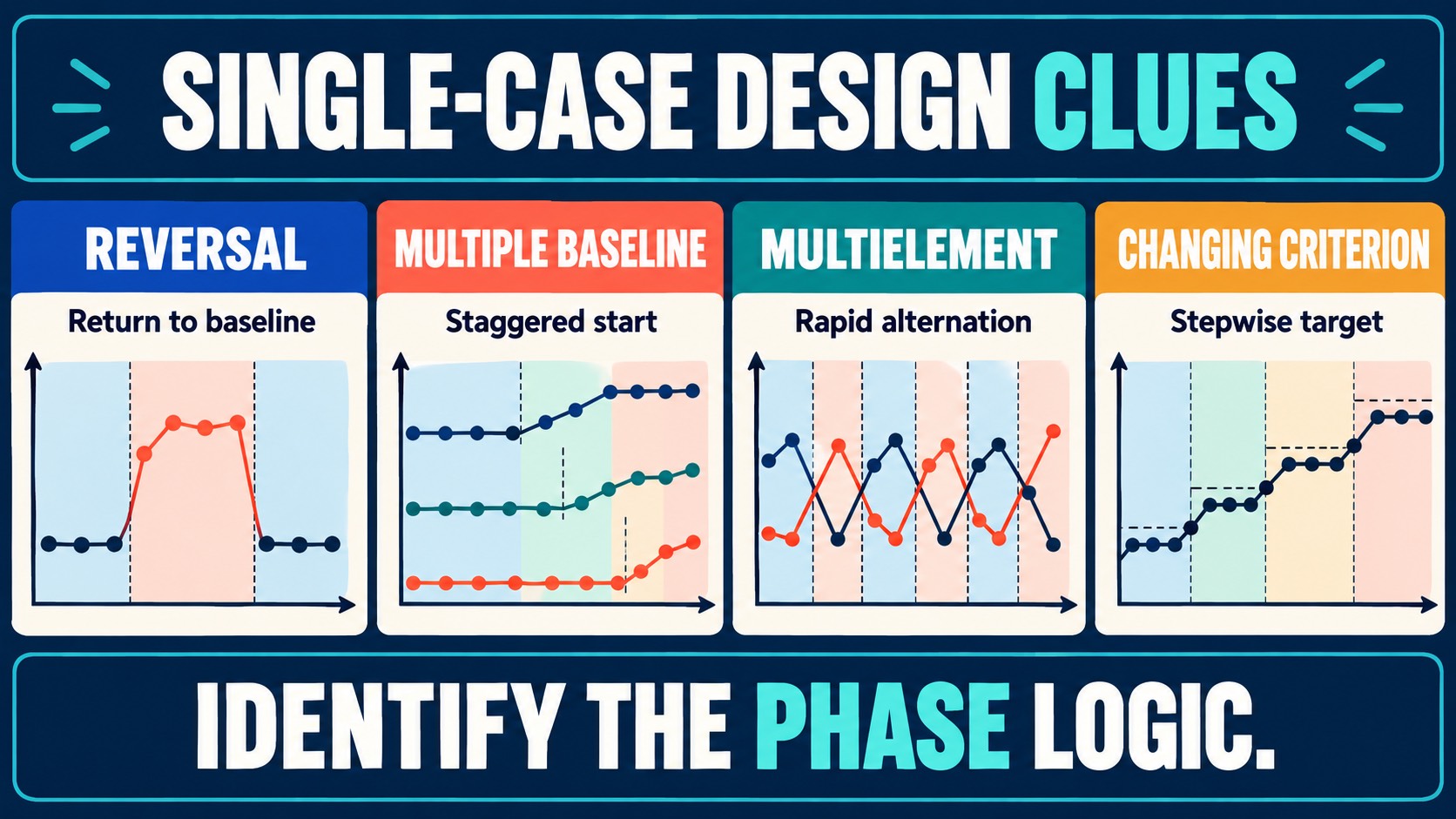
When a graph is unnamed, identify phase logic first: reversal returns to a prior condition, multiple baseline staggers intervention, multielement rapidly alternates conditions, and changing criterion changes the target in steps.
| Design | Defining phase feature | Fast exam cue |
|---|---|---|
| Reversal or withdrawal | Conditions are introduced, withdrawn, or returned | ABAB or another return to a previous condition |
| Multiple baseline | Intervention begins at different times across behaviors, settings, or participants | Staggered starts with no required withdrawal |
| Multielement or alternating treatments | Conditions alternate rapidly across sessions or trials | Rapid comparison of treatments or test conditions |
| Changing criterion | One intervention remains while the performance criterion changes successively | Stepwise target lines with behavior tracking each step |
A changing criterion design may briefly reverse a criterion, but reversal is not required. Its essential features are planned criterion levels and repeated correspondence between data and those levels.
See the site’s multiple-baseline guide and multielement-design guide when the question emphasizes staggered intervention or rapid alternation.
Strengths, Limitations, and Validity
The design can demonstrate a functional relation without withdrawing an effective intervention. It also fits situations where gradual improvement is safer than an immediate final goal, with repeated opportunities to test predicted responding.
Limits include criteria changed too quickly, steps too small to interpret, or outside events coinciding with each phase change. Inconsistent reinforcement or measurement can make the graph look stepwise for reasons unrelated to behavior.
| Validity check | Risk | Protection |
|---|---|---|
| Internal validity | History or maturation coincides with criterion changes | Use repeated steps, stable measurement, and a plausible phase schedule |
| Measurement validity | Operational definition or scoring dimension changes | Keep the target and measurement rule consistent across phases |
| Treatment integrity | Prompts, reinforcement, or materials change with the criterion | Record fidelity and document planned changes |
| Social validity | Final target is not meaningful or feasible for the learner | Include the learner’s priorities, context, safety, and meaningful outcomes |
| Generalization | Tracking occurs only in one narrow setting | Plan maintenance and generalization probes separately |
Common BCBA Exam Traps
Use the table below when a vignette mixes design features, shaping, and intervention decisions.
| Exam clue | Likely answer | Why |
|---|---|---|
| The criterion rises from 5 to 10 to 15 while the data follow each level. | Changing criterion design | The performance target changes in planned steps and behavior tracks it. |
| The intervention is introduced to reading, then math, then writing at different times. | Multiple baseline design | The intervention start is staggered across baselines. |
| Baseline and intervention alternate repeatedly. | Reversal or withdrawal design | The phase logic returns to a prior condition. |
| Two interventions are alternated rapidly across sessions. | Multielement design | Conditions are compared through rapid alternation. |
| The criterion changes, but the behavior never approaches any step. | Weak or unsupported criterion-tracking pattern | A line on a graph does not prove the design worked. |
| A novel response form is taught through successive approximations. | Shaping procedure, not automatically a changing criterion design | The response-topography and design question must be separated. |
Breaking a goal into smaller steps is not enough. A design requires an organized phase sequence, repeated measurement, and logic for interpreting whether behavior follows the changing criterion.
Changing Criterion Design FAQ and Final Review
What is a changing criterion design? It is a single-case experimental design that changes a measurable performance criterion in successive steps and evaluates whether behavior tracks each step.
What type of behavior is a good fit? A response that can change gradually along a measurable dimension, such as rate, duration, magnitude, intensity, or amount completed.
Does the design require returning to baseline? No. A return to baseline is the defining clue for a reversal design. A changing criterion design can include an optional criterion reversal, but its core feature is stepwise criterion change.
How is it related to shaping? It can evaluate shaping within a response dimension, such as increasing duration or volume. It is less straightforward for teaching an entirely novel response topography.
What demonstrates experimental control? Repeated, orderly changes in behavior that correspond to successive criterion changes, with stable measurement and plausible phase timing.
What is the fastest exam memory cue? Remember: reversal returns, multiple baseline staggers, multielement alternates, changing criterion steps.
For final review, check these points:
- The criterion changes in planned, successive steps.
- The target behavior is measured consistently in every phase.
- The data track each criterion rather than only the final goal.
- Repeated correspondence supports experimental control.
- The design is distinguished from shaping and other single-case phase patterns.



