
Intraverbal behavior is the verbal operant behind answering questions, completing familiar phrases, naming associations, and carrying on a conversation. In ABA, the useful question is not simply “Was the response spoken?” It is: What variable evoked the response, and what relation does the response have to that stimulus?
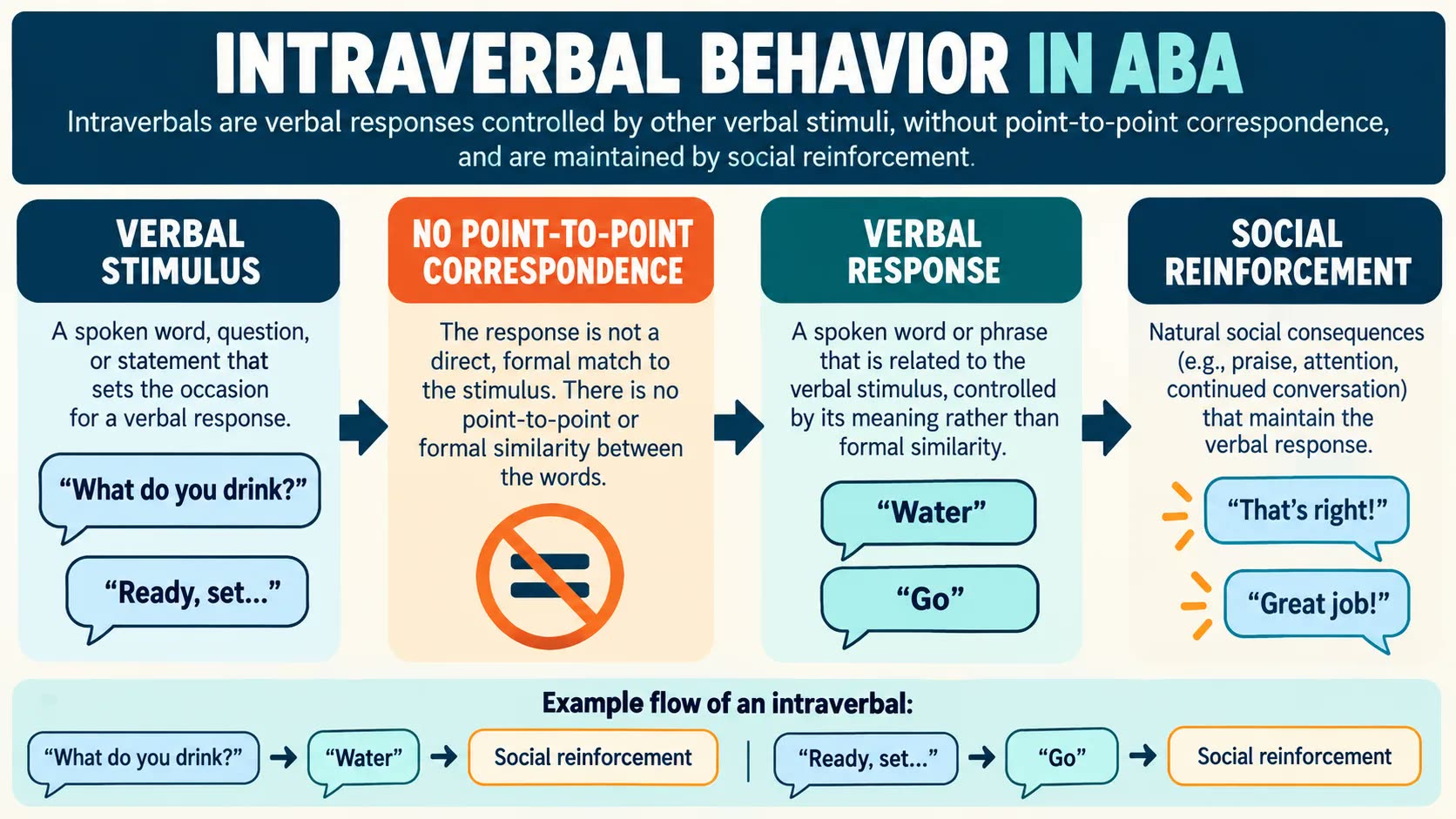
An intraverbal occurs when a verbal stimulus evokes a verbal response that does not have point-to-point correspondence with the stimulus. “What do you drink?” → “Water” is an intraverbal. “Say water” → “Water” is an echoic. The response may be correct in both examples, but the controlling relation is different. This guide defines intraverbal behavior, compares it with other verbal operants, shows teaching and measurement steps, and highlights BCBA exam traps.
What is an intraverbal in ABA?
An intraverbal is a verbal response evoked by another verbal stimulus, with no point-to-point correspondence between the stimulus and the response. The stimulus can be spoken language, a written question, a sentence stem, or another product of verbal behavior. The response can be a word, phrase, sentence, category member, or conversational turn. In everyday terms, an intraverbal is language controlled by language when the answer is not a direct copy of the words that came before it.
For example, the question “What is your favorite color?” may evoke “blue.” The words what is your favorite color do not map word-for-word onto blue. The response is shaped by a history of reinforcement in a verbal community, including feedback, access to conversation, and successful participation in social or educational routines. The definition is functional: the same spoken word can be an intraverbal in one context and a different verbal operant in another.
The current BCBA Test Content Outline (6th ed.) places identifying and distinguishing verbal operants under task B.19 and asks candidates to identify the role of multiple control in verbal behavior under B.20. That makes the controlling-variable analysis more useful than memorizing isolated examples.
| Question | Answer for an intraverbal |
|---|---|
| What evokes the response? | A verbal stimulus, such as a question, statement, sentence stem, or conversational turn. |
| Does the response copy the stimulus? | No point-to-point correspondence or formal similarity is required. |
| What commonly maintains it? | Generalized social reinforcement, such as attention, praise, feedback, or continued interaction. |
Intraverbal vs. echoic, tact, and mand
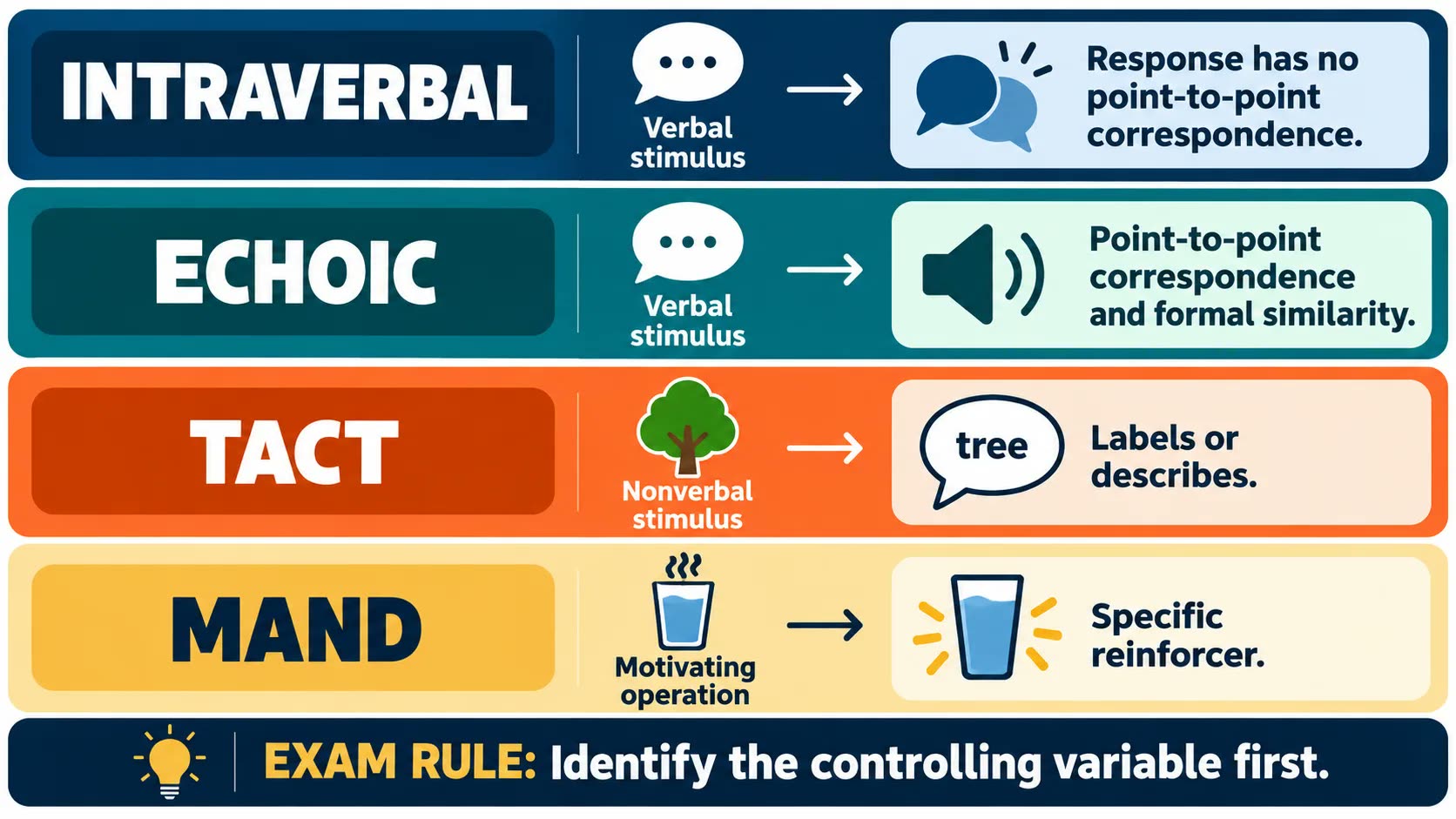
To classify a verbal response, identify the most important controlling variable before looking at the response’s wording. The table below separates four commonly tested verbal operants. The examples are intentionally short because the same response topography can change function when the antecedent changes.
| Operant | Primary controlling variable | Response relation | Example |
|---|---|---|---|
| Intraverbal | Verbal stimulus | No point-to-point correspondence | “What do bees make?” → “Honey” |
| Echoic | Verbal stimulus | Point-to-point correspondence and formal similarity | “Say honey” → “Honey” |
| Tact | Nonverbal stimulus | The response labels or describes a feature of the environment | Seeing a bee → “Bee” |
| Mand | Motivating operation plus a history of reinforcement | The response specifies its reinforcer | Thirsty → “Water,” followed by water |
“What does a dog say?” → “Woof” is usually an intraverbal even though the answer is related to a dog. The dog is not present as the controlling nonverbal stimulus; the spoken question is. By contrast, “What is that?” while a dog is visibly present may evoke a tact. “Say dog” → “Dog” is an echoic when the response matches the model. “Dog” spoken while the person wants a dog to approach could be a mand only if the relevant motivating operation and reinforcer support that interpretation.
Intraverbal examples by skill type
Intraverbal repertoires range from short sentence completions to flexible conversation. A response should be judged against the programmed antecedent and the learner’s response definition, not against whether the sentence sounds natural to an adult.
| Skill type | Verbal stimulus | Possible response | What to check |
|---|---|---|---|
| Fill-in | “Ready, set…” | “Go” | The learner responds without simply repeating the prompt. |
| WH question | “Where do you sleep?” | “In a bed” | The answer matches the question and is independently emitted. |
| Category | “Name three animals.” | “Dog, cat, horse” | Responses meet the category definition rather than being prompted by visible items. |
| Association | “You cut with a…” | “Scissors” | The verbal relation is established without requiring the tool to be present. |
| Conversation | “What did you do after class?” | “I went to the library.” | The response stays on topic and contacts the conversational consequence. |
Complex intraverbals can involve several verbal components at once. For example, “What animal lives in the ocean and has eight arms?” may require the learner to integrate the question’s components before saying “octopus.” Research on verbal stimulus control describes this as increasingly complex or conditional control; it is one reason that a learner may answer simple fill-ins but struggle with compound questions.
How to teach intraverbal behavior
Teaching should be individualized, socially meaningful, and based on data. A clear sequence reduces the chance that a learner memorizes a prompt instead of contacting the verbal stimulus.
- Define the target response. State the exact antecedent, acceptable response forms, scoring rule, and whether a response must be independent, complete, or generalized across examples.
- Check prerequisites and motivation. Confirm that the learner can understand the relevant words, emit the response form, and contact reinforcement for communicating. Select targets that matter in the learner’s daily routines.
- Start with an appropriate response effort. Begin with known or highly likely responses, then systematically increase complexity. A history of successful responding can make instructional trials more efficient.
- Present the verbal stimulus clearly. Use consistent wording at first, allow the planned response interval, and avoid adding unplanned hints that change stimulus control.
- Prompt only as needed. An echoic model, visual cue, tact prompt, or written cue may help establish the response, but the prompt should be faded so the target verbal stimulus controls responding.
- Reinforce the target response. Deliver the programmed consequence promptly and match it to the learner and context. Social reinforcement may include attention, praise, feedback, or continuing a meaningful interaction.
- Probe without prompts. Separate teaching trials from independent probes. Record whether the learner responded independently, after a prompt, incorrectly, or not at all.
- Generalize and maintain. Vary people, wording, examples, settings, topics, and response forms. Recheck targets after mastery and program naturally occurring conversational opportunities.
These steps are not a one-size-fits-all protocol. The BCBA should use assessment results, scientific evidence, client preferences, and contextual fit when selecting and evaluating an intervention. Intraverbal teaching should also respect the learner’s communication mode; spoken responses are not the only meaningful form of verbal behavior.
Prompting and transfer of stimulus control
A common teaching problem occurs when the learner answers only after an echoic model or a visible picture. The learner may be producing the correct words, but the response is still controlled by the prompt rather than by the intraverbal stimulus. Transfer procedures arrange a prompt that already evokes the response, then gradually remove or delay that prompt while preserving the target verbal stimulus.
For example, to teach “What do you drink?” → “water,” a practitioner might first use a spoken model, a tact opportunity, or a written cue depending on the learner’s repertoire. The prompt is then faded or delayed across trials. If the learner begins repeating the model instead of answering, the practitioner should adjust the prompt and scoring rule rather than count the echoic as independent intraverbal behavior.
| Observation | Likely interpretation | Next decision |
|---|---|---|
| Correct only after an echoic model | The response may still be under echoic control. | Fade the model and score independent responding separately. |
| Correct with a picture present, incorrect without it | Nonverbal stimulus control may be supporting the response. | Fade the picture and probe the verbal stimulus alone. |
| Correct on one wording only | Stimulus control may be too narrow. | Vary wording, speakers, examples, and contexts. |
| Answers a compound question with only one component | Restricted or incomplete stimulus control may be present. | Teach component relations, then recombine them and test generalization. |
How to measure intraverbal acquisition
Measurement should make independence and generalization visible. A simple percentage can be useful, but only when the denominator and response rules are clear. Define an opportunity as one presentation of the target verbal stimulus under the planned conditions, then record the response category.
| Measure | Formula or rule | Use |
|---|---|---|
| Independent accuracy | Independent correct responses ÷ opportunities × 100 | Primary acquisition measure when opportunities are comparable. |
| Prompted response | Record the prompt level and do not combine it with independent accuracy. | Shows instructional progress and whether prompts are being faded. |
| Latency | Time from the verbal stimulus to response onset, using a defined interval. | Useful when speed or conversational timing is clinically important. |
| Generalization | Probe novel wording, people, settings, topics, and response examples. | Shows whether the repertoire extends beyond trained items. |
For ten opportunities, a learner who answers independently on seven trials has 70% independent accuracy. If three additional trials are correct only after a prompt, report the prompted responses separately. Otherwise, the summary can make an emerging skill look mastered. Use graphs and repeated probes to evaluate level, trend, variability, and the effect of teaching decisions.
Common BCBA exam traps
- Confusing verbal with echoic: A verbal antecedent does not automatically make the response an intraverbal. If the learner repeats the model with point-to-point correspondence and formal similarity, classify it as echoic.
- Ignoring the nonverbal stimulus: If the object, event, or property in the environment controls the label, the response is a tact even when someone also asks a question.
- Calling every request a mand: “Water” is not automatically a mand. The vignette must show a motivating operation and a consequence that functions as the specified reinforcer.
- Using meaning instead of function: “Cat” and “meow” are related, but the classification depends on what evoked the response and how it is related to that stimulus.
- Overlooking multiple control: A response can be influenced by more than one variable. Choose the relation supported by the full vignette rather than one isolated word.
- Counting prompted answers as independent: Correct topography after a prompt is not the same as independent stimulus control. Examine the prompt, response delay, and scoring rule.
- Confusing speaker and listener behavior: Following a spoken instruction by pointing or selecting can be listener responding; answering with a verbal response is a speaker behavior that may be intraverbal.
Quick intraverbal checklist
When a BCBA exam question asks you to identify an intraverbal, run this short checklist:
- Is the immediate controlling stimulus a product of verbal behavior?
- Is the learner producing a verbal response rather than a nonverbal listener response?
- Is there no point-to-point correspondence between the verbal stimulus and response?
- Could a motivating operation, nonverbal stimulus, echoic prompt, or multiple-control arrangement explain the response instead?
- Does the data rule distinguish independent responding from prompted responding?
The shortest accurate definition is: an intraverbal is a verbal response evoked by a verbal stimulus without point-to-point correspondence. For deeper study, compare the definition with the BACB’s current BCBA Test Content Outline and the peer-reviewed discussion of verbal stimulus control and the intraverbal relation. A useful study habit is to identify the controlling variable before naming the verbal operant.



