
Why do people think ABA is abuse? The short answer is that many people are responding to a combination of history, personal experience, ethical concerns, and disagreement about what autism services should try to change. Some autistic people and self-advocacy organizations describe harmful or traumatic experiences with behavior-based services. Some families and practitioners describe meaningful gains from individualized behavioral support. Both realities can exist without making every program identical.
Table of Contents
- Why Do People Think ABA Is Abuse?
- How History Shapes the Criticism
- Why Goals and “Normal” Behavior Matter
- Coercion, Assent, and Power Differences
- Why Autistic Voices Must Be Included
- How to Review a Specific ABA Program
- What Does Ethical ABA Practice Look Like?
- Red Flags and Green Flags
- How to Think About This on the BCBA Exam
- FAQ
- Sources to Verify the Topic
- Take the Free BCBA Mock Exam
Applied behavior analysis is a broad science and professional practice, not one single protocol delivered the same way by every provider. A question about whether ABA is abusive therefore cannot be answered responsibly by a label alone. The useful review is specific: What is the goal? What procedure is being used? Can the learner communicate no or pause? What happens when the learner refuses? What do the outcome and adverse-effect data show?
This article explains why the criticism exists, how history and present-day practice get mixed together, what ethical safeguards should look like, and what a family, learner, supervisee, or BCBA student can ask before judging a service. It is an educational discussion, not a clinical recommendation or a substitute for the learner’s own informed decision-making. Table of Contents
Why Do People Think ABA Is Abuse?
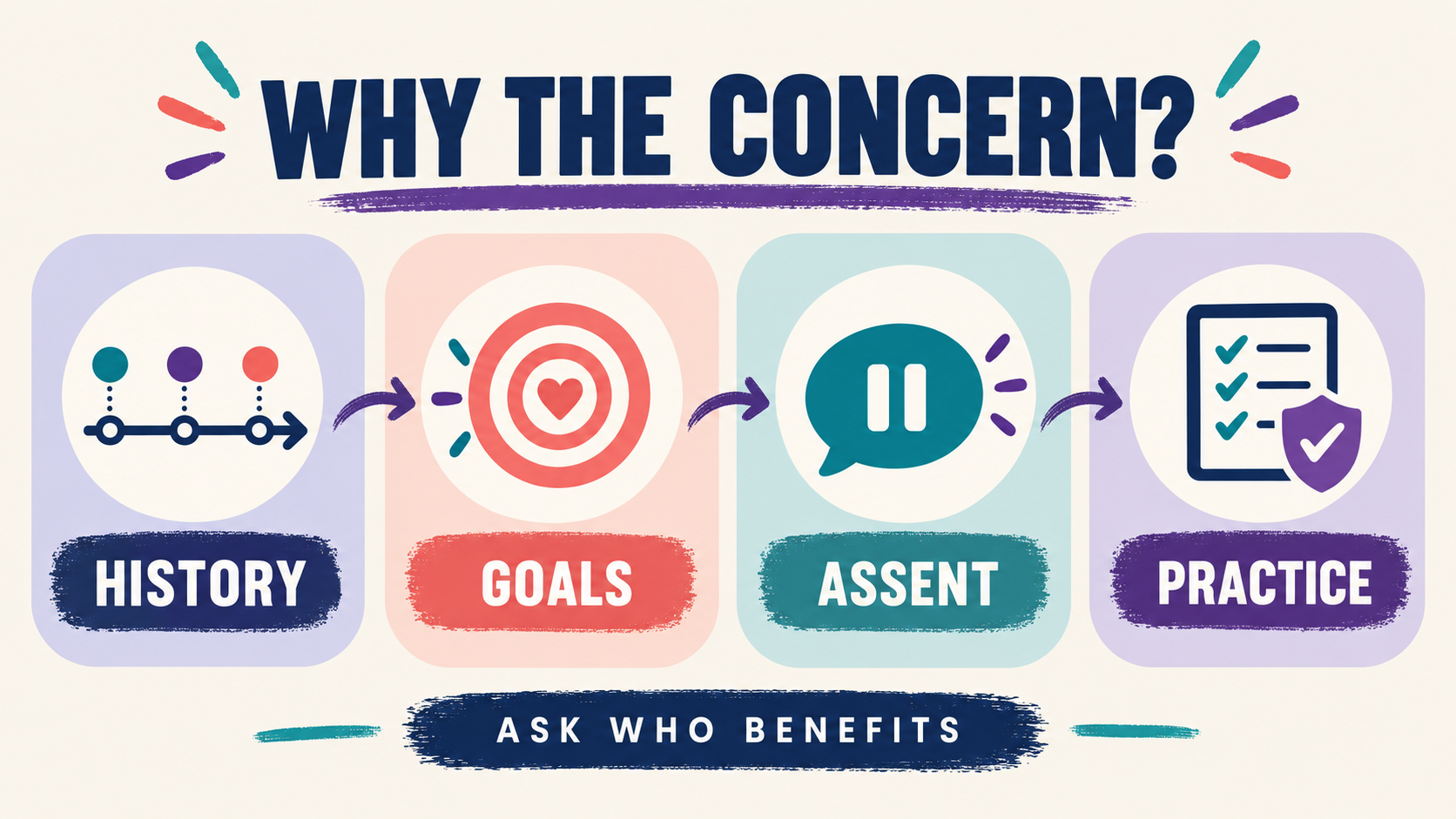
People usually point to more than one issue. The main concerns are:
- Historical practices: early behavior-modification programs included procedures and goals that many people now view as coercive, demeaning, or unsafe.
- Goals focused on appearance: suppressing harmless autistic movement, forcing eye contact, or rewarding “looking typical” can be experienced as pressure to mask identity rather than support a meaningful life.
- Power and consent: a child or nonspeaking learner may have less power to refuse, while adults control access to breaks, preferred activities, attention, or basic routines.
- Negative lived experiences: autistic people who experienced repeated demands, punishment, restraint, ignored distress, or loss of control may use the word abuse to describe the impact.
- Industry variation: the same broad label can cover a careful, assent-based program and a poorly supervised program that relies on compliance and does not listen to the learner.
These concerns should not be dismissed as a social-media rumor. At the same time, “ABA” is too broad to tell you what happened in a particular session. Ethical review requires asking about the actual target, procedure, consent and assent process, data, supervision, and response to harm.
How History Shapes the Criticism
The field’s history matters because past practices influence trust in present services. Autism interventions associated with behavior analysis have included highly intensive, adult-directed programs and goals framed around making autistic children appear indistinguishable from non-autistic peers. Later practice and professional discussion have changed in important ways, but a new label or updated mission statement does not erase what people experienced.
Historical analysis also requires precision. Behavior analysis developed across several researchers and applications; it was not invented by one person for one population. Autism services, experimental behavior analysis, applied behavior analysis, and a particular clinic’s program are related but not identical. The history page already covers the field’s multiple milestones; this article focuses on why those milestones affect ethical trust today.
A responsible provider should be able to discuss this history without defensiveness. “That was a long time ago” is not enough if a current program still uses the same goal logic, blocks communication, or treats distress as noncompliance. The relevant question is whether today’s service has safeguards that protect the learner’s autonomy and welfare.
Why Goals and “Normal” Behavior Matter
Behavior can be changed for many reasons, but not every change is equally important. A goal that helps a person communicate pain, request a break, cross a street safely, eat with less risk, participate in a chosen activity, or reduce dangerous self-injury is different from a goal chosen mainly because an adult dislikes hand-flapping, unusual play, direct language, or lack of eye contact.
Neurodiversity-informed critics argue that some services have treated non-autistic appearance as the standard of success. A peer-reviewed ethical analysis describes this criticism as a challenge to using neurotypical behavior as the benchmark, while neurodiversity-affirming frameworks emphasize autonomy, participation, and goals that matter to the autistic person. These arguments do not make every behavioral goal unethical; they make goal selection a central ethical decision.
Ask whose outcome is being measured. Is the learner safer, more independent, better able to communicate, less distressed, or more able to participate? Or is the main outcome that adults find the learner quieter, stiller, or easier to manage? A goal can be technically measurable and still fail the test of social importance.
Coercion, Assent, and Power Differences
ABA sessions often involve an uneven power relationship: the provider controls the materials, schedule, prompts, reinforcement, and sometimes access to a break. That structure can be used responsibly, but it creates a duty to watch for coercion. Consent from a parent or legal decision maker is important; it does not automatically mean the learner is willing to participate in every activity or procedure.
The BACB Ethics Code defines assent as vocal or nonvocal behavior that can indicate willingness to participate when a person cannot provide informed consent. Assent is not a one-time checkbox. A program should make it possible to pause, refuse, select among options, communicate discomfort, and return to an activity without punishment for saying no.
Coercive risk increases when a provider ignores distress, repeats a demand until the learner gives in, withholds necessities, uses punishment without strong safeguards, or treats communication of refusal as the behavior to suppress. A safety-critical situation may require immediate action, but that is not a blank check for routine forced compliance. The plan should specify the safety response, least-intrusive steps, supervision, documentation, and review.
Why Autistic Voices Must Be Included
Many autism services have historically been designed, researched, and evaluated mainly by non-autistic adults. Autistic people who received services may describe outcomes that a short skill-acquisition graph cannot capture: anxiety, masking, loss of self-advocacy, fear of mistakes, or learning that distress will not be heard. These reports are evidence about lived experience, even when they do not answer every question about treatment efficacy.
The Autistic Self Advocacy Network’s intervention-ethics brief argues that autistic people should have a stronger role in shaping autism services and evaluating their ethical consequences. Research on autistic perspectives on the acceptability of pediatric therapies likewise makes acceptability a question to assess, not an assumption to make for the learner.
Including autistic voices does not require pretending that every autistic person wants the same service. It means asking the actual learner, using accessible communication, seeking perspectives from people with different support needs, and treating disagreement as information. A program that only cites parent satisfaction while ignoring learner distress is not conducting a complete outcome review.
How to Review a Specific ABA Program
Replace the yes-or-no label question with a service-review checklist:
| Review area | Questions to ask | Evidence to request |
|---|---|---|
| Goals | Who selected the goal, and how does it improve the learner’s life? | Observable goal, learner preference, functional rationale, and social-validity review. |
| Participation | How can the learner request a break, refuse, or choose another option? | Assent signals, accessible communication, choice opportunities, and response to refusal. |
| Procedures | What prompts, reinforcement, extinction, or restrictive procedures are used? | Current written plan, staff training, supervision, safeguards, and adverse-effect review. |
| Outcomes | What changed for the learner, and what happens if the plan is ineffective? | Graphs, maintenance and generalization data, client feedback, and a modification rule. |
A provider should answer these questions in concrete language. “We follow evidence-based ABA” is not enough information to evaluate one program. Ask to see how the principle appears in a goal, a teaching trial, a refusal, and a review meeting.
What Does Ethical ABA Practice Look Like?
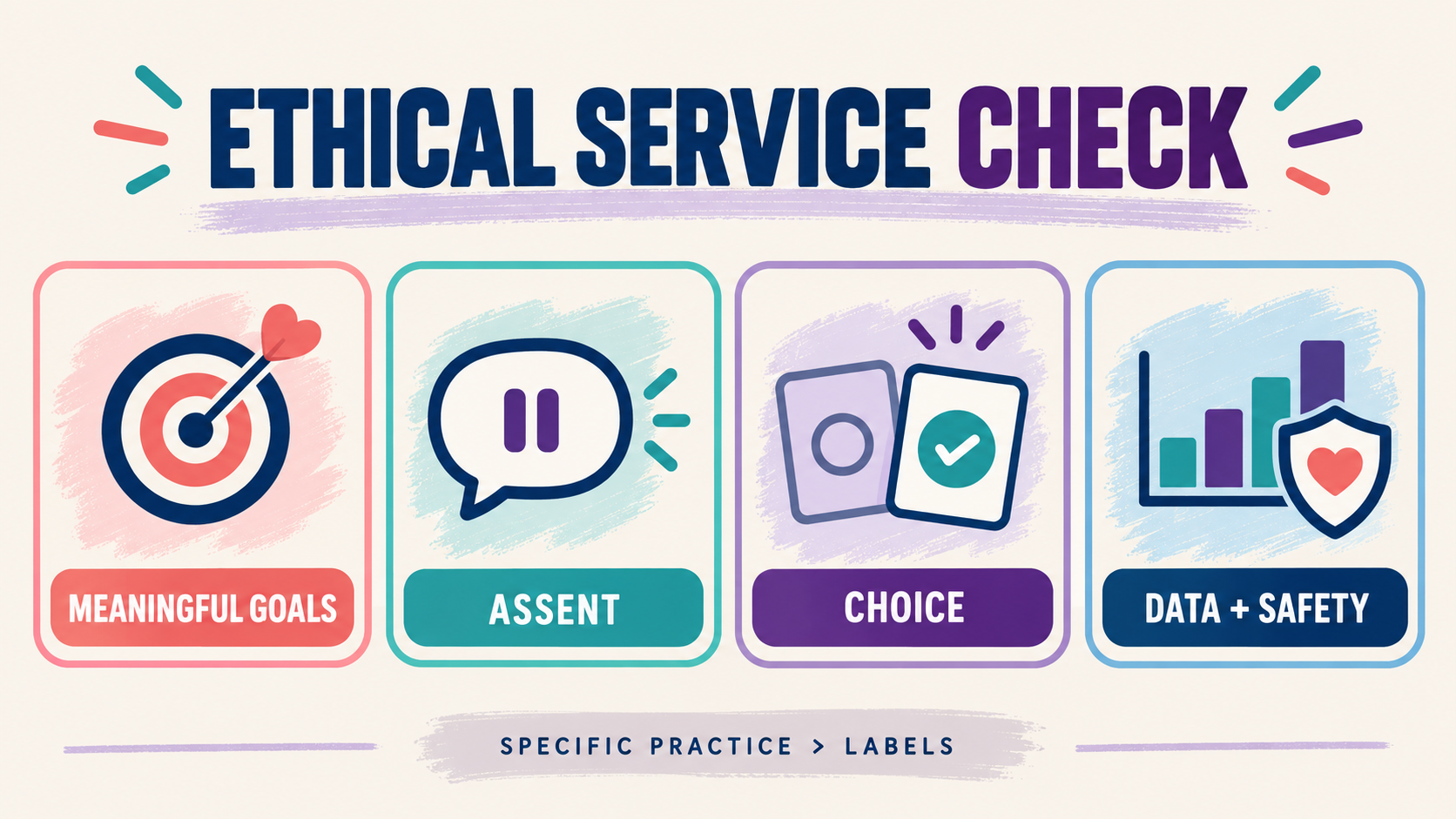
Ethical practice is judged by the specific service, not by a reassuring label. The Ethics Code for Behavior Analysts centers benefit, compassion, dignity, respect, integrity, and competence. A neurodiversity-affirming program adds practical questions about identity, autonomy, communication, sensory needs, and whose definition of success controls the plan.
- Meaningful goals: target communication, safety, independence, access, participation, or another outcome that matters to the learner.
- Real assent: teach and honor ways to pause, refuse, choose, and report discomfort.
- Least intrusive support: use the least restrictive effective approach, with clear criteria for fading prompts and revising the plan.
- Transparent data: track progress, generalization, maintenance, distress, adverse effects, and implementation fidelity.
- Competent supervision: train staff, observe performance, respond to concerns, and provide a safe complaint or transition pathway.
Ethical practice does not mean that every session is easy or that no difficult behavior is addressed. It means difficulty is handled with assessment, safety planning, respect, and review rather than shame, retaliation, or an assumption that compliance is the only good outcome.
Red Flags and Green Flags
One red flag does not prove abuse, and one green flag does not prove a program is safe. Look for patterns and ask for clarification.
| Red flag to investigate | Green flag to look for |
|---|---|
| “Compliance” is the main outcome, with no explanation of why the target matters. | Goals are tied to the learner’s communication, safety, participation, or independence. |
| Refusal, distress, or a request for a break is automatically treated as a behavior to defeat. | The team treats refusal as communication and adjusts the arrangement or plan. |
| Staff cannot explain the procedure, prompt-fading plan, or safety limits. | Staff receive training, supervision, feedback, and clear escalation steps. |
| The provider dismisses autistic criticism or promises a universal cure. | The provider welcomes questions, explains limits, and includes the learner’s perspective. |
How to Think About This on the BCBA Exam
An exam question may use this controversy to test ethics, goal selection, assent, least-intrusive procedures, social validity, or data-based decision-making. Do not choose an answer just because it says “ABA is good” or “ABA is abuse.” Identify the specific behavior, risk, client preference, procedure, and professional obligation.
The current BACB outline asks candidates to identify ethical principles, treat people with dignity and respect, develop measurable goals, consider client preferences and contextual fit, select socially valid alternatives, evaluate unwanted effects, and make data-based decisions. Those tasks support a more precise answer than a field-wide slogan. For scenario practice, the free BCBA mock exam can help you separate a defensible ethical decision from a distractor that ignores consent, risk, or evidence.
FAQ
Is all ABA abuse?: No. ABA is a broad field, and services vary by goals, procedures, provider competence, setting, and safeguards. That answer does not erase people who experienced harm. It means the ethical judgment should examine the specific service rather than assume that a label proves safety or abuse.
Why do autistic people criticize ABA?: Criticism may focus on historical punishment, goals that prioritize looking non-autistic, forced compliance, ignored distress, limited autistic participation in research and goal setting, masking, and negative personal experiences. These concerns should be heard and investigated rather than dismissed.
How can a family tell whether an ABA program is ethical?: Ask who chooses goals, how assent and refusal work, what procedures are used, how staff are trained, what data are shared, how adverse effects are reviewed, and how the program responds when the learner says no. A qualified local professional or advocate can help interpret setting-specific requirements.
Does modern ABA have the same goals as historical ABA?: Not necessarily. Practice has changed, and many providers now emphasize communication, autonomy, natural reinforcement, and socially meaningful goals. But a modern label does not guarantee ethical implementation. Review the actual goals, procedures, data, and learner experience.
Sources to Verify the Topic
- BACB Ethics Codes — official standards and assent context for behavior analysts.
- Applied Behavior Analysis and the Abolitionist Neurodiversity Critique — peer-reviewed ethical analysis of neurodiversity criticism.
- Autistic Self Advocacy Network: For Whose Benefit? — autistic-led perspective on evidence, ethics, and intervention design.
- Autistic Perspectives on the Acceptability of Paediatric Autism Therapies — research context for acceptability and lived experience.
- A Framework for Neurodiversity-Affirming Interventions — framework for autonomy, identity, and affirming service design.
- Affirming Neurodiversity within Applied Behavior Analysis — behavior-analytic discussion of neurodiversity-affirming practice.
- Autism Science Foundation: Applied Behavior Analysis — a provider-side explanation of individualized and ethical behavioral intervention.
- Ethical Concerns with Applied Behavior Analysis for Autism — bioethical critique and rights-based concerns.
Bottom line: people think ABA is abuse because historical practices, harmful individual experiences, power differences, goal selection, and limited autistic participation have created real ethical concerns. The responsible response is neither blanket dismissal nor blanket defense. Examine the specific goal, procedure, assent process, supervision, data, adverse effects, and learner’s voice.
Take the Free BCBA Mock Exam
If you want a low-pressure way to check your recall, use the free practice resource below. Take the Free BCBA Mock Exam



