
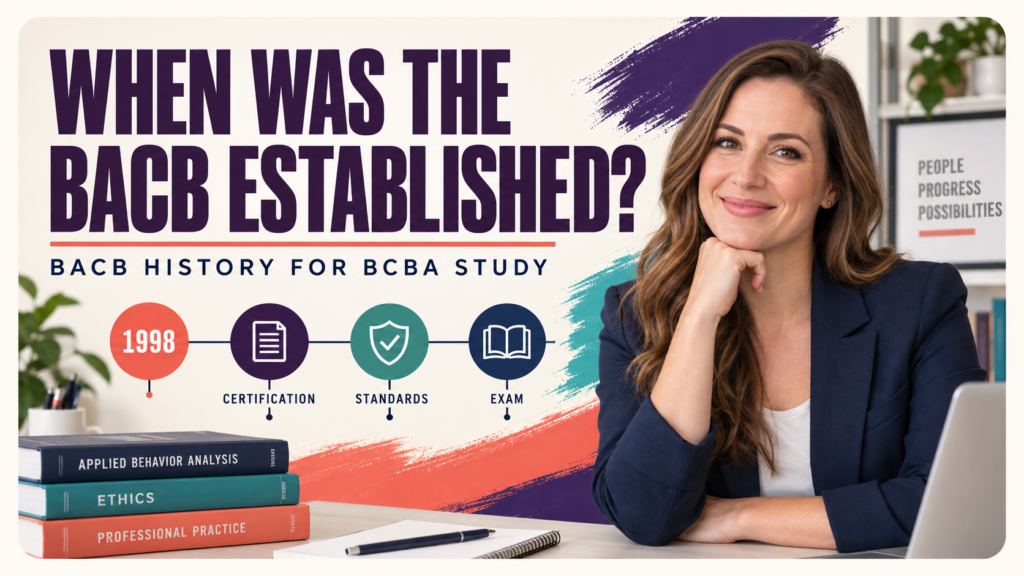
If you are asking when was the BACB established, the short answer is 1998. The Behavior Analyst Certification Board (BACB) describes itself as a nonprofit corporation established in 1998 to meet professional certification needs in behavior analysis. A more detailed history separates that organization-level answer from the legal incorporation date, the first board meeting, and later certification milestones.
Table of Contents
- When Was the BACB Established?
- What Does “Established” Mean in the BACB Timeline?
- What Is the Short BACB History Timeline?
- Why Was the BACB Created?
- How Is BACB Certification Different from State Licensure?
- What Does the BACB Do Today?
- Why Does BACB History Matter for BCBA Exam Study?
- What History and Credentialing Mistakes Should You Avoid?
- Frequently Asked Questions
- Sources for Further Study
- Quick Review Checklist
- Take the Free BCBA Mock Exam
That distinction matters for BCBA study. A question may ask for the year the BACB was established, the date the corporation was incorporated, or the role the BACB plays today. Those are related facts, but they are not interchangeable. This guide gives you the answer first, then builds a compact timeline and explains why BACB certification is different from state licensure.
When Was the BACB Established?
The BACB was established in 1998. That is the year to remember when a study question asks, “When was the BACB established?” or “When was the Behavior Analyst Certification Board founded?” The BACB’s current About page uses 1998 as the organization’s established date and explains that the nonprofit was created to meet professional certification needs.
The answer is not “when the BCBA credential first appeared,” “when a state passed a licensure law,” or “when the current Task List was published.” Those events belong to different parts of the profession’s history. The organization came first; its certification programs, examination processes, ethics requirements, and other services developed over time.
For a one-line exam note, write: BACB established: 1998. For a stronger note, add: Detailed historical accounts identify May 5, 1998, as the incorporation date, followed by early governance and credential-development milestones. Keeping those two levels of detail separate prevents an exact-date question from changing the basic year answer.
What Does “Established” Mean in the BACB Timeline?
“Established” can describe an organization’s recognized founding year, while “incorporated” refers to a legal formation event. “First board meeting” describes an early governance milestone, and “first exam” or “credential launch” describes an operational milestone. A history question becomes easier when you identify which event the wording is asking about.
| Phrase in a question | What it usually points to | BACB study answer |
|---|---|---|
| When was the BACB established? | The organization’s established or founding year | 1998 |
| When was the BACB incorporated? | The legal incorporation event identified in a detailed historical account | May 5, 1998, in the peer-reviewed historical account cited below |
| What happened in 1999? | An early governance milestone | The first Board of Directors meeting is reported as March 16, 1999 |
| What does the BACB do today? | The organization’s current role, programs, and standards | Certification programs, practice standards, exams, ethics requirements, and disciplinary processes, among other functions |
The exact incorporation date is useful context, but do not replace the common 1998 answer with a date that a question did not request. A well-written study note records both: the official organization-level year and the more specific historical milestone.
What Is the Short BACB History Timeline?
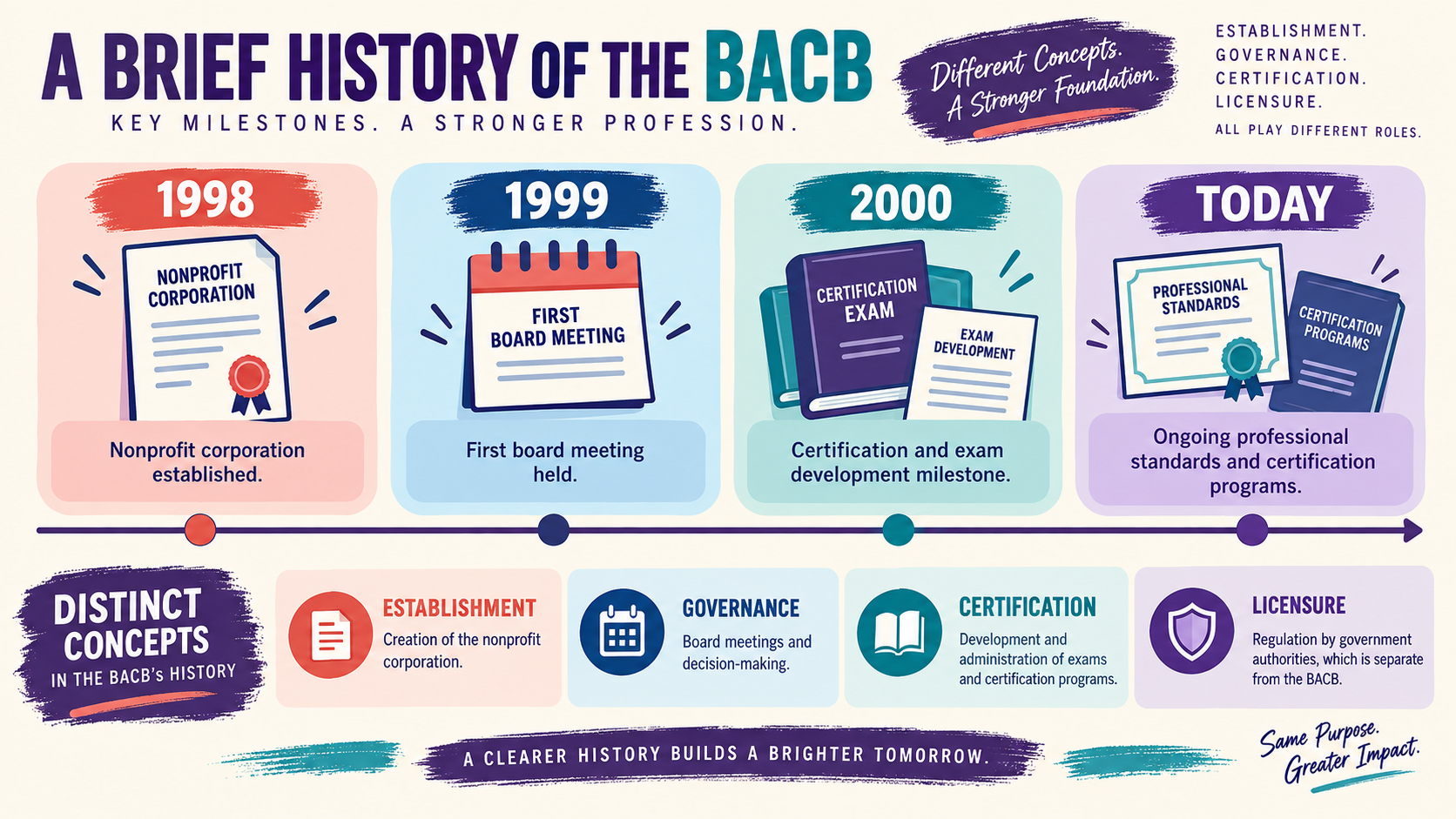
A compact timeline helps you avoid treating every date as the same kind of event. The following sequence is a study framework rather than a claim that the profession changed on one single day.
- 1998 — organization established. The BACB was formed as a nonprofit organization to address professional certification needs in behavior analysis.
- May 5, 1998 — incorporation milestone. A peer-reviewed history of professional credentialing identifies this date as the incorporation of the BACB.
- March 16, 1999 — early governance milestone. The same historical account reports the first meeting of the Board of Directors on this date.
- Following years — credentials and examinations developed. The organization built certification pathways, examination processes, eligibility rules, ethics resources, and related professional systems over time.
- Today — certification and professional standards. The BACB now maintains certification programs and related resources; its current documents and policies should be checked whenever a question involves present-day requirements.
The most important timeline skill is category matching. If the prompt asks for the founding year, answer 1998. If it asks for the incorporation date, give May 5, 1998 and identify the historical source. If it asks about the first board meeting, answer March 16, 1999. Do not use a later exam or credential milestone to answer an organization-history question.
Why Was the BACB Created?
The BACB was created to provide a professional certification structure for behavior analysts. Before a credentialing board can certify practitioners, the profession needs a way to define eligibility, evaluate competence, administer examinations, communicate ethical expectations, and respond to concerns about professional conduct. The BACB developed within that broader need for a portable, profession-wide credential.
This purpose is different from the role of a university program, a professional membership association, or a state licensing agency. A university may provide coursework and supervised training. A professional association may support research, conferences, advocacy, and member education. A state licensing board may create legal permission to practice within one jurisdiction. The BACB’s central role is professional certification and the systems that support that credential.
That distinction is also why “BACB established” is a useful historical query for BCBA candidates. It connects a date to the reason the organization exists: consistent professional credentialing, not ownership of all behavior-analysis practice and not replacement of state law.
How Is BACB Certification Different from State Licensure?
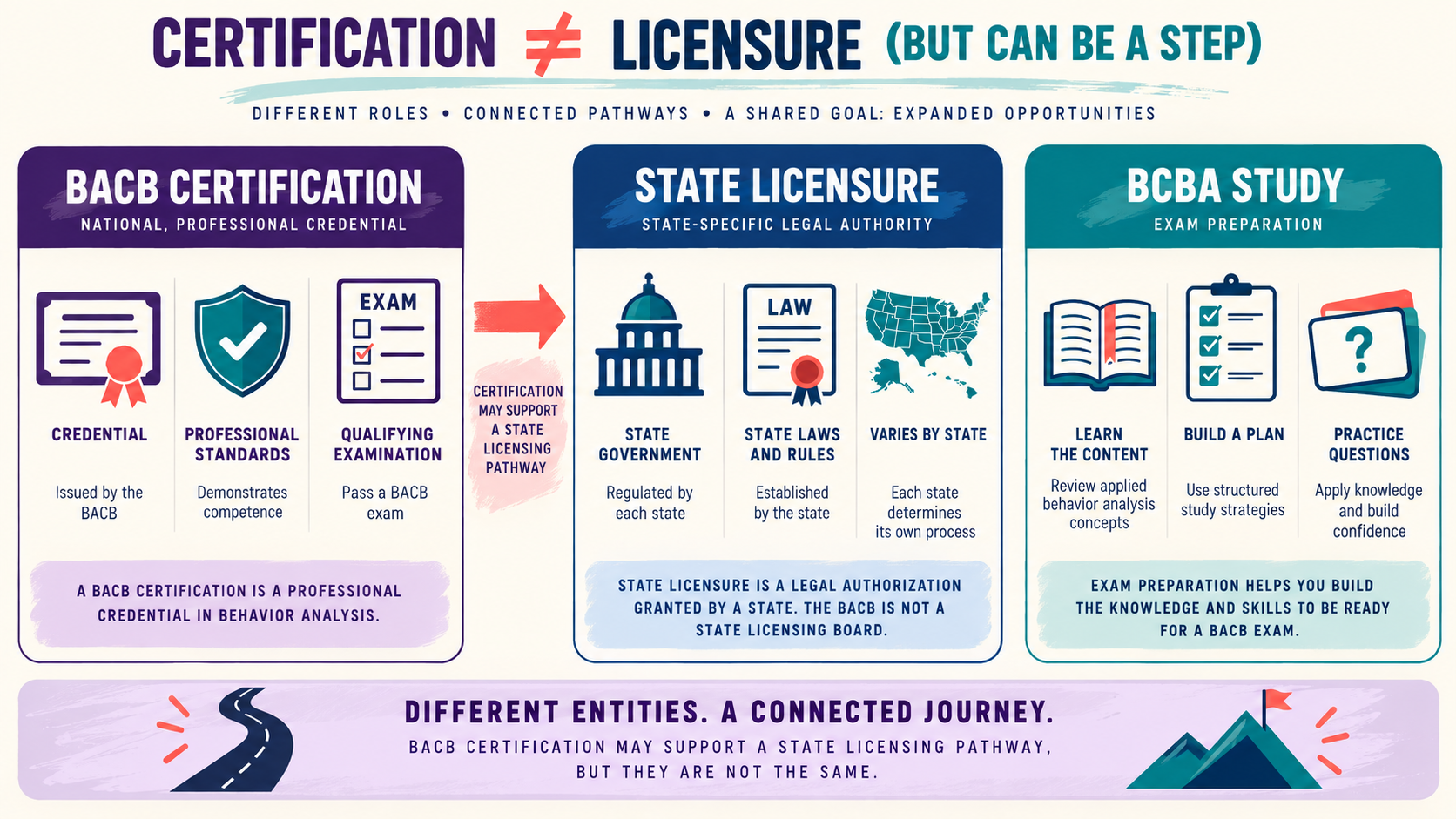
BACB certification and state licensure can interact, but they are not the same credential. The BACB is a private nonprofit credentialing organization. A state license is a legal authorization created and enforced under state law. A person may need BCBA certification as part of a state’s licensing pathway, but the exact relationship depends on the jurisdiction and the current rules.
| Feature | BACB certification | State licensure |
|---|---|---|
| Source of authority | A national professional credentialing organization | A state’s statutes, regulations, and licensing agency |
| Primary function | Certify that an applicant meets the organization’s credential standards | Grant or restrict legal permission to practice under state law |
| Geographic scope | A professional credential used across jurisdictions, subject to local rules | The state or jurisdiction that issued the license |
| Study implication | Use BACB handbooks, task lists, ethics resources, and exam information | Check the current licensing board and law for the state where practice will occur |
Never infer a state’s legal rule from the BACB founding year. The history answers when the certification board was created; it does not answer whether a specific state requires a license, what title is protected, or which activities are regulated. Those are separate research tasks.
What Does the BACB Do Today?
The BACB’s current role includes certification programs, examinations, ethics requirements, practice-related standards, and a disciplinary system. Its official About page provides the organization-level overview, while the Task Lists and Test Content Outlines page points candidates to current examination content documents.
Do not assume that a historical article can answer current eligibility or examination questions by itself. Coursework, supervised fieldwork, supervision, ethics, application, and examination rules can change. When the question is about what is required now, use the current BACB handbook or policy rather than relying on a date from the organization’s history.
The BACB examination page at Pearson VUE is another example of a current operational resource. It helps illustrate the difference between the organization’s founding history and the practical systems used to schedule and administer an examination today.
Why Does BACB History Matter for BCBA Exam Study?
History questions are often simple recall items, but they can test whether you understand the difference between certification, licensure, education, and professional association roles. A useful study method is to make a four-column note:
- Organization: BACB.
- Founding year: 1998.
- Professional function: certification and related standards, examinations, ethics, and disciplinary systems.
- Boundary: the BACB is not the same as a state licensing board.
Then practice changing only one part of the question. “When was the BACB established?” asks for 1998. “When was it incorporated?” asks for the specific historical date. “Who grants legal permission to practice?” points you toward the relevant state authority. “Where do I find current BCBA exam content?” points you toward current BACB documents, such as the Task Lists and Test Content Outlines. For broader preparation, use the current BACB study-scope resources rather than turning a historical fact into a substitute for the exam blueprint. The date is a foundation, not the whole certification process.
What History and Credentialing Mistakes Should You Avoid?
- Replacing 1998 with a later milestone. A board meeting, credential launch, or examination event does not change the organization’s established year.
- Confusing founded with incorporated. If the question asks for the year, use 1998. If it asks for the exact legal event, provide the detailed date and source.
- Calling the BACB a state board. The BACB is a credentialing organization; state licensing authority comes from state law.
- Using an old history page for current requirements. Check current handbooks, policies, and official test-content documents for present-day rules.
- Assuming certification automatically answers licensure. Certification may be part of a state pathway, but the state’s current requirements control the legal question.
Frequently Asked Questions
When was the BACB established?: The BACB was established in 1998. That is the standard answer to the organization-history question. What exact date was the BACB incorporated?: A peer-reviewed history of professional credentialing identifies May 5, 1998, as the incorporation date. Treat that as a more specific legal milestone, not a replacement for the commonly used established year. When was the first BACB Board of Directors meeting?: The same historical account reports the first Board of Directors meeting on March 16, 1999. That is an early governance milestone after the 1998 incorporation. Is the BACB the same as a state licensing board?: No. The BACB provides professional certification, while a state licensing board operates under state law and addresses legal permission to practice within that jurisdiction.
Why should BCBA candidates know the BACB founding year?: It helps candidates identify the organization’s purpose and avoid confusing certification with licensure, coursework, or a later examination milestone. It is a small fact that supports accurate professional vocabulary.
Sources for Further Study
- Behavior Analyst Certification Board: About — current organization overview and the 1998 established date.
- A History of the Professional Credentialing of Applied Behavior Analysts — peer-reviewed historical account of incorporation, early governance, and credential development.
- BACB Task Lists and Test Content Outlines — current exam-content study resources.
- BACB Ethics Resources — current ethics-resource hub and historical context.
- Pearson VUE BACB examination page — current examination administration information.
Once you can separate the 1998 founding answer from later governance, certification, and licensing questions, you have the history in the right frame. If you want to practice the distinctions that appear in BCBA-style preparation, try the free BCBA mock exam and review the explanation after each question.
Quick Review Checklist
Use this final checklist to turn when was the bacb established into exam-ready reasoning. The goal is not to memorize a label in isolation; it is to identify the relevant evidence and explain why the best answer fits the scenario. Key ideas to review:
- State the central definition or decision point for when was the bacb established in your own words.
- Identify the detail that makes when was the bacb established different from its closest related ABA term.
- Separate the observable facts in a scenario from assumptions that are not supported by the facts.
- Write one example and one nonexample so you can recognize the concept in a new setting.
Exam application checks:
- Ask what the question is actually requesting before comparing the answer choices.
- Mark the antecedent, response, consequence, or other evidence that supports the selected answer.
- Look for a distractor that describes a related process but does not answer the specific question.
Final self-check:
- Explain how you would verify the interpretation with clear observations or data.
- Change one detail in the scenario and decide whether your answer should change.
- Give a one-sentence rationale that a supervisor or study partner could evaluate.
Take the Free BCBA Mock Exam
If you want a low-pressure way to check your recall, use the free practice resource below. Take the Free BCBA Mock Exam



