
Functional pretend play ABA is a phrase people use for more than one play concept. It may refer to functional play, pretend or symbolic play, or a treatment goal that combines object use with imaginative and social interaction. A careful BCBA discussion separates those terms instead of treating one adult-preferred way of playing as universally correct.
Table of Contents
- What Does Functional Pretend Play ABA Mean?
- What Is the Difference Between Functional and Pretend Play?
- What Are Examples Across Settings?
- How Do You Assess Play Without Overpathologizing?
- How Do You Choose a Play Goal?
- How Can ABA Teaching Support Play?
- How Do You Measure and Generalize Play?
- What Ethical and Social-Validity Checks Matter?
- How Does Play Reasoning Appear on the BCBA Exam?
- Functional Pretend Play ABA Checklist
- Take the Free BCBA Mock Exam
This guide gives observable examples and shows how a behavior-analytic team might assess, teach, measure, and generalize play while protecting choice, communication, dignity, and social validity. It is educational information, not an individualized treatment plan. Table of Contents
What Does Functional Pretend Play ABA Mean?
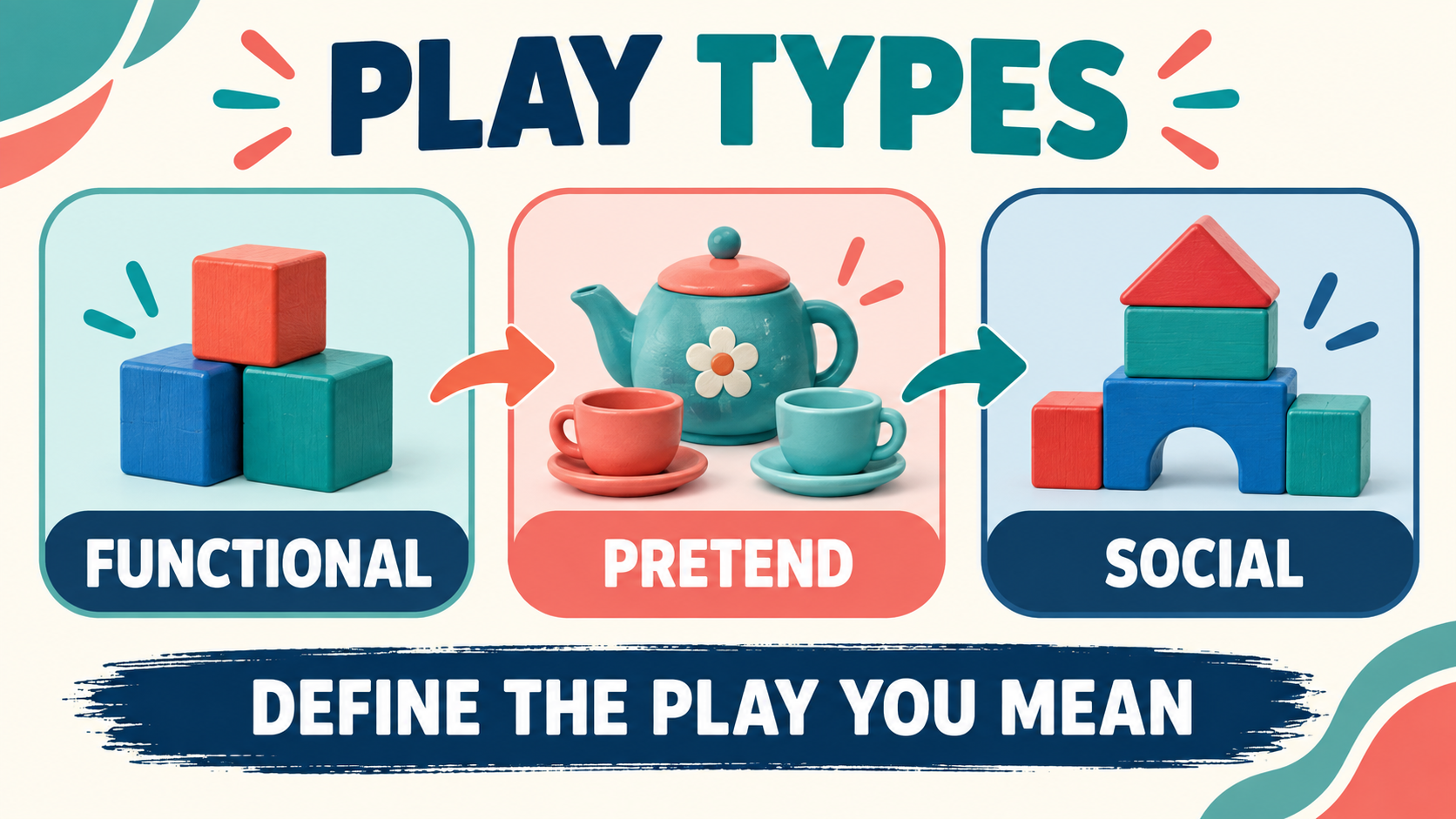
There is no single universal procedure called “functional pretend play ABA.” The wording combines terms that are often separated in developmental and behavior-analytic writing. Functional play commonly describes using an object in a conventional or intended way, such as rolling a toy car, stacking blocks, or putting pretend food on a plate. Pretend play, also called symbolic or representational play in some literature, involves treating one object, action, or role as standing for something else—for example, using a block as a phone or pretending to serve tea to a toy.
The distinction is useful, but it should not become a ranking of “good” and “bad” play. A learner may enjoy repetitive object play, imaginative play, sensory exploration, construction, movement, or social games. The relevant question is what the learner wants or needs to do, what barriers are present, and whether a proposed goal is meaningful in the learner’s everyday life. A research review on pretend play and autism also cautions that play, social communication, intervention procedures, and generalization are complex rather than interchangeable outcomes.
Readers may want a definition, example, intervention idea, or BCBA exam distinction. Name the observable behavior and context. Instead of “increase functional pretend play,” specify functional toy use, symbolic substitution, reciprocal play, flexible action, communication, or shared participation.
What Is the Difference Between Functional and Pretend Play?
The terms describe different features of an interaction with materials. They can occur in the same activity: a child may functionally pick up a cup, pretend to pour tea, and then invite another person to drink. The table below is a teaching distinction, not a diagnostic test or a rule that every learner must progress through the same sequence.
| Play feature | Observable example | Useful question |
|---|---|---|
| Functional object use | Rolls a toy car on the floor or places a block on another block. | What action does the learner choose with the object? |
| Pretend or symbolic action | Uses a block as a phone or pretends to feed a toy. | Is an object, role, or event being represented as something else? |
| Social or reciprocal play | Takes turns rolling a car, adds a related action, or responds to a partner. | What does the learner do with another person’s action or communication? |
| Flexible variation | Changes the route, material, role, or sequence when the change is acceptable. | Can the learner vary the play without losing access to communication or enjoyment? |
These dimensions can be measured separately. A learner might use toys functionally but not yet imitate a symbolic action; another learner might produce elaborate pretend actions but need support to share materials or tolerate a partner’s idea. Avoid inferring a global “play deficit” from one unfamiliar toy or one short observation.
What Are Examples Across Settings?
Examples should describe what can be seen and heard, not just a label. A possible progression in a toy kitchen might include placing a cup on the table, pretending to pour from a teapot, offering the cup to a partner, and responding when the partner requests more. The team can choose one meaningful action instead of treating the entire sequence as one large target. Other examples may include:
- Blocks: stacks or connects blocks, then builds a bridge for a chosen toy to pass under it.
- Vehicles: rolls a car along a track, then pretends the car stops for gas or visits a named location.
- Dolls or figures: moves a figure through a familiar routine, such as eating or sleeping, without requiring a scripted story.
- Art and construction: selects materials, combines them to make a personally meaningful object, and communicates about the result.
- Shared games: takes a turn, waits for a partner’s turn, requests a change, or signals that the game is finished.
Functional activity can be playful without being pretend, and pretend activity can be solitary, parallel, or social. The objective is meaningful participation, not forcing every activity into an adult-selected story.
How Do You Assess Play Without Overpathologizing?
Begin with observation across materials, people, routines, and times of day. Record what the learner selects, how long they engage, how they communicate, what changes their participation, and whether they approach or avoid specific social demands. Include unstructured opportunities when possible; an adult-directed probe alone may underestimate spontaneous play or make a preferred activity feel like work.
- Watch: record the learner’s selected materials, actions, communication, and partners.
- Ask: include the learner’s preferences and stakeholder knowledge about meaningful routines.
- Check: consider access, sensory load, motor demands, and unfamiliar materials before labeling a deficit.
Define the target at the level needed for a reliable decision. “Pretends to cook” is less precise than “places the spoon in the bowl, moves it in a circular motion for at least two seconds, and/or labels the action using speech, AAC, sign, or another established response.” The definition should allow equivalent communication forms and should not require eye contact, a particular facial expression, or an adult’s preferred imaginative script unless that feature is genuinely part of the agreed goal.
Use interviews and preference assessments as context, not substitutes for observation. Ask what is enjoyable, familiar, useful, or stressful, and review communication access, sensory needs, motor demands, and learning history. Research on video modeling can inform hypotheses, but a study procedure is not a universal prescription.
How Do You Choose a Play Goal?
Choose a goal by connecting play to a meaningful outcome for the learner: access to preferred activities, communication, participation with family or peers, independence, creativity, or a routine the learner values. A good goal is observable, achievable, and revisable. It identifies the context, materials, response, prompt conditions, and a criterion for success without assuming that one play style is inherently superior.
For example, a team might choose “during a five-minute shared car activity, the learner independently adds one related action or communication on three opportunities” rather than “plays appropriately with cars.” Another team might choose “offers a choice of two pretend themes and accepts the learner’s selected theme” as an adult-support goal. The second target changes the environment instead of placing the entire burden on the learner.
Plan for assent and choice from the start. A learner can select materials, change the theme, request help, pause, or end the activity; those responses may show that the task or social demand needs revision.
How Can ABA Teaching Support Play?
Teaching can include naturalistic modeling, imitation, shaping, prompting and fading, visual supports, video modeling, shared control, and reinforcement arranged around meaningful participation. Start where the learner is successful. Join an existing interest, imitate the learner’s action, add one small related action, and pause to allow the learner to respond. This approach can create opportunities without abruptly replacing the learner’s agenda with an adult script.
If a prompt is needed, make it the least intrusive effective support and plan how it will be faded. A model might demonstrate feeding a toy once; a gestural prompt might point to the next material; a verbal prompt might describe a choice. Record what was actually required. Do not count a heavily prompted performance as independent play.
Video modeling has been studied for reciprocal pretend play, but clinical questions remain individual: Is the model understandable? Does the skill occur with new people and materials? Is the learner gaining a meaningful option or only reproducing an adult-selected sequence? Use data and stakeholder feedback.
How Do You Measure and Generalize Play?
Measure the behavior that matches the goal. Frequency may fit the number of spontaneous play actions; duration may fit engagement; percentage of opportunities may fit responding to a partner; latency may fit how quickly the learner begins after a choice. For a social target, record both the learner’s response and the partner’s behavior so a rising score does not hide a change in the quality or accessibility of the interaction.
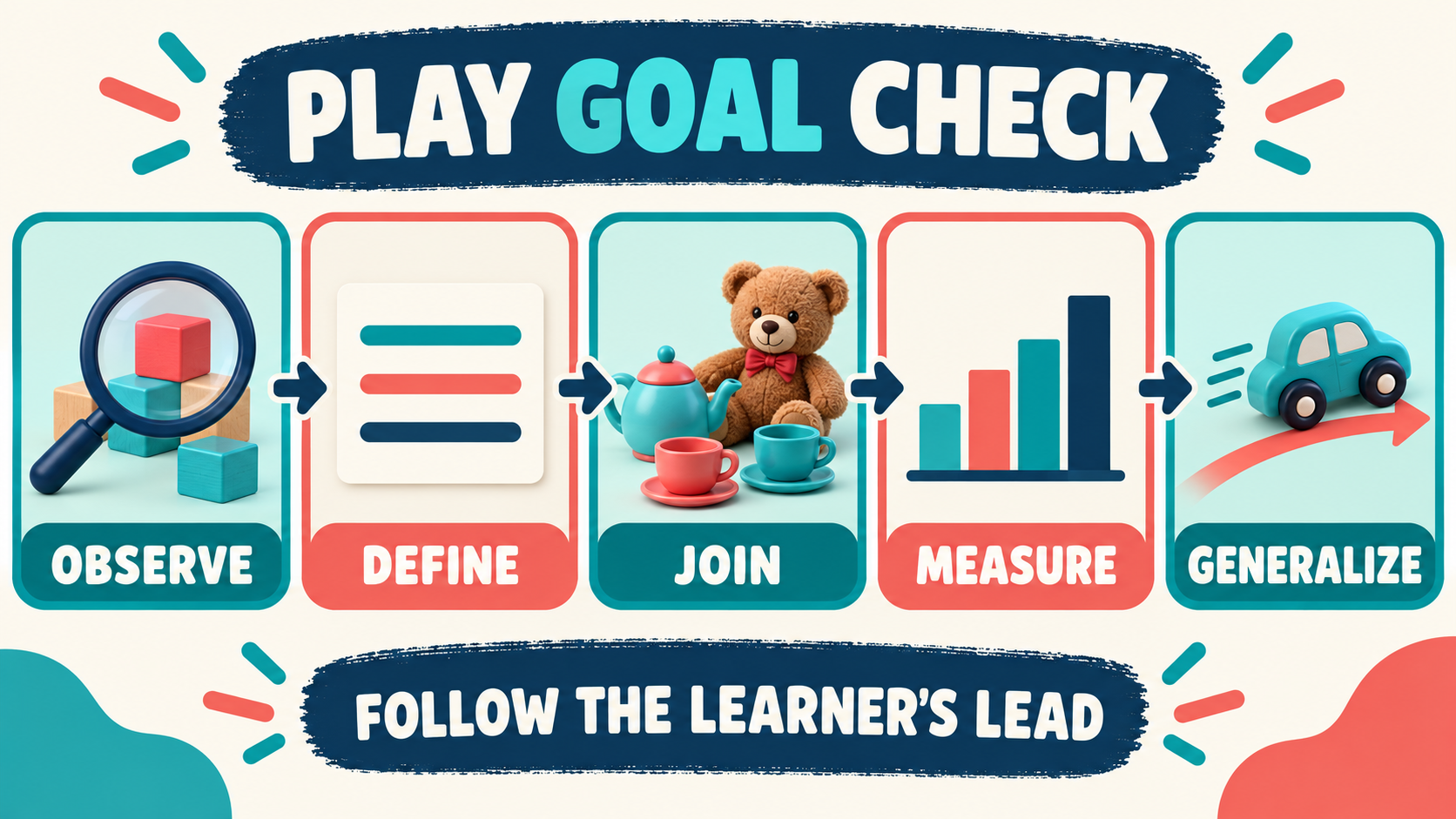
Record materials, partner, prompt level, communication mode, opportunity count, and whether the learner chose the activity. Use a reliability check when the definition is subtle. One successful trial does not prove generalization, and a low score in an unfamiliar setting does not disprove a skill. Plan generalization deliberately:
- Observe: identify the learner’s spontaneous actions and interests across more than one context.
- Define: write a response that can be recognized by different people and communicated in the learner’s established mode.
- Join: practice with varied partners and materials while preserving meaningful choice.
- Measure: compare independence, engagement, communication, and social validity—not only completion.
- Generalize: vary people, places, materials, and natural routines gradually, then check maintenance.
If performance drops, check whether the new context changed the reinforcer, sensory load, language demand, partner behavior, or response effort. Revise the teaching arrangement before simply adding prompts or extending practice.
What Ethical and Social-Validity Checks Matter?
The BACB Ethics Code for Behavior Analysts is relevant when play goals affect dignity, assent when applicable, informed consent, communication, client welfare, competence, or evaluation. A goal should be defensible because it improves a meaningful opportunity—not merely because an adult finds one play style more typical.
Ask whose outcome is being measured. Does the learner enjoy, request, or choose the activity? Can they refuse or change it? Does the intervention increase access to peers, family routines, communication, or independent leisure? Are prompts and materials culturally familiar and physically accessible? Are staff interpreting unusual play as a problem when the real barrier is a noisy setting, inaccessible toy, or lack of communication support?
Social validity can include learner preference, stakeholder feedback, quality-of-life observation, and maintenance outside sessions. If a goal produces compliance but less choice or enjoyment, review it. The BACB BCBA overview provides professional context; it does not turn an internet example into an individualized protocol.
How Does Play Reasoning Appear on the BCBA Exam?
A BCBA-style question may present a learner who uses a toy in an unusual way, a therapist who wants to teach pretend play, or a study that reports an intervention effect. The strongest answer usually begins with the operational definition and the socially significant outcome, not with the assumption that conventional toy use is automatically the correct target. Use this reasoning sequence:
- Separate functional object use, pretend or symbolic action, and social reciprocity rather than treating them as one construct.
- Check whether the target is observable, meaningful, and compatible with the learner’s communication and choice.
- Identify the antecedent, response, consequence, prompts, and measurement system.
- Look for generalization, maintenance, treatment integrity, and social-validity data before claiming success.
- Reject answers that promise one correct way to play, ignore assent or dignity, or copy a research protocol without individualized assessment.
For additional scenario practice, our functional pretend play ABA practice questions can help you rehearse operational definitions, prompting, generalization, ethics, and data interpretation. The free BCBA mock exam is a study aid, not official BACB material and not a substitute for the current BACB handbook or examination content.
Functional Pretend Play ABA Checklist
Before writing or revising a play target, confirm the following:
- Have we stated whether the target is functional object use, pretend or symbolic action, social reciprocity, flexible variation, or another skill?
- Is the response observable and inclusive of the learner’s established communication mode?
- Did the learner or relevant stakeholders help identify a meaningful activity or outcome?
- Can the learner choose, request help, pause, change the theme, or end the activity?
- Are materials, sensory conditions, motor demands, language, and partner behavior accessible?
- Are modeling, prompting, reinforcement, and fading procedures documented?
- Does the data show independent responding rather than only prompted performance?
- Will we measure maintenance and generalization across people, places, materials, and routines?
- Are learner preference, caregiver or teacher feedback, and social validity part of the review?
- Is there a clear date and decision rule for continuing, revising, or stopping the goal?
The practical takeaway is that functional pretend play ABA should be treated as a terminology and decision-making question, not as a demand for one “right” style of play. Define the behavior, honor the learner’s agenda, teach only what is meaningful, measure what changes, and use professional judgment when the context changes.
Take the Free BCBA Mock Exam
If you want a low-pressure way to check your recall, use the free practice resource below. Take the Free BCBA Mock Exam



