
How hard is the BCBA exam compared to other exams? There is no honest universal ranking because professional exams measure different jobs, bodies of knowledge, and candidate populations. The current BCBA exam is nevertheless demanding: it combines nine content domains, applied scenario reasoning, a four-hour appointment, and a criterion-referenced passing standard. The best comparison is not a dramatic “hardest exam” label; it is a clear look at what the test asks you to do and where your preparation is weakest.
Table of Contents
- How Hard Is the BCBA Exam Compared To Other Exams?
- What the Current BCBA Exam Actually Asks You to Do
- What Makes the BCBA Exam Feel Hard?
- How to Compare the BCBA Exam Fairly
- Turn Difficulty Into a Study Diagnosis
- Do the 2027 Changes Make the Exam Harder?
- BCBA Exam Difficulty FAQ
- Quick Review Checklist
- Take the Free BCBA Mock Exam
This guide uses the current BACB examination information and handbook, the 6th-edition Test Content Outline, and the latest published BCBA testing data available in September 2026. Policies can change, so confirm the handbook that applies to your authorization before scheduling. Table of Contents
How Hard Is the BCBA Exam Compared To Other Exams?
The most accurate short answer is: the BCBA exam is challenging, but its difficulty cannot be converted into a universal rank against every other professional exam. A test for project management, nursing, teaching, counseling, or law may have a different purpose, eligibility pathway, scoring model, and candidate pool. Comparing only a pass-rate percentage can make two very different assessments look equivalent.
What can be said with confidence is that BCBA candidates must integrate graduate-level behavior analysis with professional judgment. The exam does not only ask whether you remember a definition. It can ask you to interpret data, identify a functional relation, choose an assessment, select the next ethical step, or decide which intervention best matches the facts in a scenario.
The BACB’s published 2025 testing data show a 51% first-time BCBA pass rate and a 23% retake pass rate. Those figures are useful planning evidence, but they are not a universal difficulty scale. They describe the candidates who tested, the form and standard in use, and the circumstances of that testing year. They do not prove that the BCBA exam is “harder than” a different exam with a different population.
A better conclusion is practical: if you can define concepts but struggle to apply them under time pressure, the BCBA exam will feel hard until you build discrimination, decision-making, and pacing practice. If you already reason fluently through unfamiliar ABA cases, your preparation may be more efficient. Difficulty is partly a property of the exam and partly a match between the exam’s demands and your current skills.
What the Current BCBA Exam Actually Asks You to Do
The current BACB examination information and BCBA Handbook describe a computer-based examination with 185 multiple-choice questions. Of those, 175 are scored and 10 are unscored pilot questions. Each item has four possible answers with one correct answer, and the appointment lasts four hours. You cannot identify the pilot items, so every question deserves the same disciplined process.
The 6th-edition Test Content Outline distributes scored questions across nine areas. The weights do not mean every candidate will experience the same mix or the same perceived difficulty, but they show why a narrow vocabulary-only plan is risky.
| Content area | Published share | Why it affects preparation |
|---|---|---|
| Behaviorism and philosophical foundations | 5% | You must connect assumptions about behavior to later decisions. |
| Concepts and principles | 14% | Definitions must transfer to new examples and contingencies. |
| Measurement and data interpretation | 12% | The measure has to fit the behavior and the decision. |
| Experimental design | 7% | You may need to distinguish control, threats, and design logic. |
| Ethics and professional issues | 13% | The best answer often depends on sequence, consent, risk, or scope. |
| Behavior assessment | 13% | Assessment choices must follow the question and available evidence. |
| Behavior-change procedures | 14% | Several options can sound plausible; function and data decide. |
| Intervention selection and implementation | 11% | You must select and monitor a socially valid, workable plan. |
| Personnel supervision and management | 11% | Questions can test feedback, training, performance, and delegation. |
These percentages describe the scored blueprint, not a promise about an individual form. Use the official 6th-edition TCO as the source of truth for task wording and updates.
What Makes the BCBA Exam Feel Hard?
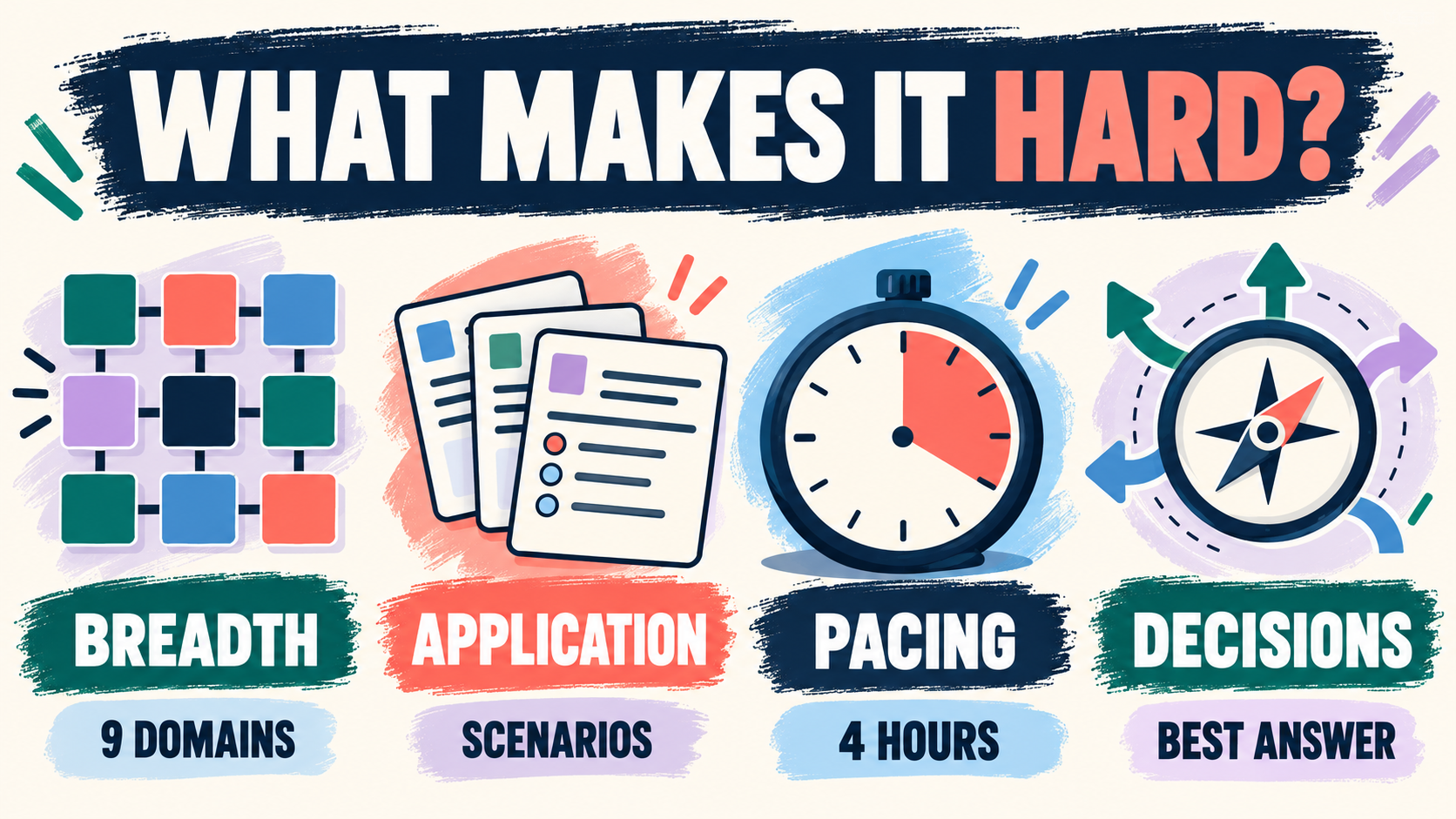
The exam’s challenge comes from several demands working together rather than from one mysterious trick. 1. Breadth creates switching costs. A candidate can understand measurement and still lose accuracy after moving into ethics, supervision, or experimental design. The task is not just knowing more facts; it is recognizing which framework applies when the subject changes every few questions.
2. Application is different from recognition. A flashcard can make a term look familiar. A scenario asks whether the term is the right answer in this situation, at this time, with this data. Pay attention to the target behavior, the controlling variables, the measurement, and the requested action before choosing a familiar phrase.
3. Several options can be partially true. A distractor may describe a reasonable intervention but skip the assessment step. Another may protect a client but fail to answer what the BCBA should do next. The exam rewards the best response to the exact stem, not the answer that sounds most sophisticated in isolation.
4. Pacing magnifies small errors. Four hours sounds generous until you include reading long stems, checking graphs, flagging uncertain items, and managing fatigue. Spending several minutes proving one answer can cost more than it helps. A calm first pass plus a targeted review is usually more useful than repeatedly rereading every item.
5. The passing standard is not a public percentage target. The BACB uses a scaled, form-equated process. A candidate should not build a plan around a claim such as “you need exactly X out of 175.” Your practice score is most useful as a trend and error map, not as a guarantee.
6. Professional judgment matters. The Ethics Code, client welfare, assent, confidentiality, scope of competence, and treatment integrity can change which answer is defensible. A technically effective option is not automatically the best option if it ignores the ethical facts in the stem.
How to Compare the BCBA Exam Fairly
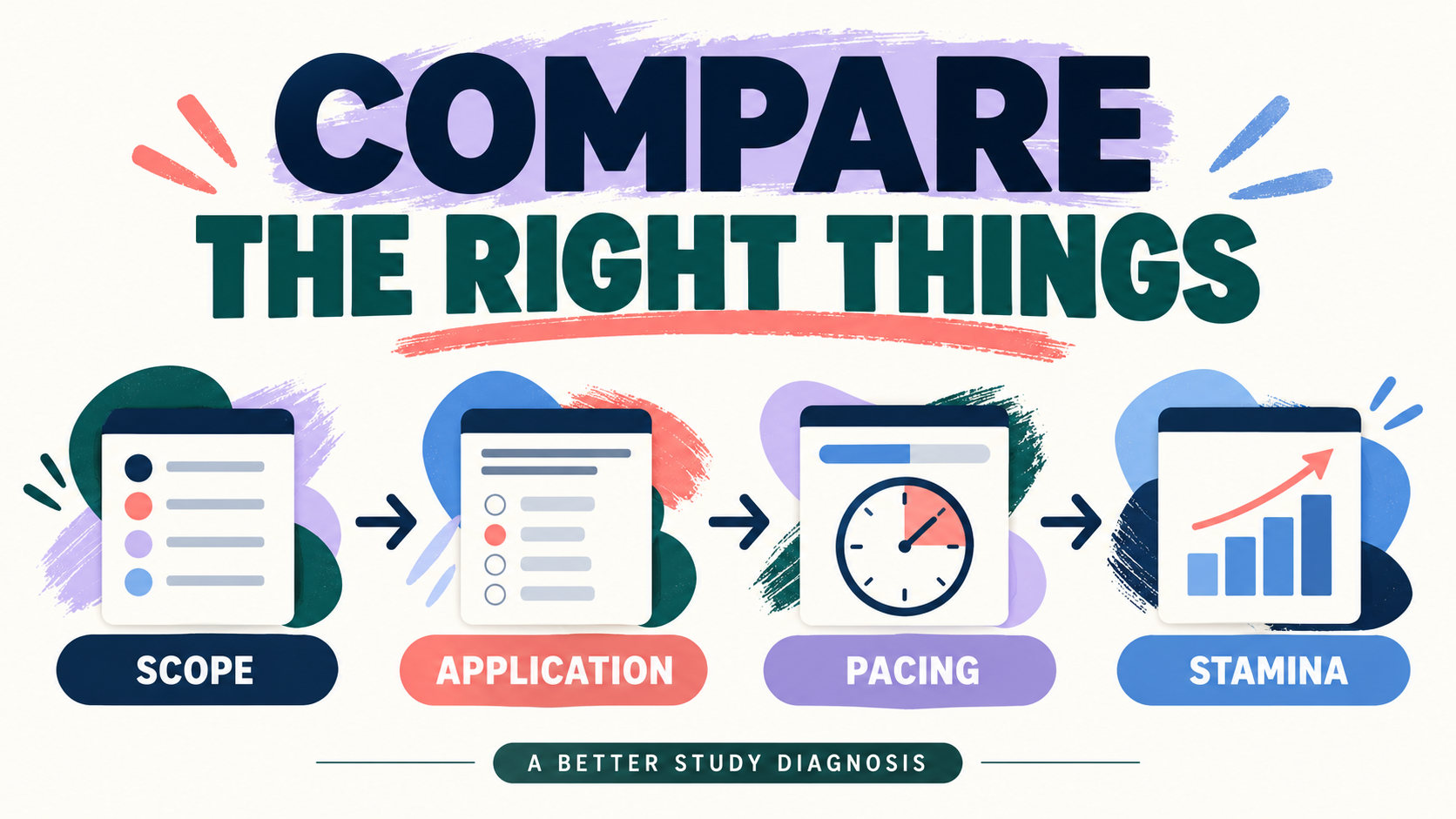
If you are comparing the BCBA exam with another certification exam, compare the structure before comparing the emotion. The question “Which is harder?” becomes more useful when it is split into observable dimensions.
| Comparison lens | BCBA question to ask | Why it matters |
|---|---|---|
| Scope | How many domains and task types must I integrate? | Breadth may create more switching and retrieval demands. |
| Cognitive demand | Is the exam mainly recall, calculation, application, or judgment? | Application requires discrimination, not only memorization. |
| Time and format | How long are the items, and can I review or flag them? | Pacing and stamina can change the experience of the same knowledge. |
| Evidence | Are pass-rate data reported for comparable candidates? | A percentage without context is easy to overinterpret. |
For example, the BCBA exam is not directly comparable to the RBT exam simply because both are BACB credentials. They operate at different certification levels and test different responsibilities. A candidate who finds the BCBA exam harder may be responding to the graduate-level scope and independent-practice decisions, not to a universal property shared by every test taker.
The same caution applies to the BCaBA exam and to exams in other professions. If a source publishes a confident ranking without matching the candidate population, exam blueprint, and scoring standard, treat the ranking as opinion. Use it to identify questions you want answered, not as a fact to repeat.
Turn Difficulty Into a Study Diagnosis
Instead of asking only whether the BCBA exam is hard, ask which part is hard for me? A timed diagnostic set can separate four common problems:
- Knowledge gap: you cannot explain the concept or rule even without time pressure.
- Discrimination gap: you know the concepts but confuse similar procedures, measures, or functions.
- Application gap: you can define the term but miss the best answer in a novel scenario.
- Pacing or stamina gap: your accuracy is strong early and falls after long sets or when the clock becomes salient.
Each gap needs a different response. A knowledge gap calls for targeted content review. A discrimination gap calls for side-by-side contrasts and error explanations. An application gap calls for scenario practice in which you state the controlling variables before viewing the options. A pacing gap calls for shorter timed sets, planned checkpoints, and gradual exposure to full-length practice.
Do not use a single mock-exam percentage as your whole readiness judgment. Keep an error log with the domain, the missed cue, the reason your selected answer was tempting, and the rule that makes the correct answer better. Review the log after a delay, then test the same distinction in a new context. That process shows whether you learned a decision rule or merely remembered one answer.
Study time should also be individualized. Someone returning to behavior analysis after a long break may need more weeks than someone who recently completed coursework and fieldwork. A practical plan includes content review, mixed-domain questions, ethical and supervision scenarios, data interpretation, and at least some timed practice. More hours are not automatically better if every hour repeats the same comfortable topic.
Do the 2027 Changes Make the Exam Harder?
The BACB’s 2027 BCBA Requirements address eligibility, coursework, fieldwork, supervisor qualifications, and transition rules. They are important for anyone planning certification around January 1, 2027, but an eligibility change is not the same thing as a published change to the exam’s question format or difficulty.
Keep two planning tracks separate. The first is eligibility: degree and coursework route, supervised fieldwork, documentation, deadlines, and the transition guidance that applies to you. The second is exam readiness: the current handbook, the 6th-edition TCO, ethics, scenario reasoning, measurement, intervention selection, supervision, and pacing. Read the current official documents for both tracks rather than assuming that a new pathway automatically changes what appears on screen. If your exam date falls near the transition, verify the applicable handbook and authorization instructions with the BACB. This article explains difficulty and preparation logic; it does not replace official eligibility advice.
BCBA Exam Difficulty FAQ
Is the BCBA exam harder than the RBT exam?: They should not be treated as a simple difficulty ladder. The credentials serve different roles and test different responsibilities. The BCBA exam has a graduate-level blueprint and expects broader independent judgment, so a candidate may experience it as more demanding, but there is no single personal ranking that applies to everyone.
Is the BCBA exam harder than the BCaBA exam?: The exams are built for different certification levels. Compare the applicable handbook and content outline rather than relying on anecdotes. If you are moving from BCaBA preparation to BCBA preparation, expect broader content integration and more independent-practice decisions, then diagnose the gaps with mixed scenario practice.
Does a 51% first-time pass rate prove that the BCBA exam is harder than another exam?: No. The 51% figure is an official 2025 BCBA first-time pass rate, but pass rates depend on the tested population, eligibility filters, exam form, and reporting method. It is useful evidence that candidates should prepare seriously, not a universal conversion table between professions.
How can I tell whether I am ready?: Use a full-length, timed practice set after targeted review, then inspect your error pattern. Readiness is stronger when you can explain why the correct option fits the data, function, sequence, and ethics—and why the distractors do not. If you want a structured baseline, try a free BCBA mock exam and use the results to choose your next study block.
Bottom line: the BCBA exam can be difficult because it asks for breadth, applied reasoning, professional judgment, and sustained pacing at the same time. Comparing it fairly means comparing those demands—not repeating an unsupported “hardest exam” ranking. Build your preparation around the exact skills that your diagnostic work shows you need.
Quick Review Checklist
Use this final checklist to turn how hard is the bcba exam into exam-ready reasoning. The goal is not to memorize a label in isolation; it is to identify the relevant evidence and explain why the best answer fits the scenario. Key ideas to review:
- State the central definition or decision point for how hard is the bcba exam in your own words.
- Identify the detail that makes how hard is the bcba exam different from its closest related ABA term.
- Separate the observable facts in a scenario from assumptions that are not supported by the facts.
- Write one example and one nonexample so you can recognize the concept in a new setting.
Exam application checks:
- Ask what the question is actually requesting before comparing the answer choices.
- Mark the antecedent, response, consequence, or other evidence that supports the selected answer.
- Look for a distractor that describes a related process but does not answer the specific question.
Final self-check:
- Explain how you would verify the interpretation with clear observations or data.
- Change one detail in the scenario and decide whether your answer should change.
- Give a one-sentence rationale that a supervisor or study partner could evaluate.
Take the Free BCBA Mock Exam
If you want a low-pressure way to check your recall, use the free practice resource below. Take the Free BCBA Mock Exam



