
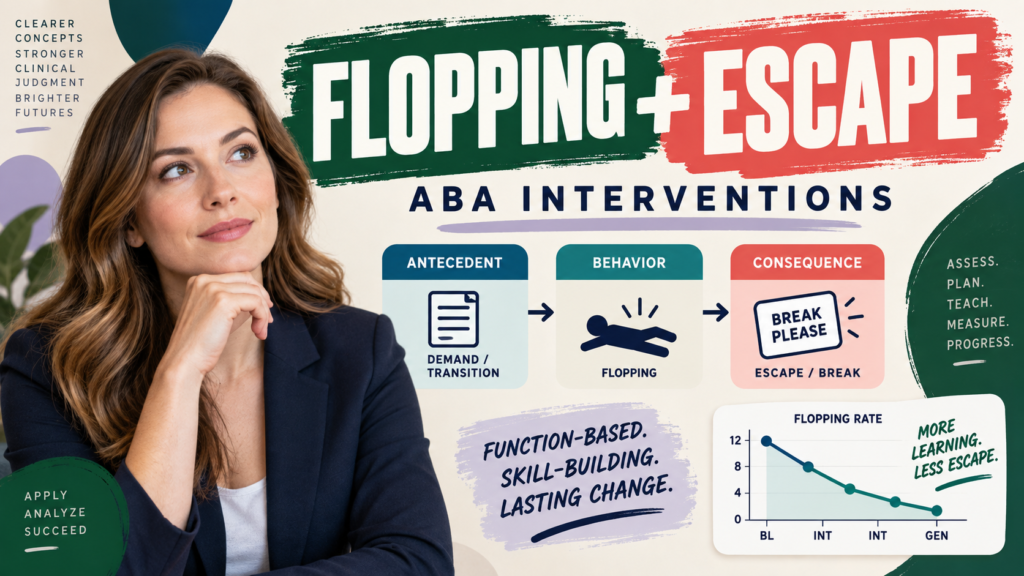
ABA interventions for flopping, dropping to the floor, and escape behavior should begin with assessment—not a guessed consequence. When someone searches for “aba interventions for flopping dropping to floor escape behavior,” the useful question is not simply how to make the person stand up. The useful question is: what happens before the response, what does the response produce, and what safer skill could produce the same meaningful outcome?
Table of Contents
- ABA Interventions for Flopping Dropping to Floor Escape Behavior: What Does Flopping Mean?
- What Should You Check Before Choosing an Intervention?
- How Can You Confirm Escape as the Function?
- How Can You Match an Intervention to Function?
- How Do You Teach a Functional Break Request?
- How Do You Reinforce Safe Participation and Return?
- What Data Should You Collect?
- What Safety and Ethics Guardrails Matter?
- What Are the BCBA Exam Traps?
- Worked BCBA-Style Scenario
- Quick Review Checklist
- Take the Free BCBA Mock Exam
- Sources to Verify
Flopping is a descriptive label, not a function. A learner may drop to the floor to delay a difficult task, obtain attention, access a preferred item, escape a transition, or respond to pain, fatigue, sensory conditions, or another variable. This guide focuses on cases in which data support an escape-related hypothesis. It is an educational BCBA study guide, not an individualized treatment plan. Safety, assent, medical concerns, crisis procedures, and implementation decisions require qualified professional review. Table of Contents
ABA Interventions for Flopping Dropping to Floor Escape Behavior: What Does Flopping Mean?
In everyday conversation, flopping can mean going limp, sitting down suddenly, lying down, or refusing to move. For ABA data, that label needs an operational definition. For example: “After a transition cue or task demand, the learner places the knees, hips, or torso on the floor and remains there for at least three seconds.” The definition should state what counts, what does not count, and how one episode ends. A person sitting on the floor during a planned activity is not automatically flopping.
Escape-maintained behavior is behavior that has a history of producing removal, delay, reduction, or postponement of an aversive event. If a demand appears, the learner drops, and the demand is routinely removed, the consequence may strengthen the response through negative reinforcement. That is a behavioral relation; it is not a claim that the learner is manipulative or consciously plotting to avoid work. The task may be too difficult, too long, unclear, painful, or poorly matched to the learner’s communication and skill level.
Before using the phrase “escape behavior,” check competing explanations. A sudden change can signal illness, injury, sleep loss, hunger, medication effects, overload, or an unsafe environment. A BCBA should also check whether the response produces attention, tangibles, sensory consequences, or a predictable change in the routine. The same topography can have different functions for different learners—or different functions across settings.
What Should You Check Before Choosing an Intervention?
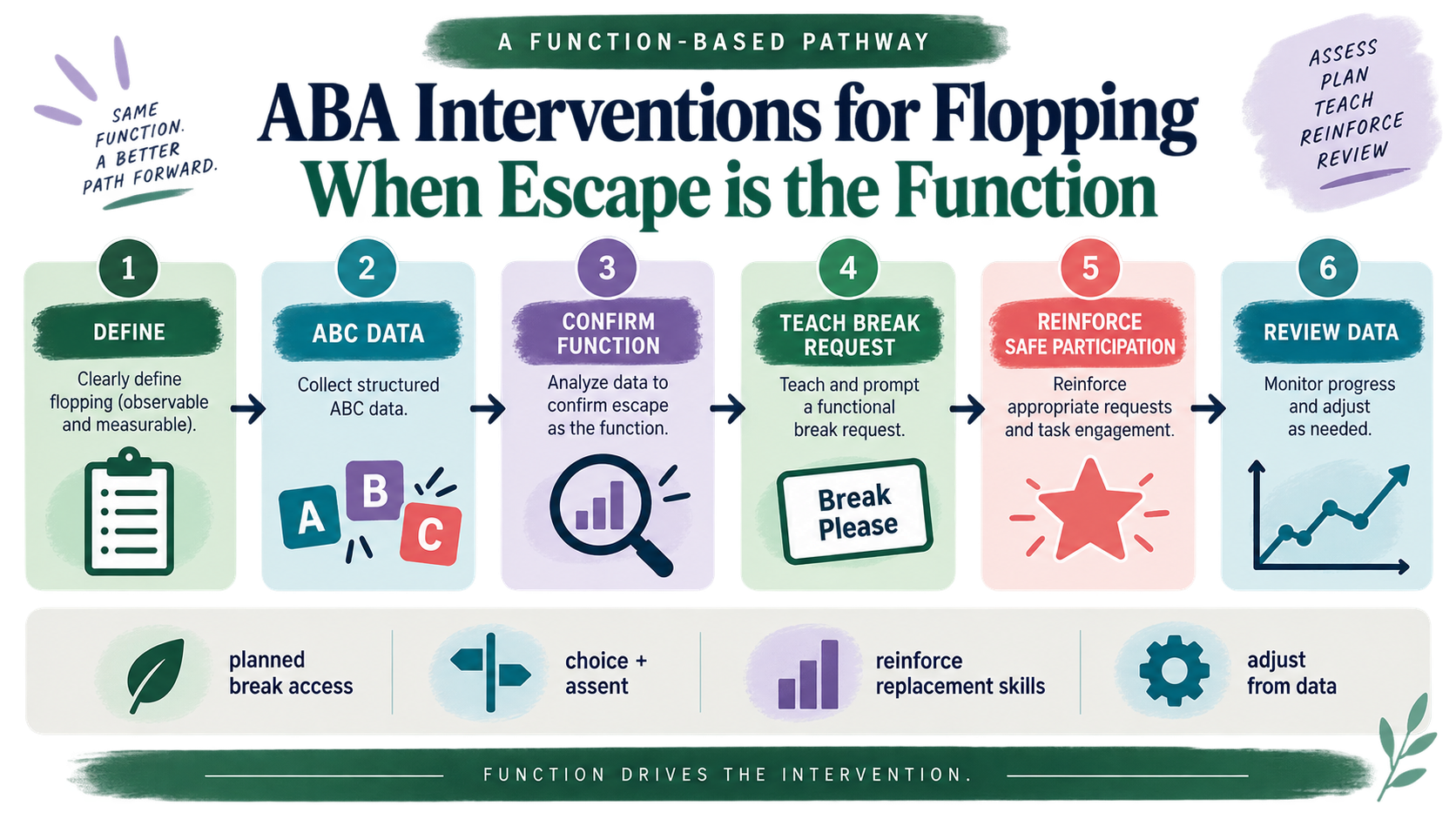
A function-based plan begins with a precise question. The goal is not to find the fastest way to suppress dropping. The goal is to arrange instruction so that the learner can access a meaningful outcome safely and efficiently through an appropriate response, while the team teaches the skills needed to tolerate, communicate, and participate.
| Question | Evidence to review | Why it matters |
|---|---|---|
| What exactly is flopping? | Observable start, stop, duration, context, and examples/nonexamples | Prevents vague labels from driving treatment. |
| What reliably precedes it? | Demand type, transition, task difficulty, prompt, setting, people, and time | Identifies antecedent patterns and possible prevention. |
| What follows it? | Break, task removal, attention, item access, delay, or sensory change | Tests the maintaining-consequence hypothesis. |
| Is there an urgent safety or health issue? | Injury risk, falls, pain indicators, elopement, aggression, medical changes | Safety and referral decisions come before routine teaching. |
The behavior-pathway materials illustrate why defining the response and examining antecedents and consequences are foundational steps. In a real case, the team may combine interviews, direct observation, ABC recording, skill assessment, and a functional analysis or other function-based assessment when appropriate and safe.
How Can You Confirm Escape as the Function?
Descriptive ABC data can show that dropping is more likely after demands and that demands are often removed afterward. That pattern supports a hypothesis, but correlation alone does not prove function. The team should ask whether the same consequence is available after other responses, whether task difficulty changes the probability, and whether the learner can communicate a break without dropping.
A functional assessment may include interviews, observation across conditions, and—when clinically appropriate—an experimental analysis conducted by trained professionals. A brief functional analysis may compare conditions such as attention, tangible, escape, alone, and play, with careful attention to risk. The study by Roane and colleagues on emergent dropping during treatment of elopement is a useful reminder that dropping behavior can be clinically complex and may require concurrent safety and treatment decisions; it does not support copying a protocol without assessment.
For study purposes, remember the logic: if flopping occurs most often when demands are presented and decreases when escape is not the only route to a break, escape may be relevant. But do not infer a function from the body position alone. This is the same reason a functional analysis ABA guide should be read as a decision framework, not a do-it-yourself procedure.
How Can You Match an Intervention to Function?
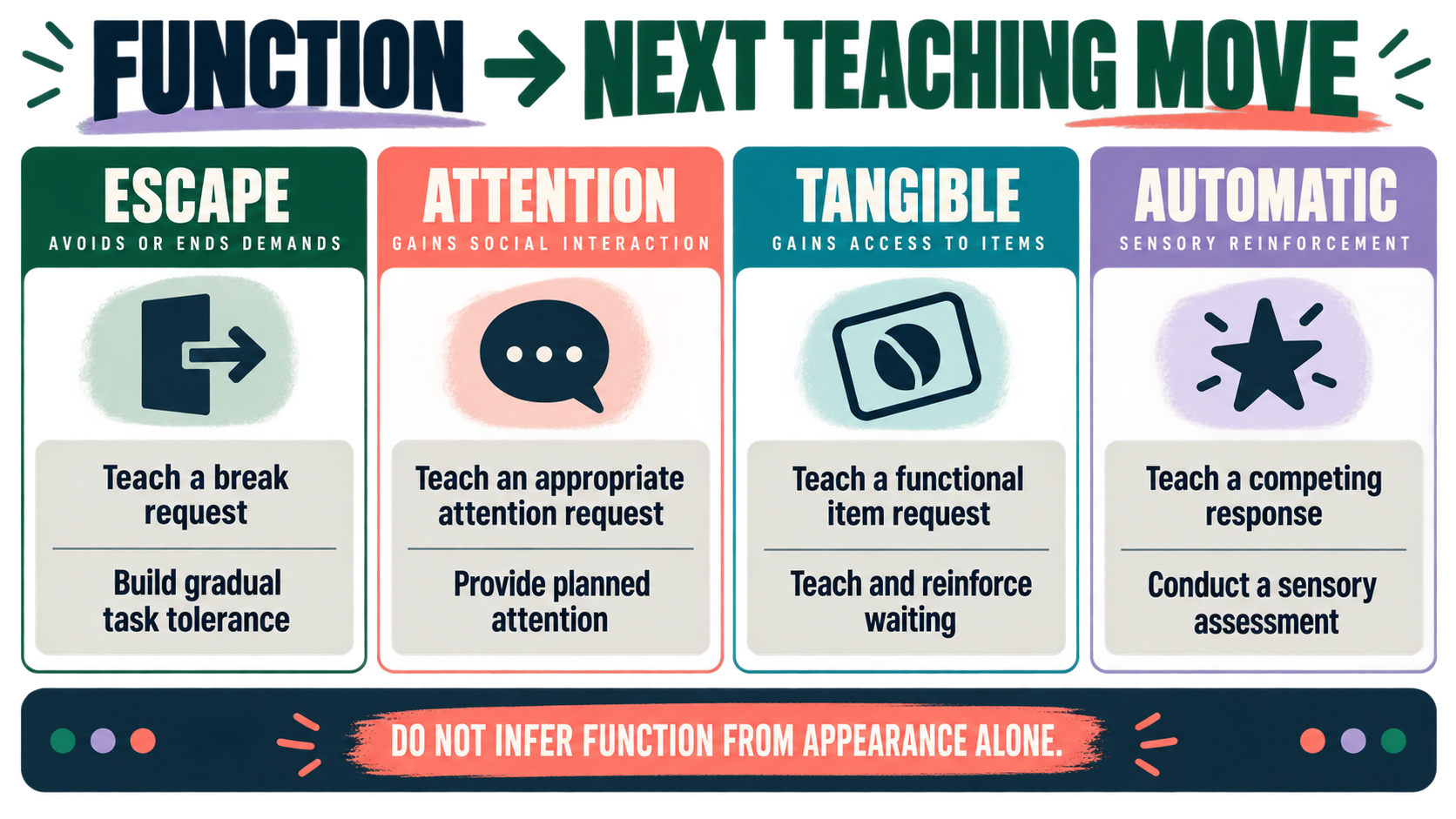
Once the function is supported, the plan should make the replacement response efficient, understandable, and worth using. A replacement behavior is not merely “stop flopping.” It is a response that gives the learner an appropriate way to communicate or access the same outcome. If the function is escape, common teaching priorities include requesting a break, requesting help, choosing between tasks, tolerating a small amount of work, and returning after a planned break.
| Possible function | Teaching priority | Example data question |
|---|---|---|
| Escape or avoidance | Break/help request, task adaptation, gradual tolerance, planned return | Does an appropriate request produce a brief, predictable break? |
| Attention | Appropriate attention request and planned, high-quality attention | Does the replacement request contact attention more reliably? |
| Tangible access | Functional item/activity request, waiting, and transition support | Can the learner request and wait without dropping? |
| Automatic or sensory | Competing response, environmental assessment, and sensory-informed support | Does the alternative compete with the relevant sensory consequence? |
The graphic is a study map, not a prescription. Confirm the function and review task demands, communication, assent, and safety before choosing a plan.
How Do You Teach a Functional Break Request?
A break request can be spoken, signed, gestured, exchanged as a card, selected on a device, or expressed through another reliable communication system. The response should be accessible under stress and should not require a long verbal explanation when the learner is already overwhelmed.
- Choose one clear response. Define what counts as “break,” “help,” or “more time,” and make sure all implementers recognize it.
- Teach before the hardest moment. Practice during calm, easy tasks. Model the request and use the least intrusive prompt that helps the learner contact the outcome.
- Honor the request predictably. A planned, brief break should not be a trick. The learner needs a history showing that communication works.
- Start with an achievable response requirement. If every request is followed by a long demand, the replacement may not compete with flopping.
- Build return skills gradually. After the break, use a clear transition cue, a small response requirement, and reinforcement for re-engagement.
- Fade prompts and expand generalization. Move from dense support to natural cues across people, tasks, rooms, and community routines as data show readiness.
Choice matters. Offer options such as task order, work location, materials, or a planned break now versus after one easy response. Choice can reduce unnecessary coercion and support cooperation.
How Do You Reinforce Safe Participation and Return?
Participation must be defined as a behavior, not as emotional calm or a particular body posture. Depending on the task, it may mean orienting to materials, completing one step, using a taught communication response, walking with a support, or remaining in a safe area. Reinforce a meaningful approximation that the learner can actually perform.
Use differential reinforcement thoughtfully: reinforce the replacement request and safe engagement more strongly than dropping, while preserving the learner’s right to signal distress and access planned support. Avoid turning “return to task” into an endless battle. Adjust task length, prompt level, material difficulty, schedule, and break timing based on data. If the learner’s distress escalates, follow the individualized safety plan and obtain clinical guidance rather than improvising.
What Data Should You Collect?
Match measurement to the decision. Frequency or rate may be useful when episodes are clearly countable. Duration may be better when remaining on the floor is the central concern. Latency can show how long it takes to begin a task after a direction. A transition-based percentage can show how often the learner moves safely from one activity to the next. Also record replacement responses, prompt levels, break access, task completion, and adverse events.
| Decision | Useful measure | Avoid this error |
|---|---|---|
| Is dropping happening less often? | Frequency or rate per opportunity | Comparing raw counts when the number of demands changed. |
| Is each episode shorter? | Duration per episode and total duration | Calling a short pause a new episode without defining the reset rule. |
| Is communication replacing dropping? | Independent versus prompted break requests | Counting prompted requests as independent skill acquisition. |
| Is participation generalizing? | Successful transitions across tasks, people, and settings | Declaring success from one familiar room or therapist. |
What Safety and Ethics Guardrails Matter?
The BACB Ethics Code for Behavior Analysts is a professional standard, not a substitute for judgment. For a flopping case, ethical review includes competence, individualized assessment, dignity, communication access, assent and withdrawal signals, least restrictive effective teaching, accurate data, supervision, and clear response to risk.
- Check for pain, injury, medical change, fatigue, and environmental overload before treating the response as escape-maintained.
- Do not use physical prompting, restraint, blocking, or crisis procedures unless they are legally and clinically authorized, trained, documented, and necessary for immediate safety.
- Do not remove communication or planned breaks as a punishment for requesting help.
- Do not hide a demand behind a “choice” or represent distress as noncompliance without reviewing the task and the learner’s signals.
- Review whether the goal improves safety, communication, autonomy, access, or participation—not merely adult convenience.
These guardrails protect the learner and improve the data. Change variables deliberately so the team can tell whether the replacement response is functional and sustainable.
What Are the BCBA Exam Traps?
The BCBA 6th Edition Task List rewards function-based reasoning. When you see a scenario about dropping to the floor, slow down before selecting an answer.
- Topography is not function: “flopping” describes what the behavior looks like; it does not prove escape.
- Negative reinforcement is not punishment: if task removal increases the future probability of the response, the relation is negative reinforcement, even if the long-term result is problematic.
- DRA requires a replacement: reinforcing “not flopping” without teaching a communication or participation response is incomplete.
- Escape extinction is not the first sentence: check assessment, safety, skill deficits, assent, and less intrusive function-based options before discussing a procedure that may evoke escalation.
- Data beat intuition: choose the intervention and measurement system that answer the functional question presented in the stem.
Worked BCBA-Style Scenario
A learner drops to the floor during difficult writing tasks. Across ten observations, dropping is most likely after the worksheet is placed, the worksheet is removed in eight of ten episodes, and the learner independently hands over a break card only when the task is easy. The team also finds that the worksheet requires fine-motor skills the learner has not mastered.
The strongest first response is not “make the learner finish the worksheet.” The team should confirm the operational definition, assess the motor and instructional demands, teach and honor a functional break or help request, adapt the task, reinforce a small achievable response, and collect data on dropping, communication, prompt level, and task completion. The wording “escape function” points to a functional hypothesis; it does not erase the need to make the task accessible.
Quick Review Checklist
- Define flopping with observable start, stop, examples, and nonexamples.
- Record antecedents and consequences instead of assuming intent.
- Rule out pain, injury, fatigue, overload, and skill mismatch.
- Confirm whether escape is the function and check competing functions.
- Teach an efficient break, help, or more-time response.
- Make planned break access predictable and honor communication.
- Reinforce safe participation and gradual task tolerance.
- Measure both the target response and the replacement skill.
- Review assent, dignity, safety, supervision, and adverse effects.
- Use data to adjust the plan rather than escalating demands by intuition.
For targeted review, use our aba interventions for flopping dropping to practice questions to apply the concept in exam-style scenarios.
Take the Free BCBA Mock Exam
If you want a low-pressure way to check your recall, apply this case logic to fresh scenario questions: define the behavior, identify the functional relation, select a replacement response, and choose measurement that matches the decision. Take the Free BCBA Mock Exam
Sources to Verify
- BACB BCBA 6th Edition Task List
- BACB Ethics Code for Behavior Analysts
- Reduction of emergent dropping behavior during treatment of elopement
- Behavior pathway and FBA resource
This page explains assessment and study logic. It does not diagnose a learner or replace an individualized plan from a qualified professional.



