
How many questions can you miss on the BCBA exam? The official answer is that there is no fixed number you can safely calculate in advance. The current BCBA exam has 185 multiple-choice questions, but 175 are scored and 10 are unscored. The BACB establishes a passing standard for each examination form and converts performance to a scaled score, so a raw “you may miss exactly X” rule is not published.
Table of Contents
- How Many Questions Can You Miss on the BCBA Exam?
- What Are the Current BCBA Exam Facts?
- Why Is There No Fixed Number of Wrong Answers?
- Which Questions Count Toward the Score?
- What Does a Failing Score Report Tell You?
- What Practice Target Should You Use?
- How Should You Use the Answer in Your Study Plan?
- BCBA Exam Wrong-Answer FAQ
- Quick Review Checklist
- Take the Free BCBA Mock Exam
That answer can feel unsatisfying when you are planning a study schedule. It is also more useful than a made-up cutoff. Instead of chasing a universal wrong-answer number, you can track mixed-question accuracy, pacing, content-area errors, and whether your performance remains stable across several practice sessions.
This guide uses the current BACB Examination Information page and BCBA Handbook. A practice percentage in this article is a planning benchmark only. It is not an official BACB passing score, a guarantee, or a substitute for the current handbook. Table of Contents
How Many Questions Can You Miss on the BCBA Exam?
You cannot determine an official fixed number of questions you may miss before sitting for the BCBA exam. The BACB does not publish a raw-score formula such as “get 140 out of 175” for every form. The passing standard is established for the examination form, and statistical equating is used so that forms with different difficulty levels can be compared on the same scale. There are three reasons a simple subtraction answer is unreliable:
- Only some questions are scored: The exam includes 10 unscored questions, but you cannot identify them during the test.
- Forms are equated: The number of correct answers required can vary with the form and its difficulty.
- The raw result is not reported: Candidates do not receive an official count of exactly how many questions they answered correctly.
So the honest answer to “how many questions can you miss on the BCBA exam?” is: the BACB does not give candidates a universal number. Treat any exact number presented as an official cutoff with caution unless it appears in current BACB material for a specific purpose.
What Are the Current BCBA Exam Facts?
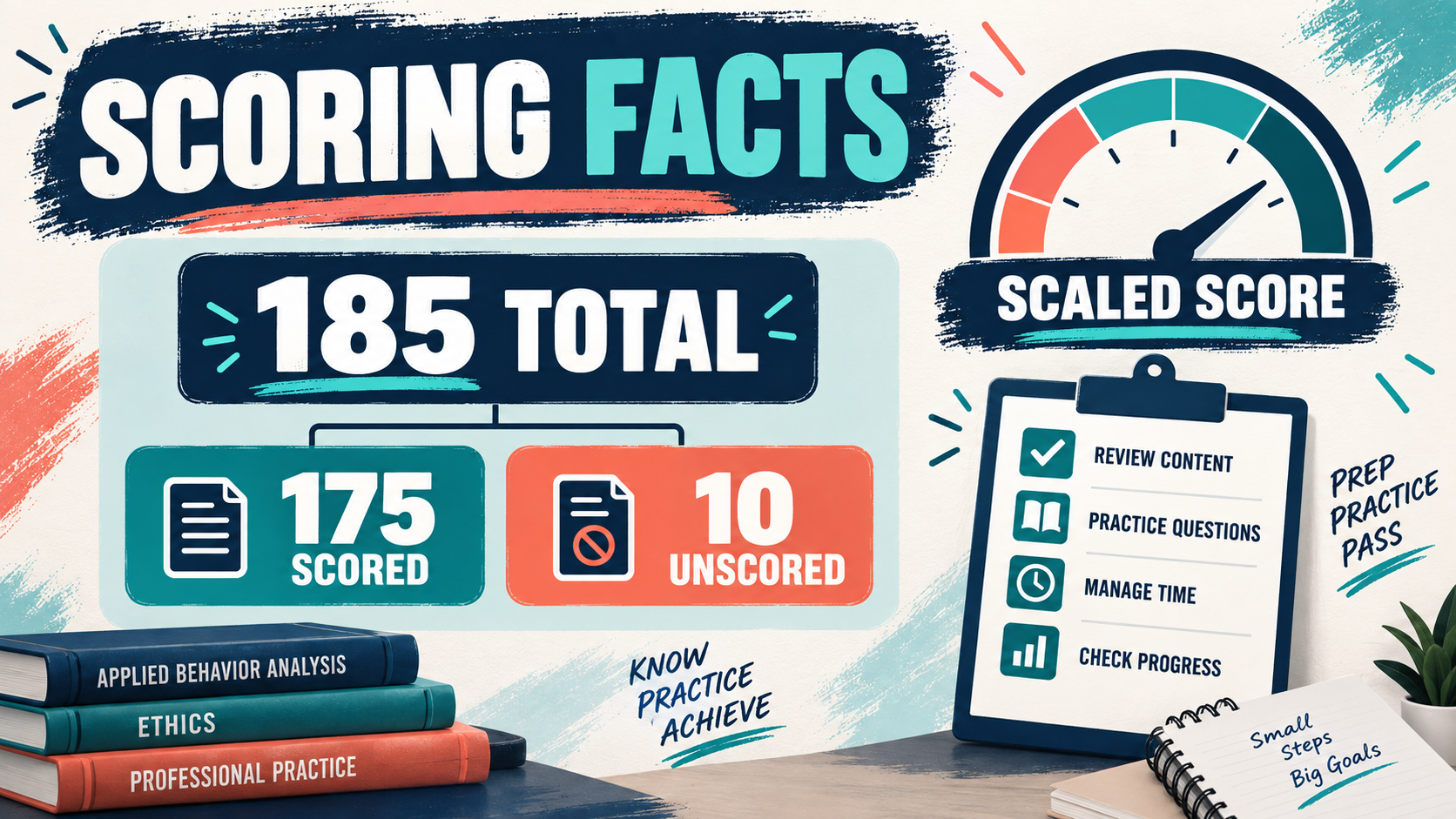
The current BACB examination information describes the BCBA test as an in-person, four-hour, multiple-choice examination with 185 questions. Each question has four answer choices and one correct answer. The current handbook and examination page distinguish 175 scored questions from 10 unscored questions.
| Fact | What it means for preparation |
|---|---|
| 185 total questions | Build stamina for the complete testing experience, not only a short quiz. |
| 175 scored questions | Your performance is evaluated on the scored portion, but the candidate cannot sort scored from unscored items. |
| 10 unscored questions | Do not skip or relax on a question because you hope it is unscored; every item should receive your best effort. |
| Four-hour limit | The simple average is about 78 seconds per question, including reading, decisions, navigation, and any review. |
| Scaled scoring | Use practice data to guide preparation, but do not convert a mock percentage into an official pass prediction. |
The four-hour clock also includes more than the moment you spend choosing an answer. You need to read the prompt carefully, compare close options, manage navigation, and leave enough time to revisit marked items. A study plan that focuses only on the number of questions missed ignores the pacing problem that can create avoidable errors late in the session.
Why Is There No Fixed Number of Wrong Answers?
The BACB uses a modified Angoff method to establish the passing score for a base examination form. Subject-matter experts judge the performance expected from a minimally qualified entry-level behavior analyst, and the standard is approved through the BACB’s process. The form is then equated so performance can be interpreted fairly across forms.
This is different from a classroom test where the instructor may say that 80% is a pass. On a classroom test, the raw number correct may be enough to calculate a grade. On the BCBA exam, the candidate’s raw count is transformed to a scaled score, and the required raw performance may vary with the form. The BACB therefore does not report a universal number of correct answers or a universal number of misses.
The unscored questions add another reason not to use a fixed subtraction formula. They are included in the exam, but candidates are not told which questions they are. If you assumed that ten misses are automatically harmless, you could be wrong about the scored items that produced them.
Which Questions Count Toward the Score?
Only the scored questions contribute to the examination score, but there is no visible marker that lets you identify them. The safest test-taking rule is to treat all 185 questions as important. Read every item, eliminate weak choices, answer every question, and return to marked items only when the time cost is reasonable.
It is also a mistake to think that each content area must be passed separately. The official score information is intended to guide future study; it is not presented as nine independent pass/fail tests. A candidate may miss more items in one area and still pass overall, or miss fewer items and fail if the total performance does not meet the form’s standard.
Use the current BCBA Test Content Outline to map study coverage across the blueprint. Do not study only the topic where one practice report shows the most errors, because a small sample of questions may not represent your complete understanding.
What Does a Failing Score Report Tell You?
The BACB does not provide a raw total of correct answers or an overall percentage correct as the official answer to the wrong-question question. Failing candidates receive information about performance by primary content area, including the percentage of questions answered correctly and the total number of questions in those areas. That information can guide a retake plan, but it should not be treated as a precise diagnosis of every task.
A score report is most useful when you combine it with your own error log. For each missed practice question, record whether the problem was a definition, discrimination, data interpretation, ethics, application, or pacing error. If you only reread the explanation, you may recognize the answer without fixing the decision process that caused the miss.
The official guidance also cautions against studying only the areas that appear weak on a report. The number of items tied to an individual task can be small. Review the whole content outline while giving extra practice to repeated error patterns.
What Practice Target Should You Use?
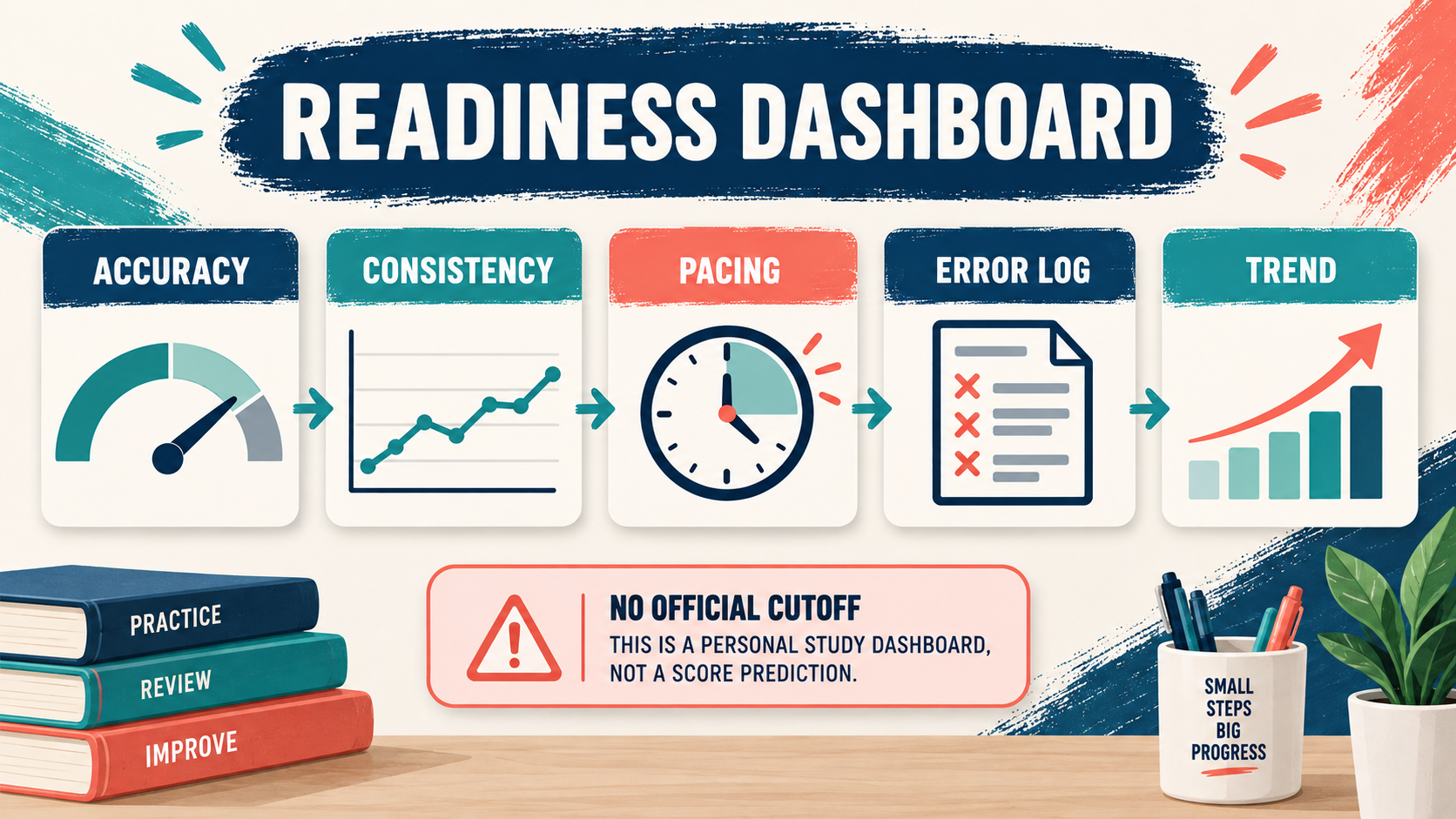
Because there is no official fixed number of misses, use a personal readiness dashboard instead of a single magic score. A useful target has four parts: accuracy, consistency, pacing, and explanation quality.
| Readiness signal | What to measure | What to do next |
|---|---|---|
| Accuracy | Your percentage on mixed, scenario-based sets under a realistic time limit. | Review why each distractor was weaker; do not count recognition as mastery. |
| Consistency | Whether your results stay stable across several days and content mixes. | Look for a trend, not one unusually high or low attempt. |
| Pacing | Completion rate, time spent per item, and whether accuracy drops late. | Practice timed blocks and a deliberate mark-and-return strategy. |
| Explanation | Your ability to explain why the best answer fits the facts and why alternatives do not. | Rework uncertain items even when you happened to choose the correct answer. |
You may choose a personal benchmark, such as consistently scoring above 80% on difficult mixed sets, but label it honestly: it is your preparation target, not a BACB cutoff. The right benchmark depends on the quality of the questions, the similarity of the timing, and whether you can explain your decisions without relying on answer-pattern memory.
How Should You Use the Answer in Your Study Plan?
- Start with a timed baseline. Use a mixed set large enough to reveal pacing and content patterns. Record how many items you left blank, rushed, or changed.
- Build an error taxonomy. Label each miss as knowledge, application, measurement, ethics, reading, or time management. A vocabulary gap needs a different fix from a distractor-discrimination problem.
- Study the full blueprint. Use the current TCO and the official handbook as the map. Spend extra time on recurring weaknesses without abandoning areas that were not sampled often.
- Repeat under conditions. Increase the length of practice blocks and include review time. A short untimed quiz cannot show whether you can make a careful decision after several hours.
- Track stability. Compare several recent attempts instead of reacting to one score. Your goal is a reliable performance pattern with enough time to finish and review.
A free BCBA mock exam can be one diagnostic checkpoint in that workflow. Use it to practice scenarios and identify errors; it is not official BACB content and cannot tell you the exact number of questions you may miss on your future examination form.
BCBA Exam Wrong-Answer FAQ
Can I miss 10 questions because 10 questions are unscored?: No. You cannot identify the unscored questions, and the 10 unscored items are not a guaranteed allowance. Treat every question as important. Is there an official 70% or 80% BCBA exam cutoff?: Do not treat a general percentage as the official cutoff. The BACB uses form-specific standards and scaled scoring. A percentage may be useful for your own practice target, but it is not a universal BACB rule.
Will the BACB tell me exactly how many questions I got right?: The current examination information says the BACB does not report the raw number of questions answered correctly or an overall percentage correct. Failing candidates receive content-area information to guide future study.
Do I need to pass every BCBA content area separately?: The official score information is used to guide study by content area; the exam is not described as nine separate pass/fail tests. Focus on overall performance while correcting repeated weaknesses across the blueprint.
What is the best way to know if I am ready?: Use several timed, mixed practice sets and review accuracy, consistency, pacing, and reasoning. A stable trend is more informative than a single exact number of wrong answers.
The answer to “how many questions can you miss on the BCBA exam?” is not a magic subtraction formula. The BACB’s 185-question exam contains 175 scored and 10 unscored items, uses form-specific standards, and reports scaled results rather than a universal raw cutoff. Prepare for the real task: make accurate, ethical, data-based decisions across the full blueprint while managing the four-hour clock.
Quick Review Checklist
Use this final checklist to turn how many questions can you miss into exam-ready reasoning. The goal is not to memorize a label in isolation; it is to identify the relevant evidence and explain why the best answer fits the scenario. Key ideas to review:
- State the central definition or decision point for how many questions can you miss in your own words.
- Identify the detail that makes how many questions can you miss different from its closest related ABA term.
- Separate the observable facts in a scenario from assumptions that are not supported by the facts.
- Write one example and one nonexample so you can recognize the concept in a new setting.
Exam application checks:
- Ask what the question is actually requesting before comparing the answer choices.
- Mark the antecedent, response, consequence, or other evidence that supports the selected answer.
- Look for a distractor that describes a related process but does not answer the specific question.
Final self-check:
- Explain how you would verify the interpretation with clear observations or data.
- Change one detail in the scenario and decide whether your answer should change.
- Give a one-sentence rationale that a supervisor or study partner could evaluate.
Take the Free BCBA Mock Exam
If you want a low-pressure way to check your recall, use the free practice resource below. Take the Free BCBA Mock Exam



