
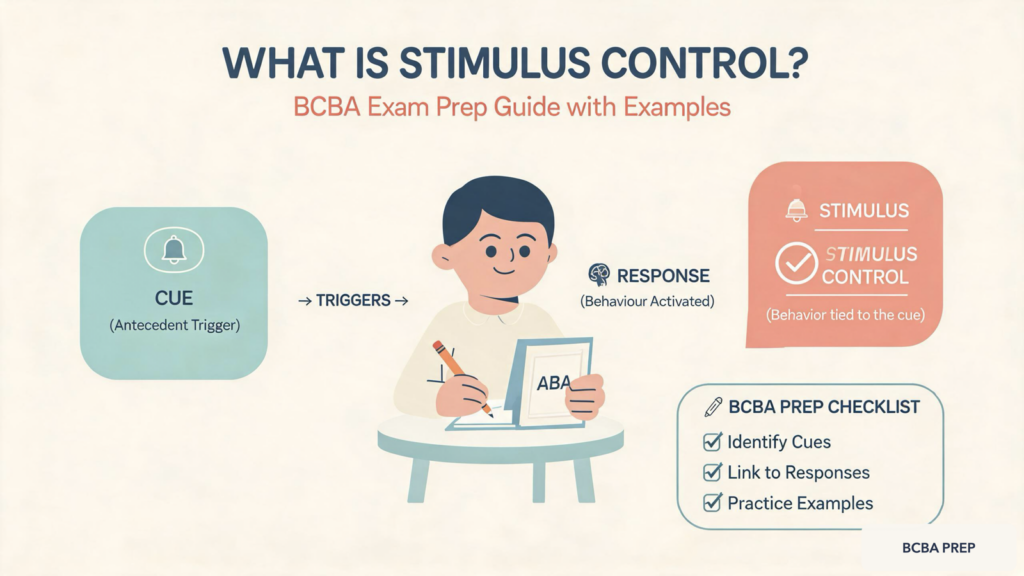
What Is Stimulus Control in ABA?
Stimulus control is a core concept in applied behavior analysis (ABA). It refers to a situation where a particular behavior is more likely to occur in the presence of a specific antecedent stimulus because that stimulus has been reliably correlated with reinforcement in the past. In simple terms, the antecedent stimulus ‘controls’ the behavior: when the stimulus is present, the behavior happens; when it is absent, the behavior does not.
Practice this concept
Table of Contents
- What Is Stimulus Control in ABA?
- Real-World ABA Examples of Stimulus Control
- Why Stimulus Control Matters on the BCBA Exam
- Quick Checklist for Stimulus Control
- Stimulus Control vs. Related Terms
- Final Summary
- References
For the BCBA exam, you need to understand that stimulus control is established through a history of differential reinforcement. The behavior is reinforced only when a specific stimulus is present, and not reinforced (or punished) when that stimulus is absent. This creates a reliable relationship between the stimulus and the response.
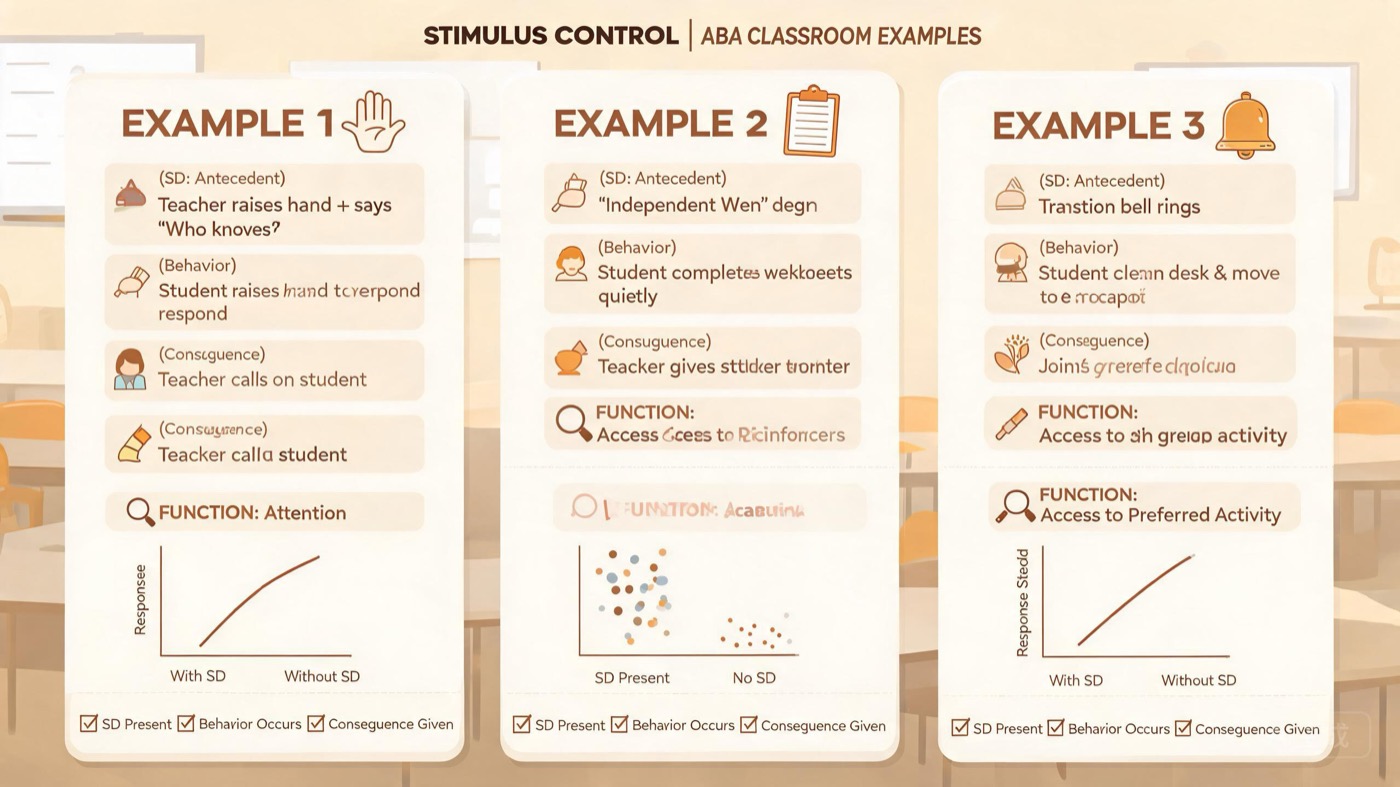
Key Components: SD and S-Delta
Two stimuli work together to produce stimulus control: the discriminative stimulus (SD) and the S-delta (SΔ). The SD signals that reinforcement is available for a particular behavior. The S-delta signals that reinforcement is not available (or a punishment may occur if the behavior is emitted). Over time, the learner comes to respond only in the presence of the SD.
- SD (Discriminative Stimulus): ‘Set the occasion’ for reinforcement. Example: A green light signals that pressing the gas pedal will move the car forward.
- S-delta (SΔ): Signals extinction or punishment. Example: A red light signals that pressing the gas will not move the car forward safely; instead, it may produce a collision.
How Stimulus Control Develops
Stimulus control develops through a process called differential reinforcement. When a behavior is reinforced in the presence of one stimulus (SD) but not in the presence of another (S-delta), the individual learns to discriminate. Over time, the SD evokes the behavior reliably, while the S-delta suppresses it. This is why stimulus control is also called discrimination training.
For example, a child learns to ask for a cookie only when the cookie jar is visible (SD) because the parent typically gives a cookie when asked in that situation. When the jar is hidden (S-delta), asking does not produce a cookie, so the child stops asking.
Real-World ABA Examples of Stimulus Control
Let’s explore three practical examples that illustrate how stimulus control works in everyday ABA practice. Each includes an ABC analysis and a hypothesized function.
Example 1: Classroom Behavior
Setting: A classroom during group instruction. Antecedent (SD): Teacher raises her hand while saying ‘Who knows the answer?’ Behavior: Students raise their hands. Consequence: Teacher calls on a student who raised their hand; the student receives teacher attention. Hypothesized function: Social positive reinforcement (access to attention). Over time, the teacher’s raised hand becomes an SD for hand-raising by students. Conversely, if the teacher is not raising her hand (S-delta), students rarely raise theirs because they have not been reinforced for that behavior in the absence of the SD.
Example 2: Driving and Traffic Lights
Setting: A driver approaches an intersection. Antecedent (SD): Green traffic light illuminated. Behavior: Driver presses the gas pedal. Consequence: Car moves forward and the driver progresses toward their destination. Hypothesized function: Automatic positive reinforcement (moving forward is inherently reinforcing). The green light has acquired stimulus control over pressing the gas pedal. If the light is red (S-delta), the driver does not press the gas; instead, they press the brake. This discrimination is learned through a history of reinforcement (green light = forward motion) and possible punishment (red light = risk of accident or ticket).
Example 3: Child Asking for Candy
Setting: Grocery store checkout aisle. Antecedent (SD): Visible candy display near the register. Behavior: Child says ‘Can I have candy?’ Consequence: Parent buys the candy. Hypothesized function: Social positive reinforcement (access to tangible item). The candy display acts as an SD for the child’s requesting behavior. When the candy is not visible (S-delta), the child is less likely to ask because that behavior has not been reinforced in the absence of the display.
Why Stimulus Control Matters on the BCBA Exam
The BCBA exam frequently tests your understanding of stimulus control, often in scenario-based questions. You may be asked to identify the SD in a given situation, explain how stimulus control was established, or distinguish it from related concepts. Here are common traps and test-taking tips.
Common Exam Traps to Avoid
- Confusing stimulus control with stimulus discrimination: They are related but not identical. Stimulus control is the outcome; discrimination is the process of learning to respond differently to different stimuli.
- Overgeneralizing: A learner may respond to similar stimuli that were not explicitly trained. This is stimulus generalization, not stimulus control. Stimulus control requires a specific stimulus-response-reinforcement history.
- Forgetting the role of reinforcement history: Stimulus control is not automatic; it depends on a history of differential reinforcement. If that history changes, stimulus control may weaken.
- Ignoring the S-delta: Many exam scenarios ask about both the SD and the S-delta. Always consider what stimulus signals the absence of reinforcement.
Test-Taking Tips
- Always identify the SD first: ask yourself, ‘In the presence of what stimulus does the behavior reliably occur?’
- Look for differential reinforcement: the scenario must include a history where reinforcement followed the behavior only in the presence of a specific stimulus.
- Remember that stimulus control is not permanent: if the contingency changes (e.g., the SD no longer leads to reinforcement), control may fade. This is called stimulus control decay.
- Practice with ABC data: write out the antecedent (SD or S-delta), behavior, and consequence to clarify the relationship.
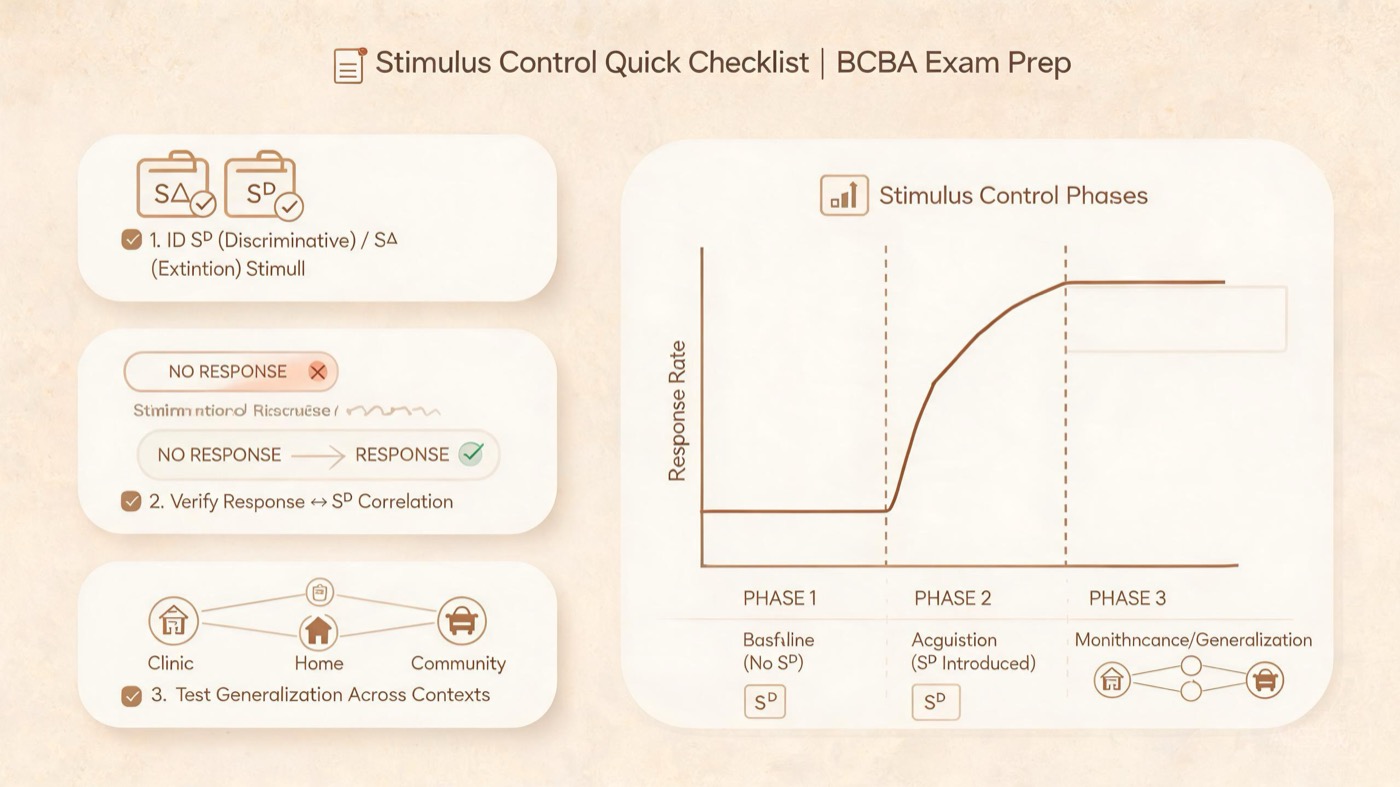
Quick Checklist for Stimulus Control
Use this checklist to review stimulus control before your exam. Each item includes an action to test your understanding.
- Identify the SD: In a given scenario, name the stimulus that signals reinforcement is available.
- Identify the S-delta: Name the stimulus that signals reinforcement is not available for that behavior.
- Confirm differential reinforcement history: Was the behavior reinforced in the presence of the SD and not in the presence of the S-delta?
- Check for alternative control: Could a motivating operation (MO) or other antecedent be responsible? Remember that SD signals availability, not value.
- Describe the function: What type of reinforcement maintains the behavior under stimulus control?
Stimulus Control vs. Related Terms
ABA includes several concepts that are often confused with stimulus control. Understanding the differences is crucial for exam success.
Stimulus Discrimination vs. Stimulus Control
Stimulus discrimination is the process of learning to respond differently to two or more stimuli. It is the training procedure that produces stimulus control. Stimulus control is the resulting state in which a specific stimulus evokes a behavior. In other words, discrimination training leads to stimulus control.
Stimulus Generalization
Stimulus generalization occurs when a behavior occurs in the presence of stimuli that share properties with the original SD but were not part of the training. For example, a child who learns to say ‘cat’ when seeing a picture of a domestic cat may also say ‘cat’ when seeing a lion. This is the opposite of stimulus control, which requires responding only to the specific trained stimulus.
Motivating Operations (MOs)
Motivating operations alter the value of a reinforcer and the likelihood of behaviors that have previously produced that reinforcer. They can temporarily override stimulus control. For example, extreme deprivation of water may cause a person to drink from any available source, even if the usual SD (a clean cup) is absent. The exam often tests your ability to distinguish between an SD (which signals availability) and an MO (which alters value). For a deeper dive, see our SD vs MO guide.
Final Summary
Stimulus control is a fundamental concept in ABA that describes how antecedent stimuli guide behavior through a history of differential reinforcement. On the BCBA exam, you must be able to identify the SD and S-delta, explain how stimulus control is established, and avoid common traps that confuse it with generalization or forget the role of reinforcement history. Use the checklist above and practice with real-world examples to solidify your understanding. For additional practice, check out our free BCBA mock exam questions and our comprehensive differential reinforcement guide.
References
Complete BCBA Exam Prep
Turn this topic into exam-day practice
Practice concepts in context with five full-length 6th Edition mock exams, two bonus practice exams, a 6th Edition study guide, and key-term flashcards—all in one $120 USD package.
Get the $120 All-in-One Prep Pack
Review everything included on the product page before ordering. No pass guarantee is implied.



