
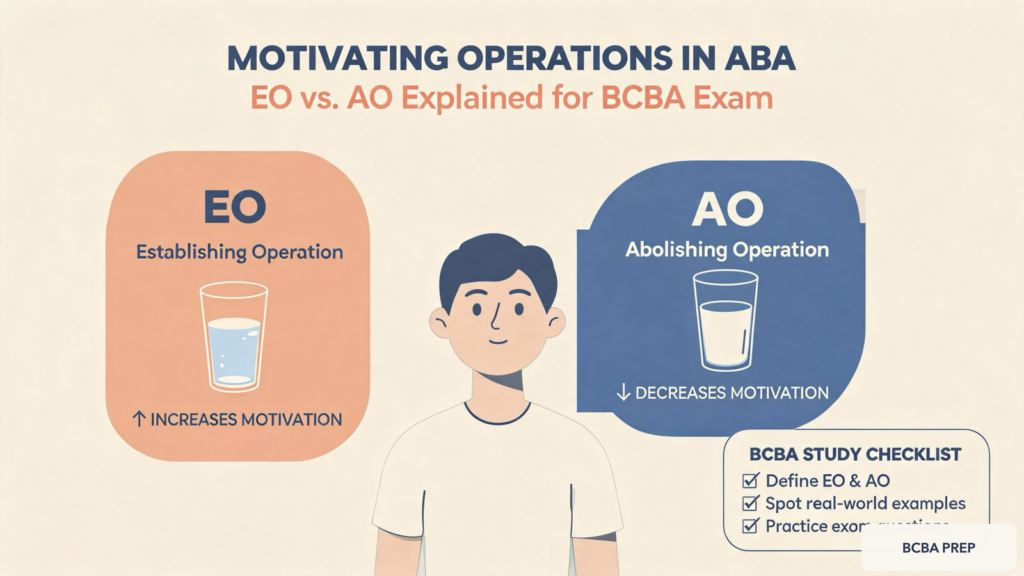
What Is a Motivating Operation in ABA?
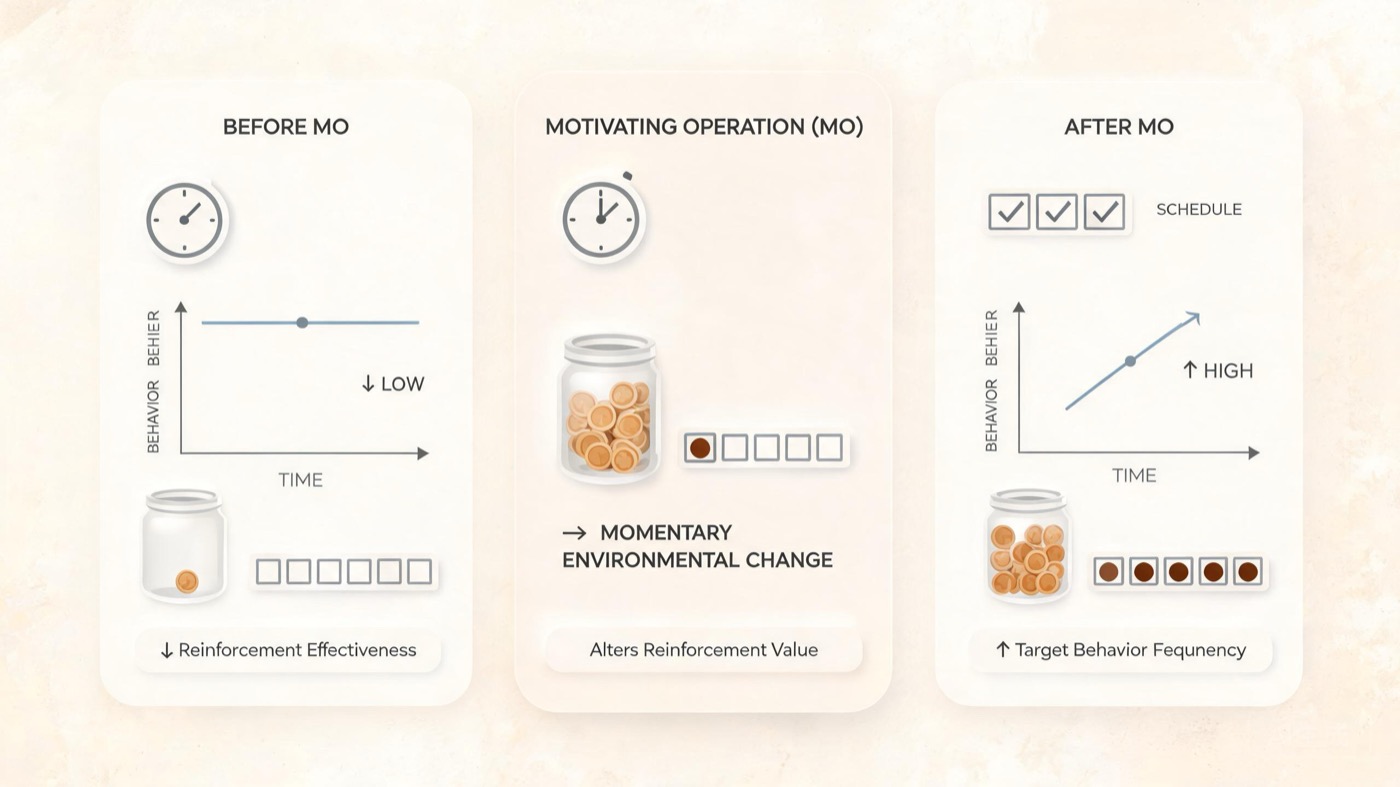
A motivating operation (MO) is an environmental event or condition that momentarily alters the reinforcing (or punishing) effectiveness of a stimulus and simultaneously alters the frequency of behaviors that have been reinforced by that stimulus in the past. For the BCBA exam, understanding MOs is critical because they explain why a behavior occurs at a particular moment, not just what triggers it.
Practice this concept
Want to test motivating operation examples? Try these BCBA motivating operations practice questions.
Table of Contents
- What Is a Motivating Operation in ABA?
- Establishing Operations (EO) vs. Abolishing Operations (AO)
- Conditioned Motivating Operations: An Intermediate Step
- Real Exam-Style Worked Examples
- Common Exam Traps and How to Avoid Them
- Quick Checklist for the BCBA Exam
- References
The Two Core Effects of an MO
Every MO has two simultaneous effects: value-altering and behavior-altering.
- Value-altering effect: Changes how effective a reinforcer or punisher is. For example, food deprivation makes food more reinforcing.
- Behavior-altering effect: Changes the frequency of behaviors that have previously produced that reinforcer. The same deprivation increases the likelihood of food-seeking behaviors.
MO vs. Discriminative Stimulus (SD): A Critical Distinction
Students often confuse MOs with discriminative stimuli (SDs). An SD signals that a reinforcer is available given a particular response; it does not change the value of that reinforcer. In contrast, an MO alters the value of the consequence itself. For example, a coffee shop sign (SD) indicates coffee is available, but caffeine deprivation (MO) makes coffee more valuable in that moment. For more on this distinction, see our SD vs. MO guide.
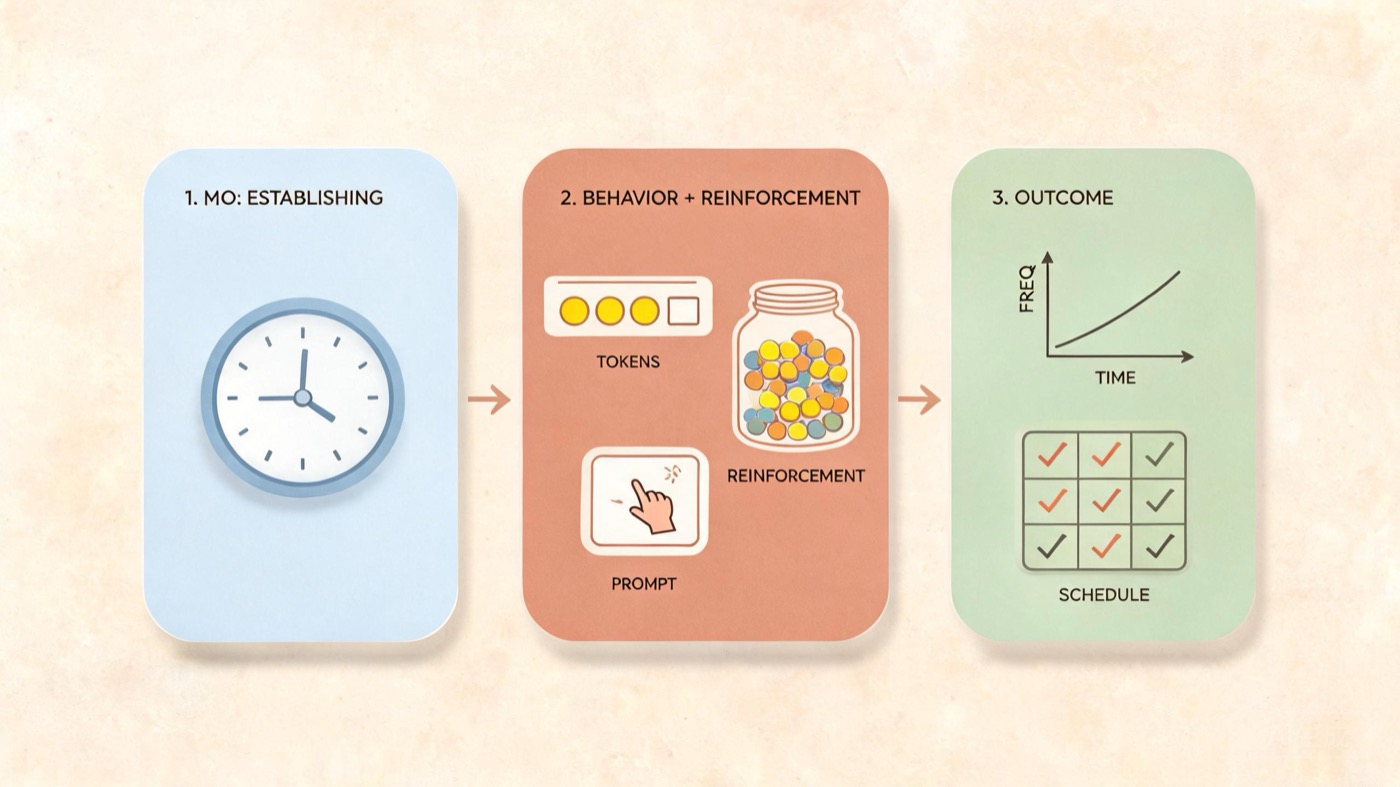
Establishing Operations (EO) vs. Abolishing Operations (AO)
MOs come in two flavors: establishing operations (EO) increase the reinforcing effectiveness of a stimulus, while abolishing operations (AO) decrease it. The exam will ask you to identify which type is operating in a given scenario.
EO: When Deprivation Increases Motivation
An EO is any event that makes a consequence more reinforcing. For instance, after several hours without water, thirst deprivation is an EO that makes water a potent reinforcer. In ABC terms:
- Antecedent (EO): 8 hours without water
- Behavior: Walking to the kitchen to get a drink
- Consequence: Drinking water (reinforcing because of EO)
AO: When Satiation Turns Off the Value
An AO makes a reinforcer less effective. After a large meal, food satiation is an AO that reduces the value of food. The same person is less likely to engage in snack-seeking behaviors. Understanding AO helps in designing interventions: if a client is satiated on a reinforcer, it won’t work.
Conditioned Motivating Operations: An Intermediate Step
Conditioned motivating operations (CMOs) are MOs that acquire their effects through learning history. They are especially important for the BCBA exam and functional analysis. There are three types:
- CMO-T (Transitive): An environmental change that establishes another stimulus as a reinforcer. Example: Presenting a puzzle piece makes the missing piece more valuable. The learner is motivated to obtain the missing piece.
- CMO-R (Reflexive): A stimulus that abolishes its own removal as a reinforcer. Example: A flashing red light (warning) makes terminating the light reinforcing. Escape from the light becomes more valuable.
- CMO-S (Surrogate): A neutral stimulus paired with an MO that eventually functions as an MO itself. Example: Pairing a bell with food deprivation; eventually the bell alone can evoke food-seeking.
For a deeper dive, see our full CMO guide.
Real Exam-Style Worked Examples
Let’s walk through two ABA scenarios that test MO concepts.
Example 1: EO in Action
Client: Child with autism who engages in tantrums to access a tablet. During free play, the child has not had screen time all morning (EO for tablet). When a therapist holds the tablet (SD), the child immediately screams (behavior). The therapist gives the tablet (reinforcer). The EO (deprivation of tablet) increased the value of the tablet, making the tantrum more likely.
Example 2: AO in Action
Client: Adult with intellectual disability who earns coffee tokens for completing tasks. After drinking three cups of coffee (AO for coffee), the client refuses to work for tokens. The AO (satiation on coffee) reduced the reinforcing value of the tokens, decreasing work behavior.
Both examples illustrate how MOs drive behavior—and why we must assess MOs before implementing interventions.
Common Exam Traps and How to Avoid Them
The BCBA exam loves to test MOs with subtle twists. Watch out for these pitfalls:
- Confusing MO with SD: Remember: MO changes value; SD signals availability. A common trick scenario: ‘The presence of the teacher signals math problems are available’—that’s an SD, not an MO.
- Thinking EO/AO are behaviors: They are antecedent variables, not behaviors. The EO/AO is the condition, not the response.
- Ignoring CMOs: Single-subject design questions often include CMO-T (e.g., a missing piece). Recognize the learning history that gives the CMO its power.
- Forgetting both effects: An MO always has both value-altering and behavior-altering effects. If a question only implies one, think again.
Quick Checklist for the BCBA Exam
Use this checklist to cement your understanding of motivating operations before test day:
- Define MO and list both effects (value-altering, behavior-altering).
- Differentiate MO from SD with a clear example.
- Recall the two types: EO increases reinforcer value; AO decreases it.
- Name the three CMOs and give one example each.
- Apply MO logic to ABC data: identify the MO as part of the antecedent.
- Review functions of behavior alongside MOs to see the full picture.
Master these concepts, and MO questions will become a strength rather than a stumbling block. For additional practice, explore our free BCBA mock exam questions.
References
Complete BCBA Exam Prep
Turn this topic into exam-day practice
Practice concepts in context with five full-length 6th Edition mock exams, two bonus practice exams, a 6th Edition study guide, and key-term flashcards—all in one $120 USD package.
Get the $120 All-in-One Prep Pack
Review everything included on the product page before ordering. No pass guarantee is implied.



