
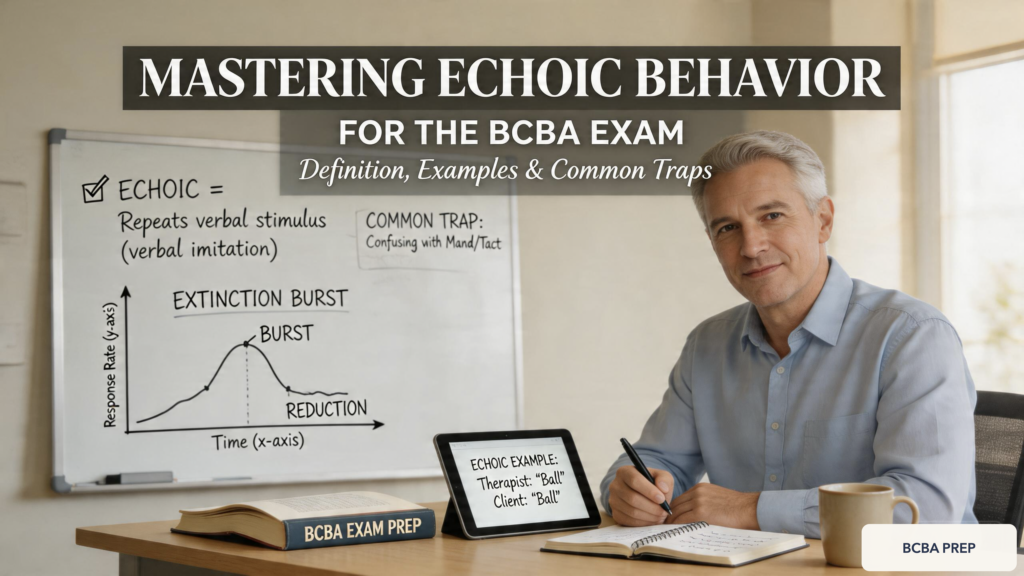
Understanding echoic behavior is crucial for BCBA candidates, as it forms a foundational part of language development in Applied Behavior Analysis (ABA). This guide breaks down its definition, provides practical examples, and highlights common exam pitfalls.
Table of Contents
- echoic behavior ABA: What is Echoic Behavior in ABA?
- Echoic Behavior Examples with ABC Analysis
- Echoic Behavior on the BCBA Exam
- Quick Checklist for Mastering Echoic Concepts
- Summary and Key Takeaways
echoic behavior ABA: What is Echoic Behavior in ABA?
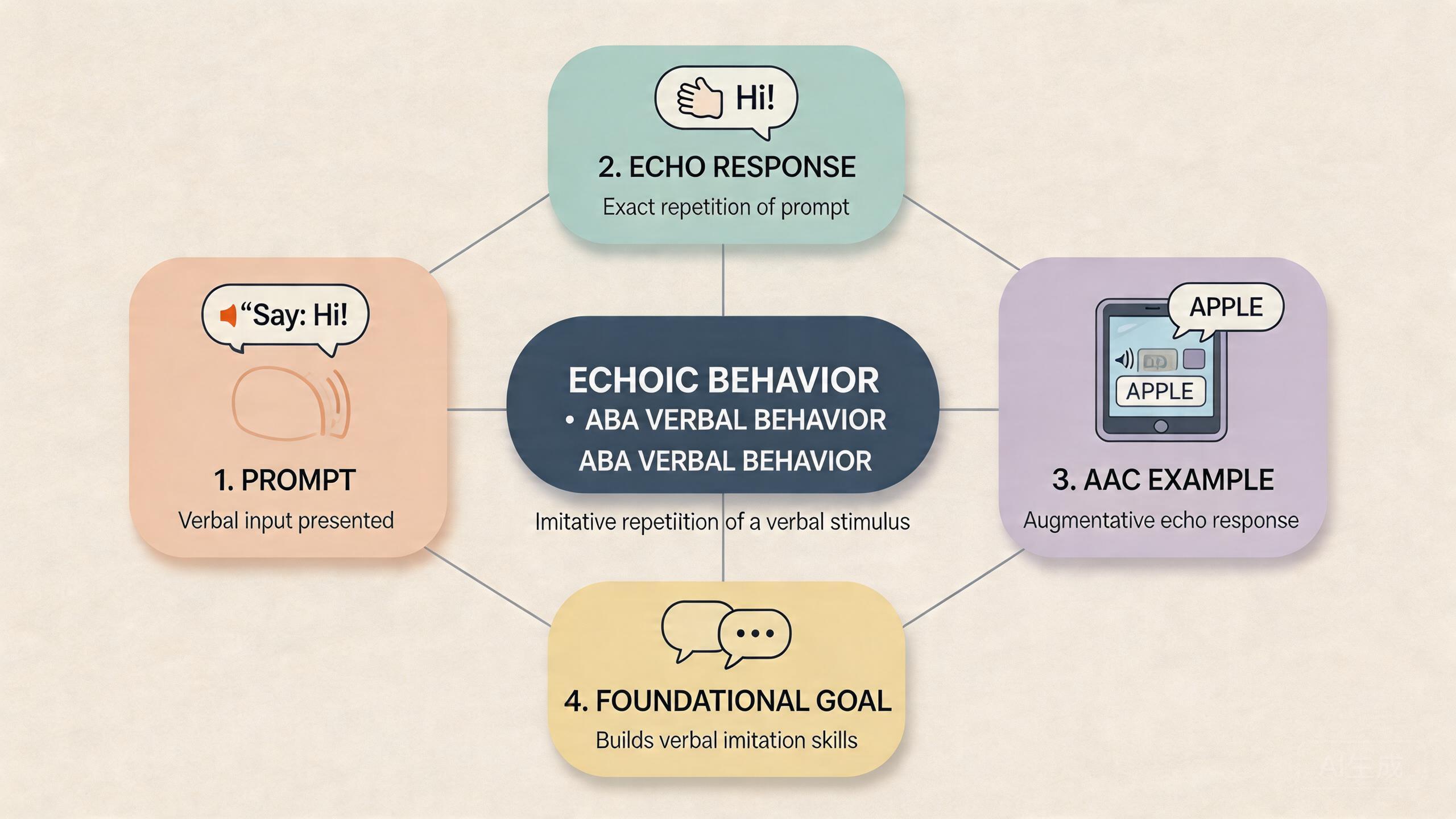
Echoic behavior is a verbal operant where a person repeats a word or sound heard from another. It’s defined by formal similarity and point-to-point correspondence with the antecedent stimulus.
Skinner’s Verbal Behavior and the Echoic Operant
In B.F. Skinner’s framework, the echoic is one of six primary verbal operants. It differs from a mand (request), tact (label), and intraverbal (conversational response). For more on verbal operants, see our verbal operants guide.
Key Characteristics of Echoic Responses
- Formal similarity: The response physically matches the antecedent sound.
- Point-to-point correspondence: Each part of the response aligns with the stimulus.
- Reinforcement history: Often established through social or tangible rewards.
Echoic Behavior Examples with ABC Analysis
Applied examples help clarify how echoics function in real scenarios. Each includes an ABC analysis and hypothesized function.
Example 1: Teaching a Child to Repeat Words
- Antecedent: Therapist says “ball.”
- Behavior: Child echoes “ball.”
- Consequence: Praise or a token.
- Function: Social positive reinforcement.
Example 2: Echoic in Social Conversation
- Antecedent: Peer says “hello.”
- Behavior: Individual echoes “hello.”
- Consequence: Continued social interaction.
- Function: Automatic reinforcement via mimicry.
Example 3: Echoic as a Prompt in Discrete Trial Training
- Antecedent: Instruction “say cat.”
- Behavior: Echoic response “cat.”
- Consequence: Token for compliance.
- Function: Tangible reinforcement.
Echoic Behavior on the BCBA Exam
Exam questions often test your ability to identify echoics and distinguish them from other operants. Focus on antecedent stimuli and reinforcement contingencies.
Common Exam Traps and How to Avoid Them
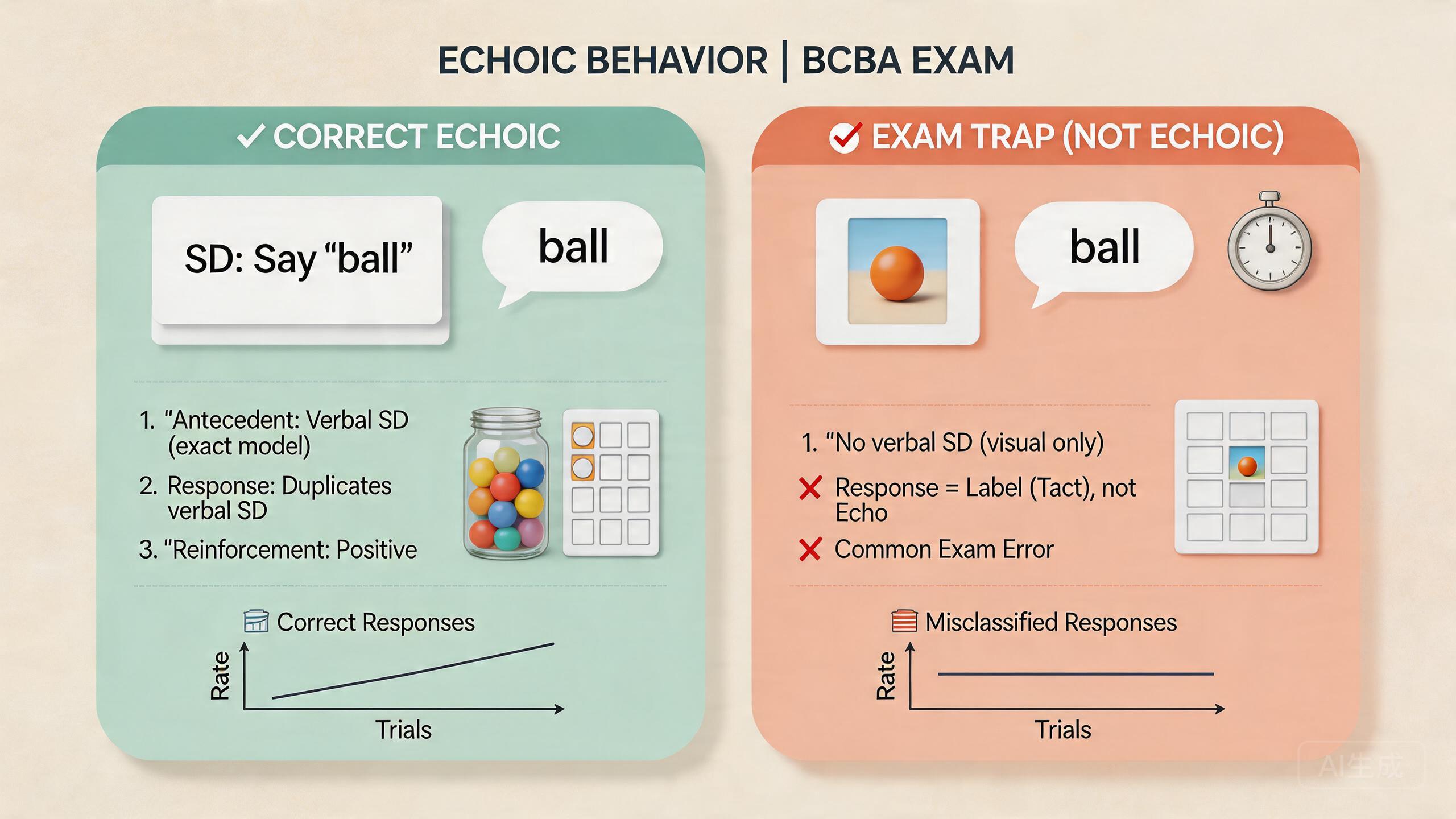
Misidentifying echoics is a frequent error. Watch for these traps:
- Confusion with other verbal operants: Echoics require vocal antecedents; tacts involve nonverbal stimuli.
- Overgeneralization: Not all repetitions are echoics; consider the function.
- Misidentifying functions: Echoics can serve multiple functions; analyze the consequence carefully.
Practice Scenarios for BCBA Candidates
- A child says “cookie” after hearing it in a song. Is this an echoic? (Yes, if the antecedent is auditory.)
- A therapist says “red” and the client points to a red card. Is this an echoic? (No, it lacks vocal correspondence.)
Quick Checklist for Mastering Echoic Concepts
Use this list to review key points before the exam:
- Define echoic behavior with formal similarity.
- Identify the antecedent as a vocal stimulus.
- Distinguish from mands, tacts, and intraverbals.
- Analyze the function using ABC data.
- Practice with varied examples to avoid common traps.
Summary and Key Takeaways
Echoic behavior is a verbal operant essential for language acquisition. Mastery involves understanding its defining features, applying ABC analysis, and avoiding exam pitfalls. For further study, explore the BACB website and our BCBA exam prep guide. Remember, consistent practice with real-world scenarios will solidify your knowledge for test day.
Complete BCBA Exam Prep
Turn this topic into exam-day practice
Practice concepts in context with five full-length 6th Edition mock exams, two bonus practice exams, a 6th Edition study guide, and key-term flashcards—all in one $120 USD package.
Get the $120 All-in-One Prep Pack
Review everything included on the product page before ordering. No pass guarantee is implied.



