
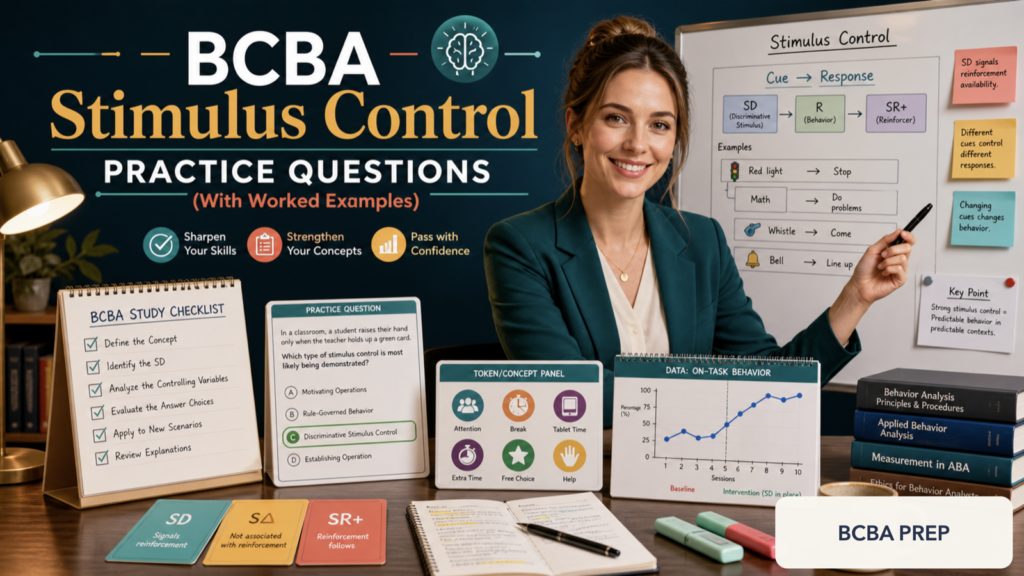
Master Stimulus Control with These BCBA Practice Questions
Stimulus control is a core concept on the BCBA exam. These five scenario-based questions will test your ability to identify discriminative stimuli (Sd) and stimulus deltas (SΔ), and to distinguish stimulus control from other processes.
Table of Contents
- Master Stimulus Control with These BCBA Practice Questions
- BCBA Stimulus Control Practice Questions
- Common Exam Traps on Stimulus Control
- Stimulus Control Checklist for the BCBA Exam
- Ready for More? Take a Free BCBA Mock Exam
- FAQ on Stimulus Control
- References
Each question includes a detailed explanation of why the correct answer is right and why the other options are wrong, plus an exam trap to watch out for.

BCBA Stimulus Control Practice Questions
Read each scenario carefully and select the best answer.
Question 1: Identifying the Sd
Scenario: During a DTT session, a therapist presents a red card and says ‘touch red.’ The child touches the red card and receives a preferred toy. When the therapist presents a blue card and says ‘touch red,’ the child does not touch any card.
Prompt: In this scenario, what is the discriminative stimulus (Sd) for touching the card?
- A. The therapist’s vocal instruction ‘touch red’
- B. The red card
- C. The blue card
- D. The preferred toy
Correct Answer: B
Why This Answer Is Correct: The red card is the Sd because touching the card is reinforced only in its presence. The blue card is an SΔ (no reinforcement).
Why the Other Options Are Wrong:
- A: The vocal instruction is part of the antecedent, but stimulus control refers to the physical stimulus that signals reinforcement, not the instruction.
- C: The blue card is an SΔ; touching is not reinforced when it is present.
- D: The toy is the reinforcer, not an antecedent stimulus.
Exam Trap: Don’t confuse the Sd with the instruction; the Sd is the stimulus that evokes the behavior because it has been correlated with reinforcement.
Question 2: Stimulus Delta Effect
Scenario: A student raises his hand in class. When the teacher is facing the board, the teacher does not call on him. When the teacher is facing the class, the teacher calls on him. Hand-raising occurs more often when the teacher is facing the class.
Prompt: What is the stimulus delta (SΔ) for hand-raising?
- A. Teacher facing the class
- B. Teacher facing the board
- C. Calling on the student
- D. Raising the hand
Correct Answer: B
Why This Answer Is Correct: The SΔ is the stimulus in which the behavior (hand-raising) is not reinforced. Teacher facing the board results in no reinforcement, so it is the SΔ.
Why the Other Options Are Wrong:
- A: Teacher facing the class is the Sd because hand-raising is reinforced.
- C: Calling on the student is the reinforcer, not a stimulus.
- D: Hand-raising is the behavior, not a stimulus.
Exam Trap: The SΔ is the stimulus that signals extinction; it does not evoke the behavior.
Question 3: Stimulus Generalization
Scenario: A child is taught to say ‘dog’ when shown a Golden Retriever. Later, the child also says ‘dog’ when shown a Poodle, a Beagle, and a Chihuahua.
Prompt: This is an example of:
- A. Stimulus discrimination
- B. Stimulus generalization
- C. Response generalization
- D. Stimulus control
Correct Answer: B
Why This Answer Is Correct: Stimulus generalization occurs when a response is evoked by stimuli that share similar features with the training stimulus.
Why the Other Options Are Wrong:
- A: Stimulus discrimination would involve only responding to the trained breed.
- C: Response generalization involves variation in the response, not the stimulus.
- D: Stimulus control is a broader term; generalization is a specific outcome of stimulus control.
Exam Trap: Do not confuse stimulus generalization with response generalization; the former involves different stimuli, the latter different responses.
Question 4: Stimulus Discrimination Training
Scenario: A therapist teaches a child to identify the color red by presenting a red card and a blue card. The child is reinforced for touching the red card but not the blue card. After several trials, the child consistently touches only the red card.
Prompt: This procedure is known as:
- A. Stimulus discrimination training
- B. Stimulus generalization
- C. Differential reinforcement of alternative behavior
- D. Shaping
Correct Answer: A
Why This Answer Is Correct: Stimulus discrimination training involves reinforcing a response in the presence of one stimulus (Sd) and not in the presence of another (SΔ).
Why the Other Options Are Wrong:
- B: Generalization would involve responding to similar stimuli, not discriminating.
- C: DRA reinforces a different behavior, not the same behavior under different stimulus conditions.
- D: Shaping involves reinforcing successive approximations of a behavior, not stimulus control.
Exam Trap: Stimulus discrimination training requires both an Sd and an SΔ; if only one stimulus is used, it’s just reinforcement.
Question 5: Multiple Stimulus Control
Scenario: A student raises his hand only when (1) the teacher asks a question and (2) the student knows the answer. If either condition is absent, he does not raise his hand.
Prompt: This is an example of:
- A. Simple stimulus control
- B. Multiple stimulus control (conjunctive)
- C. Multiple stimulus control (conditional)
- D. Stimulus fading
Correct Answer: B
Why This Answer Is Correct: Conjunctive multiple stimulus control requires both stimuli (teacher asks questions AND student knows answer) to be present for the response to occur.
Why the Other Options Are Wrong:
- A: Simple stimulus control would involve only one stimulus.
- C: Conditional stimulus control means one stimulus alters the function of another (e.g., if teacher asks… then…). Here both must be present.
- D: Stimulus fading is a procedure to transfer stimulus control.
Exam Trap: Conjunctive = both stimuli must be present; conditional = one stimulus changes the effect of another.
Common Exam Traps on Stimulus Control
Watch out for these tricky distinctions on the BCBA exam:
- Confusing the Sd with the response or reinforcer.
- Thinking stimulus generalization means the same behavior under different conditions—that’s correct, but don’t call it discrimination.
- Mixing up conjunctive vs. conditional stimulus control.
- Forgetting that stimulus discrimination training requires both an Sd and an SΔ.
Stimulus Control Checklist for the BCBA Exam
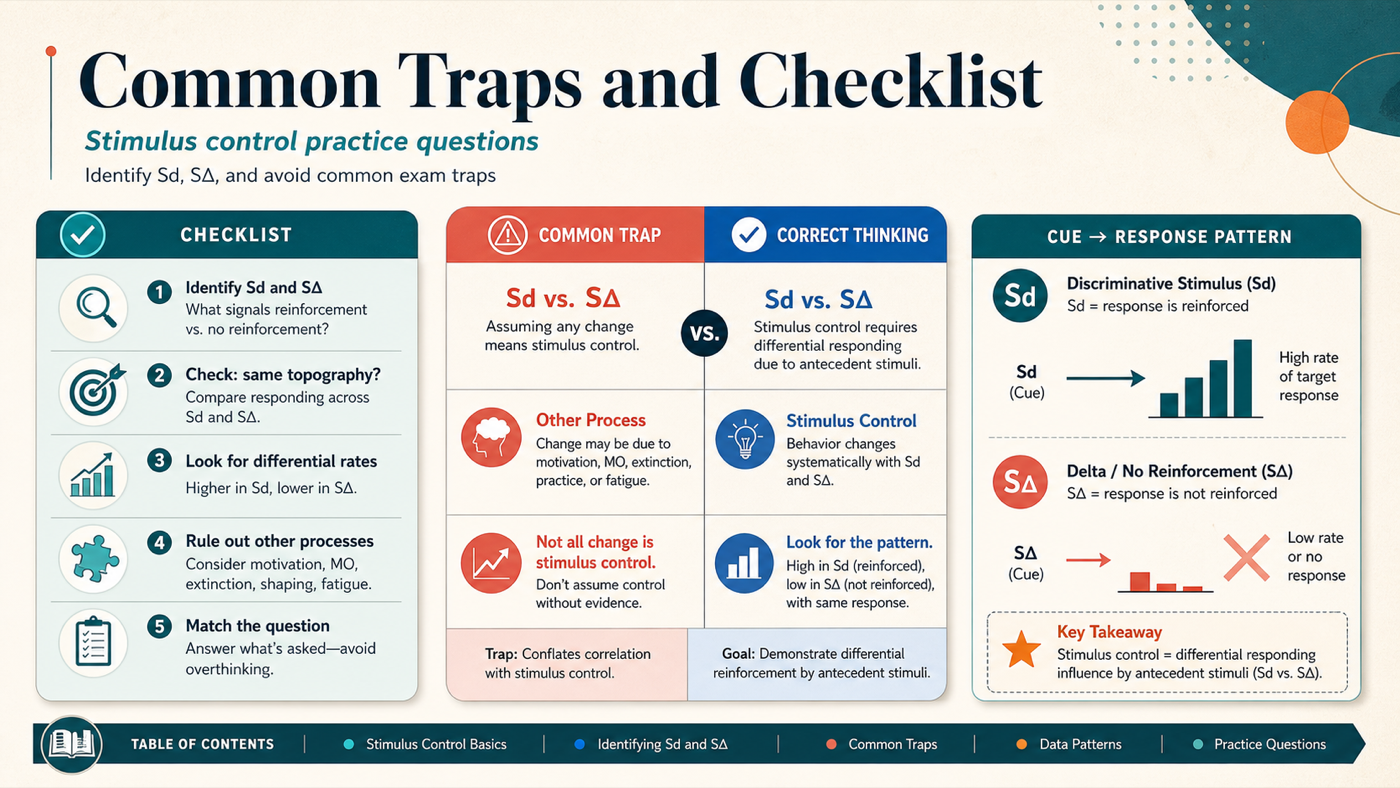
- Identify the Sd: stimulus in which behavior is reinforced.
- Identify the SΔ: stimulus in which behavior is not reinforced.
- Distinguish generalization (similar stimuli) from discrimination (different stimuli).
- Recognize conjunctive (both) vs. conditional (if-then) stimulus control.
- Remember that stimulus control is demonstrated when behavior changes across stimulus conditions.
Ready for More? Take a Free BCBA Mock Exam
Test your knowledge with a full-length, free BCBA mock exam that covers stimulus control and all other BACB task list items.
Take the Free BCBA Mock Exam
Click here to access your free BCBA mock exam and get instant feedback with detailed explanations.
FAQ on Stimulus Control
Q: What is the difference between Sd and SΔ?
A: Sd is a stimulus that signals reinforcement is available for a behavior; SΔ signals reinforcement is not available.
Q: Is stimulus control the same as discrimination?
A: Stimulus control is the overall effect; discrimination is a specific outcome where behavior differs across stimuli.
Q: Can stimulus control involve more than one stimulus?
A: Yes, multiple stimulus control involves two or more stimuli (conjunctive or conditional).
References
Next step for BCBA exam prep
Turn this topic into exam-day practice
Use this topic as a focused review, then test it in exam-style conditions with a free mock before deciding whether five full-length mocks are the right next step.
Start the Free BCBA Mock ExamContinue with Five Full-Length Mocks — $99
Review the included materials and access details before ordering. No pass guarantee is implied.



