
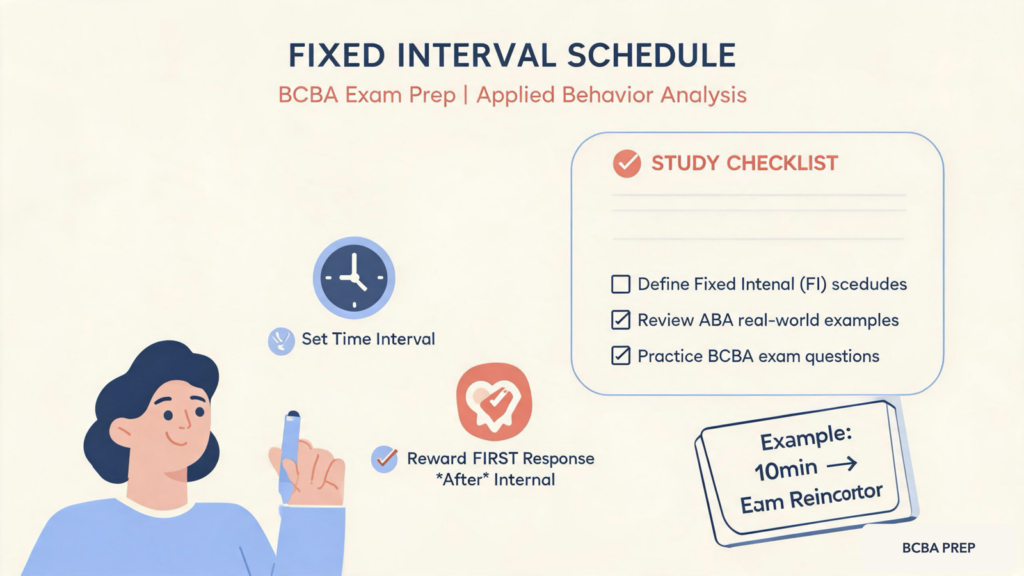
What Is a Fixed Interval Schedule?
A fixed interval schedule (FI) delivers reinforcement for the first response that occurs after a fixed amount of time has passed. This schedule creates a distinct pattern of behavior that is important to recognize for the BCBA exam.
Table of Contents
- What Is a Fixed Interval Schedule?
- Fixed Interval Example in ABA: Three Detailed Scenarios
- Exam Relevance: Common Traps and Tips
- Quick Checklist for Fixed Interval Scenarios
- Summary: Why Mastering Fixed Interval Examples Matters for Your Exam
- References
Core Definition
In an FI schedule, the time requirement is constant. For example, an FI-5-minute schedule means the first correct response after 5 minutes is reinforced, regardless of how many responses occurred before that moment. Key features include a post-reinforcement pause (a brief stop in responding right after reinforcement) and a scalloped response pattern (low responding early, increasing toward the end of the interval).
Key Characteristics
- Time-based: The schedule is defined by a fixed interval, not a number of responses.
- Predictable: Because the interval is constant, the learner may anticipate when reinforcement is available.
- Response rate scallop: Responding accelerates near the end of the interval and drops sharply after reinforcement.
- Contrast with FR: Fixed ratio schedules require a fixed number of responses, leading to high and steady rates; FI schedules produce a pause-run pattern.
Fixed Interval Example in ABA: Three Detailed Scenarios
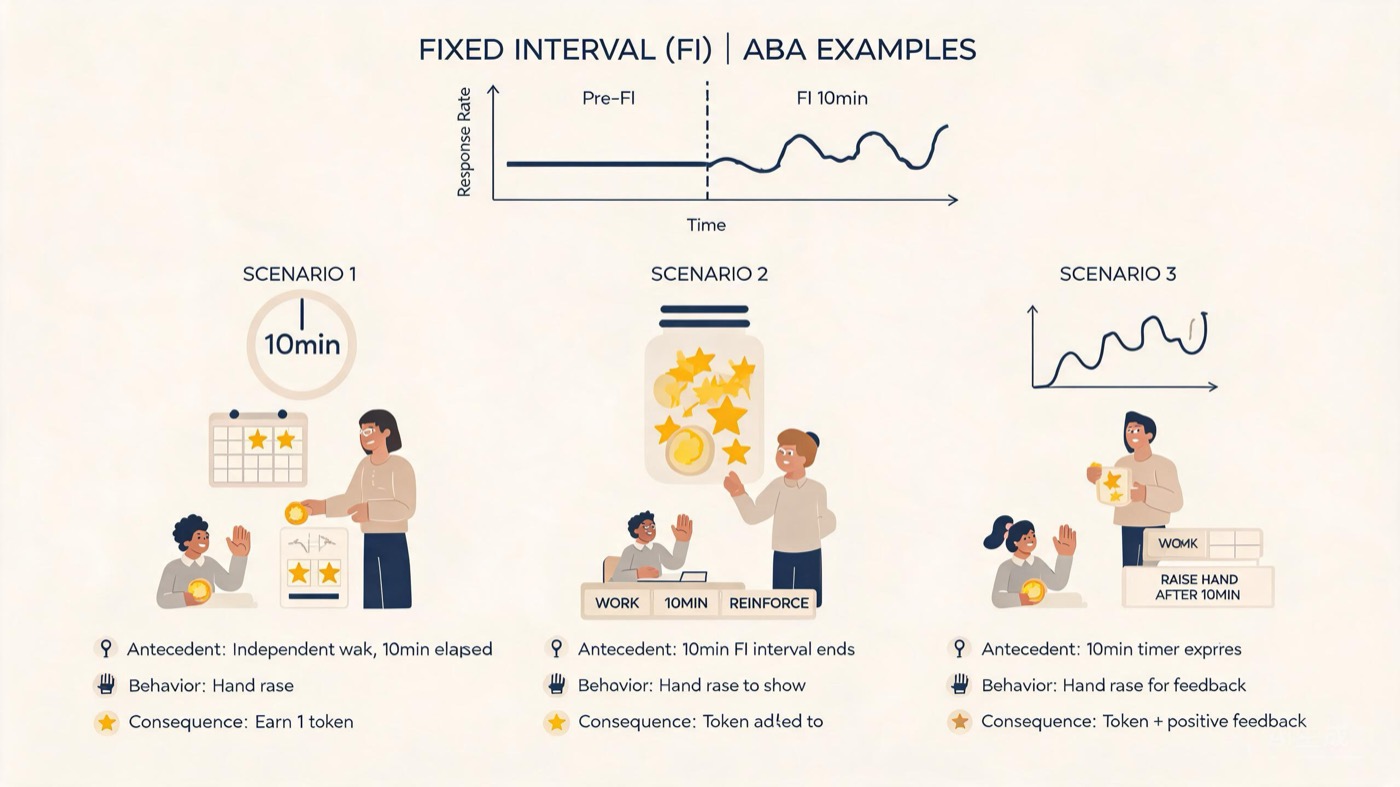
Understanding FI through concrete examples is the best way to prepare for BCBA exam scenario questions. Below are three worked examples with ABC analysis.
Classroom Behavior: Student Raising Hand
Setting: A teacher provides a point (token) for hand-raising every 10 minutes during independent work time.
Antecedent: Clock shows 10 minutes have passed since the last point.
Behavior: Student raises hand.
Consequence: Teacher adds a point to the chart (hypothesized function: tangible reinforcement).
Pattern: The student rarely raises hand in the first 5 minutes (post-reinforcement pause), but frequency increases as the 10-minute mark approaches (scalloped pattern).
Therapy Session: Compliance with Request
Setting: During one-on-one therapy, a therapist delivers a token after 5 minutes of continuous compliance.
Antecedent: Timer reaches 5 minutes; therapist says ‘Great job waiting.’
Behavior: Client follows instructions (e.g., sitting, completing tasks).
Consequence: Token delivered (hypothesized function: access to preferred items).
Pattern: After receiving the token, the client may pause responding for 15-30 seconds, then resume compliance. To thin the schedule, the interval can be gradually increased to build sustained behavior.
Staff Training: Quality Check Feedback
Setting: A BCBA gives praise every hour if the staff member’s work meets criteria.
Antecedent: One hour passes; supervisor observes the work.
Behavior: Staff correctly implements behavior intervention plans.
Consequence: Supervisor says ‘Nice work, the data collection is accurate’ (hypothesized function: social positive reinforcement).
Pattern: The staff member’s accuracy is high just before the hour check, but may dip slightly right after praise. This variability near the end is common in FI schedules.
Exam Relevance: Common Traps and Tips
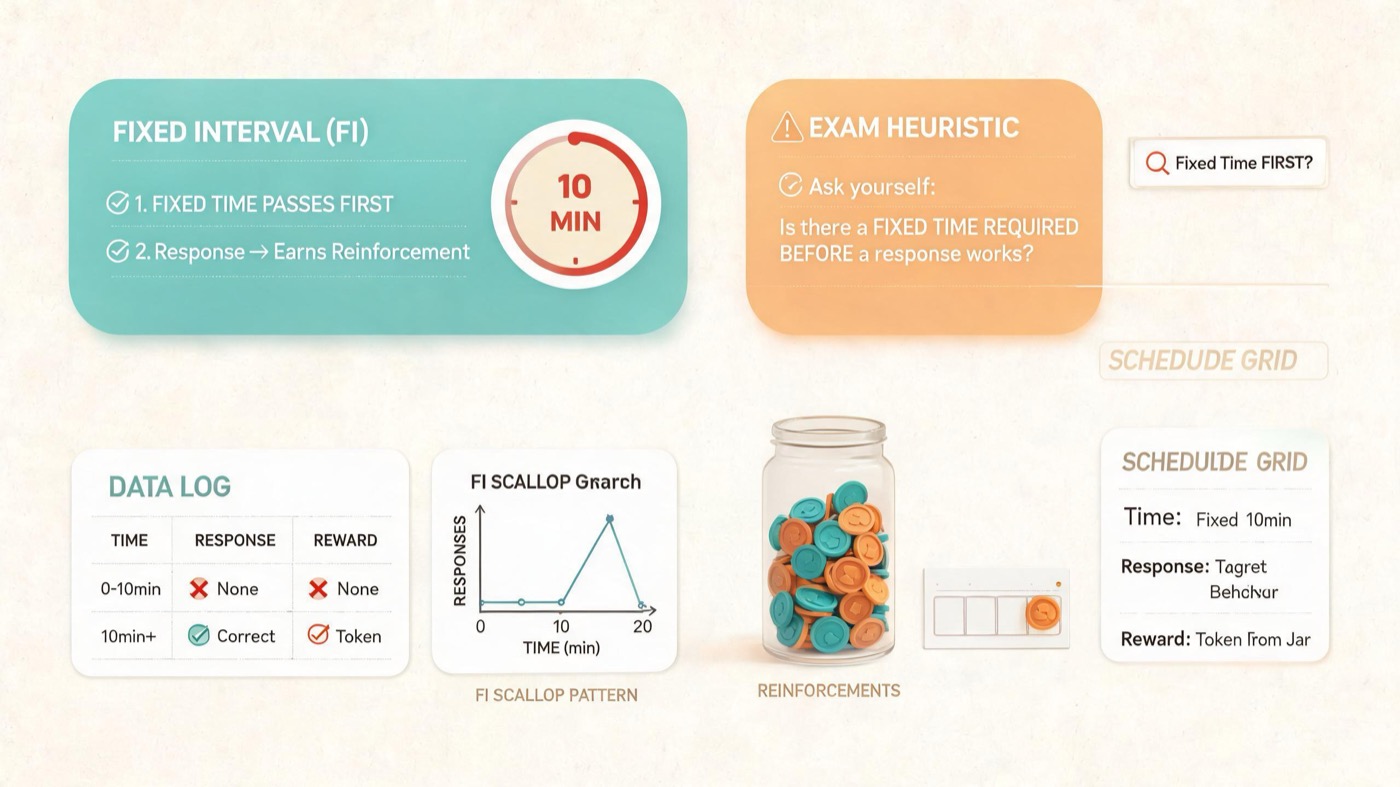
The BCBA exam often includes questions about schedules of reinforcement, and FI is a frequent target. Here are traps to avoid and tips to identify FI quickly.
Common Traps on the BCBA Exam
- Confusing FI with FR: Look for time (FI) vs. number of responses (FR). If the scenario mentions ‘every 5 minutes,’ it’s FI; if ‘after every 5 responses,’ it’s FR.
- Forgetting the post-reinforcement pause: Candidates sometimes fail to recognize the pause that follows reinforcement, which is a hallmark of FI.
- Assuming scalloped pattern always occurs: The scalloped pattern may not appear if the reinforcer is delayed or if the learner has a high motivation; the exam may test this nuance.
- Ignoring schedule thinning: The exam may ask how to increase response persistence by gradually increasing the interval (e.g., from FI-2 to FI-5 minutes).
How to Identify FI in Scenario Questions
Use the ‘time-check’ heuristic: Ask yourself, ‘Is there a fixed duration of time that must elapse before a response produces reinforcement?’ If yes, it is likely FI. Also, note if the behavior rate is low right after reinforcement and increases later. For practice, review our related article on compound vs. simple schedules for a broader context.
Quick Checklist for Fixed Interval Scenarios
Use this checklist when analyzing an FI question on the exam. Check off each item as you confirm.
- Identify the time interval: Is a specific amount of time (e.g., 5 minutes, 1 hour) mentioned?
- Check the response requirement: Is one response after time has elapsed reinforced?
- Observe the pattern: Is there a pause after reinforcement? Does responding increase near the end of the interval?
- Determine the reinforcer: What consequence follows the response? Is it tangible, social, or automatic?
- Rule out other schedules: Is it time-based (FI or VI) or response-based (FR or VR)? If time-based, is the interval fixed (FI) or variable (VI)?
- Consider schedule thinning: If the goal is to increase durability, gradually increase the interval duration.
Summary: Why Mastering Fixed Interval Examples Matters for Your Exam
Understanding fixed interval examples is not just about memorizing definitions; it is about applying them to real behavior. On the BCBA exam, you will be asked to identify schedules from vignettes, predict response patterns, and select appropriate interventions. By practicing with classroom, therapy, and staff training scenarios, you build the analytical skills needed to recognize FI in any context. For more practice, check out our free BCBA mock exam questions that include schedule-of-reinforcement items.
Remember the key takeaways: FI = time-based, one response after fixed time, post-reinforcement pause, scalloped pattern. Avoid confusing it with FR, and always look for the fixed time interval. With these tools, you are ready to tackle FI questions with confidence.
References
Next step for BCBA exam prep
Turn this topic into exam-day practice
Use this topic as a focused review, then test it in exam-style conditions with a free mock before deciding whether five full-length mocks are the right next step.
Start the Free BCBA Mock Exam
Continue with Five Full-Length Mocks — $99
Review the included materials and access details before ordering. No pass guarantee is implied.



