
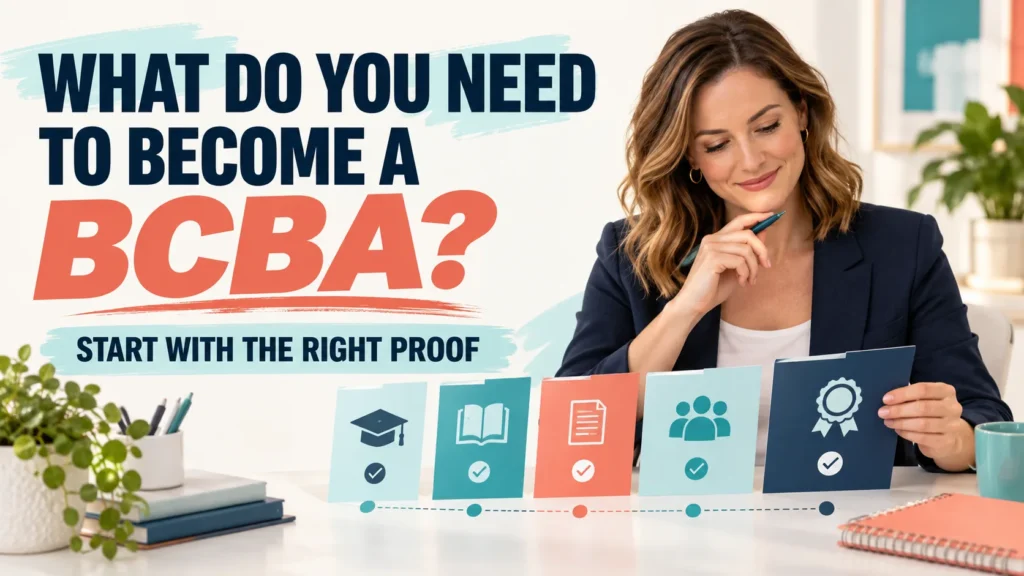
A starting-point readiness check for identifying the proof you have, the first requirement you are missing, and the next action to take. If you are asking what do you need to become a BCBA, you probably do not need another vague promise that “it takes a master’s degree.” You need to know which evidence bucket you are in right now: degree, behavior-analytic preparation, supervised fieldwork, application, or examination.
Table of Contents
- The short answer: five proof buckets
- Find your first missing proof
- Know whether you are starting, applying, or preparing to practice
- Use the application date as your rule checkpoint
- Build a seven-day first-action plan
- Avoid the four common false starts
- When to use exam practice
- What do you need to become a BCBA FAQ
- Take the next verifiable step
- Official sources to recheck
- Quick Review Checklist
- Take the Free BCBA Mock Exam
The short answer is that BCBA certification is a graduate-level behavior-analysis certification. The current BACB pathway requires the applicable degree or program evidence, behavior-analytic preparation, supervised fieldwork, an application, and a passing BCBA examination. The exact documents and forms depend on the pathway and the date you apply. A job title, a general ABA course, or a few months of experience does not prove that the whole sequence is complete.
This is a readiness checklist, not a replacement for the official BACB Handbook. The site’s broader BCBA certification roadmap explains the full route. Use this page when you are starting with an incomplete picture and need to find the first missing proof instead of trying to solve every step at once.
The short answer: five proof buckets
Think of the process as five connected buckets. You do not necessarily finish them in a strict one-at-a-time order, but you should be able to show what belongs in each bucket and who can verify it.
| Bucket | What it proves | First question to ask |
|---|---|---|
| 1. Degree or program | You have the degree or qualifying program evidence required by the pathway you plan to use. | Which current BACB pathway am I evaluating, and what does the handbook call a qualifying degree? |
| 2. Coursework | Your behavior-analytic content is documented at the level and through the route the BACB accepts. | Can my institution or program contact explain how my courses map to the current rule? |
| 3. Fieldwork | Your supervised practical work is being accrued, observed, verified, and recorded on the applicable forms. | Who is supervising, which activities count, and which form version will apply when I submit? |
| 4. Application | The BACB has the required application, payment, official documents, and supporting evidence. | What must be sent directly by a university, supervisor, or other third party? |
| 5. Examination | You are authorized and prepared to take the current BCBA examination. | Have I confirmed eligibility and authorization before treating exam practice as my main blocker? |
If you can label each bucket verified, in progress, not started, or unclear, you already have a better plan than someone who only searches for a degree program. The goal is to turn “What do I need?” into a short list of evidence questions.
Find your first missing proof
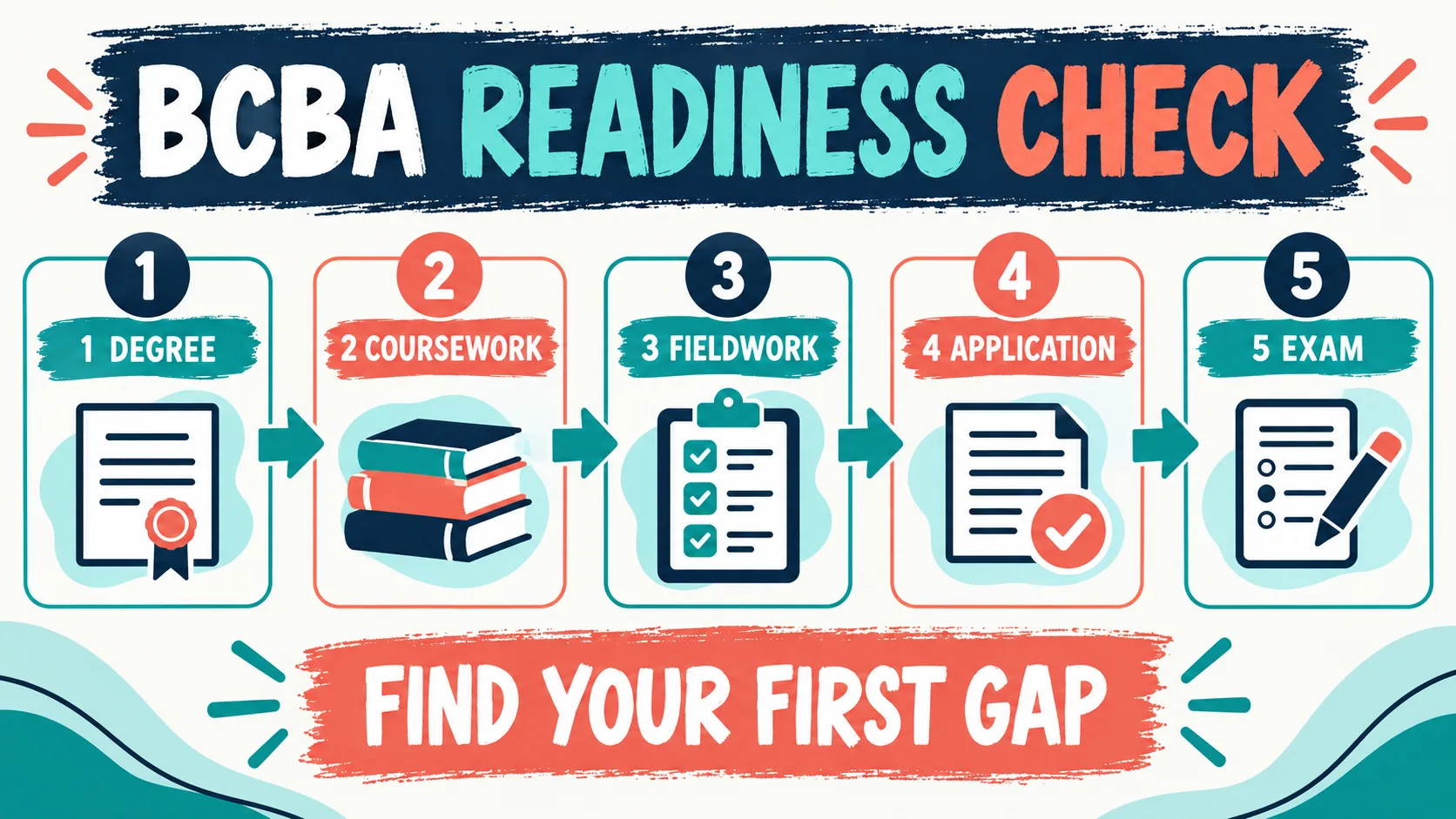
Use the diagnostic below before enrolling, changing jobs, or booking an exam. Work from evidence, not from what a school advertisement or job description implies.
- Write the goal in one line. For example: “I want to apply for BCBA certification under the rule that applies to my intended application date.”
- Inventory what already exists. List your highest degree, course records, supervisor information, fieldwork logs, and any correspondence with the BACB.
- Mark the first hard blocker. If your degree pathway is unknown, resolve that before collecting random certificates. If your fieldwork documentation is incomplete, resolve the supervision and form question before estimating an exam date.
- Assign an evidence owner. You may own the checklist, but a university, supervisor, program contact, or BACB process may own the actual verification.
- Record one next action. “Email the program contact with the handbook question” is actionable. “Research BCBA requirements” is not yet a task.
The BACB describes the BCBA as a graduate-level certification and identifies supervised fieldwork and examination requirements. It does not mean that every experience described as “ABA” automatically counts. Ask what the activity was, who supervised it, what documentation exists, and which current requirement it is intended to satisfy.
Know whether you are starting, applying, or preparing to practice
Many confusing answers come from mixing three different stages. The same person may be starting one bucket while applying another, so name the stage before choosing advice.
| Your stage | Main question | Useful next move |
|---|---|---|
| Starting | Which degree, program, and pathway can produce the evidence I will need? | Compare the current BACB rule with the program’s written pathway and documentation plan. |
| Building fieldwork | Are my activities, supervision, observations, and records aligned with the applicable fieldwork requirements? | Review the current handbook, supervision resources, contract, logs, and monthly verification process. |
| Applying | Is the application complete, and are third parties sending the required records through the correct route? | Use the official application checklist, payment record, transcript instructions, and status messages. |
| Preparing to test | What concepts and decision skills need practice after eligibility and authorization are clear? | Use current exam content guidance and practice questions to find knowledge gaps. |
State licensure is a separate check. If you plan to work in a jurisdiction that regulates behavior analysis or related services, add a state-board column to your plan. A BCBA certification is not automatically a state license, and a state job title is not proof of BACB eligibility.
Use the application date as your rule checkpoint
The BACB’s official 2027 summary says that, beginning January 1, 2027, applicants may use two eligibility pathways. Both include degree, behavior-analytic preparation, supervised fieldwork, and the BCBA examination, but the evidence details and forms differ. The question is not simply “What do I need in 2026?” It is “What rule set and form version applies to the date I will submit?”
| Checkpoint | What to verify | Why it changes your plan |
|---|---|---|
| Application date | The date you realistically expect to submit, not the date you first started a course. | It determines which official requirements, forms, and transition guidance you must recheck. |
| Pathway 1 | Whether the degree came from the accredited or recognized program route described by the current BACB materials. | Program status and degree history may be more important than a course title alone. |
| Pathway 2 | Whether coursework meets the current rule and how the institution’s Pathway 2 program contact handles attestation. | A personal spreadsheet or an old course list may not replace the required institutional evidence. |
| Fieldwork forms | Which monthly and final verification forms match your application date. | Using the wrong version can create a documentation problem even when the work itself was appropriate. |
For date-sensitive questions, save the official page or handbook version you relied on, write the access date, and recheck it before applying. Do not let a 2027 label on a program advertisement replace the BACB’s own requirement page.
Build a seven-day first-action plan
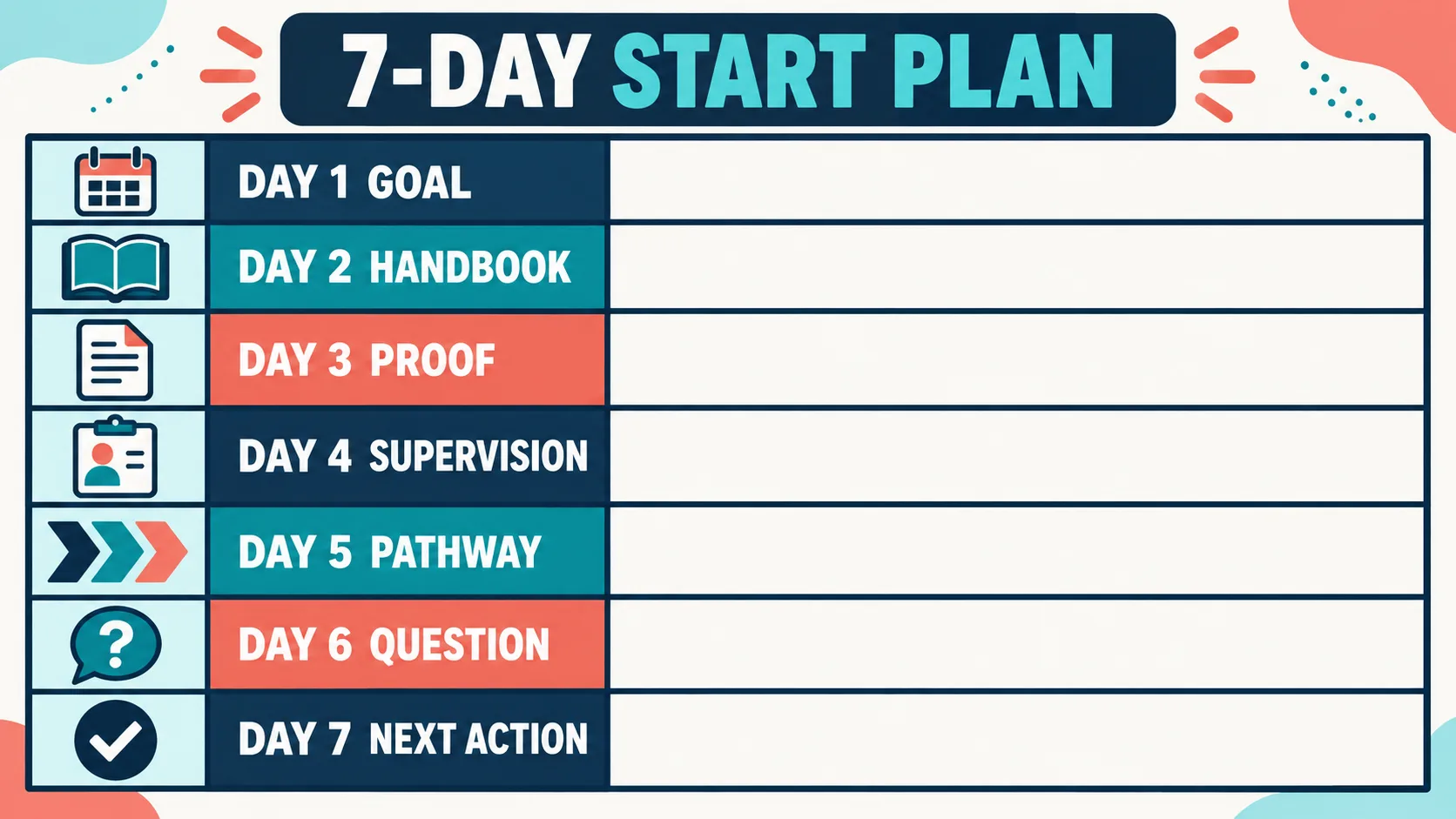
You do not need to solve the whole BCBA process in one week. You need to produce a verified next decision. Use this seven-day sequence:
- Day 1 — Goal: write the intended credential, jurisdiction, and likely application date.
- Day 2 — Handbook: read the current eligibility overview and mark the pathway language that appears to fit.
- Day 3 — Proof: gather your degree record, course list, fieldwork record, and any existing BACB correspondence.
- Day 4 — Supervision: ask the supervisor or program contact how your practical work and forms are documented.
- Day 5 — Pathway: verify whether the degree/program or coursework route needs a separate institutional confirmation.
- Day 6 — Question: send one precise question to the correct authority, including the rule date and the evidence you have.
- Day 7 — Next action: schedule the first blocker-resolution task and set a date to recheck the official source.
A precise question contains four parts: “I plan to apply on [date]. I have [evidence]. I am considering [pathway]. Does the current rule require [specific confirmation]?” That format is more useful than asking a school, supervisor, or support team to interpret a vague “Can I become a BCBA?”
Avoid the four common false starts
| False start | Why it fails | Better move |
|---|---|---|
| Choosing a program from the title alone | A program name does not by itself prove a current BACB pathway or acceptable documentation. | Ask for the pathway, institutional status, course mapping, and evidence process in writing. |
| Calling any ABA job fieldwork | The activity, supervision, observation, client work, and records must fit the current rule. | Map duties and supervision to the handbook before counting hours. |
| Starting exam prep as the first task | Practice cannot repair an unknown degree pathway, missing fieldwork evidence, or incomplete application. | Resolve the first eligibility blocker, then use practice to measure knowledge and decision gaps. |
| Treating state licensure as BACB certification | National certification and state practice authority are separate questions. | Add the relevant state board, employer, payer, and scope checks to the plan. |
When to use exam practice
Exam practice becomes most useful after you know what you are preparing for. Use it to identify whether you can interpret measurement, assessment, intervention, ethics, supervision, and scope scenarios—not as proof that your degree, fieldwork, or application is complete.
- Practice one content area at a time.
- Record why the correct answer fits the facts in the vignette.
- Track the distractor that tempted you and the rule or concept it tested.
- Return to the current BACB materials when a question exposes a date-sensitive requirement.
What do you need to become a BCBA FAQ
Do you need a master's degree to become a BCBA?: The current BACB materials describe graduate-level certification and 2027 pathways that require a master’s degree or higher, with pathway-specific degree and program conditions. Check the current handbook for the exact route and your application date.
Do you need a degree in ABA?: Do not reduce the answer to the degree title. The applicable pathway may depend on the degree, program recognition or accreditation, behavior-analytic coursework, fieldwork, and other evidence. Compare the program’s written pathway to the current BACB requirements.
Does working in an ABA clinic mean you are on the BCBA path?: It may provide relevant experience, but a job title alone does not prove that activities count as supervised fieldwork. Verify the supervisor, activities, observations, records, and form version before treating the work as certification evidence.
Can you take a mock exam before finishing the requirements?: Yes. Practice can reveal knowledge gaps early. Keep the purpose clear: a mock exam measures practice performance; it does not determine BACB eligibility, replace an application, or guarantee a passing result.
Take the next verifiable step
To answer “what do you need to become a BCBA?” for your own situation, fill in five lines: the degree or program evidence, the coursework evidence, the fieldwork and supervisor evidence, the application evidence, and the examination readiness evidence. Circle the first line you cannot verify. That is the next action—not a reason to download another generic checklist.
When your eligibility plan is clear and you want to practice the exam-side decisions, use the Free BCBA Mock Exam to work through scenario-based questions and log the concepts that need review. It is a study resource—not a certification application, licensure determination, or guarantee of exam success.
Official sources to recheck
Current reference points: the BACB Handbook, the 2027 BCBA Requirements, the BACB BCBA resource page, the supervision and training hub, and the BACB’s university transition guidance. Requirements and forms can change; verify the current source before applying. For targeted review, use our what do you need to become a bcba practice questions to apply the concept in exam-style scenarios.
Quick Review Checklist
Use this final checklist to turn what do you need to become a bcba into exam-ready reasoning. The goal is not to memorize a label in isolation; it is to identify the relevant evidence and explain why the best answer fits the scenario. Key ideas to review:
- State the central definition or decision point for what do you need to become a bcba in your own words.
- Identify the detail that makes what do you need to become a bcba different from its closest related ABA term.
- Separate the observable facts in a scenario from assumptions that are not supported by the facts.
- Write one example and one nonexample so you can recognize the concept in a new setting.
Exam application checks:
- Ask what the question is actually requesting before comparing the answer choices.
- Mark the antecedent, response, consequence, or other evidence that supports the selected answer.
- Look for a distractor that describes a related process but does not answer the specific question.
Final self-check:
- Explain how you would verify the interpretation with clear observations or data.
- Change one detail in the scenario and decide whether your answer should change.
- Give a one-sentence rationale that a supervisor or study partner could evaluate.
Take the Free BCBA Mock Exam
A useful next step is to apply this idea in a fresh set of BCBA-style practice questions and review the feedback. Take the Free BCBA Mock Exam



