
Manipulating the consequent stimulus in ABA means deliberately arranging, changing, or withholding what happens immediately after a behavior so a practitioner can evaluate or teach a functional relation. The phrase describes a change to the consequence stimulus; it does not, by itself, prove that the behavior will increase or decrease.
Table of Contents
- What Does Manipulating the Consequent Stimulus Mean?
- Consequence Form Versus Behavioral Function
- Function-Matched Examples
- How to Check a Consequence-Based Intervention
- Common BCBA Exam and Practice Errors
- The BCBA Study Lens
- FAQ
- Quick Review Checklist
- Take the Free BCBA Mock Exam
That distinction matters because “positive” and “negative” describe whether a stimulus is added or removed, while “reinforcement” and “punishment” describe the measured effect on future behavior. A stimulus can be added without reinforcing behavior, or removed without functioning as negative reinforcement. The behavioral effect has to be demonstrated with data.
This BCBA study guide defines the term, separates consequence form from consequence function, gives original examples, and shows how to check an intervention without overclaiming. It is an educational resource, not an individualized behavior plan. Any real intervention should be designed, monitored, and reviewed by qualified professionals with attention to assent, communication access, safety, and the current BACB Ethics Code. Table of Contents
What Does Manipulating the Consequent Stimulus Mean?
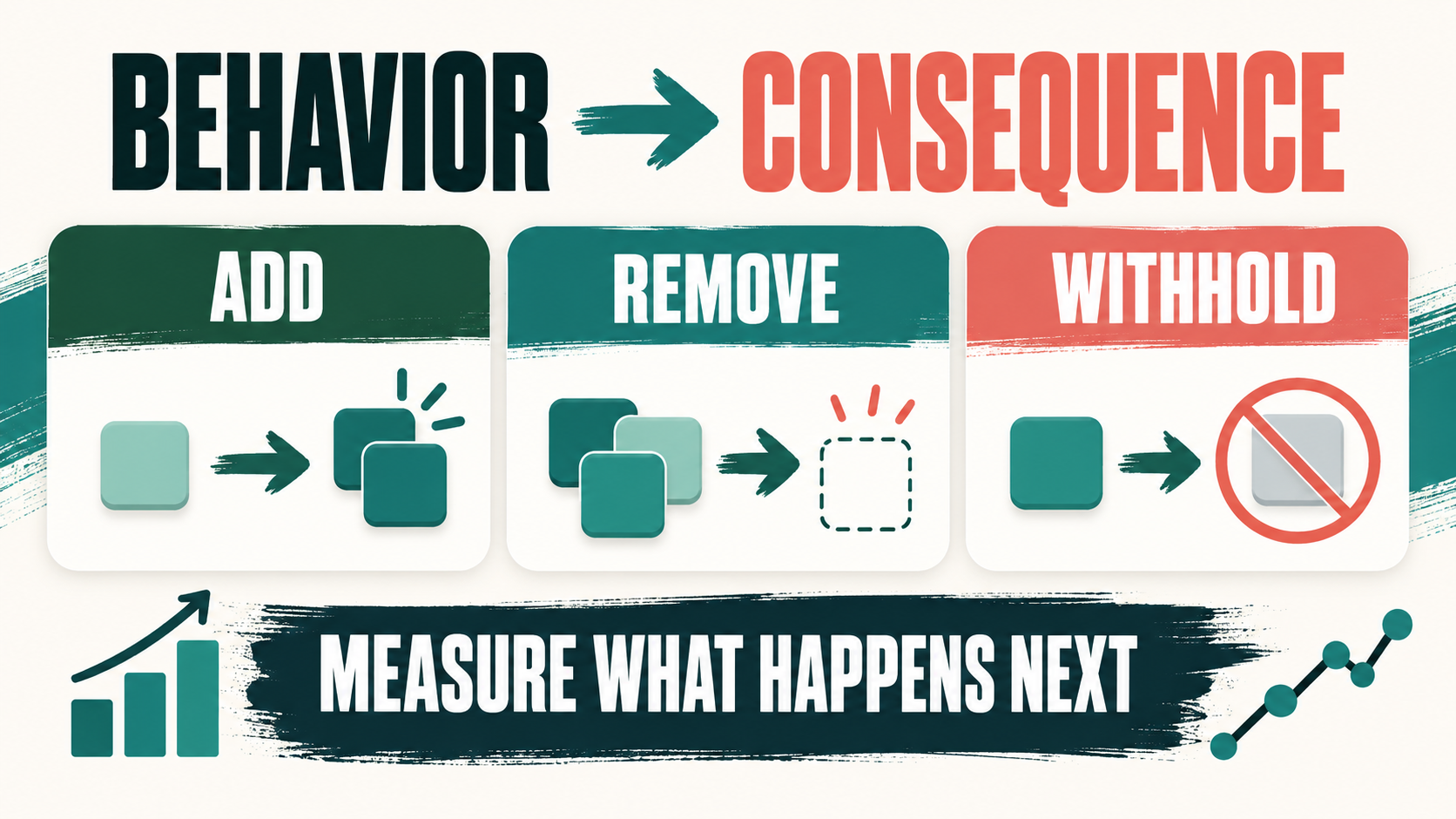
In a three-term contingency, an antecedent comes before a behavior and a consequence follows it. The consequence is not simply “what the adult intended.” It is the event arranged after the response, including what is delivered, removed, delayed, or no longer available. Manipulating the consequent stimulus means changing that event in a planned way while observing what happens to the target behavior later.
For example, a practitioner might arrange access to a break after an appropriate request, remove a difficult task after a request, deliver praise after a completed step, or stop delivering attention after a response that previously produced attention. These are descriptions of what is arranged after behavior. They are not yet conclusions about reinforcement, punishment, or extinction. A useful operational description includes five parts:
- Target behavior: define the response in observable terms, such as “hands the break card to the instructor,” rather than “appropriately asks.”
- Timing: state how soon the consequence follows and whether a delay is part of the plan.
- Stimulus change: specify what is added, removed, delayed, or withheld.
- Contingency: state which response produces the consequence and what happens after other responses.
- Outcome measure: track a future behavior dimension, such as rate, duration, latency, or probability across comparable opportunities.
The last item is essential. Immediate quiet, compliance, or task completion may be useful observations, but none automatically establishes the behavioral function of a consequence. The question is whether the planned consequence changes the future occurrence of the target response under the stated conditions.
Consequence Form Versus Behavioral Function
ABA terminology uses two different classification systems. The first describes the stimulus operation. The second describes its effect on behavior. Keeping the systems separate prevents a common exam error: labeling an event based only on whether it feels pleasant, unpleasant, added, or removed.
| Description | What it tells you | What it does not prove |
|---|---|---|
| Positive stimulus change | A stimulus is presented after the response, such as attention, a token, or access to an item. | It does not prove positive reinforcement. The target behavior must increase under the contingency. |
| Negative stimulus change | A stimulus is removed, postponed, or reduced after the response. | It does not prove negative reinforcement. The response must become more likely in the relevant conditions. |
| Reinforcement effect | The future frequency, probability, or relevant dimension of the behavior increases. | It does not tell you whether a stimulus was added or removed; that is a separate question. |
| Punishment effect | The future frequency, probability, or relevant dimension of the behavior decreases. | It does not mean the event is defined by discomfort, intention, or immediate suppression. |
Think of the two systems as coordinates rather than synonyms. “Positive reinforcement” combines an added stimulus with an increase in behavior. “Negative reinforcement” combines a removed stimulus with an increase in behavior. “Positive punishment” combines an added stimulus with a decrease, and “negative punishment” combines a removed stimulus with a decrease. The result still has to be measured in the target response.
Function-Matched Examples
The following examples illustrate the reasoning process. They are not universal prescriptions, and the same consequence can have a different effect for different learners, responses, or contexts.
| Observed arrangement | Behavioral question | Data to review |
|---|---|---|
| A learner hands over a break card and the task is paused for two minutes. | Does independent break requesting increase while problem behavior decreases or stays safe? | Independent requests, prompt level, latency to return, task completion, and problem-behavior rate. |
| A completed routine step produces specific praise and access to a chosen activity. | Does the completed step become more likely with less prompting? | Independent step completion, prompt fading, duration of engagement, and choice-based participation. |
| Attention is no longer delivered after a behavior that previously produced repeated attention. | Does the response decrease, and is an efficient replacement communication response available? | Target-response trend, replacement response, escalation risk, latency, and implementation fidelity. |
In the first example, removing a task may be a negative stimulus change. If break requests increase because the break effectively strengthens requesting, the arrangement may function as negative reinforcement for that communication response. But if requests do not increase, or if the pause is delivered after problem behavior more reliably than after the card, the result may not be the one intended. The data—not the label—settle the interpretation.
When a consequence is used to decrease a dangerous or disruptive response, the plan should not stop at suppression. A functional replacement response, reinforcement for appropriate behavior, and a safety plan may be needed. Withholding attention can also produce a temporary increase in responding or emotional distress. Monitor the pattern and involve the responsible clinical team rather than treating extinction as a simple “ignore it” rule.
How to Check a Consequence-Based Intervention
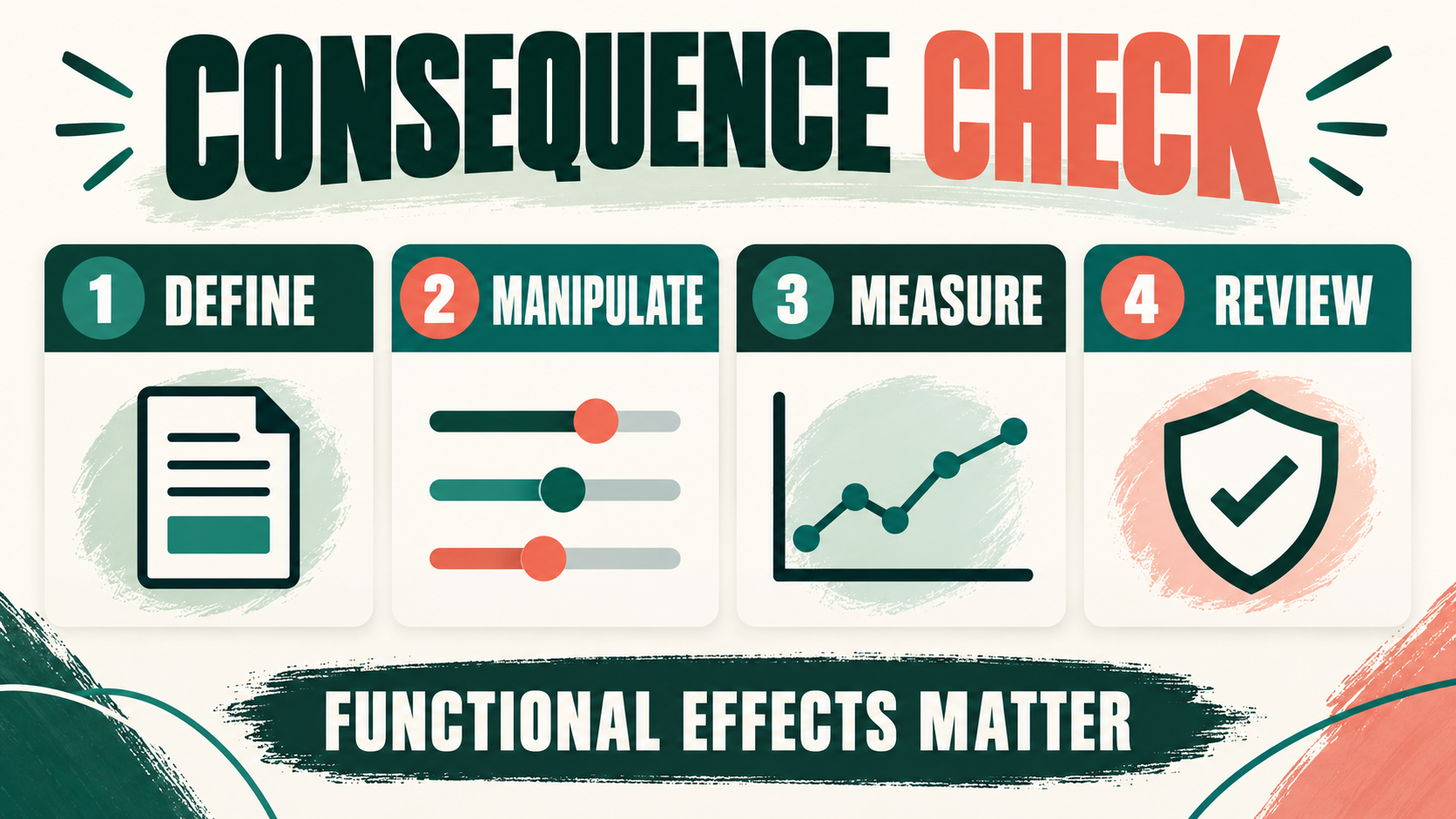
A strong consequence analysis is a small cycle of definition, arrangement, measurement, and revision. Use this checklist when studying a vignette or reviewing a real data set:
- Define the response and consequence separately. Write what the person does and what changes afterward. Do not define the behavior as “seeking reinforcement.”
- Confirm the contingency. Identify whether the consequence follows the target response, a different response, or an adult decision unrelated to behavior.
- Check the relevant baseline. Compare similar opportunities before and during the arrangement. A single quiet moment is not a behavior-change demonstration.
- Measure the replacement response. If problem behavior is being reduced, track whether the learner has an accessible, efficient, and reinforced alternative.
- Measure implementation fidelity. Record whether staff delivered the planned consequence at the planned time and after the planned response.
- Review side effects and assent. Watch for distress, avoidance, response bursts, prompt dependence, or reduced communication. Pause and consult the qualified team when the plan is unsafe or not working.
- Generalize carefully. Probe a new person, setting, material, or routine only when the plan and safety conditions support it.
Suppose a learner completes 6 of 10 task steps at baseline and 8 of 10 after a preferred activity is arranged. That is a descriptive change of two steps, or a 20-percentage-point increase, but it is not enough by itself to prove the activity caused the change. Check how many opportunities were available, whether task difficulty changed, whether prompts increased, and whether the pattern repeats across sessions. A clean data display makes the contingency easier to evaluate than a narrative such as “the learner liked the reward.”
Functional analysis research also shows why consequence conditions must be defined precisely. Studies comparing consequence arrangements have found that changing the consequences available during an analysis can change what function is identified. In practice, that means a professional should document the condition, use appropriate safeguards, and avoid describing a consequence as functionally established from appearance or intention alone.
Common BCBA Exam and Practice Errors
- “It was added, so it is reinforcement.” Addition describes positive stimulus change. Reinforcement requires an increase in the behavior.
- “It was removed, so it is punishment.” Removal describes negative stimulus change. Punishment requires a decrease in the behavior.
- “The behavior stopped immediately, so punishment occurred.” Immediate suppression is not the full future-behavior definition and may reflect other variables.
- “The learner got a break, so the break is a reinforcer.” A break is a candidate consequence until data show its effect for that response and context.
- “The consequence is whatever the adult wanted to happen.” Consequences are analyzed by their relation to behavior and future responding, not by intention.
- “No attention means ignore every response.” A consequence plan must preserve safety and teach an efficient communication alternative when one is needed.
- “One successful session proves the intervention.” Look for repeated changes across comparable opportunities and check fidelity.
On a BCBA-style question, underline the response, the event that follows it, and the direction of future change. Then classify the stimulus operation and the behavioral effect separately. This two-pass method is faster and more accurate than deciding from emotionally loaded words such as “reward,” “removal,” or “consequence.”
The BCBA Study Lens
For exam preparation, manipulating the consequent stimulus belongs with three-term contingencies, consequence-based interventions, functional assessment, measurement, and ethical decision-making. The current BCBA Test Content Outline is the appropriate source for current exam-domain wording. Research articles can deepen understanding, but they should not be treated as a promise that a particular scenario or phrase will appear on the exam.
A useful review card can ask four questions: What changed after the behavior? Was the change added, removed, delayed, or withheld? Did the future target behavior increase or decrease? What alternative response, safety issue, or fidelity variable must also be measured? If you can answer all four, you are less likely to confuse the physical form of a consequence with its demonstrated function.
For optional practice after reviewing the concept, the free BCBA mock exam can provide additional study questions. It is not affiliated with BACB, does not guarantee a passing score, and does not contain claimed copies of live exam items.
FAQ
What is the simplest definition of manipulating the consequent stimulus?: It is deliberately arranging or changing what happens after a behavior so the practitioner can evaluate or teach a contingency. The later effect on behavior must still be measured.
Is manipulating a consequent stimulus the same as reinforcement?: No. Manipulation describes the planned change to the post-behavior event. Reinforcement is a demonstrated increase in future behavior. A consequence can be arranged with reinforcement as the goal and fail to reinforce.
What should I look for in a BCBA exam question?: Separate the target response, the event that follows, and the direction of future behavior change. Classify added or removed stimuli independently from reinforcement or punishment, and check whether the stem provides enough data to support the label.
Bottom line: manipulating the consequent stimulus is about controlling and describing the event after behavior, not assigning a label based on intention or appearance. Define the response, specify the consequence, measure the future pattern, protect communication and safety, and revise the plan when the data do not support the intended function.
Quick Review Checklist
Use this final checklist to turn manipulating the consequent stimulus into exam-ready reasoning. The goal is not to memorize a label in isolation; it is to identify the relevant evidence and explain why the best answer fits the scenario. Key ideas to review:
- State the central definition or decision point for manipulating the consequent stimulus in your own words.
- Identify the detail that makes manipulating the consequent stimulus different from its closest related ABA term.
- Separate the observable facts in a scenario from assumptions that are not supported by the facts.
- Write one example and one nonexample so you can recognize the concept in a new setting.
Exam application checks:
- Ask what the question is actually requesting before comparing the answer choices.
- Mark the antecedent, response, consequence, or other evidence that supports the selected answer.
- Look for a distractor that describes a related process but does not answer the specific question.
Final self-check:
- Explain how you would verify the interpretation with clear observations or data.
- Change one detail in the scenario and decide whether your answer should change.
- Give a one-sentence rationale that a supervisor or study partner could evaluate.
Take the Free BCBA Mock Exam
If you want a low-pressure way to check your recall, use the free practice resource below. Take the Free BCBA Mock Exam



