

A practical checklist for turning an SBT plan into observable staff performance, safe rehearsal, and measurable treatment fidelity. If you are searching for SBT training ABA, the useful question is not only “What does skill-based treatment mean?” It is: How will an implementer learn the sequence, demonstrate it, receive feedback, and show that the performance remains safe and accurate?
Table of Contents
- What SBT training ABA should produce
- Use the four BST components as a training loop
- Build an implementer competency target
- Observe fidelity before you call training complete
- What the 2026 study does—and does not—tell you
- Set safety boundaries before rehearsal
- Test generalization and maintenance deliberately
- Use a repair loop instead of retraining everything
- A simple 30-day SBT training cadence
- How BCBA exam practice fits
- SBT training in ABA FAQ
- The bottom line
- Sources to recheck
- Quick Review Checklist
- Take the Free BCBA Mock Exam
Skill-based treatment (SBT) is a clinical process, while training is the implementation system around that process. A supervisor may use behavioral skills training (BST)—instruction, modeling, rehearsal, and feedback—to teach an implementer, but the training label alone does not prove competence. Competence must be defined, observed, measured, and rechecked in the setting where the work will occur.
This article focuses on that downstream task: staff fidelity and safety auditing. The existing PFA and SBT overview remains the place for the broad treatment model, and the site’s BST versus SBT terminology guide handles the distinction between those terms. Use this page when you need to plan training, score implementation, and decide what to repair before calling training complete.
What SBT training ABA should produce
Good SBT training should produce an implementer who can follow the written procedure, respond to the learner’s communication and safety signals, record the required data, and seek help when the situation exceeds the person’s training or role. It should also produce a supervisor who can show how that conclusion was reached.
| Training target | Observable evidence | What it does not prove |
|---|---|---|
| Procedure accuracy | The implementer follows the defined steps in the right order and records the required information. | That the plan is appropriate for every learner or context. |
| Communication response | The implementer responds according to the written decision rules rather than improvising a new consequence. | That the implementer can practice outside the trained scope. |
| Safety judgment | The implementer recognizes the pause or escalation condition and contacts the designated supervisor. | That a training session can replace clinical oversight. |
| Maintenance and transfer | Performance remains accurate across people, materials, times, or routines that were deliberately selected for generalization. | That one successful rehearsal guarantees long-term generalization. |
Use the four BST components as a training loop
Behavioral skills training is commonly organized around four components: instruction and rationale, modeling, rehearsal, and feedback. The sequence is a loop, not a one-time presentation. If the implementer misses a critical step, return to the component that will make the next practice opportunity better.
| BST component | Supervisor action | Evidence to keep |
|---|---|---|
| Instruction and rationale | Describe the step, its decision rule, the reason it matters, and the boundary that requires help. | A short competency checklist and the implementer’s questions. |
| Modeling | Demonstrate a correct example and, when appropriate, an error followed by the correct response. | The modeled steps and the conditions shown. |
| Rehearsal | Have the implementer practice the exact skill with a role-play, simulation, or approved supervised opportunity. | Trial-level accuracy, errors, and any safety stop. |
| Feedback | Give specific praise for accurate steps and specific corrective feedback for the next trial. | The feedback delivered and the next practice decision. |
Build an implementer competency target
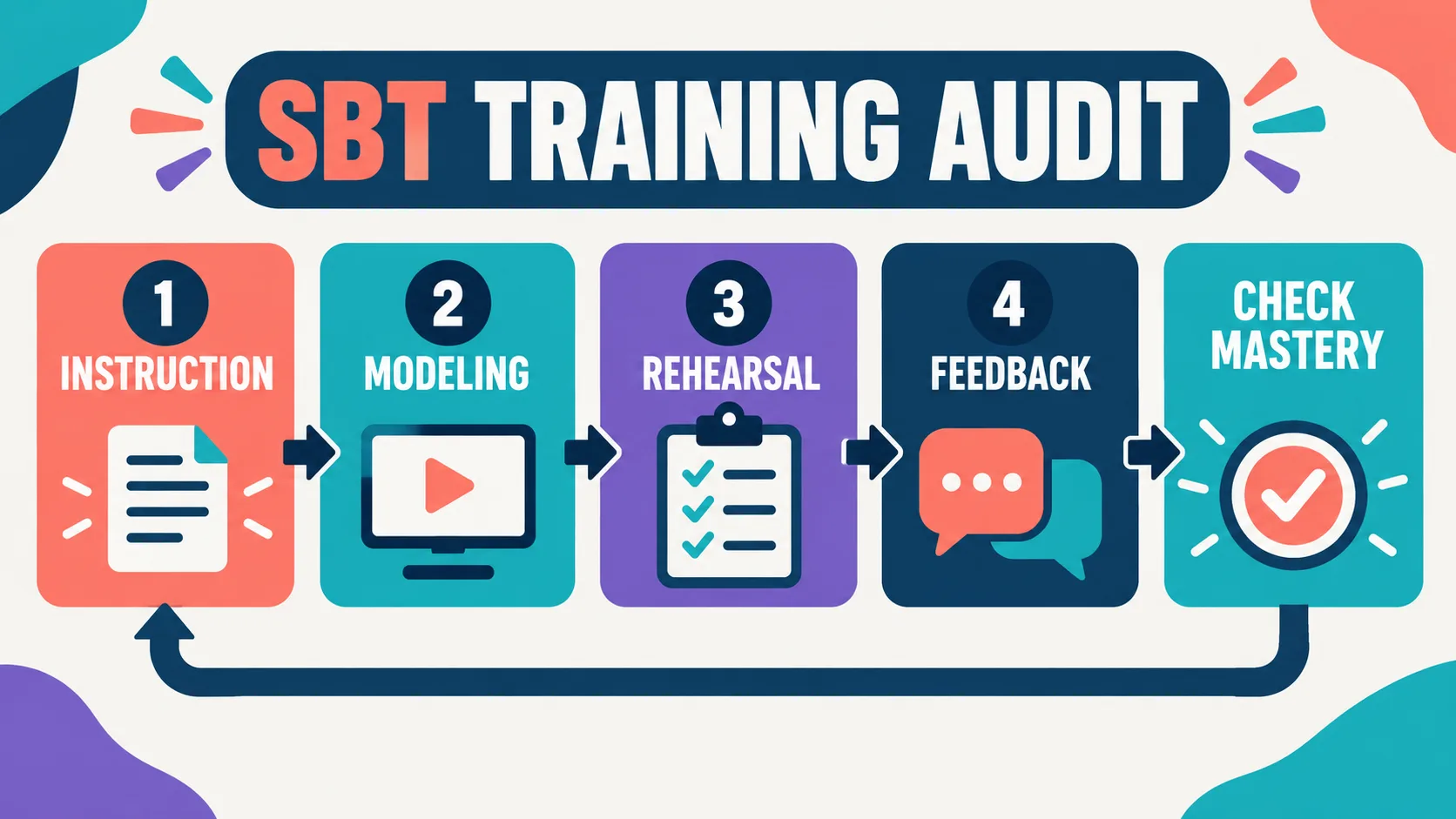
Turn the treatment plan into a small set of skills that can be taught and scored. A useful target might include preparing the environment, presenting the relevant instruction, recognizing the learner’s communication, delivering the programmed response, recording data, and applying the safety rule. The exact steps must come from the approved clinical plan and the supervisor’s scope; this article does not create a client-specific protocol. For each target, write four details:
- Antecedent or context: what situation tells the implementer the skill may be needed?
- Performance: what exactly should the implementer say, do, record, or avoid?
- Decision rule: what response changes the next step?
- Mastery rule: what accuracy, number of opportunities, or repeated observation will support the local training decision?
Do not borrow a percentage from a study and call it a universal requirement. A mastery rule should be agreed with the supervisor, fit the risk and complexity of the skill, and be checked in the setting where performance matters. A high score in a quiet role-play may be a useful prerequisite, not the final generalization test.
Observe fidelity before you call training complete
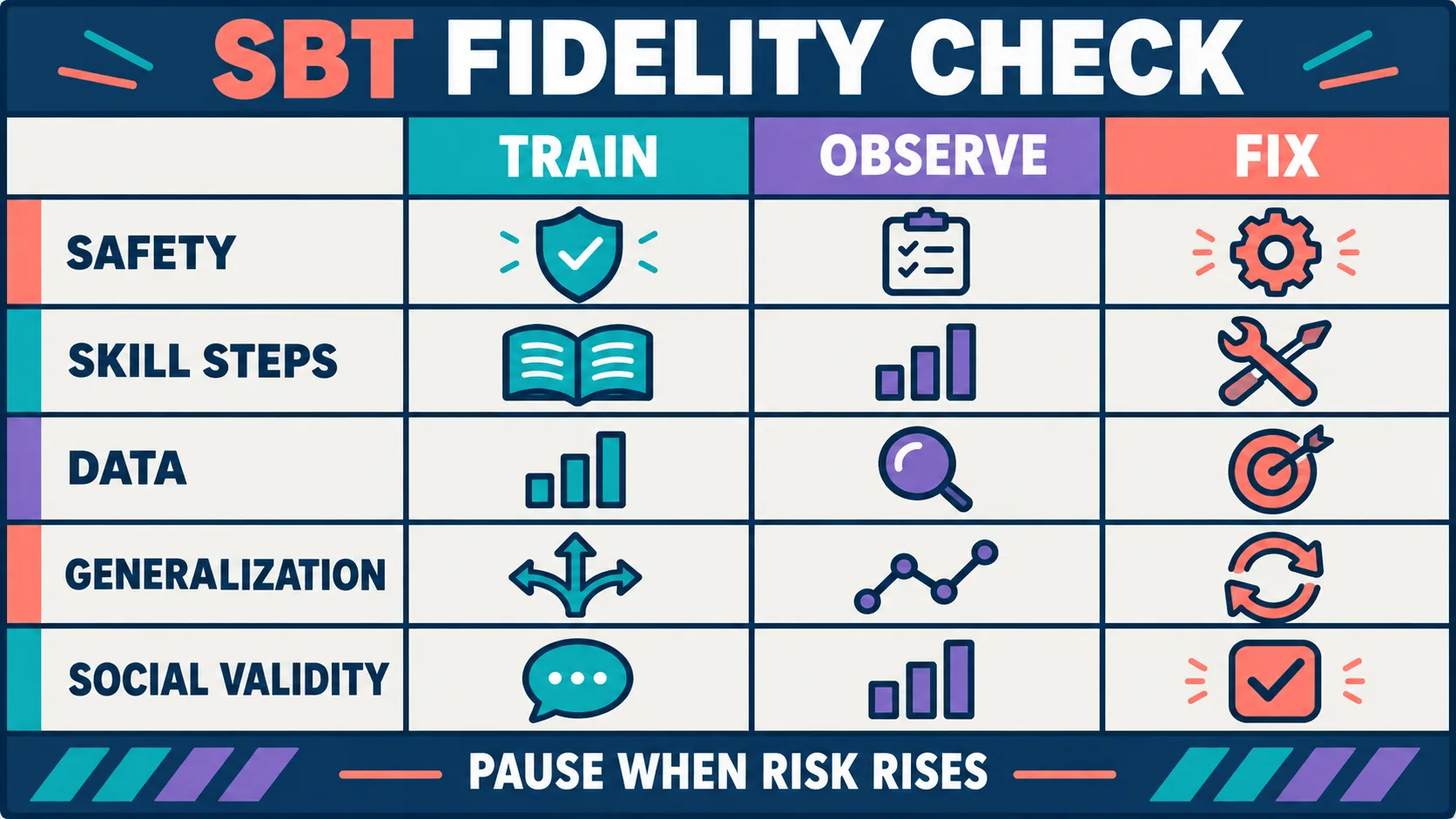
Training is incomplete if nobody observes what happens after instruction. Use a short fidelity form that lets the observer mark accurate, inaccurate, not observed, or safety stop. The form should be specific enough that two trained observers can discuss the same step instead of relying on a general impression.
| Fidelity anchor | Observation question | Repair if missed |
|---|---|---|
| Safety | Did the implementer recognize the defined stop, escalation, or help condition? | Pause practice, review the boundary, and involve the designated supervisor before another live opportunity. |
| Skill steps | Were the programmed steps delivered in the required order and with the intended prompt or response? | Model the missed step, rehearse it, and observe again under a comparable condition. |
| Data | Was the opportunity, learner response, implementer action, and relevant outcome recorded as defined? | Reconcile the form with the written definition; do not infer missing data after the fact. |
| Generalization | Does accuracy hold across a planned change in person, material, routine, or setting? | Return to a supported condition, then introduce one planned variation at a time. |
| Social validity | Are the goals, procedures, burden, and observed effects acceptable to the relevant stakeholders? | Collect feedback, review the concern with the clinical team, and document the decision. |
What the 2026 study does—and does not—tell you
A 2026 Behavior Analysis in Practice study examined BST for teaching components of SBT. Four behavior technicians were trained on the first three component skills; all participants reached the study’s mastery criterion within three training trials, maintained high accuracy two weeks later, and rated the training favorably. That is a helpful proof of concept for using instruction, modeling, rehearsal, and feedback together.
It is not a universal rule that every staff member will be competent after three trials, that every SBT component will transfer automatically, or that a short follow-up proves durable implementation in every setting. The sample was small and the task set was bounded. Use the study to justify a structured training loop, then set local mastery and maintenance checks that match the plan, population, risk, and role.
Set safety boundaries before rehearsal
Safety should be taught before an implementer is asked to rehearse a difficult scenario. The training packet should identify what the implementer may do independently, what requires immediate supervisor contact, and what is outside the person’s role. If a rehearsal creates a safety concern, stop the exercise and review it; do not treat continuing as evidence of resilience.
| Boundary question | Training record |
|---|---|
| What signal means “pause”? | The observable condition, the immediate safe action, and the person to contact. |
| What is within the implementer’s role? | The approved steps the person has been trained and supervised to perform. |
| What requires a plan review? | Repeated fidelity errors, unexpected risk, missing data, or a change in the learner’s context. |
| What must not be improvised? | A new consequence, restriction, escalation response, or clinical decision outside the written plan and supervision. |
The BACB’s ethics and supervision resources should remain the authority for competence, client protection, professional conduct, and supervision. This checklist is a planning aid; it does not grant a technician permission to design or change treatment.
Test generalization and maintenance deliberately
After the implementer is accurate in the original training arrangement, plan one controlled change at a time. A new staff member, room, material, schedule, or communication partner may reveal a different fidelity gap. Keep the change small enough that the supervisor can identify why performance shifted.
- Choose the generalization feature before the observation, rather than changing several features at once.
- Keep the same operational definitions and data rules while the context changes.
- Schedule a later maintenance check; do not infer maintenance from a strong first session.
- Ask whether the procedure remains workable and acceptable for the people who use it.
- Route unexpected outcomes back to the clinical supervisor instead of silently editing the plan.
Use a repair loop instead of retraining everything
When fidelity drops, identify the smallest component that explains the error. If the implementer cannot state the decision rule, improve instruction. If the rule is understood but the sequence is missing, model and rehearse. If the skill is accurate in role-play but not in the setting, observe the transfer condition and adjust supervision. If safety is unclear, stop and escalate before more practice.
| Pattern | Likely training response | Next check |
|---|---|---|
| Cannot explain the rule | Return to instruction and rationale; ask the implementer to describe the trigger and response. | A brief verbal check before rehearsal. |
| Explains but skips a step | Model the complete sequence, then rehearse with immediate feedback. | Trial-level step accuracy. |
| Accurate in role-play, variable in context | Observe the context, identify the transfer barrier, and add supported practice. | One planned generalization probe. |
| Safety condition missed | Pause the opportunity and involve the supervisor; do not simply repeat the trial. | Documented safety review before resuming. |
A simple 30-day SBT training cadence
A short cadence keeps training from disappearing after orientation. Adapt the timing to the actual supervision plan and clinical risk:
- Days 1–3: define the target skills, materials, safety boundaries, data fields, observer, and mastery decision.
- Days 4–10: deliver BST, run rehearsals, give immediate feedback, and record the exact errors.
- Days 11–17: observe implementation in the planned context and repair the smallest fidelity gap.
- Days 18–24: test one planned generalization feature while preserving the same definitions and data rules.
- Days 25–30: complete a maintenance observation, review social validity, and decide whether continued supervision or retraining is needed.
How BCBA exam practice fits
SBT training questions often combine supervision, treatment integrity, measurement, ethics, and scope-of-practice decisions. Exam practice can help a BCBA candidate recognize which fact matters, separate a direct observation from an assumption, and choose the next defensible action in a vignette.
Practice is not staff authorization, clinical supervision, or proof that a treatment plan is safe. When you are ready to work on the exam-side decision skills, use the Free BCBA Mock Exam to practice scenario-based questions and log the concepts behind each answer.
SBT training in ABA FAQ
Is SBT training the same as BST?: No. SBT is a treatment process; BST is a training method that can be used to teach implementer behavior. A page about terminology can clarify the distinction, but a training audit still needs observable targets, rehearsal, feedback, and fidelity data.
How many training trials are enough?: There is no universal number. The 2026 study reported mastery within three training trials for four behavior technicians on a bounded set of early SBT component skills. Use that finding as evidence for a structured loop, not as a guarantee. Set local criteria based on skill complexity, risk, context, and supervision.
What should a supervisor measure?: Measure the steps that matter: safety response, procedural accuracy, communication response, data recording, generalization, maintenance, and acceptability. Define the scoring rule before observing and document what happens after an error. Can a checklist replace supervision?: No. A checklist makes supervision more concrete; it does not replace the qualified supervisor’s judgment, the approved clinical plan, or the official ethics and supervision requirements.
The bottom line
The strongest answer to “SBT training ABA” is a closed loop: define the implementer skill, teach it with instruction and modeling, rehearse it, give specific feedback, observe fidelity, protect safety, and test maintenance and generalization. Keep the 2026 evidence in proportion, keep clinical decisions within supervision, and use the record to decide what happens next.
Sources to recheck
Current reference points: the 2026 BST and SBT implementation study, the Grand Valley State University START resource, the BACB ethics-code hub, and the BACB supervision and training hub. Recheck the current official materials and the supervising clinician before applying any training plan to a real learner. For targeted review, use our sbt training aba practice questions to apply the concept in exam-style scenarios.
Quick Review Checklist
Use this final checklist to turn sbt training aba into exam-ready reasoning. The goal is not to memorize a label in isolation; it is to identify the relevant evidence and explain why the best answer fits the scenario. Key ideas to review:
- State the central definition or decision point for sbt training aba in your own words.
- Identify the detail that makes sbt training aba different from its closest related ABA term.
- Separate the observable facts in a scenario from assumptions that are not supported by the facts.
- Write one example and one nonexample so you can recognize the concept in a new setting.
Exam application checks:
- Ask what the question is actually requesting before comparing the answer choices.
- Mark the antecedent, response, consequence, or other evidence that supports the selected answer.
- Look for a distractor that describes a related process but does not answer the specific question.
Final self-check:
- Explain how you would verify the interpretation with clear observations or data.
- Change one detail in the scenario and decide whether your answer should change.
- Give a one-sentence rationale that a supervisor or study partner could evaluate.
Take the Free BCBA Mock Exam
A useful next step is to apply this idea in a fresh set of BCBA-style practice questions and review the feedback. Take the Free BCBA Mock Exam



