

An ABA discharge report is the final clinical and administrative record explaining why applied behavior analysis services ended, changed, or transferred, what the data show, and what should happen next. It is related to an ABA discharge plan, but the two documents are not identical. The plan describes the transition process; the report records the decision and the evidence at the point of discharge.
Table of Contents
- ABA Discharge Report vs. ABA Discharge Plan
- What the Report Must Answer
- Clinical Reason, Administrative Reason, and Ongoing Recommendation
- How to Summarize Goals and Data
- Handoff and Continuity Details
- Payer and Authorization Checklist
- How BCBA-Style Questions Test the Topic
- Common Discharge Report Mistakes
- A Practical Report Outline
- FAQ
A useful report does not simply say “services completed” or list the last date of treatment. It distinguishes clinical progress from an administrative ending, identifies ongoing recommendations, protects continuity, and gives the receiving person enough information to act. Requirements vary by payer, state, provider, and setting, so a template should be treated as a prompt rather than a universal form.
This guide explains what an ABA discharge report should answer, how to organize the data, and how the topic appears in BCBA-style questions. It is educational information, not clinical, legal, insurance, or payer advice. The current treatment plan, consent, professional standards, and applicable payer instructions control. Table of Contents
ABA Discharge Report vs. ABA Discharge Plan
The simplest distinction is timing and purpose. A discharge plan is prospective: it explains the criteria, fade steps, training, handoff, and follow-up that should guide a transition. A discharge report is retrospective and current: it documents the reason services ended or changed, the client’s status, the actions completed, and the recommendation for the next step. A program may use one combined document, but the reasoning should still answer both questions.
| Document | Main question | Typical content |
|---|---|---|
| Discharge plan | How will the transition be prepared and evaluated? | Criteria, fade schedule, training, generalization, review dates, and contingency steps. |
| Discharge report | What happened, why did it happen, and what is recommended now? | Last service date, reason, goal status, current risks, ongoing recommendation, handoff, and follow-up. |
The distinction prevents a common error: copying a future plan into a final report without documenting what actually occurred. A report should use completed records and clearly label recommendations that remain pending.
What the Report Must Answer
Before writing, convert the discharge report into a short set of questions. A reviewer should be able to find the answer without reconstructing the entire case file.
- Who and when? Identify the client using the approved record, the service period, and the last date of billed or delivered services.
- Why did services end or change? State whether the reason was goal achievement, lower need, transfer, relocation, family choice, funding, provider capacity, lack of benefit, safety, or another documented circumstance.
- What does the data show? Summarize priority goals, measures, trends, maintenance, generalization, and remaining barriers.
- What is recommended now? Distinguish no current recommendation from continued services, a lower intensity, another provider, caregiver support, consultation, or a referral.
- What was handed off? Record training, consent, records, contacts, referrals, and any follow-up route.
Use objective language. “Family was difficult” does not explain a behavior-analytic or administrative event. “The family requested discontinuation after discussing the current goals and available alternatives” is more precise, while the supporting note belongs in the record. Avoid unnecessary identifying details in study examples and public-facing materials.
Clinical Reason, Administrative Reason, and Ongoing Recommendation
One of the most important parts of an ABA discharge report is separating the decision to end this service arrangement from the clinical recommendation. For example, a payer change or relocation may end the current provider relationship even when the client still benefits from behavior-analytic services. Conversely, goals may be met and the provider may recommend discharge even though the payer would have authorized more services. The report should not collapse those different facts into one vague sentence.
The ABA individualizing-care guidance gives a useful example of this distinction: a discharge report can explain why services ended, state the ongoing recommendation, and identify criteria for resuming services if needed. It also emphasizes coordination with future providers when the family consents. The exact document may not apply to every payer, but the reasoning is broadly useful.
Write the reason in a way that can be supported. If the reason is progress, name the goals and data. If the reason is an administrative barrier, name that barrier and preserve the clinical recommendation. If the reason is a transfer, identify the receiving provider or next setting when consent and logistics permit. If services were not beneficial, describe the review and alternatives rather than using a conclusory label.
How to Summarize Goals and Data
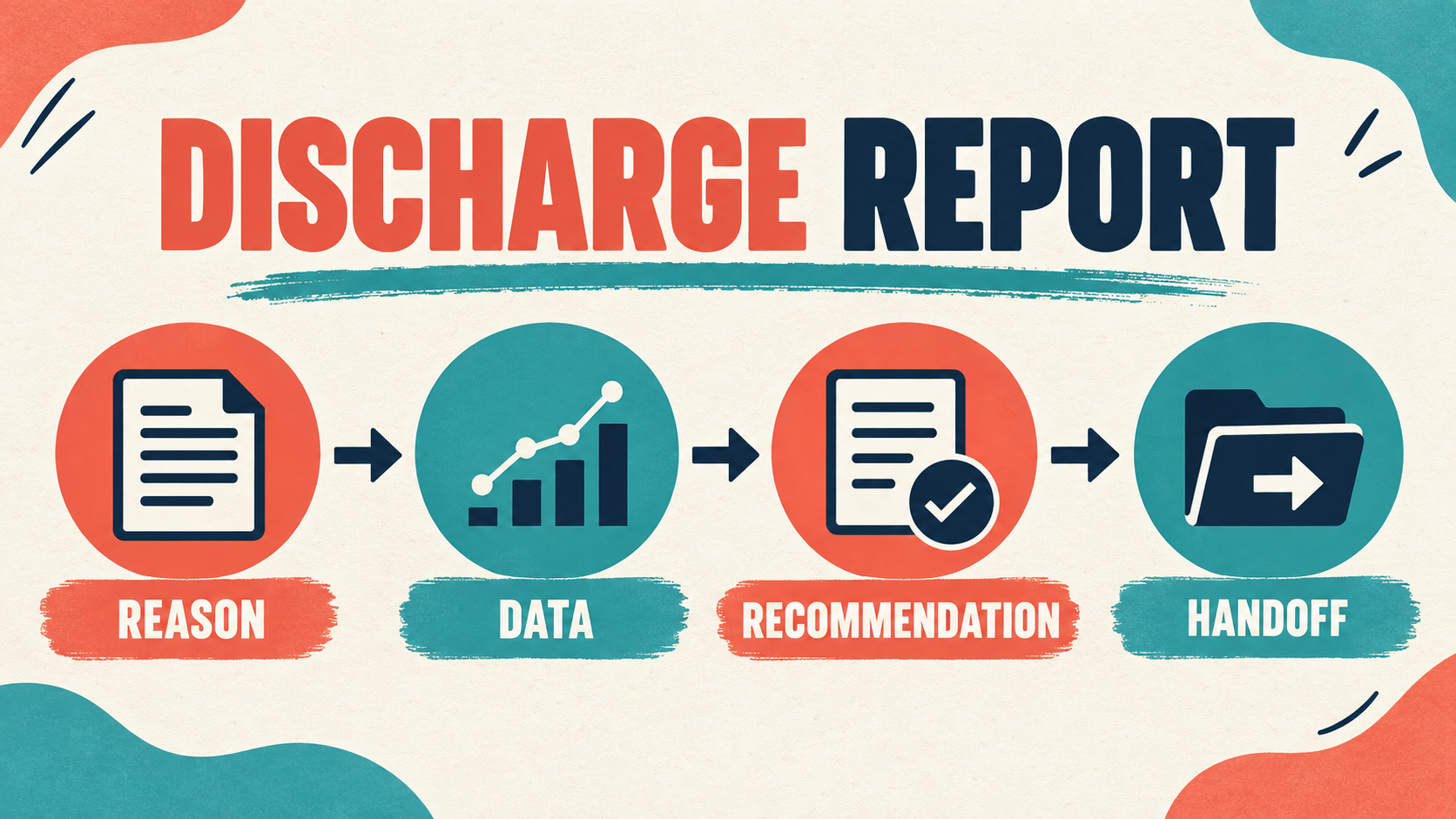
A discharge report does not need to reproduce every session note, but it should make the final decision traceable. For each priority goal, summarize the baseline, the most recent level or trend, the setting or measure, and the status: met, progressing, maintained, generalized, revised, discontinued, or still needing support. If a goal was not evaluated in the relevant setting, say so.
Do not use one successful session as proof of readiness. Consider variability, prompting, reinforcement, maintenance over time, and performance with different people or materials. For a safety target, describe the remaining risk and the plan for managing it. For a caregiver-mediated goal, state whether the caregiver received training and demonstrated the relevant steps. The report should help a receiving provider decide what to assess next.
| Report field | What to summarize | Avoid |
|---|---|---|
| Goal status | Defined target, measure, current level, trend, and setting. | “Doing well” without observable evidence. |
| Support needs | Prompts, reinforcement, caregiver support, risks, and barriers. | Assuming independence because a prompt was absent once. |
| Next assessment | What the receiving person should check or continue monitoring. | A promise of automatic services or a fixed outcome. |
Handoff and Continuity Details
A report becomes more useful when it tells the next support person what to do. Include a concise summary of current procedures, the purpose of each support, known effective reinforcers or communication methods when appropriate, and signals that the plan needs review. Share records only with the required consent and through the approved channel.
For relocation or provider transfer, identify the receiving contact, the expected date, the records sent, and any open referral or authorization issue. The TRICARE discharge and relocation guidance illustrates why continuity planning matters when a person moves. Its requirements are program-specific, so do not turn one payer’s time frame into a universal ABA rule.
- Provide the family or client a copy when the applicable policy requires it.
- Record caregiver or staff training and any questions that remain unresolved.
- Identify referrals, receiving providers, and contact dates when consent and availability permit.
- State how to request a review if progress changes or a safety concern returns.
Payer and Authorization Checklist
An ABA discharge report may be part of a payer’s authorization workflow. The exact fields vary, but provider guidance commonly asks for the last service date, reason for discharge, current treatment-plan or care-plan information, clinical recommendations, and whether support is needed to transfer care. Some plans also require an authorization number, notice period, family review, or a formal reassignment request.
For example, a Health Plan of San Mateo provider document describes discharge-report steps such as sharing the report with the family, including the current authorization number, and coordinating reassignment when a provider initiates discharge. That is a local payer process, not a national template. Use it as an example of the type of instruction that must be checked before submission.
- Confirm whether the payer requires a discharge report or a different final report.
- Check the last service date, submission deadline, authorization number, and required signatures.
- Ask whether a transfer or reassignment form is needed before ending services.
- Separate a payer ending from the clinical recommendation for continued or reduced care.
- Keep a copy of the submitted report and the response in the approved record.
CMS explains that Medicaid autism-service coverage operates within federal requirements and state-administered programs. That context is useful, but a current state plan, managed-care contract, or provider manual controls the details. Do not promise coverage or use a generic discharge report to answer a payer-specific question.
How BCBA-Style Questions Test the Topic
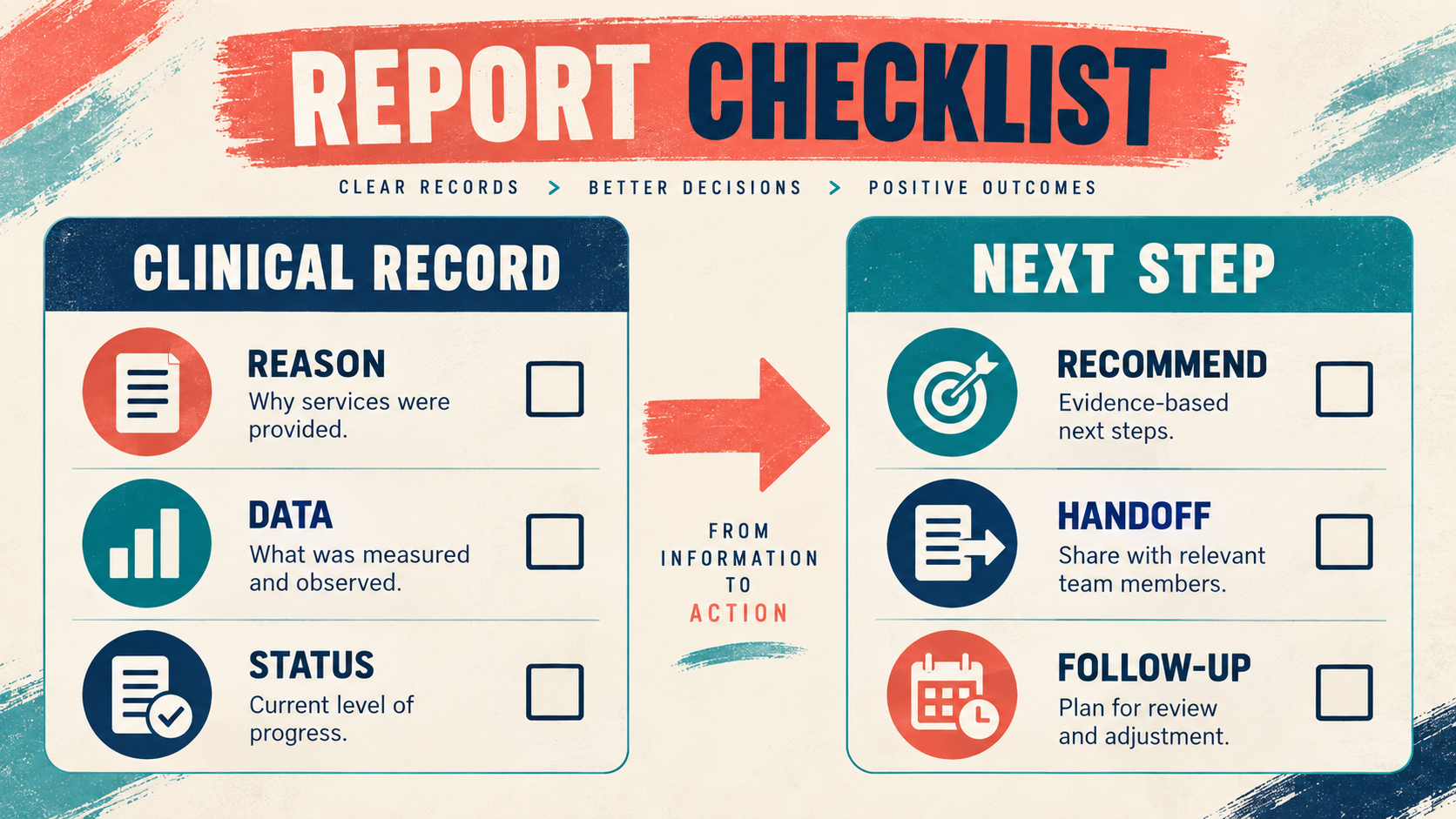
On a BCBA-style question, an ABA discharge report may test data-based decision-making, generalization, caregiver training, treatment integrity, ethics, or coordination of care. Read the reason for discharge and identify what the evidence actually proves. A strong answer records the client’s status, protects continuity, and distinguishes a service-ending reason from a clinical conclusion.
- If the payer ends authorization, do not automatically mark every goal as met.
- If the client transfers, include a handoff and the receiving setting when the facts support it.
- If the client appears improved in one room, look for maintenance and generalization data.
- If the family requests discharge, document the request and discuss appropriate next steps rather than arguing from a template.
- If the report contains a safety concern, make the recommendation and follow-up route explicit.
The most attractive distractor often confuses a complete form with a complete decision. A signature, discharge date, or authorization number does not replace a data summary. Conversely, a long narrative is not automatically better if it hides the reason, status, or next step.
Common Discharge Report Mistakes
- Copying the discharge plan into the report. State what was actually completed and label future recommendations clearly.
- Using a generic reason. “Client discharged” describes an event, not why it occurred.
- Calling administrative closure clinical mastery. Funding, relocation, capacity, and family decisions can end a provider relationship without proving every goal was met.
- Omitting the ongoing recommendation. If support remains clinically relevant, say what should be assessed or continued next.
- Ignoring the handoff. A final report should reduce the information gap for the next provider or caregiver.
- Using a payer form as a universal rule. Verify the state, plan, provider contract, and current submission instructions.
A Practical Report Outline
Use this outline for study or internal planning. Adapt it to the client, service, payer, consent, and record policy.
| Section | Core question | Evidence or action |
|---|---|---|
| Identification | Who and which service period? | Approved identifiers, last service date, authorization details. |
| Reason and status | Why did the service end or change? | Clinical data, administrative reason, goal status, barriers. |
| Recommendation | What should happen next? | Step-down, transfer, referral, monitoring, or reassessment. |
| Handoff | Who received the information? | Consent, training, records, contacts, follow-up route. |
FAQ
What is included in an ABA discharge report?: Usually the report identifies the service period and last date, explains why services ended or changed, summarizes goal status and relevant data, states the ongoing recommendation, and records handoff or follow-up actions. The exact fields depend on the payer and provider.
Is an ABA discharge report the same as a discharge plan?: No. A plan prepares for the transition; a report records the decision, current status, completed actions, and next recommendation. A combined form can contain both functions if it makes the distinction clear.
Does a discharge report mean all ABA goals are complete?: No. Services can end for administrative, family, relocation, provider, funding, or transfer reasons. The report should distinguish those reasons from goal mastery and state what support or reassessment is recommended.
Who receives the report?: The client or family, payer, current provider, and receiving provider may receive different portions depending on consent, privacy rules, and policy. Use the approved channel and share only what is permitted.
A strong ABA discharge report makes the ending of one service arrangement understandable and actionable: record the reason, summarize the data, state the recommendation, and coordinate the next step. If you want to practice separating administrative facts from clinical conclusions in scenario questions, take the free BCBA mock exam for additional practice.



