
A practical evidence audit for separating BACB certification, Pennsylvania licensure, PALS uploads, and the 2027 BCBA transition. If you search for bcba certification pa, you may be trying to answer two different questions: “How do I qualify for the BCBA certification?” and “What does Pennsylvania require before I provide a regulated behavior-specialist service?” Those questions can overlap in one career plan, but they are not the same application.
Table of Contents
- BCBA certification in PA: separate the BACB and Pennsylvania checks
- Run a two-layer eligibility audit before you apply
- Build your Pennsylvania application evidence packet
- Use PALS as a status workflow, not a one-time upload
- Check the 2027 BACB transition before choosing a pathway
- Fix the packet before you submit
- Turn the audit into a study and submission plan
- BCBA certification PA FAQ
- Take the next accurate step
- Official sources to recheck
- Quick Review Checklist
- Take the Free BCBA Mock Exam
The short answer is that a BCBA is a graduate-level certification issued by the Behavior Analyst Certification Board (BACB), while Pennsylvania may impose a separate state licensing requirement for a behavior-specialist role or service. Your evidence packet should therefore have two labeled sections: one for the BACB pathway and one for any Pennsylvania license or employer/payer requirement that applies to your intended work.
This page is an application-and-document audit. It complements the site’s broader Pennsylvania BCBA pathway guide, which covers the larger education-to-exam route. Use this page when you are close to applying and need to check evidence, dates, uploads, and the boundary between national certification and Pennsylvania licensure.
BCBA certification in PA: separate the BACB and Pennsylvania checks
Start by writing the exact credential or permission you are pursuing at the top of your checklist. The BACB controls BCBA certification eligibility and examination requirements. Pennsylvania boards and agencies control state licensure and the services covered by that license. A university degree, an employer title, or a BCBA certification does not automatically answer every state-practice question.
| Evidence layer | What it answers | What to verify |
|---|---|---|
| BACB BCBA certification | Whether you meet the current national certification pathway and can apply for and pass the BCBA examination. | Degree or qualifying program, behavior-analytic coursework, supervised fieldwork, application pathway, current forms, and examination. |
| Pennsylvania behavior-specialist license | Whether the Pennsylvania license requirements apply to the role or service you intend to perform and whether your state packet is complete. | Board-approved degree, experience, coursework, clearances, child-abuse training, fee, PALS uploads, and current board instructions. |
| Employer, payer, or setting rules | Whether a particular job, contract, school, health plan, or facility imposes additional documentation or credential rules. | Service description, supervision arrangement, payer enrollment, background checks, and local policy. |
| Scope of competence | Whether your training and supervised experience match the population, procedure, setting, and risk level. | Actual training records, supervised practice, consultation, ethics obligations, and referral boundaries. |
Run a two-layer eligibility audit before you apply
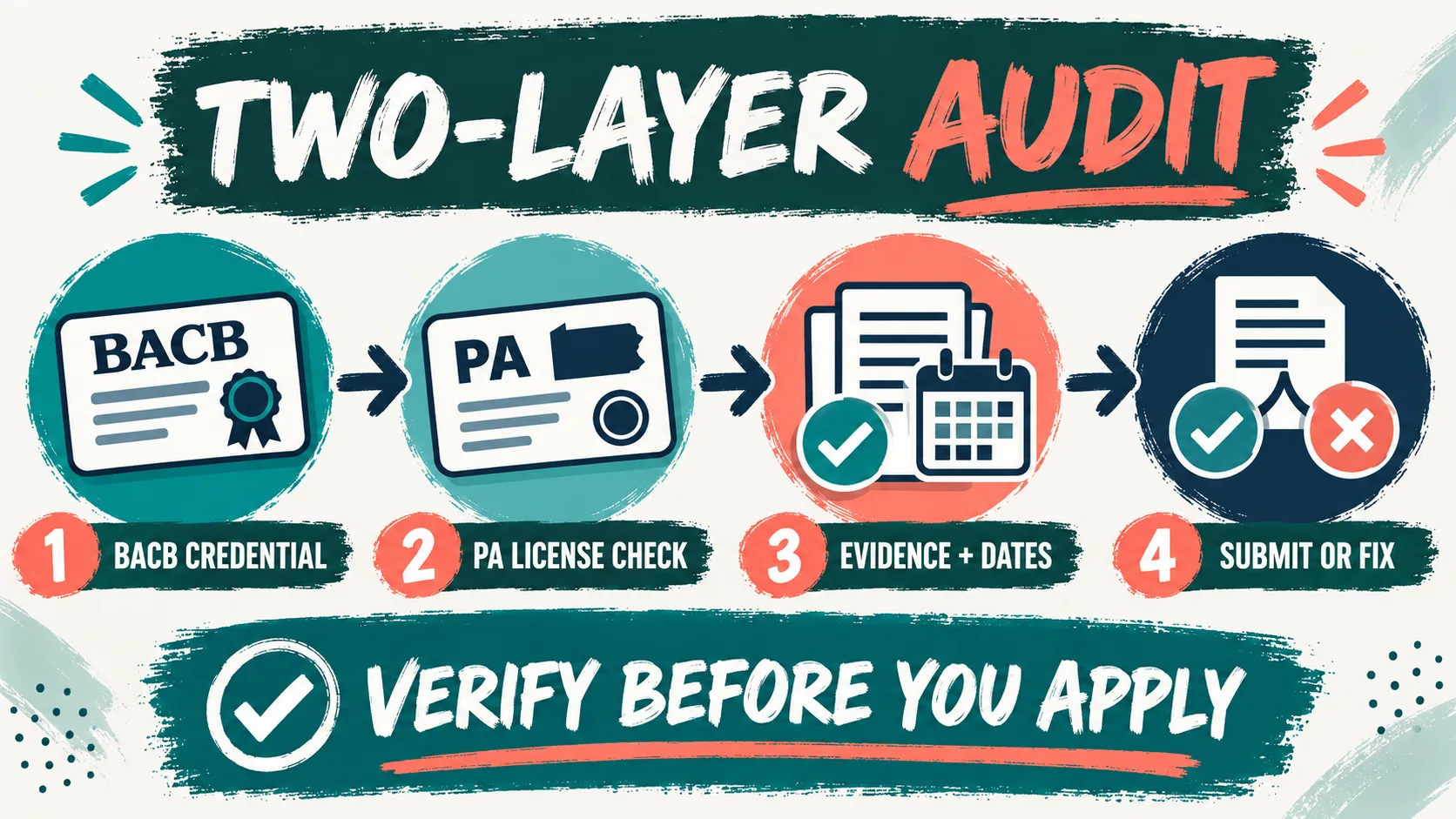
Use the same four-step sequence for both evidence layers. The goal is not to collect every document you have ever received; it is to connect each document to one current requirement and record what still needs action.
- Name the target. Write “BACB BCBA application,” “Pennsylvania behavior-specialist license,” or both. If you cannot name the target, you cannot tell whether a missing document actually matters.
- Freeze the rule version. Record the date you plan to apply and open the current official handbook, Pennsylvania board snapshot, regulation, and PALS checklist. A 2026 packet and a 2027 packet may use different forms or pathway evidence.
- Match evidence to a requirement. Put the requirement in one column, the document or third-party source in another, and the owner of the next action in a third. A transcript, verification form, or clearance should never sit in a folder with no explanation of what it proves.
- Check dates and status. Mark whether the document is current, whether the board or BACB must receive it directly, whether a clearance has an expiration or freshness window, and whether the application portal shows it as received.
Build your Pennsylvania application evidence packet
The Commonwealth’s current behavior-specialist snapshot lists a master’s degree, one year of relevant experience, specified evidence-based coursework, no examination requirement for that state license, and child-abuse education requirements. Pennsylvania Code §18.523 also describes supporting background documents and requires updates when documents remain with the board for more than six months. Treat the official sources as the controlling checklist; the table below is a way to organize your evidence.
| Packet line | Evidence to locate | Audit question |
|---|---|---|
| Degree | Transcript, diploma, and any required institutional verification. | Does the degree and major fit the Pennsylvania rule, and is the issuing school able to send what the board requests? |
| Experience and clinical hours | Employer or supervisor verification, dates, population, FBA work, and behavior-support or treatment-plan experience. | Can you show the required duration and the kind of work rather than only a job title? |
| Evidence-based coursework | Course titles, syllabi, certificates, and hour totals mapped to the state categories. | Are ethics, assessment, crisis, family collaboration, autism, instructional strategies, co-morbidity/medications, and skill-deficit topics documented separately? |
| Clearances | Pennsylvania State Police or applicable state police report, child-abuse history clearance, and FBI criminal-history record when required. | Were the records obtained for the relevant states and within the timing described by the current rule? |
| Child-abuse training | Proof of the required approved training and, where applicable, renewal training. | Does the certificate show the provider, completion date, and number of approved hours? |
| Fee and portal record | Payment receipt, application number, upload confirmations, and portal messages. | Can you prove what was submitted and see whether the board marked it received, deficient, or pending? |
Use PALS as a status workflow, not a one-time upload
Pennsylvania’s Department of State describes PALS as the online system for applying for or renewing a professional license. The published process moves from submission to an initial determination, a response phase for missing requirements and third-party documents, and a final determination after the application is complete. That means “I uploaded the form” is not the same as “the board has accepted the evidence.”
- Sign in to PALS and select the relevant board and license type. Read the portal’s plain-language prompts instead of selecting a familiar-sounding license.
- Download or record the application checklist before uploading. Save the application number, payment receipt, and the date each document was sent.
- Use a three-column follow-up log: requested, sent by, and shown as received. Include universities, supervisors, clearance agencies, and the board.
- Read every deficiency notice literally. If the board requests a new transcript or updated clearance, replacing an unrelated file will not close the deficiency.
- Check the portal and email on a repeatable schedule. Ask the board directly when the portal status and a third-party confirmation disagree.
Check the 2027 BACB transition before choosing a pathway
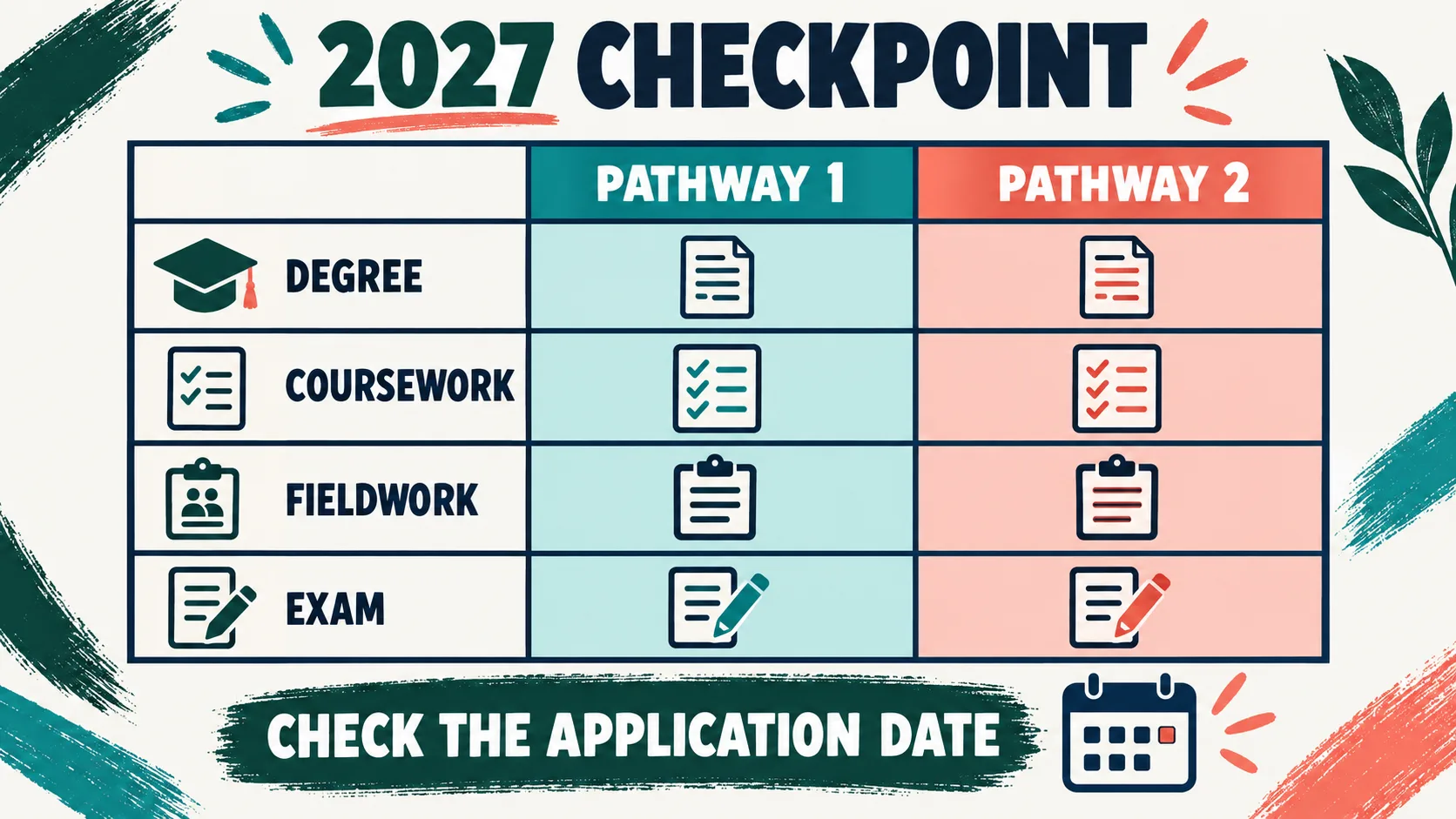
The BACB’s current 2027 summary says that, beginning January 1, 2027, applicants may use two eligibility pathways. Both involve a qualifying degree, behavior-analytic preparation, supervised fieldwork, and the BCBA examination, but the evidence is not identical. The handbook and official transition pages control; this article only gives you a way to decide which documents to verify.
| 2027 checkpoint | Pathway 1 | Pathway 2 | Your audit action |
|---|---|---|---|
| Degree | Master’s or doctoral degree from an applicable accredited or recognized behavior-analysis program. | Master’s degree or higher from a qualifying institution; confirm the current rule’s definition. | Save the program name, degree date, and the official pathway evidence that applies to you. |
| Coursework | Verify the recognized/accredited program record. | Verify the required behavior-analytic coursework and Pathway 2 program-contact attestation process. | Ask the institution how it will document the coursework before you submit. |
| Fieldwork | Practical fieldwork in applied behavior analysis using the current forms. | Practical fieldwork in applied behavior analysis using the current forms. | Check the application date and use the matching monthly and final verification forms. |
| Examination | Pass the BCBA examination under the current Test Content Outline. | Pass the BCBA examination under the current Test Content Outline. | Do not treat the Pennsylvania license packet as a substitute for the BACB examination. |
If you expect to apply around the transition, write the intended application date at the top of the folder and verify the official version immediately before submission. For Pathway 2, the BACB’s university guidance explains that an institution’s program contact has a role in attesting to coursework; candidates should not assume that an old course list or a self-created spreadsheet replaces that attestation. The 2027 forms and handbook are the source of truth.
Fix the packet before you submit
Most application delays are not caused by one dramatic problem. They come from an evidence mismatch: the document exists, but it proves a different requirement, uses the wrong date, or was sent to the wrong body.
| Warning sign | Likely issue | Next action |
|---|---|---|
| You have a degree but no pathway proof. | The degree may not be the evidence the selected BACB pathway requires. | Ask the program or BACB which official record establishes the applicable pathway. |
| Your hours are listed only as “ABA experience.” | The record may not show population, FBA work, treatment-plan duties, supervision, or dates. | Request a more specific verification mapped to the current requirement. |
| A clearance is older than the application window. | The document may not satisfy the Pennsylvania timing rule when received. | Check the current code and order the correct update before submission. |
| PALS shows incomplete after an upload. | The upload may be unreadable, attached to the wrong line, or awaiting third-party verification. | Save the deficiency message, correct only the requested item, and record the resubmission date. |
| You cannot tell whether the rule is BACB or Pennsylvania. | The packet has no credential owner or rule-version label. | Split the folder into BACB, PA license, and employer/payer sections before doing anything else. |
Turn the audit into a study and submission plan
Once the evidence gaps are visible, prioritize them in this order: first resolve eligibility or licensure blockers, then request third-party documents, then correct portal deficiencies, and only after that optimize your exam study schedule. A practice test cannot repair a missing transcript or clearance, but exam preparation can help you recognize the credential, ethics, measurement, supervision, and scope clues that appear in BCBA-style scenarios.
- Create one row for every requirement and assign an owner and due date.
- Mark the official source and version date beside every rule-sensitive row.
- Keep a separate list of questions for the BACB, Pennsylvania board, university, supervisor, employer, and payer.
- After each answer, update the packet rather than relying on memory or an old checklist.
- Use exam-style practice to review decision making, not to claim that practice results prove certification eligibility.
If your target is BCBA certification, the national BCBA certification pathway guide can supply the broader sequence. The official BACB Handbook and Pennsylvania sources should control the final application decision.
BCBA certification PA FAQ
Is BCBA certification the same as a Pennsylvania license?: No. BCBA is a BACB certification. Pennsylvania may have a separate behavior-specialist or other professional-license requirement depending on the service, role, and setting. Check the relevant state board and current employer or payer rules.
Does Pennsylvania require an exam for the behavior-specialist license?: The current Pennsylvania behavior-specialist snapshot says no examination is required for that license. That statement does not remove the BACB examination requirement for BCBA certification, and it should be rechecked against the current board instructions before you apply.
What documents can delay a Pennsylvania application?: Common delay points include third-party transcripts or verifications, background and child-abuse clearances, child-abuse training proof, experience records, and documents that become stale while an application is pending. Use PALS status messages and the current Pennsylvania Code rather than guessing which replacement document is needed.
Do the 2027 BCBA changes affect Pennsylvania licensure?: They affect the BACB certification evidence and pathway you use. They do not automatically rewrite Pennsylvania’s separate state-license rules. Keep the two checklists separate and verify both authorities for your intended application date.
Take the next accurate step
Before you submit, be able to answer five questions in one sentence each: Which credential am I applying for? Which rule version applies? What document proves each requirement? Which portal or board must receive it? What will I do if the evidence is deficient? If you can answer those questions, your application plan is much stronger than a generic “BCBA certification in PA” checklist copied from an old year.
If you are ready to practice the exam-side decisions, use the Free BCBA Mock Exam to work through credential, ethics, measurement, supervision, and scope scenarios. It is a study resource—not a license application, legal opinion, or guarantee of certification or exam success.
Official sources to recheck
Current reference points: the Pennsylvania Behavior Specialist Licensure Snapshot, 49 Pa. Code §18.523, Pennsylvania’s PALS application process, the BACB Handbook, the 2027 BCBA Requirements, and the BACB’s university transition guidance. Rules and application instructions can change; verify them before submitting.
Quick Review Checklist
Use this final checklist to turn bcba certification pa into exam-ready reasoning. The goal is not to memorize a label in isolation; it is to identify the relevant evidence and explain why the best answer fits the scenario. Key ideas to review:
- State the central definition or decision point for bcba certification pa in your own words.
- Identify the detail that makes bcba certification pa different from its closest related ABA term.
- Separate the observable facts in a scenario from assumptions that are not supported by the facts.
- Write one example and one nonexample so you can recognize the concept in a new setting.
Exam application checks:
- Ask what the question is actually requesting before comparing the answer choices.
- Mark the antecedent, response, consequence, or other evidence that supports the selected answer.
- Look for a distractor that describes a related process but does not answer the specific question.
Final self-check:
- Explain how you would verify the interpretation with clear observations or data.
- Change one detail in the scenario and decide whether your answer should change.
- Give a one-sentence rationale that a supervisor or study partner could evaluate.
Take the Free BCBA Mock Exam
A useful next step is to apply this idea in a fresh set of BCBA-style practice questions and review the feedback. Take the Free BCBA Mock Exam



