
BACB Guidelines for Responsible Conduct is a historical phrase, not the name of the current ethics standard for BCBA applicants and certificants. The BACB’s archived Guidelines document is provided for historical reference and is no longer in effect. The current document for BCBA and BCaBA applicants and certificants is the Ethics Code for Behavior Analysts, which went into effect on January 1, 2022.
Table of Contents
- In This Guide
- BACB Guidelines for Responsible Conduct: What It Was
- Why the Historical Phrase Still Appears in Search Results
- How the BACB Ethics Documents Changed Over Time
- Historical Guidelines Versus the Current Ethics Code
- What to Study for Current BCBA Ethics Questions
- How to Analyze an Older Practice Question
- Common BACB Guidelines Version-Control Mistakes
- Frequently Asked Questions
- Take the Free BCBA Mock Exam
That distinction matters because older study guides, course notes, flashcards, and exam questions may still use the older title. If you see this phrase, first identify the document version and its effective date. Then use the current BACB code for present-day professional conduct, while using the historical document only to understand older terminology or the evolution of BACB ethics requirements.
This article gives you a version-safe way to interpret the phrase, compare the old and current documents, and study without turning an archived rule into current advice. It is an educational overview, not legal or ethics advice, and the BACB’s current documents control when a summary conflicts with them.
In This Guide
BACB Guidelines for Responsible Conduct: What It Was
The Guidelines for Responsible Conduct for Behavior Analysts were an earlier BACB ethics document. The BACB’s archived PDF is titled “Guidelines for Responsible Conduct for Behavior Analysts (2001)” and states that it is provided for historical purposes only and is no longer in effect. The document itself explains that portions of certification examinations relating to ethical practices were based on the Guidelines at that time.
In practical terms, the historical document helped organize expectations about competence, integrity, professional relationships, confidentiality, records, supervision, research, public statements, and other professional conduct. Those subjects remain important, but the fact that a topic appears in both an old and a current document does not mean the wording, numbering, scope, or answer to a scenario is unchanged. Use the old PDF when you need to:
- Understand a citation in an older textbook, course, or exam-prep explanation.
- Interpret an archival ethics question that names the Guidelines explicitly.
- Study the history of BACB ethics requirements and terminology.
- Compare how a professional responsibility was framed before the current code.
Do not use it as the current authority for a live client decision, a current complaint process, a current application question, or a current BCBA practice policy. For those questions, start with the BACB’s current Ethics Codes page and the applicable law, licensure rule, or employer policy.
Why the Historical Phrase Still Appears in Search Results
The phrase continues to appear because the BACB ethics system developed through several document generations. Search engines also preserve old PDFs, university syllabi, quiz banks, and blog posts. A query can therefore have two different intents:
| Search situation | What the reader probably needs | Safe response |
|---|---|---|
| An older question names the Guidelines | The meaning of the historical term and the intended rule in that source. | Identify the edition, answer the historical question, then map the topic to the current code. |
| A current professional dilemma uses the old title | Current ethics requirements, reporting procedures, and applicable law. | Do not rely on the archived wording; open the current code and seek qualified guidance when needed. |
| A study guide mixes old and new labels | A version map showing which source controls the question. | Mark every note with the document title, edition, and effective date before memorizing it. |
This is why a useful article should not simply repeat the historical title as if it were current. The search demand is real, but the answer must resolve the version ambiguity in its first paragraph.
How the BACB Ethics Documents Changed Over Time
The BACB maintains an ethics history because older documents still help explain how the profession’s standards developed. The historical-resources page warns that archived documents are for historical reference and that newer documents define the current ethics standards and codes.
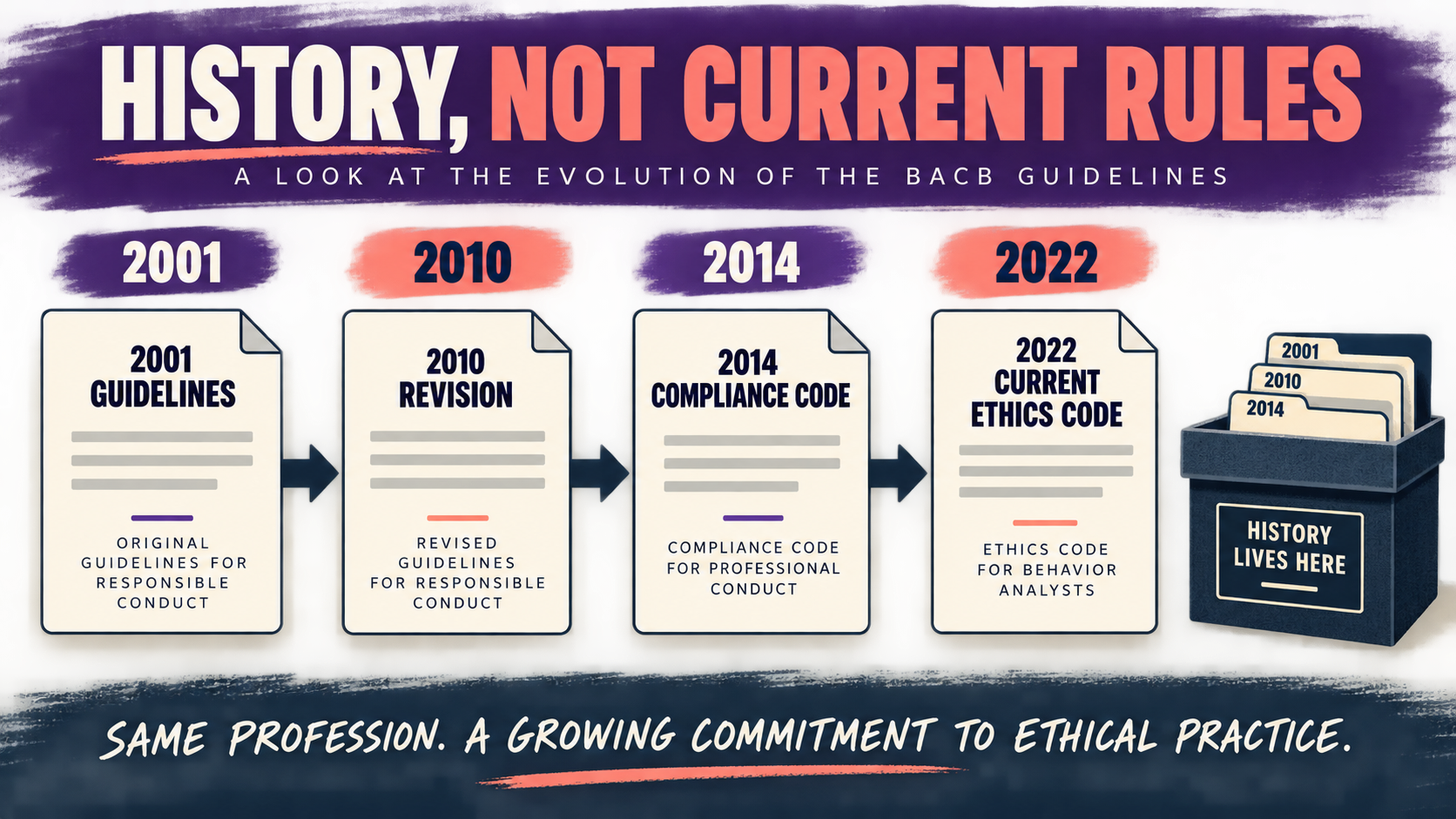
A simplified study timeline is:
- Earlier Guidelines: The Guidelines for Responsible Conduct organized early expectations for behavior analysts and were revised over time.
- 2010 revision context: Older materials may refer to revised Guidelines tied to the task-list and ethics education of that period.
- 2014 Professional and Ethical Compliance Code: This was a later code generation and is not the current code.
- 2022 current Ethics Code: The Ethics Code for Behavior Analysts replaced the 2014 code and became effective for BCBA and BCaBA applicants and certificants on January 1, 2022.
The timeline is useful for recognizing a source, not for memorizing a single “old rule.” The same broad concept—such as competence, confidentiality, or supervision—may be expressed differently in each generation. Always read the standard that belongs to the document named by the question or the current code that governs the present situation.
Historical Guidelines Versus the Current Ethics Code
The current Ethics Code is organized into six sections: Responsibility as a Professional, Responsibility in Practice, Responsibility to Clients and Stakeholders, Responsibility to Supervisees and Trainees, Responsibility in Public Statements, and Responsibility in Research. It also includes core principles, a glossary, application guidance, ethical decision-making steps, and enforcement information.
| Feature | Historical Guidelines | Current Ethics Code |
|---|---|---|
| Status | Archived; the BACB labels the document historical and no longer in effect. | Current ethics standard for BCBA and BCaBA applicants and certificants, subject to current BACB updates. |
| Organization | Earlier numbered guidelines and topic groupings. | Six responsibility sections, core principles, glossary, application, and enforcement guidance. |
| How to use it | Historical context or interpretation of an older source. | Starting point for current ethics study and present professional responsibilities. |
| Exam-prep warning | Do not assume old item numbers or wording are current. | Use the current code and current BACB exam materials for present preparation. |
The current code also says that lack of awareness or misunderstanding of an ethics standard is not a defense against an alleged violation. That does not mean every historical practice question has one timeless answer; it means a current professional must know and follow the requirements that apply now.
What to Study for Current BCBA Ethics Questions
If you are preparing for the BCBA exam, begin with the current BACB exam materials and the current Ethics Code rather than building your notes around an archived PDF. Focus on the reasoning pattern behind an ethics scenario:
- Identify who may be affected, including the client, stakeholders, supervisees, trainees, and other professionals.
- Separate a legal, licensure, employer, or funding requirement from a BACB ethics requirement; more than one may apply.
- Look for risk of harm, confidentiality concerns, conflicts of interest, competence limits, inaccurate reporting, or inadequate documentation.
- Use the exact current standard and its defined terms instead of relying on a familiar phrase from an older code.
- Choose an action that protects clients, follows the law, addresses the concern, and documents the steps taken.
- Check whether the scenario asks what a behavior analyst should do now or what an older document called the conduct.
The current code describes a structured ethical decision-making process that includes defining the issue, identifying relevant individuals, gathering documentation, identifying core principles and standards, considering possible actions, selecting an action, documenting it, and evaluating the outcome. That process is often more useful for new scenarios than memorizing an obsolete section number.
How to Analyze an Older Practice Question
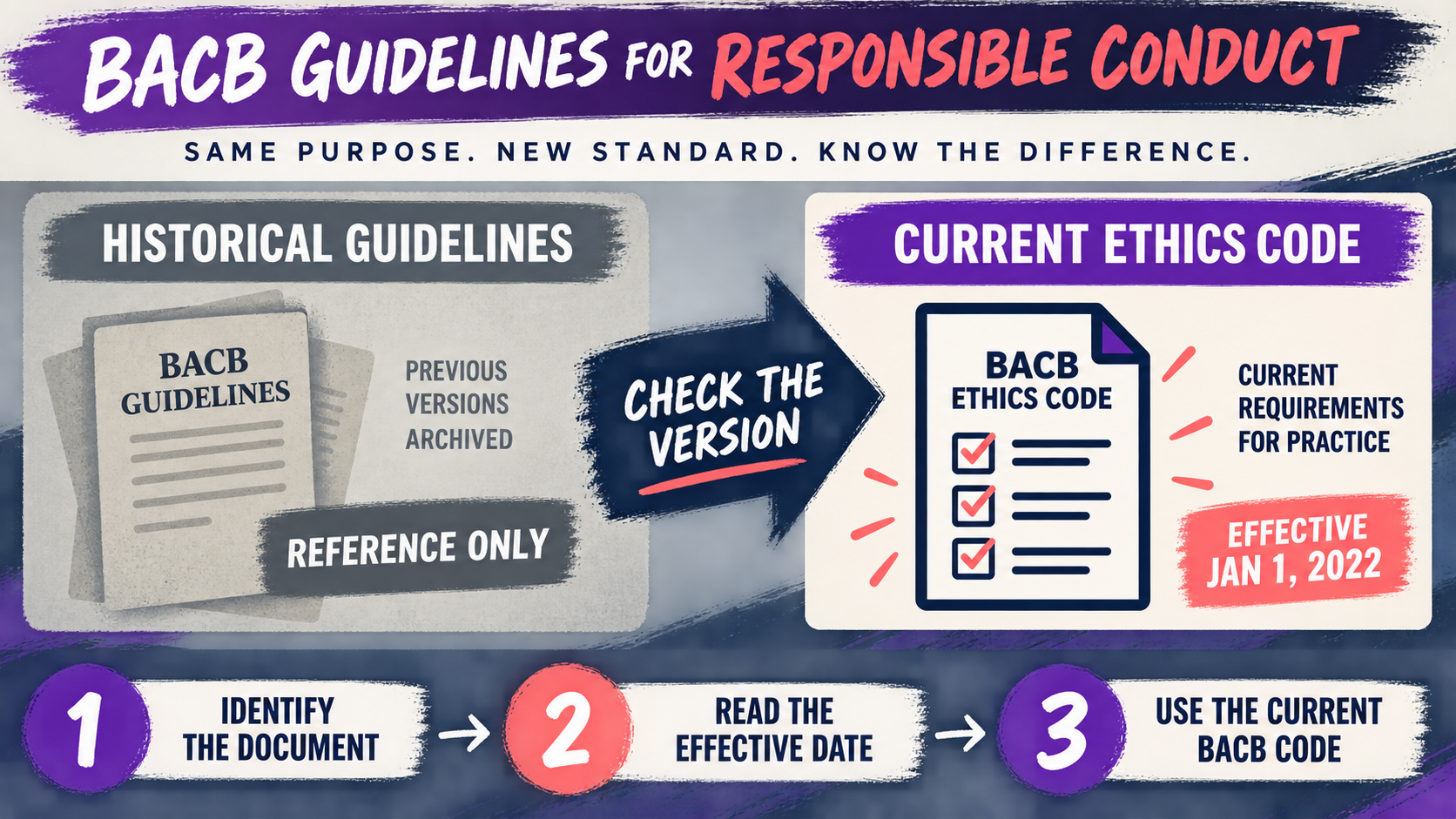
Suppose an old quiz asks which action violates “the BACB Guidelines for Responsible Conduct.” Do not immediately replace the words with the 2022 code and assume the quiz key is current. Use a four-step version check:
- Locate the source date. Look for the publication year, code title, task-list edition, or course date.
- Read the historical rule in context. Do not infer the entire code from a single sentence or a third-party summary.
- Map the topic forward. Find the related concept in the current Ethics Code, such as responsibility in practice, supervision, public statements, or research.
- Record both answers when studying. Label one “historical source answer” and the other “current code application” so the distinction remains visible.
For example, a question about protecting confidential information may appear in both an older guideline and the current code. The correct study move is not to treat the documents as interchangeable. Compare scope, defined terms, exceptions, and required action, then verify the current version before using the idea in practice.
Common BACB Guidelines Version-Control Mistakes
- Calling the archive current. The BACB labels the old Guidelines as historical and no longer in effect.
- Memorizing old numbers without the title. A number can point to a different topic in a later code.
- Using a search snippet as the rule. Open the official document and check the effective date and revision status.
- Mixing exam history with current compliance. An older question may explain why a phrase appears, but it does not replace current professional requirements.
- Ignoring other authorities. State licensure laws, employer rules, contracts, and applicable regulations may impose additional obligations.
- Reproducing an entire copyrighted code. Link to the BACB source, summarize the relevant idea, and keep your own explanation focused.
Frequently Asked Questions
Are the BACB Guidelines for Responsible Conduct still in effect?: No. The BACB’s archived Guidelines document is provided for historical purposes and states that it is no longer in effect. The current Ethics Code for Behavior Analysts applies to BCBA and BCaBA applicants and certificants effective January 1, 2022.
What replaced the BACB Guidelines for Responsible Conduct?: The BACB ethics system moved through later code generations, including the 2014 Professional and Ethical Compliance Code. The current document is the Ethics Code for Behavior Analysts, which replaced the 2014 code.
Should I study the old Guidelines for the BCBA exam?: Study the current BACB exam materials and current Ethics Code first. Review the old Guidelines only when an older course, question, or reference uses the phrase and you need to understand its historical context.
Where can I find the current BACB ethics document?: Use the BACB Ethics Codes page and open the current Ethics Code for Behavior Analysts from there. The BACB periodically updates documents, so avoid relying on a saved PDF without checking the official page.
Can the free BCBA mock exam replace ethics-code study?: No. The free BCBA mock exam can be used as a separate practice activity, but it is not BACB guidance, legal advice, a substitute for the current Ethics Code, or a guarantee of certification.
The best way to handle the BACB Guidelines for Responsible Conduct keyword is to treat it as a version-control question: recognize the historical document, label it clearly, use the current Ethics Code for present requirements, and connect older practice questions to current concepts without pretending the wording never changed.
Take the Free BCBA Mock Exam
If you want a low-pressure way to check your recall, use the free practice resource below. Take the Free BCBA Mock Exam



