
The reliability and validity of the Functional Analysis Screening Tool matter because FAST results are easy to overinterpret. FAST is an indirect questionnaire that can organize informant reports about events associated with problem behavior. It can help a BCBA form a preliminary hypothesis and decide what to examine next. It does not, by itself, demonstrate that attention, escape, tangible access, or automatic reinforcement is the confirmed function.
Table of Contents
- What Are the Reliability and Validity of the Functional Analysis Screening Tool?
- What Does Reliability Mean for FAST?
- What Does Validity Mean for FAST?
- How Should You Interpret a FAST Result?
- How Is FAST Different From a Direct Functional Analysis?
- How Can a BCBA Use FAST Responsibly?
- How Does the BCBA Exam Test FAST Reliability and Validity?
- Frequently Asked Questions
- Sources for Further Study
- Take the Free BCBA Mock Exam
For BCBA exam questions, keep two questions separate: reliability asks whether raters or administrations produce consistent results, while validity asks whether the result corresponds to the construct or comparison it is supposed to represent. The landmark Iwata, DeLeon, and Roscoe study examined both issues and found useful but limited evidence. The practical answer is not “FAST is useless” or “FAST proves function.” The better answer is that FAST is a screening and interview aid whose results require cautious interpretation and follow-up assessment.
What Are the Reliability and Validity of the Functional Analysis Screening Tool?
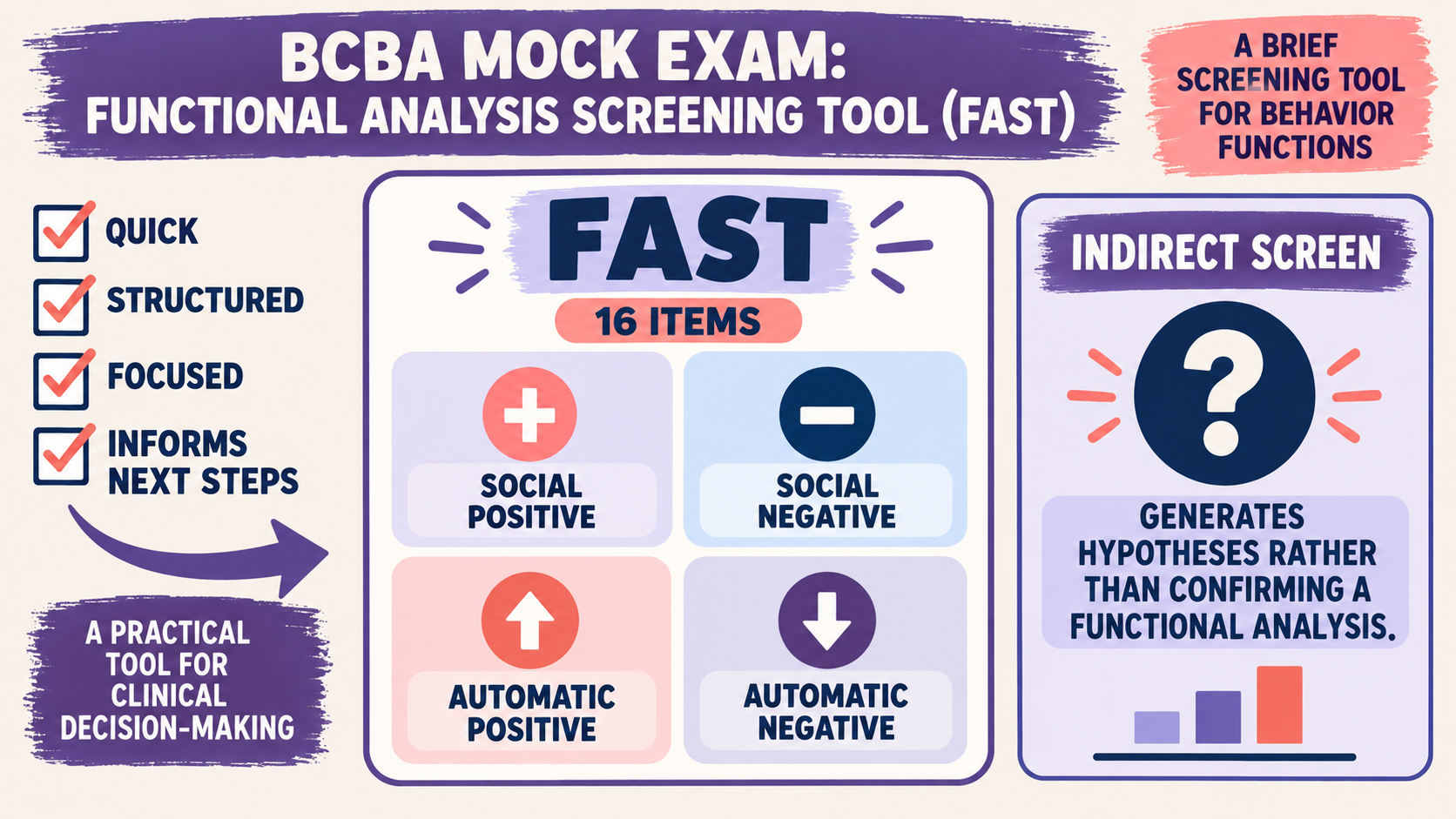
The Functional Analysis Screening Tool, commonly called FAST, is a structured indirect assessment. It asks an informant to report whether particular antecedent and consequent events tend to occur around problem behavior. The original research describes FAST as a 16-item questionnaire organized into four functional categories:
- Social-positive reinforcement: behavior may be associated with access to attention, tangibles, or other socially mediated reinforcers.
- Social-negative reinforcement: behavior may be associated with escape or avoidance of demands, activities, or social situations.
- Automatic-positive reinforcement: behavior may produce sensory stimulation or another internally generated consequence.
- Automatic-negative reinforcement: behavior may reduce an aversive physical or internal condition.
The categories are hypotheses about possible reinforcement contingencies. A high score means the informant endorsed more items related to that category. It does not mean the questionnaire directly observed the behavior, manipulated the contingency, or demonstrated a functional relation.
That distinction is important for study and practice. An indirect tool is often efficient when a clinician is beginning an interview or organizing information from people who know the learner. However, reports can be affected by memory, context, expectations, and the informant’s understanding of the questions. FAST can structure the conversation; it should not replace operational definitions, direct observation, or a properly selected functional assessment.
What Does Reliability Mean for FAST?
Reliability describes the consistency of measurement. In the FAST research, one reliability question was whether two informants who completed the questionnaire about the same problem behavior agreed on their item responses. If two raters independently endorse the same items, the screen is more consistent at the item level. If their highest-scoring functional categories differ, the outcome is less stable for decision-making.
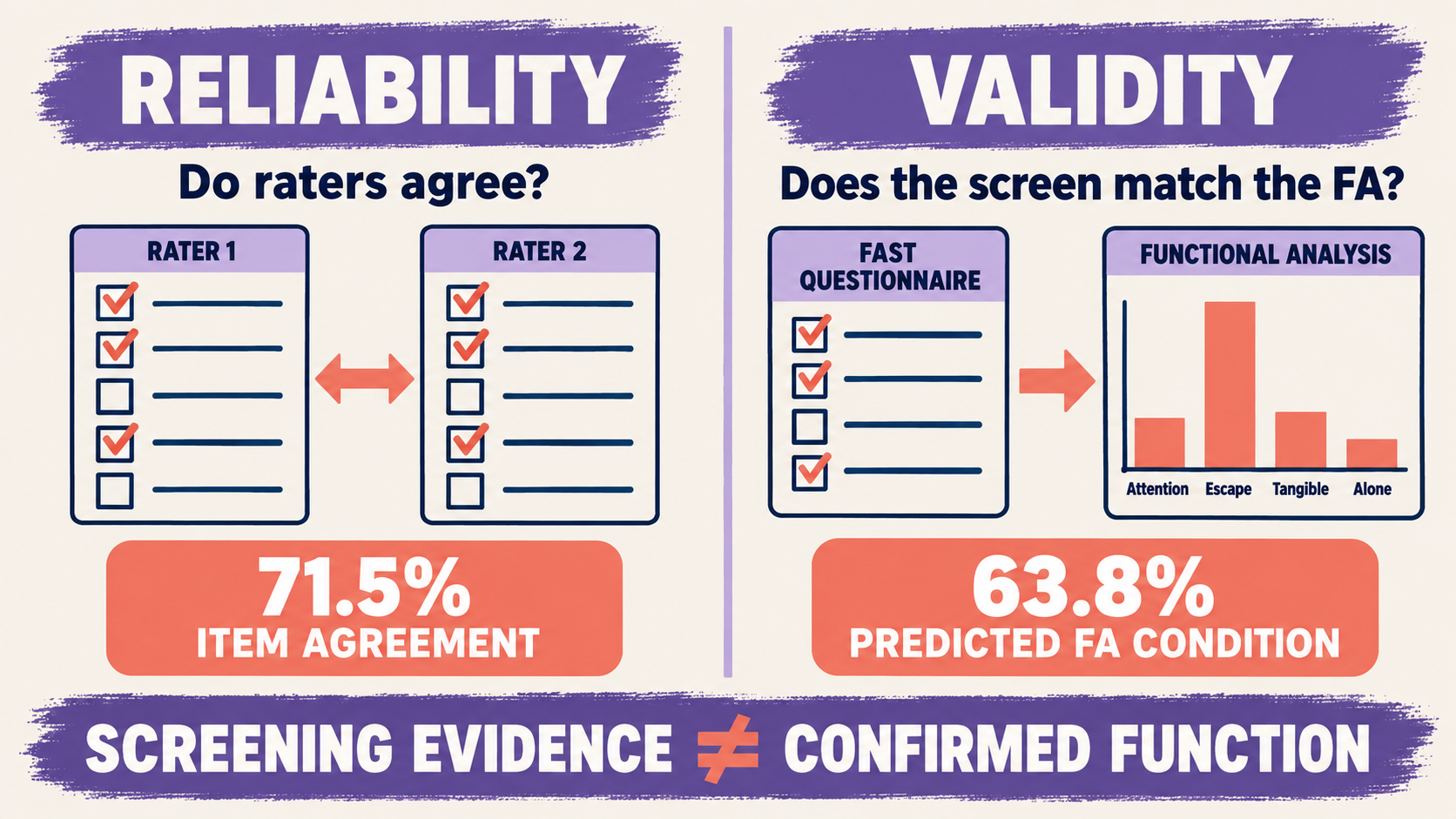
In the Iwata, DeLeon, and Roscoe study, mean item-by-item agreement between pairs of informants was 71.5%. Agreement for individual items ranged from 53.3% to 84.5%. Agreement on the highest FAST outcome, based on the informants’ highest category totals, was 64.8%. Those numbers show why an exam question may describe FAST reliability as moderate rather than perfect.
Reliability is not the same as accuracy. Two people can agree with each other and still be wrong about the actual maintaining contingency. For example, two caregivers may both believe that a learner’s aggression is maintained by escape. Their agreement demonstrates consistency between reports, but it does not prove that escape is the function. The analyst still needs to evaluate the evidence and decide whether a direct assessment is needed.
| Reliability question | What it tells you | What it does not tell you |
|---|---|---|
| Do raters endorse the same items? | Consistency of item-level reports | That the reported function is confirmed |
| Do raters identify the same highest category? | Stability of the leading hypothesis | A demonstrated cause-and-effect relation |
| Would a second administration produce a similar pattern? | Possible repeatability under similar conditions | That the score will generalize to every setting |
What Does Validity Mean for FAST?
Validity asks whether a measure supports the interpretation being made from it. For FAST, one important validity comparison is whether the category with the highest FAST score corresponds to the condition that produces the highest rate of problem behavior in a functional analysis. A functional analysis directly arranges test and control conditions and measures behavior under those conditions; the FAST gathers indirect report data.
In the study’s comparison with 69 functional analyses, the FAST’s highest score predicted the functional-analysis condition with the highest rate of problem behavior in 44 cases, or 63.8%. That is evidence of correspondence in a particular sample and comparison. It is not a 63.8% guarantee that a FAST result is correct for a new client. It also does not turn an indirect questionnaire into a direct experimental analysis.
The study’s conclusion is especially useful for exam reasoning: FAST reliability and validity were not adequate for using the tool as a replacement for a functional analysis when treatment decisions require a demonstrated function. The tool may help structure a preliminary interview, identify possible contingencies, and inform the design of follow-up assessment. The analyst must state what the evidence supports and what it does not support.
For example, if the social-negative category has the highest score, a careful interpretation is: “Informant responses suggest that escape from demands may be a leading hypothesis.” An overconfident interpretation is: “The FAST proves the behavior is escape-maintained.” The first statement preserves the distinction between screening evidence and functional confirmation.
How Should You Interpret a FAST Result?
Start with the measurement level. A FAST score is a pattern of informant responses, not a direct frequency, duration, latency, or rate measure of problem behavior under manipulated conditions. Before using the result, ask who completed the form, how familiar that person is with the behavior, which situations were considered, and whether the behavior was defined clearly enough for the questions to be answered consistently.
Next, look at the separation between categories. A large difference between the highest and next-highest category may provide a clearer hypothesis than a near tie. A near tie should not be resolved by simply selecting the first category on the page. It may signal that additional interviews, observation, record review, or direct assessment is needed.
Also check for a mismatch between the report and direct evidence. If the FAST points to attention but observation shows that problem behavior reliably ends a difficult task, the analyst should not force the observation into the questionnaire result. The conflicting evidence is a reason to refine the operational definition, gather more data, and examine the contingencies more directly.
Finally, consider the risk of the behavior and the cost of an incorrect hypothesis. When problem behavior is severe, dangerous, or treatment-resistant, a quick indirect screen may be useful for planning but is not a reason to skip a more rigorous assessment. Safety, informed consent, dignity, and qualified clinical oversight remain part of responsible assessment.
How Is FAST Different From a Direct Functional Analysis?
FAST and a functional analysis answer related but different questions. FAST asks an informant to report patterns that may be associated with problem behavior. A direct functional analysis manipulates relevant environmental conditions and measures the behavior’s differential responding across conditions. The direct analysis is designed to demonstrate a functional relation when the arrangement is valid and implemented safely.
| Feature | FAST | Functional analysis |
|---|---|---|
| Assessment type | Indirect questionnaire and interview support | Direct experimental assessment |
| Primary data source | Informant report | Observed behavior under arranged conditions |
| Main result | Leading hypothesis about possible function | Differential responding that can support a functional relation |
| Best exam distinction | Efficient screen; do not treat as confirmation | Manipulates conditions to test the behavior–consequence relation |
How Can a BCBA Use FAST Responsibly?
A responsible workflow treats FAST as one part of an assessment sequence. The analyst can use it to prepare a focused interview, identify events to observe, prioritize possible test conditions, and explain why a more direct assessment may be needed. The tool is most useful when it makes the next step clearer rather than when it is used to end the assessment process.
- Define the target behavior. Use an observable, measurable definition before asking informants to identify patterns.
- Select informed respondents. Ask people who have frequent and recent contact with the behavior, and document the context of their reports.
- Compare the pattern across informants. Look for agreement, disagreement, near ties, and possible setting events.
- Observe the behavior directly. Compare reported antecedents and consequences with ABC data or another appropriate descriptive assessment.
- Choose the next assessment based on risk and uncertainty. When a function must be demonstrated, use a qualified and safe functional-analysis process rather than relying on the screen alone.
- Evaluate treatment data. If an intervention is selected, monitor behavior change, treatment integrity, generalization, and social validity.
These steps also prevent a common error: using a high FAST category as a label for the person or the behavior. The score is not a diagnosis, and it does not establish that the behavior is intentional, manipulative, or caused by one simple variable. Functional assessment describes relations among behavior and environmental events; it does not replace respectful clinical reasoning.
How Does the BCBA Exam Test FAST Reliability and Validity?
BCBA exam questions often give you a tempting answer that confuses agreement with accuracy. If two informants choose the same FAST category, that supports interrater agreement or consistency. It does not automatically support validity. If FAST results are compared with a functional analysis and the leading category corresponds to the highest FA condition, that is evidence relevant to predictive or concurrent validity in the described study—not proof that every future FAST score will be correct. Watch for these exam traps:
- “The FAST identified the function.” Unless the question specifically describes a confirmed functional relation, say that FAST suggested a hypothesis.
- “The raters agreed, so the tool was valid.” Agreement is a reliability result; validity asks whether the interpretation is accurate or meaningful for the intended construct.
- “A 63.8% correspondence rate proves the tool is accurate.” The percentage describes one research comparison and does not guarantee an individual result.
- “Indirect assessment is always invalid.” Indirect tools can be efficient and useful for hypothesis generation; the key is not overstating their evidence.
- “FAST replaces a functional analysis.” The original study and responsible practice distinguish a screening questionnaire from a direct experimental assessment.
The BACB’s current BCBA Test Content Outline includes assessment, measurement, and data-based decision-making competencies. When a question asks about FAST, identify the assessment type first, then decide whether the described result is about consistency, correspondence, or a demonstrated functional relation.
Frequently Asked Questions
What is the Functional Analysis Screening Tool?: FAST is a 16-item indirect questionnaire that organizes informant reports into four possible functional categories. It is used to generate or refine hypotheses about problem behavior; it is not a direct functional analysis.
What did the reliability study find?: The reported mean item-by-item agreement between informant pairs was 71.5%, with individual item agreement ranging from 53.3% to 84.5%. Agreement on the highest outcome category was 64.8%.
What did the validity comparison find?: When FAST outcomes were compared with 69 functional analyses, the highest FAST score predicted the condition with the highest rate of problem behavior in 44 cases, or 63.8%. That is useful evidence but not a universal accuracy guarantee.
Can FAST results be used to choose treatment?: FAST may help organize an interview and guide the next assessment step. Treatment decisions should be based on a broader body of evidence, including direct observation, functional assessment when indicated, treatment integrity, safety, and ongoing outcome data.
The key takeaway about the reliability and validity of the Functional Analysis Screening Tool is simple: FAST can make an initial hypothesis more organized, but it cannot turn an informant questionnaire into a confirmed function. Separate reliability from validity, separate screening from experimental analysis, and interpret every score within the behavior, context, and decision the data are meant to support. After studying the distinction, use the free BCBA mock exam to practice assessment, measurement, and data-based decision questions. It is a study aid, not a BACB protocol or certification guarantee.
Sources for Further Study
- Iwata, DeLeon, and Roscoe: Reliability and Validity of the Functional Analysis Screening Tool — original Journal of Applied Behavior Analysis study.
- Open PDF of the FAST reliability and validity study — full research article.
- Reliability and Validity of Indirect Assessment Outcomes — context for indirect assessment and informant reports.
- BCBA Test Content Outline, 6th edition — official BACB source for assessment, measurement, and data-based decisions.
Take the Free BCBA Mock Exam
If you want a low-pressure way to check your recall, use the free practice resource below. Take the Free BCBA Mock Exam



