
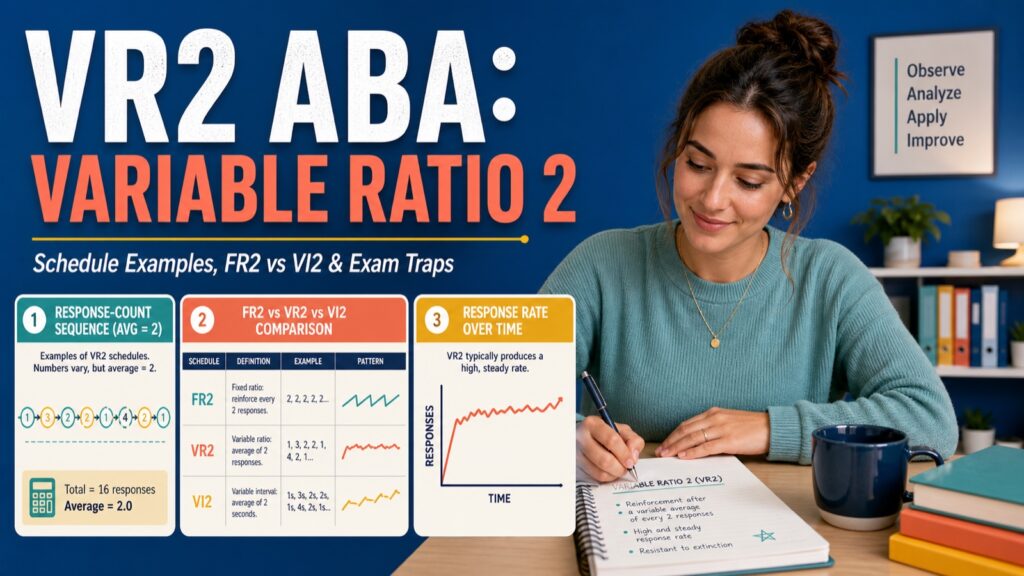
VR2 ABA refers to a variable-ratio schedule in which reinforcement is delivered after a changing number of responses, with an average requirement of two responses per reinforcer. The number is an average, not a fixed rule. A learner might be reinforced after one response, then after three, then after two, as long as the schedule is arranged and described accurately. On the BCBA exam, the main challenge is separating a variable ratio from a fixed ratio and from a variable-interval schedule.
Table of Contents
- How VR2 ABA Appears on the BCBA Exam
- What a Variable Ratio 2 Schedule Means
- How to Read the Contingency
- VR2 vs FR2 and VI2
- VR2 ABA Examples
- Response Patterns and Postreinforcement Pauses
- How to Measure a VR2 Schedule
- Designing and Fading a Ratio Schedule
- Common VR2 Exam Traps
- Quick Review Checklist
- Frequently Asked Questions
- Take the Free BCBA Mock Exam
- References
This guide explains how to identify a VR2 schedule, write the contingency clearly, compare it with neighboring schedules, measure responding, and avoid common schedule-of-reinforcement traps. It uses practical ABA scenarios involving token boards, teaching trials, data collection, and maintenance. The focus is functional analysis of the schedule, not memorizing the label without checking what determines reinforcement.
How VR2 ABA Appears on the BCBA Exam
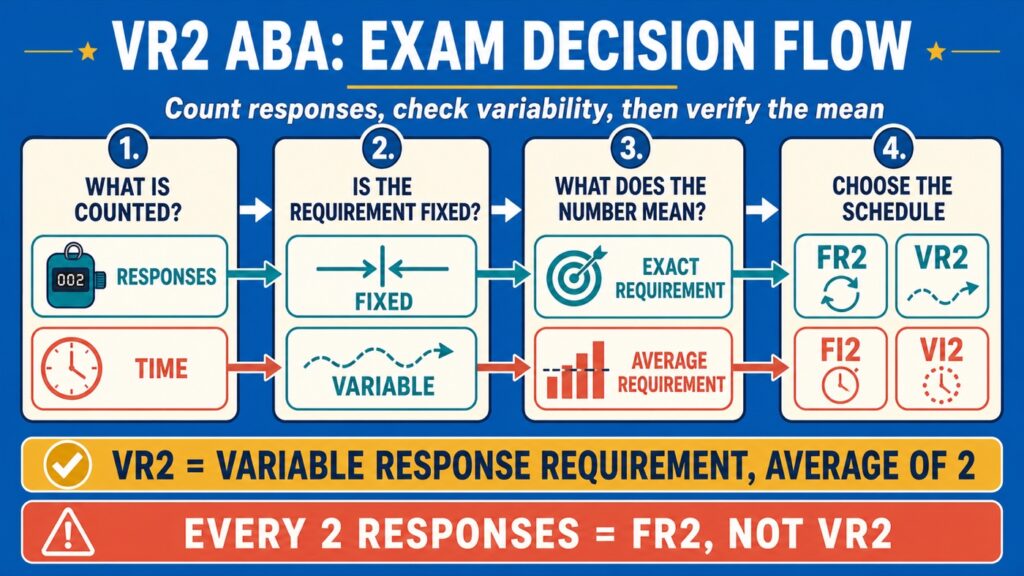
Exam questions about VR2 ABA usually provide the reinforcement rule in a short scenario. The stem may say that the learner receives a reinforcer after a changing number of responses, that the average requirement is two, or that the teacher uses a schedule that prevents the learner from predicting the exact response requirement. You must identify the dimension that determines reinforcement and whether the requirement is fixed or variable. Use this sequence when reading the item:
- Ask whether reinforcement depends on the number of responses or on the passage of time.
- If it depends on responses, identify ratio rather than interval.
- Ask whether the response requirement stays the same or changes from opportunity to opportunity.
- Check whether the stated number is an average, a minimum, or a fixed requirement.
- Identify what consequence follows the qualifying response and whether it changes future responding.
- Choose the schedule label that matches the contingency, not the learner’s response rate.
A fast response rate does not automatically mean variable ratio, and a slow response rate does not automatically mean interval. Schedule names describe how reinforcement is arranged. The learner’s performance pattern is an outcome to measure, not the definition of the schedule.
When an item says “on average every two responses,” do not translate it to “after exactly two responses.” The word variable means the ratio requirement changes. A sequence of 1, 3, 2, 2, and 2 responses has an average of 2, but the sequence and how it is generated must still be specified.
What a Variable Ratio 2 Schedule Means
A variable-ratio schedule reinforces the first response after a changing number of responses. In a VR2 schedule, the average response requirement is two. The schedule is response-based, so time passing by itself does not complete the requirement. If the learner does not respond, the schedule does not advance simply because a minute passed. The symbol VR2 contains two pieces of information:
- V: the response requirement varies across reinforcement opportunities.
- R: reinforcement depends on a number or count of responses.
- 2: the average number of responses required per reinforcer is two.
- Contingency: the response must occur before the arranged ratio is completed.
- Consequence: the specified reinforcer is delivered after the qualifying response.
For instruction, the schedule must be implemented consistently enough that the learner contacts the programmed contingency. A teacher might arrange requirements of 1, 3, 1, 2, and 3 across consecutive reinforcement opportunities. The average of this particular sequence is 2, but the analyst should document the schedule-generation method, the actual requirements, and the reinforcer delivered.
Do not call a schedule VR2 merely because the teacher occasionally reinforces after one or three responses. The schedule must be planned as a variable-ratio arrangement with a defined mean. Random, undocumented delivery may create an unpredictable pattern, but unpredictability alone is not a complete schedule description.
How to Read the Contingency
To classify a schedule, rewrite the sentence as a contingency. Start with the target response, then ask what event determines when reinforcement becomes available. If the count of responses determines availability, it is a ratio schedule. If elapsed time determines availability, it is an interval schedule. Next, ask whether that requirement is fixed or variable. Use this functional mapping:
- Response unit: define what counts, such as each correct label or each completed task.
- Requirement: specify how many responses are needed for the next reinforcer.
- Variation: state whether the requirement stays constant or changes.
- Mean: state the average when a variable ratio is used.
- Delivery rule: identify which response produces the reinforcer after the requirement is met.
Suppose a learner earns a token after an average of two completed math problems, with requirements changing from opportunity to opportunity. That is consistent with a VR2 schedule if the problem completion is the response unit and the token follows the qualifying response. If a token becomes available after two minutes regardless of how many problems the learner completes, that is not VR2; it is time-based and may be a VI schedule if availability varies around a mean interval. The visual comparison below shows how response count, time, and predictability determine the schedule label. It also separates the schedule arrangement from the response pattern that may develop.
VR2 vs FR2 and VI2
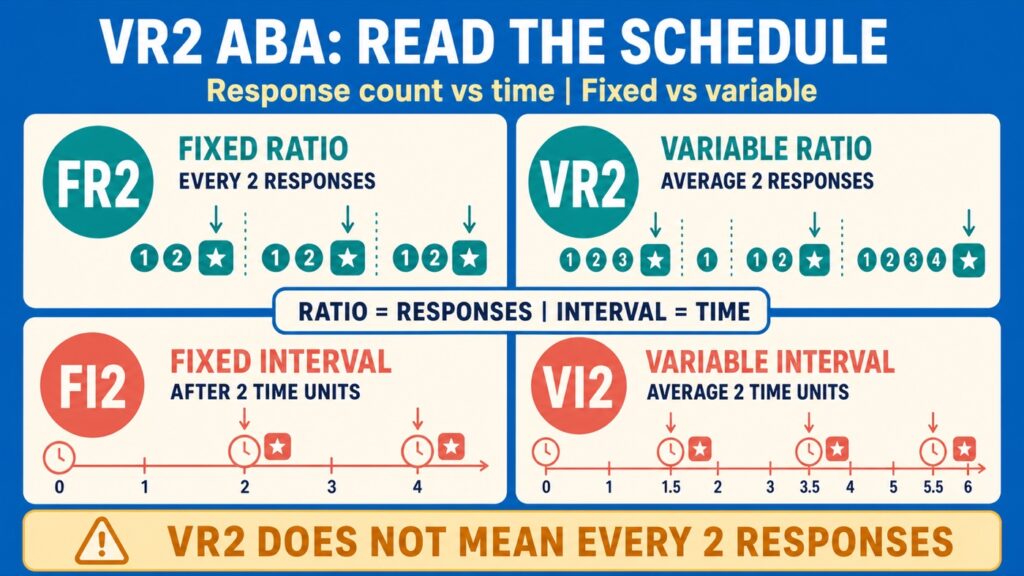
VR2, FR2, and VI2 can sound similar because each includes the number two. The final symbol and the dimension of the requirement are decisive. FR2 means reinforcement after every second response. VR2 means a changing response requirement averaging two. VI2 means the first response after an average interval of two time units, with the interval changing across opportunities.
- FR2: fixed ratio; two responses are required every time.
- VR2: variable ratio; a changing number of responses is required, averaging two.
- FI2: fixed interval; the first response after two time units is reinforced.
- VI2: variable interval; the first response after a changing interval averaging two time units is reinforced.
- FT2: fixed time; a consequence is delivered after two time units independent of responding.
- VT2: variable time; a consequence is delivered after changing time intervals independent of responding.
Ratio schedules are response-based; interval schedules are time-based. Fixed schedules keep the requirement predictable; variable schedules change the requirement around a mean. A learner’s high rate of responding does not turn an interval schedule into a ratio schedule, and an unpredictable delivery pattern does not turn every arrangement into VR2.
Consider three examples. A token after exactly two correct answers is FR2. A token after one, three, or two correct answers in a planned sequence with a mean of two is VR2. A token after the first correct answer following intervals that average two minutes is VI2. The response may be the same in all three examples; the contingency is what changes.
VR2 ABA Examples
Example 1: Token board. A learner earns a token after a changing number of completed independent tasks. The requirements are arranged around a mean of two, and the token is delivered after the qualifying task. The analyst records the exact requirement and the response that completed it. This is a VR2 arrangement if the task completion is the response unit and the sequence is intentionally variable.
Example 2: Communication practice. During a requesting session, the instructor reinforces an independent request after a variable number of correct requests averaging two. The request must be defined, and prompts should be recorded separately. If the instructor simply gives access after a random amount of time, the arrangement is not VR2.
Example 3: Classroom participation. A student earns brief access to a preferred activity after contributing a changing number of relevant answers, averaging two. The teacher should define what counts as a relevant answer and avoid shifting the requirement without documentation. If the teacher reinforces every second answer, the schedule is FR2 instead.
Example 4: Task completion. A learner receives praise after a variable number of completed steps around a mean of two. The response unit might be each independently completed step, not the entire activity. If the unit is unclear, the schedule cannot be classified confidently.
Example 5: Maintenance probe. After a skill is established, the analyst uses a planned VR2 schedule to thin reinforcement while maintaining responding. Data show the exact ratio requirements, independent responses, prompted responses, and reinforcers delivered. The schedule label describes the programmed rule, while the data show whether maintenance occurred.
In each example, identify the response unit before calculating the ratio. “Two tasks” and “two steps” are not interchangeable if the task contains several measurable responses. The analyst should also distinguish an earned reinforcer from praise or access that happens to occur nearby but is not contingent on the qualifying response.
Response Patterns and Postreinforcement Pauses
Variable-ratio schedules often produce relatively high and steady response rates because the next requirement is difficult to predict. A learner cannot know whether the next reinforcer will follow one response or several. However, the response pattern is not the definition of VR2. A low rate can occur if the reinforcer is weak, the response is effortful, the schedule is poorly implemented, or other variables compete with responding.
Fixed-ratio schedules may produce a postreinforcement pause because the learner can predict that a new requirement must be completed. Variable-ratio schedules generally reduce predictability and may produce less pronounced pauses. Do not select VR2 merely because a stem mentions steady responding. Confirm that the requirement varies and is response-based. When interpreting performance, consider:
- Whether the learner understands the response requirement.
- Whether the reinforcer remains valuable under current motivating operations.
- Whether the response is defined consistently across observers.
- Whether prompts or errors count toward the programmed ratio.
- Whether the schedule is truly variable around a documented mean.
- Whether the learner contacts delayed or competing consequences.
A ratio schedule can also generate frustration if the requirement is increased too quickly or if the learner cannot predict when reinforcement will occur. The analyst should monitor response quality, problem behavior, task engagement, and preference changes instead of pursuing a high rate at the expense of socially meaningful performance.
How to Measure a VR2 Schedule
Measurement should document both the programmed schedule and the learner’s behavior. Record the ratio requirement for each reinforcement opportunity, the number of responses emitted, the number of independent responses, prompts, errors, latency, and the consequence delivered. Without the actual sequence, a claim that the schedule is VR2 may be impossible to verify. Useful measures include:
- Responses per reinforcer: calculate the ratio completed for each reinforcer and examine the mean across opportunities.
- Rate: record responses per minute when comparing performance across sessions.
- Postreinforcement pause: measure time from reinforcer delivery to the next response.
- Independent response percentage: separate prompted responding from schedule-controlled responding.
- Accuracy or quality: confirm that a high response rate does not reduce skill quality.
- Problem behavior: monitor behavior that may signal excessive response effort or unclear contingencies.
Suppose five reinforcement opportunities require 1, 3, 1, 2, and 3 responses. The mean is 2. If the teacher actually delivers reinforcement after 1, 3, 1, 2, and 4 responses, the mean is 2.2 for that sample, even if the planned schedule is described as VR2. Report the planned schedule and the observed implementation separately.
Graph the data across sessions rather than relying on one average. A mean can hide a sequence that is too predictable, too effortful, or inconsistently implemented. The analyst should also verify whether the learner’s future responding changes when the schedule is introduced or thinned.
Designing and Fading a Ratio Schedule
Schedule design should start with a response that the learner can perform and a reinforcer that is likely to be effective. Define the response, establish the contingency, and confirm that the learner contacts reinforcement. A variable ratio is not a substitute for teaching the response or for assessing motivation. A practical design sequence is:
- Define the response unit and what counts as an independent response.
- Identify a meaningful reinforcer and how it will be delivered.
- Begin with a schedule the learner can contact successfully.
- Introduce planned variability only after the response-reinforcer relation is clear.
- Record each ratio requirement and check the mean.
- Monitor responding, quality, prompts, problem behavior, and learner choice.
- Adjust gradually and evaluate maintenance across people and settings.
Do not make the learner guess whether any response will be reinforced. The schedule can be variable while the overall contingency remains understandable and ethical. Use clear signals, predictable session routines, and accessible communication when the learner needs help or a break.
When fading reinforcement, do not assume that a larger ratio is automatically better. Increase response effort only when data show that the skill remains strong and the change is socially valid. If responding drops, return to a more effective schedule, examine reinforcer value, and check for competing variables. The second visual below summarizes the exam decision path from response count to fixed or variable requirement, then to the final schedule label and measurement check.
Common VR2 Exam Traps
The most common trap is treating VR2 as reinforcement after exactly two responses. That is FR2. The second trap is confusing a changing response requirement with a changing time interval. The third is selecting the schedule from the learner’s response rate instead of from the programmed contingency.
- Do not read the “2” as a fixed requirement without checking the first symbol.
- Do not call a schedule ratio when elapsed time determines reinforcement.
- Do not call a schedule variable because the teacher is inconsistent or undocumented.
- Do not count prompted responses as independent responses unless the definition says they count.
- Do not assume a high steady rate proves VR2.
- Do not calculate the mean without recording the actual ratio requirements.
- Do not confuse the programmed schedule with the consequence’s effectiveness.
- Do not increase ratio requirements without monitoring quality and problem behavior.
- Do not ignore the response unit; tasks, steps, and trials may be different units.
When two options remain, translate each one into a sentence. “Reinforcement follows a changing number of responses averaging two” is VR2. “Reinforcement follows every second response” is FR2. “The first response after a changing amount of time averaging two minutes is reinforced” is VI2. This translation usually reveals the correct option.
Quick Review Checklist
Before answering a question about VR2 ABA, check:
- What exact response is being counted?
- Does response count or elapsed time determine reinforcement?
- Is the requirement fixed or variable?
- Does the number indicate a fixed value or an average?
- Is the reinforcer delivered after a qualifying response?
- Are prompts, errors, and responses defined consistently?
- Is the planned ratio sequence documented?
- Does the observed mean match the planned schedule?
- Are responding quality, latency, pauses, and problem behavior measured?
- Is the intervention socially valid and function-based?
The shortest rule is: ratio means responses, variable means changing requirements, and 2 means the average response requirement. VR2 is not “every two responses.” Always reconstruct the contingency before choosing the label.
Frequently Asked Questions
What does VR2 mean in ABA?: VR2 means a variable-ratio schedule with a changing response requirement that averages two responses per reinforcer. It does not mean that reinforcement occurs after exactly two responses every time.
What is the difference between VR2 and FR2?: FR2 reinforces after every second response. VR2 reinforces after a changing number of responses with an average of two. FR2 is predictable; VR2 is variable around its mean. Is VR2 based on time?: No. VR2 is response-based. A schedule based on a changing time interval averaging two time units would be VI2, not VR2. How do you measure a VR2 schedule?: Record the exact response requirement completed before each reinforcer, calculate the observed mean, and measure rate, independence, quality, pauses, prompts, and problem behavior.
Does a high response rate prove that a schedule is VR2?: No. Response rate is an outcome. The schedule is classified from the programmed contingency: what determines reinforcement and whether that requirement is fixed or variable.
Take the Free BCBA Mock Exam
Ready to test your understanding of VR2 ABA? Take the free BCBA mock exam and practice distinguishing response-based schedules from time-based schedules, fixed requirements from variable requirements, and average values from exact requirements. Use the checklist whenever a question includes FR2, VR2, VI2, or a token schedule.
References
For examination context and the current task-list framework, consult the BACB BCBA Test Content Outline. Use current coursework, supervision, and applicable clinical guidance when designing reinforcement schedules and evaluating learner outcomes.



