

Introduction to Overgeneralization in Applied Behavior Analysis
Have you ever taught a child to say “dog” and then watched them point to a cat and say “dog”? That is a classic moment when learning goes a bit too far. In behavior analysis, we call this overgeneralization. It happens when a behavior that was reinforced in one context expands to other contexts where it is not appropriate. For BCBA exam candidates, understanding this concept is essential because it frequently appears in scenario-based questions and practical applications.
Table of Contents
- Introduction to Overgeneralization in Applied Behavior Analysis
- Real-World Examples of Overgeneralization in ABA
- Overgeneralization and the BCBA Exam: What You Need to Know
- Addressing Overgeneralization: The Role of Discrimination Training
- Quick Checklist for Overgeneralization in ABA
- Final Thoughts and Additional Resources
- Take the Free BCBA Mock Exam
In technical terms, overgeneralization is the excessive application of a discriminated operant. Think of it as stimulus generalization that is too broad. While stimulus generalization is a natural and often desirable process—like a child learning to say “ball” for many round objects—overgeneralization becomes a problem when the response occurs in the presence of stimuli that should not evoke it. For instance, saying “ball” for a balloon is acceptable, but saying it for a plate is not. This distinction is critical in clinical settings, where precise responding is often the goal.
What Is Overgeneralization?: Let’s start with a plain-language definition: overgeneralization is when a learned behavior occurs in situations that are too dissimilar from the original training context. In ABA, we often refer to the three-term contingency (antecedent-behavior-consequence). Overgeneralization implies that the antecedent control is not sharp enough. The behavior is under the control of a broader class of stimuli than intended.
For example, if a child learns to request “juice” only when a specific juice box is present, but later says “juice” when seeing a milk carton, that is overgeneralization. The response is not differentiated across relevant stimuli. This can lead to ineffective communication or safety issues. In the BCBA exam, you may be asked to identify whether a behavior is an example of overgeneralization or a different concept like faulty stimulus control.
Overgeneralization vs. Stimulus Generalization: It is easy to confuse overgeneralization with stimulus generalization, but the difference lies in appropriateness. Stimulus generalization is the tendency for a behavior to occur in the presence of stimuli that share physical properties with the training stimulus. It is often adaptive—for example, a child who learns to say “dog” for a Golden Retriever may also say it for a Poodle. That is expected and desirable.
Overgeneralization occurs when the response extends to stimuli that are not similar enough. For instance, if the same child says “dog” for a cat, a horse, or even a cow, that is overgeneralization because those stimuli do not share the critical features of the original dog. In clinical practice, we use discrimination training to sharpen stimulus control and reduce overgeneralization. The goal is to reinforce responding in the presence of the correct stimulus (S^D) and not in the presence of the incorrect one (S^Delta). Understanding this balance is a core skill for any behavior analyst.
Real-World Examples of Overgeneralization in ABA
To master overgeneralization for the exam, you need to see it in action. Real-world examples help you recognize the pattern in scenario questions. Each example below includes a brief ABC analysis to highlight how antecedents and consequences contribute to the behavior. Remember, the function of the behavior is crucial for designing effective interventions.
Example 1: A Child and the Word “Dog”: Consider 3-year-old Maya, who learns to say “dog” when she sees her family’s Golden Retriever. The parents reinforce this by smiling and saying, “Yes, that’s a dog!” One day, at the park, Maya sees a cat and exclaims, “Dog!” The parents laugh and say, “No, that’s a cat.”
- Antecedent: Seeing a four-legged animal (cat)
- Behavior: Saying “dog”
- Consequence: Adult attention (laughing, correction)
In this case, the hypothesized function is likely attention because the behavior receives adult reactions. The child has overgeneralized the label “dog” to all small, furry animals. The intervention would involve teaching discrimination between dogs and other animals, perhaps using picture cards and reinforcing only correct responses.
Example 2: Social Skills and “Sharing”: Seven-year-old Liam has been taught to share his toys with his younger brother at home to avoid tantrums. His parents praise him for sharing. At school, Liam starts sharing all his belongings—including his lunch, his pencil, and even his jacket—with classmates, even when they do not ask. This leads to his own needs being neglected and peers taking advantage.
- Antecedent: Presence of peers (any context) or perceived expectation
- Behavior: Giving away personal items
- Consequence: Social praise from adults and peers
Here, the behavior is maintained by social reinforcement (praise). Overgeneralization is evident because sharing is appropriate in some contexts (with a sibling at home) but not when it compromises personal needs or when the item is not meant to be shared. Discrimination training should help Liam identify when sharing is appropriate—for example, when a peer asks or when it’s a communal item like a class project.
Example 3: Safety Skills and “Stop”: A child with autism is taught to stop at the curb when crossing the street. The training uses a specific curb at a crosswalk near his school. The child learns to pause and look both ways. However, he begins to stop at every raised surface, including a curb in a parking lot, a step at a playground, and even a small ledge in a hallway. This becomes problematic because it interrupts his movement unnecessarily.
- Antecedent: Any raised edge (curb, step, ledge)
- Behavior: Stopping and standing still
- Consequence: Avoidance of potential danger (but also loss of momentum)
The hypothesized function is avoidance of a perceived danger. Overgeneralization here is a safety issue: the child is not differentiating between a busy street curb and a safe indoor step. Discrimination training would involve exposing the child to various surfaces and reinforcing stopping only for actual street curbs, while moving smoothly over other raised surfaces.
Overgeneralization and the BCBA Exam: What You Need to Know
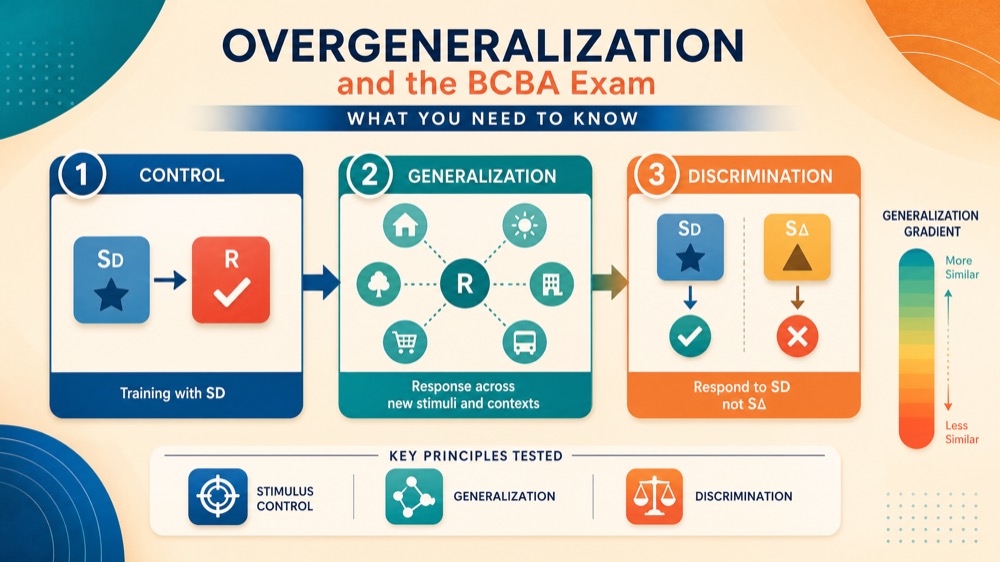
The BCBA exam often tests your ability to apply behavioral concepts to real-life scenarios. Overgeneralization is a popular topic because it combines several key principles: stimulus control, generalization, and discrimination. You need to be able to spot it in a vignette and know how to address it. Common Exam Traps: When answering questions about overgeneralization, candidates often fall into predictable traps. Being aware of these can save you valuable points:
- Confusing with discrimination: Remember, discrimination is the ability to respond differently to different stimuli. Overgeneralization is the opposite—it is a failure to discriminate effectively.
- Ignoring the antecedent: Overgeneralization is about stimulus control. If you focus only on consequences, you may miss the key issue. Always look at what antecedent is evoking the behavior.
- Overlooking function: The function of the behavior matters for intervention. For example, if the behavior is maintained by attention, you cannot simply punish overgeneralization; you must teach an appropriate alternative response.
These traps are common in scenario questions where the behavior seems appropriate at first glance but is actually occurring in an inappropriate context. Practice identifying the discriminative stimulus (S^D) and the S^Delta to avoid these mistakes. Strategies for Answering Scenario Questions: When you encounter a scenario question on the exam, follow a systematic approach to determine if overgeneralization is happening and how to address it: Step 1: Identify the behavior and its current context. What exactly is the learner doing, and in what situations? Step 2: Determine the antecedent: What stimulus is present when the behavior occurs? Is it similar to the original training stimulus? Step 3: Analyze the consequence: What is maintaining the behavior? Is there a reinforcement history that supports the broad responding? Step 4: Decide if the behavior is overgeneralized: Does the behavior occur in contexts that are too dissimilar from the training context? If yes, what would be the appropriate relative?
This step-by-step analysis helps you avoid jumping to conclusions. Many questions provide extra details to distract you, so focus on the core elements. You can also use process of elimination by checking which answer options align with the definition of overgeneralization. Practice Prompts to Test Yourself: To solidify your understanding, try these quick self-test scenarios. Cover the answers and think through them first.
- Prompt 1: A child learned to request “more” during snack time. Now the child says “more” during play time when they want a toy. Is this overgeneralization? Answer: Yes, because “more” is being used in a different context that may not be appropriate or may confuse communication partners. The function may be access to tangibles, and discrimination training is needed.
- Prompt 2: A teenager with autism is taught to say “hello” when meeting people. They now say “hello” to everyone, including the mailman, classmates, and even the cashier, which is generally acceptable. Is this overgeneralization? Answer: No, because the response is appropriate across many social contexts. This is stimulus generalization, not overgeneralization.
- Prompt 3: A child is taught to raise their hand to ask a question in class. One day, they raise their hand in the cafeteria and the teacher does not see them. They stop raising their hand altogether. Is this overgeneralization? Answer: No, this is more likely extinction-induced or a discrimination issue, but not overgeneralization because hand-raising is not occurring in inappropriate contexts.
These examples show how to differentiate overgeneralization from other concepts. Practice with flashcards or mock exams to build fluency.
Addressing Overgeneralization: The Role of Discrimination Training
When overgeneralization is identified, the most effective intervention is discrimination training. This process involves reinforcing a behavior in the presence of one stimulus (the S^D) and withholding reinforcement in the presence of another (the S^Delta). Over time, the learner becomes more precise in when they emit the behavior.
How Discrimination Training Helps: Discrimination training directly targets the problem of overgenerous stimulus control. By providing consequences that differ across stimuli, you teach the learner to respond only when the appropriate cue is present. For example, in the case of the child saying “dog,” you would show pictures of dogs (S^D) and reinforce “dog,” while showing pictures of cats (S^Delta) and not reinforcing “dog.” This sharpens the association.
The key is to use differential reinforcement: you consistently reinforce correct responses and withhold reinforcement for incorrect ones. This helps the learner form a new discrimination. It is important to choose S^D and S^Delta that are distinct enough initially, then gradually make them more similar to generalize the skill appropriately. This process is called stimulus fading. Implementing a Discrimination Training Program: To implement a discrimination training program effectively, follow these steps: Step 1: Define the targeted behavior and the contexts where it should and should not occur. Step 2: Select S^D and S^Delta stimuli. Start with stimuli that are very different to build success. Step 3: Provide reinforcement for correct responses in the presence of S^D, and ensure reinforcement is unavailable for responses to S^Delta. Step 4: Systematically introduce more similar stimuli to teach finer discriminations, always monitoring for overgeneralization.
Throughout this process, data collection is crucial. Track the percentage of correct responses to assess whether the discrimination is improving. Remember to include a generalization probe to ensure the skill transfers to real-world settings while maintaining appropriate boundaries. This is a common exam topic, so be prepared to identify the components of effective discrimination training.
Quick Checklist for Overgeneralization in ABA
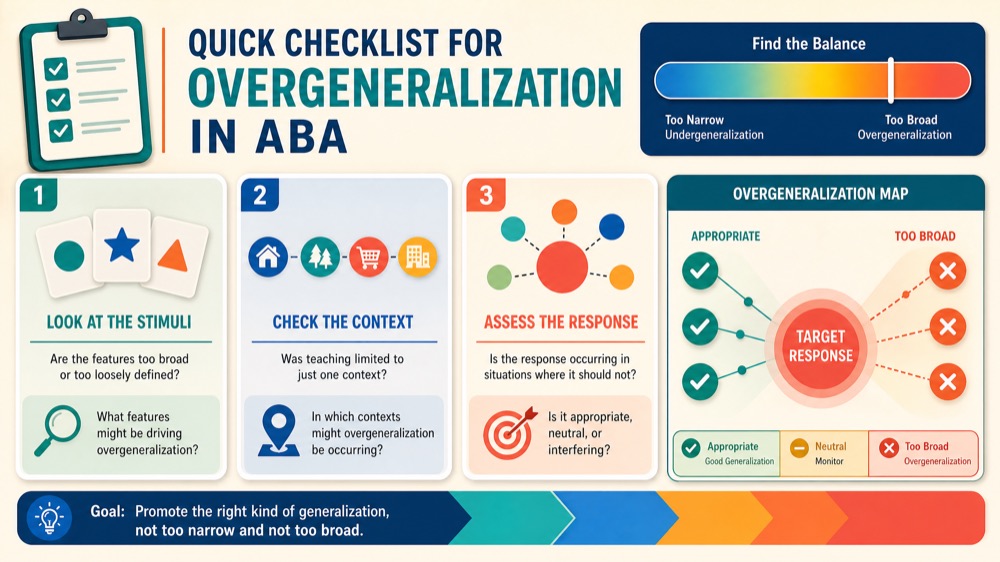
Before the exam, run through this quick checklist to ensure you have a solid grasp on overgeneralization. It summarizes the key points you need to remember:
- Definition: Overgeneralization is the application of a learned behavior to too broad a range of stimuli or contexts.
- Contrast: Distinguish from stimulus generalization (which is appropriate) and discrimination (which is the goal).
- Identify: Use ABC analysis to spot overgeneralization. Look for the antecedent context and whether it is similar to training.
- Function: Always consider the function of the behavior (attention, escape, access, automatic) to guide intervention.
- Intervention: Use discrimination training with differential reinforcement and fading to sharpen stimulus control.
- Exam trap: Do not confuse overgeneralization with simple generalization or discrimination. Practice with vignettes.
This checklist encapsulates the core ideas you need to apply in both exam questions and real-world practice. Keep it handy for last-minute review.
Final Thoughts and Additional Resources
Overgeneralization is a fundamental concept in ABA that highlights the delicate balance between generalization and discrimination. As a future BCBA, you will regularly encounter learners who overgeneralize skills, and your ability to design effective interventions depends on understanding this principle deeply. The BCBA exam will test your knowledge through scenario-based questions, so practice applying the definitions and steps discussed here.
Remember that overgeneralization is not inherently bad—it shows that learning has occurred. The challenge is to shape it into appropriate, context-specific responding. By mastering discrimination training, you can help learners generalize their skills to relevant situations while avoiding excessive responding. This skill is highly valued in clinical practice and is a common theme in our guide on generalization of skills.
If you found this guide helpful, consider exploring our other resources on related topics. For example, you can read more about discriminative stimuli and how they control behavior. Additionally, review our articles on ABA assessment methods to enhance your overall exam preparation. For authoritative information, you can also check the Behavior Analyst Certification Board website for the latest standards and ethics codes. Ultimately, understanding overgeneralization is a stepping stone to becoming a competent behavior analyst. Keep practicing, stay curious, and always apply the science with care. Good luck with your exam preparation!
Take the Free BCBA Mock Exam
Ready for more practice? Use the free mock exam to keep testing your accuracy with realistic BCBA-style items. Take the Free BCBA Mock Exam
Next step for BCBA exam prep
Turn this topic into exam-day practice
Use this topic as a focused review, then test it in exam-style conditions with a free mock before deciding whether five full-length mocks are the right next step.
Start the Free BCBA Mock ExamContinue with Five Full-Length Mocks — $99
Review the included materials and access details before ordering. No pass guarantee is implied.



