

Adaptation in ABA describes a change in responding that occurs as a learner repeatedly contacts the same stimulus or consequence. The term can be useful when a response becomes weaker, stronger, or less noticeable over time, but it is not a stand-alone explanation for every decrease in behavior. On the BCBA exam, the important work is identifying what changed, what remained constant, and whether the pattern is better explained by habituation, sensitization, satiation, extinction, or another behavioral process.
Table of Contents
- How Adaptation Appears on the BCBA Exam
- What Adaptation Means in ABA
- Habituation, Sensitization, and Satiation
- How to Analyze an Adaptation Scenario
- Adaptation in ABA Examples
- Adaptation Versus Extinction and Habituation
- How to Measure Adaptation
- Designing a Responsible Intervention
- Common Adaptation Exam Traps
- Quick Review Checklist
- Frequently Asked Questions
- Take the Free BCBA Mock Exam
- References
This guide turns that distinction into a practical decision process. It covers how adaptation appears in exam scenarios, how to separate nonassociative changes from contingency changes, how to measure the pattern, and how to avoid labeling a learner’s response without enough data. The examples use sound, touch, food, attention, task materials, and repeated practice so the concept stays tied to observable behavior rather than a vague internal explanation.
How Adaptation Appears on the BCBA Exam
Exam questions about adaptation usually describe repeated exposure and a later change in observable responding. A learner may stop orienting toward a repeated tone, show fewer escape responses during a familiar sensory event, or respond less strongly to a reinforcer after many uninterrupted deliveries. The stem may ask for the best interpretation, the next measurement step, or the process that should not be confused with extinction. Before choosing an answer, reconstruct the sequence:
- Identify the stimulus or consequence that was repeated.
- Define the target response in observable and measurable terms.
- Ask whether a response-consequence contingency changed.
- Check whether the change occurs across repeated exposure or only in one context.
- Look for evidence that the stimulus became less effective, more effective, or simply familiar.
- Separate a temporary response change from a durable skill or treatment effect.
The exam is not asking you to infer a hidden mental state from a single observation. It is testing whether you can describe a functional relation and select data that would distinguish competing explanations. If reinforcement stopped following a response, extinction may be relevant. If the same stimulus was repeatedly presented without a new contingency, habituation or sensitization may be more plausible. If a preferred item lost value after unrestricted access, satiation is the stronger candidate.
A useful shortcut is to ask, “What changed in the environment?” If the answer is “only repeated contact with the stimulus,” begin with a nonassociative explanation. If the answer is “the consequence no longer follows the response,” inspect the contingency. If the answer is “the learner had unlimited access to the reinforcer,” inspect the motivating operation. The learner’s lower response rate is an outcome, not the name of the process.
What Adaptation Means in ABA
Adaptation is a broad descriptive term for adjustment to repeated or sustained stimulation. In applied behavior analysis, the word should be made more precise before it is used in a treatment decision. A practitioner might observe that a learner no longer turns toward a background fan, but that observation alone does not establish why the orienting response decreased or whether the learner would respond to a change in sound intensity. Use adaptation as a starting description, then specify the behavioral process:
- Habituation: responding to a repeated, nonharmful stimulus decreases with continued or repeated exposure.
- Sensitization: responding to a stimulus increases or becomes more intense after repeated exposure, especially when the stimulus is aversive or salient.
- Satiation: the effectiveness of a reinforcer decreases after unrestricted or repeated access.
- Deprivation: the effectiveness of a reinforcer increases after limited access or withholding.
- Extinction: a previously reinforced response decreases because the reinforcing consequence is no longer delivered.
- Stimulus control change: responding shifts because stimulus-response relations or discriminative conditions changed.
These labels are not interchangeable. A learner can habituate to a repeated tone while still responding to a novel tone. A learner can become satiated with crackers while still orienting to a visual cue. A learner can show extinction when a response no longer produces attention, even if the room and materials are unchanged. The correct label follows the arrangement and the data.
For clinical documentation, avoid writing that a learner “got used to it” as the final explanation. Instead, document the stimulus, the exposure history, the response measure, the context, the consequence arrangement, and whether responding returned when the stimulus changed. This makes the observation testable and reduces the risk of designing an intervention around an unsupported assumption.
Habituation, Sensitization, and Satiation
Habituation and sensitization concern changes in responding to repeated stimulation. Satiation concerns the changing value of a consequence. The scenarios can look similar because all three may produce a change in behavior across time, but their environmental descriptions are different. The question may include a neutral sound, an unpleasant tactile event, or a preferred edible, and the relevant distinction is what was repeated and what function that event served.
- Repeated neutral sound plus declining orienting is consistent with habituation when other variables are controlled.
- Repeated aversive stimulation plus increasing reactivity may indicate sensitization, but the analyst should still assess safety and context.
- Repeated free access to a preferred edible followed by fewer requests is consistent with satiation.
- Limited access followed by stronger requesting suggests deprivation or an establishing operation, not habituation.
- A response that stops producing attention and then declines reflects a changed reinforcement contingency, which points toward extinction.
Context matters. Habituation can be stimulus-specific, so reduced responding to one sound does not prove that the learner will ignore every sound. Satiation can be reinforcer-specific, so access to one snack does not necessarily reduce the value of a different snack. Sensitization can generalize across related stimuli, but that possibility must be tested rather than assumed. The comparison below organizes the key questions: is the event a stimulus or a reinforcer, did the exposure repeat, did the response increase or decrease, and did a programmed contingency change?
How to Analyze an Adaptation Scenario
When a question uses the word adaptation, translate the prose into a small behavior-analytic model. Identify the antecedent event, the response, the immediate consequence, and the pattern across repeated trials. Then compare the most likely process with at least one plausible alternative. The strongest answer is usually the one that explains the environmental change without adding an unsupported private event. Use this four-part analysis:
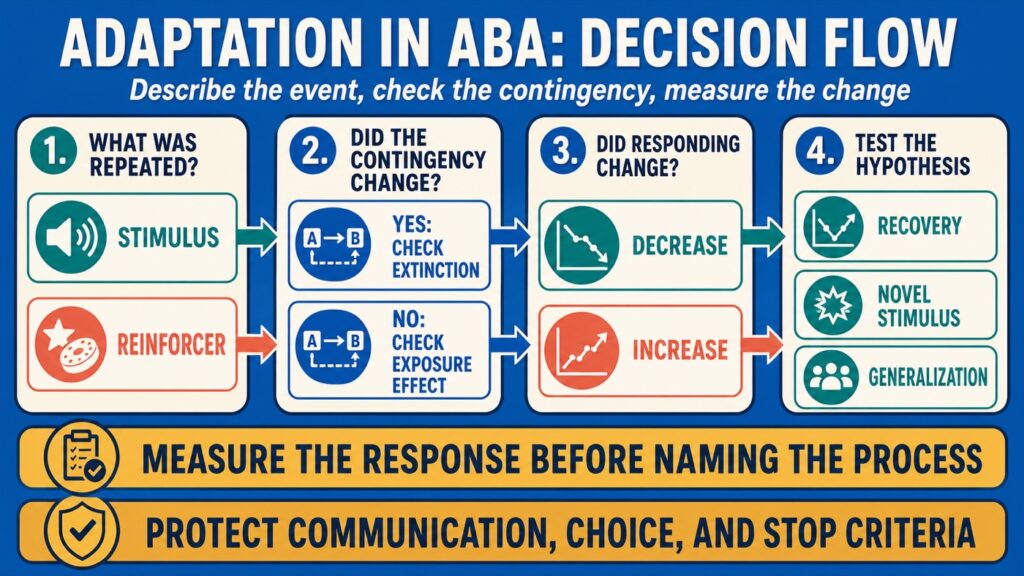
- Describe the event: state exactly what was presented, for how long, and how often.
- Describe the response: choose frequency, duration, latency, intensity, orientation, approach, or another observable measure.
- Check the contingency: determine whether responding still produces the same consequence.
- Test the alternative: vary the stimulus, context, access, or consequence one factor at a time when ethically appropriate.
Suppose a learner initially covers their ears when a low-volume fan starts, but the covering response decreases after the fan remains on in the same room. If the fan is neutral, the sound level is stable, and no response-contingent consequence changed, habituation is a reasonable hypothesis. If the response increases with each exposure, sensitization deserves consideration. If the fan is turned off following ear covering, escape reinforcement could be operating instead.
Do not treat the word “repeated” as proof of habituation. Repetition can establish a history of reinforcement, punishment, escape, or attention. The exact consequence after the response determines whether the contingency stayed the same. On a BCBA exam, a single phrase about repeated exposure is not enough; read the entire stem for what follows the behavior.
For exam questions that ask for the next step, select direct measurement and a controlled comparison whenever feasible. Ask whether the response returns after a break, whether a novel version of the stimulus produces responding, and whether the effect is present across settings. Those tests are more useful than simply asking the learner why the response changed.
Adaptation in ABA Examples
Repeated classroom sound: A bell rings at the same volume before transitions. At first, the learner turns toward the bell on nearly every trial. Over several days, orienting decreases, but the learner still transitions when the visual schedule appears. The pattern may reflect habituation to the auditory stimulus, not a loss of transition skill.
Repeated tactile input: A therapist presents a neutral textured object for brief exploration. The learner initially looks at the object and then stops looking while continuing to manipulate it. Reduced looking is not automatically a treatment failure; the analyst should measure manipulation, avoidance, duration, and response to a novel texture before deciding what changed.
Preferred edible access: A learner receives unlimited access to small pieces of a preferred food before instruction. Requests for that food decrease and the learner selects another item during a preference check. The likely explanation is a temporary reduction in reinforcer value through satiation, not habituation to an antecedent stimulus.
Unpleasant noise: A loud alarm is presented during a safety assessment, and vocal protest becomes more intense across repeated presentations. This may be sensitization, but the appropriate clinical response is to stop and review the safety plan rather than continue exposure merely to confirm a label. Ethical assessment requires minimizing unnecessary aversive stimulation.
Attention contingency: A learner’s calling-out initially produces teacher attention, then the teacher consistently withholds attention while reinforcing hand raising. Calling-out may temporarily increase and later decrease as the contingency changes. This is a behavior-change procedure involving extinction and differential reinforcement, not simply adaptation to the teacher’s presence.
Across these examples, the observable pattern is similar: behavior changes across time. The correct interpretation differs because the repeated event, consequence, response measure, and ethical conditions differ. This is exactly why the exam rewards reconstruction of the contingency instead of a quick label.
Adaptation Versus Extinction and Habituation
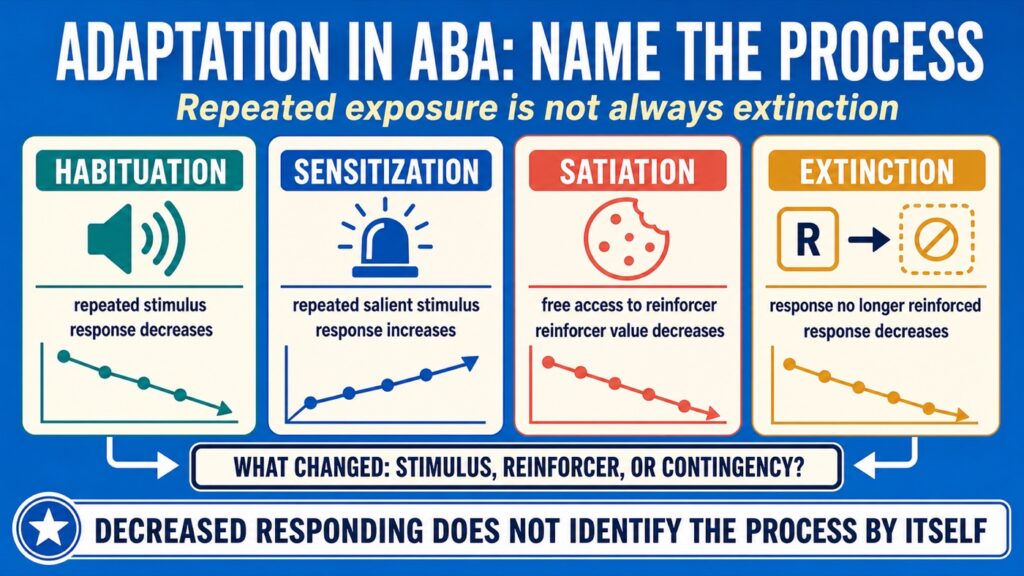
Habituation and extinction can both look like a decrease in responding, but they involve different relations. In habituation, repeated exposure to a stimulus is associated with a declining response, often without a response-dependent consequence being removed. In extinction, a response that previously produced reinforcement no longer produces it. The analyst must identify the response-consequence relation before choosing the term.
- Ask whether the response had a documented reinforcement history.
- Ask whether the consequence stopped immediately after the response.
- Check for extinction-burst or spontaneous-recovery patterns.
- Test whether a novel stimulus restores orienting or responding.
- Check whether reinforcer value changed because of free access or deprivation.
- Record whether the response decreased only in one setting or across settings.
For example, if a learner presses a button to hear a song and the song no longer follows pressing, a later decline in pressing is explained by extinction if the relation was previously reinforcing. If a background hum is played repeatedly and the learner’s brief orienting declines without a response-contingent event, habituation is a better descriptive fit. Both cases involve less behavior, but they do not call for the same interpretation or intervention.
A key exam trap is assuming that any decrease after repetition is extinction. Extinction requires a discontinuation of reinforcement for a previously reinforced response. If the question does not establish that history, do not add it. Likewise, do not call reduced food requests habituation when the key event was unrestricted access to food.
How to Measure Adaptation
Measurement should capture the response pattern over repeated exposures and preserve the conditions under which the change occurred. A single before-and-after observation cannot show whether the effect was gradual, temporary, stimulus-specific, or caused by a contingency change. The analyst should define the observation window and record enough trials to compare responding across time.
- Frequency: count orienting, approach, avoidance, requests, or protest responses per exposure.
- Duration: measure how long the response continues after stimulus onset.
- Latency: measure time from stimulus presentation to the first response.
- Intensity: use a defined rating or observable topography when intensity is clinically relevant.
- Habituation curve: graph response magnitude across repeated presentations.
- Recovery: insert an appropriate break or novel stimulus and test whether responding returns.
- Generality: compare people, settings, stimulus features, and times of day.
- Contingency record: document what happened after each response.
Imagine that orienting durations across six sound presentations are 8, 7, 6, 5, 5, and 4 seconds. That pattern suggests declining responding, but it does not prove habituation. The analyst still needs to know whether the sound stayed the same, whether the learner was tired, whether the teacher delivered attention after orienting, and whether a novel sound produced a recovery response.
Data quality is especially important when a behavior is subtle. Define what counts as orienting, train observers, and use agreement checks when decisions depend on small changes. If the response is avoidance or distress, prioritize safety and stop criteria over completing a planned number of exposures. Measurement is meant to improve decisions, not justify unnecessary exposure.
Designing a Responsible Intervention
Adaptation is not automatically a treatment goal. A practitioner should first decide whether the change is helpful, neutral, or a warning signal. Reduced orienting to a predictable background sound may be adaptive, while escalating distress to a painful stimulus requires immediate safety review. The intervention should target a meaningful functional outcome, not simply make a learner look less reactive. A responsible plan includes:
- A precise operational definition of the response and the stimulus.
- A baseline showing the pattern before any planned change.
- A reasoned hypothesis that distinguishes adaptation from contingency effects.
- Gradual exposure only when it is necessary, acceptable, and safe.
- Choice, communication, breaks, and an observable stop criterion.
- Data review after each meaningful change rather than relying on impressions.
- A generalization plan for people, settings, and stimulus variations.
- A plan to discontinue or revise the approach if distress or problem behavior increases.
Do not use repeated exposure to suppress communication about discomfort. If a learner can request a break, access to that communication should be protected while the team evaluates the stimulus. A decrease in protest may mean the learner adapted, but it may also mean the learner stopped communicating effectively. Functional assessment, assent-sensitive practice, and ongoing data protect against that error. The decision flow below summarizes how to move from repeated exposure to a defensible interpretation: identify the event, check the contingency, measure the direction of change, and test recovery or generalization without sacrificing safety.
Common Adaptation Exam Traps
The most common mistake is treating adaptation as a single technical procedure. It is better understood as a descriptive starting point that must be narrowed using the scenario. The exam may include a tempting answer that names habituation simply because a stimulus was repeated, even though the item actually describes satiation or extinction.
- Do not call every decrease after repetition habituation.
- Do not call a loss of reinforcer value a change in stimulus control.
- Do not call a response decrease extinction without a reinforcement history and contingency change.
- Do not assume that a response to one stimulus will adapt to every similar stimulus.
- Do not infer the learner’s internal state from one brief observation.
- Do not continue aversive exposure simply to obtain a cleaner graph.
- Do not confuse lower response rate with improved quality or comfort.
- Do not ignore free access, deprivation, or competing consequences.
- Do not measure only the target behavior while ignoring communication and distress.
- Do not describe a stimulus as neutral without considering its effects for this learner.
When two options seem plausible, compare the environmental event that each option requires. “Repeated neutral stimulus with declining orienting” supports habituation. “Repeated access to a preferred item with declining requests” supports satiation. “Previously reinforced response no longer contacts reinforcement” supports extinction. Translating each option into a full sentence often exposes the mismatch.
Quick Review Checklist
Before answering an adaptation ABA question, run this checklist:
- What exact stimulus or consequence was repeated?
- What observable response changed?
- Did responding increase, decrease, or change in form?
- Did the response still produce the same consequence?
- Was there free access or restricted access to a reinforcer?
- Could the pattern reflect habituation, sensitization, satiation, or extinction?
- Is the effect stimulus-specific or generalized?
- What direct measure would separate the competing explanations?
- Would a break or novel stimulus show recovery?
- Are choice, communication, and safety protected?
The shortest rule is: describe the repeated event, inspect the contingency, measure the response across time, and only then name the process. Adaptation is not a reason to skip functional analysis. It is a prompt to look more carefully at how repeated environmental contact changes behavior.
Frequently Asked Questions
What does adaptation mean in ABA?: Adaptation is a broad description of behavioral adjustment after repeated or sustained stimulation. The practitioner should specify whether the observed pattern is habituation, sensitization, satiation, extinction, or another process supported by the contingency and data.
What is the difference between habituation and satiation?: Habituation is a decrease in responding to a repeated stimulus. Satiation is a decrease in the effectiveness of a reinforcer after unrestricted or repeated access. A sound and a preferred food may both produce less behavior later, but the environmental relations differ.
Is adaptation the same as extinction?: No. Extinction requires that a previously reinforced response no longer produce its reinforcing consequence. Adaptation is a broad descriptive term and may occur without a change in reinforcement contingency.
How can a BCBA measure habituation?: Define the response, record it across repeated presentations, graph its magnitude or rate, document consequences, and test recovery or stimulus specificity when safe and appropriate. Direct data are stronger than impressions such as “the learner got used to it.”
What should a practitioner do if repeated exposure increases distress?: Prioritize safety, stop criteria, communication, and clinical review. Increasing distress may reflect sensitization or another problem, and repeated exposure should not continue just to confirm a hypothesis.
Take the Free BCBA Mock Exam
Ready to test your understanding of adaptation ABA concepts? Take the free BCBA mock exam and practice distinguishing habituation, sensitization, satiation, deprivation, extinction, and stimulus-control changes in realistic scenarios. Return to the checklist whenever a question describes a response that changes after repeated exposure.
References
For examination context and the current task-list framework, consult the BACB BCBA Test Content Outline. Apply current coursework, supervision, assent-sensitive practice, and applicable clinical guidance when evaluating repeated stimulation or changes in learner responding.



