
Definition and Purpose of a Transfer Trial in ABA
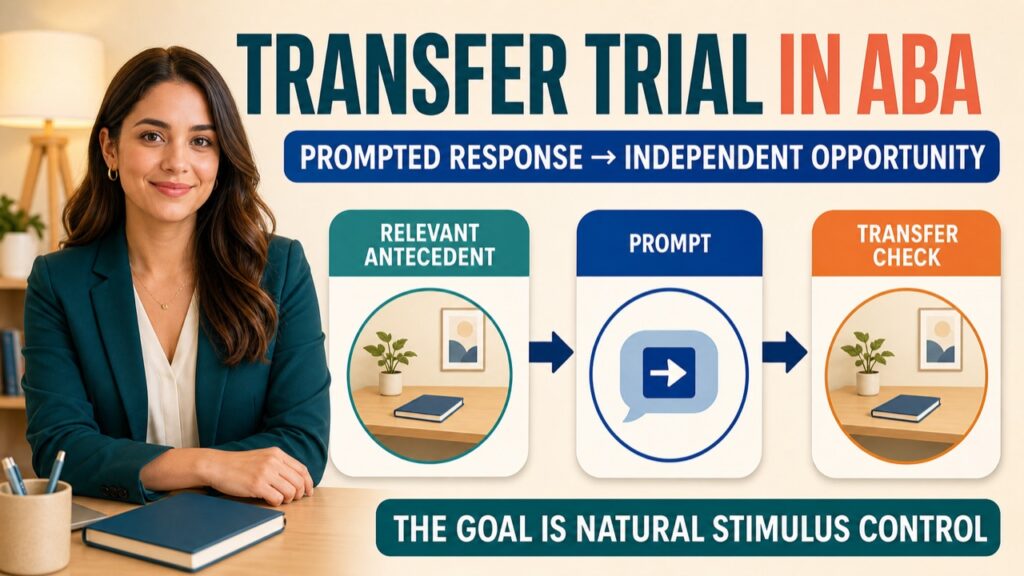
A transfer trial in ABA is a component of discrete-trial teaching in which the relevant antecedent or instruction is re-presented after a prompted trial to create an opportunity for an independent response. The primary purpose is to evaluate or facilitate transfer of stimulus control from the prompt to the relevant antecedent. The goal is not merely to obtain another correct topography but to shift control so that the natural discriminative stimulus evokes the behavior without artificial cues. This distinction is important: a transfer trial is a specific procedure, not a generic repetition of a trial.
Table of Contents
- Definition and Purpose of a Transfer Trial in ABA
- Key Steps in a Transfer Trial Sequence
- Distinguishing Transfer Trials from Other Procedures
- Types of Transfer Procedures and Considerations
- Original Examples of Transfer Trials
- Common Errors and Measurement Considerations
- The Role of Transfer Trials in Stimulus Control
- Practical Checklist for Implementing Transfer Trials
- Test Your Knowledge with a Free BCBA Mock Exam
The current BACB BCBA Test Content Outline (6th ed.) separates selecting stimulus and response prompting procedures (G.7) from fading those prompts (G.8). A published evaluation of transfer trials in tact instruction defines the procedure as re-presenting the initial instruction after a prompted trial, while a broader assessment of stimulus-control transfer procedures illustrates that effective transfer depends on the actual controlling variables and learner performance. These sources support treating a transfer trial as a planned teaching and measurement opportunity, not proof that transfer has already occurred.
Transfer trials are embedded within skill acquisition programming, often as part of errorless teaching or prompt-fading protocols. They differ from simple repetition because they follow a prompted response and explicitly test whether stimulus control has transferred. They also differ from generic error correction, which may involve multiple repetitions or changed antecedents without the immediate re-presentation of the same SD. Understanding the precise function of a transfer trial helps practitioners avoid prompt dependency and promote independent skill performance. For an overview of discrete-trial teaching, see What is Discrete Trial Training?.
Key Steps in a Transfer Trial Sequence
The following steps describe a common prompted-trial-to-transfer-trial sequence. However, this is one protocol-dependent arrangement; some procedures may include intervening, distractor, or neutral trials between the prompted and transfer trial. The specific steps should be tailored to the learner and the teaching plan.
- Present the relevant antecedent (SD): The therapist presents the natural instruction or discriminative stimulus (e.g., showing a picture of a cat and asking “What is this?”). The learner is given an opportunity to respond.
- Deliver a prompt if needed: If the learner does not respond or responds incorrectly, the therapist delivers a prompt (e.g., verbal model, gesture, physical guidance) to evoke a correct response.
- Apply the programmed consequence: Follow the written teaching protocol after the prompted response. Some programs arrange differential consequences for prompted and independent responses, but a lower-magnitude reinforcer after every prompted response is not a defining feature of a transfer trial.
- Re-present the relevant antecedent (transfer trial): The therapist presents the same SD again, without the prompt or with a reduced prompt, allowing an opportunity for an independent response.
- Respond according to the protocol: Record whether the response was independent and apply the programmed consequence. After an error or no response, the practitioner follows the preselected correction or prompting rule rather than improvising a stronger prompt or reinforcer.
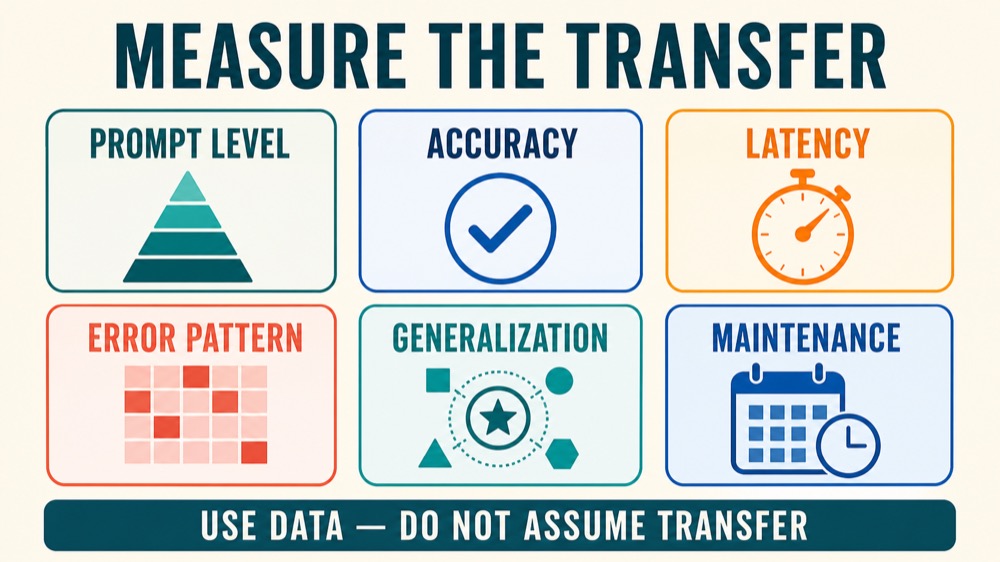
The sequence may be repeated or modified according to the teaching plan and the learner’s data. Prompt level, accuracy, latency, error patterns, generalization, and maintenance provide different evidence about performance; no single correct transfer-trial response is sufficient to establish generalized or maintained stimulus control.
Distinguishing Transfer Trials from Other Procedures
- Transfer trial vs. generic error correction: Error-correction packages vary and may include a model, prompt, repetition, practice, or other programmed steps after an error. A transfer trial is identified more narrowly by re-presenting the relevant antecedent after a prompted response to provide an unprompted or less-prompted opportunity.
- Transfer trial vs. prompt fading: Prompt fading is a broader strategy of gradually reducing prompt assistance over trials. Transfer trials are a specific way to assess whether fading is effective, but not all fading protocols require a transfer trial after every prompted response.
- Transfer trial vs. massed trials: Massed trials involve repeated presentation of the same SD without intervening stimuli. Transfer trials are part of a sequence that includes a prompted trial and are not necessarily massed.
- Transfer trial vs. simple repetition: Simple repetition does not follow a prompted trial and does not specifically aim to transfer stimulus control. A transfer trial is a deliberate probe of independent responding.
Types of Transfer Procedures and Considerations
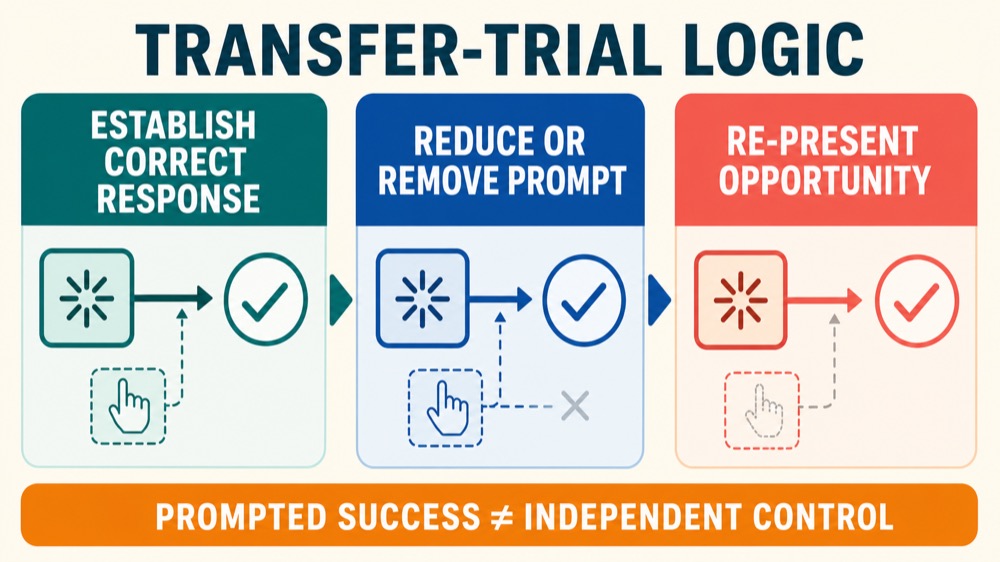
Several procedures exist for implementing transfer trials. The choice of procedure depends on the learner’s needs, the target skill, and the overall teaching environment.
- Most-to-least prompting with transfer trials: The therapist begins with the most intrusive prompt and gradually reduces it across successive transfer trials. For example, teaching a child to touch a picture of a dog might start with full physical guidance, then a light tap, then a gesture, and finally no prompt. Transfer trials occur after each prompted trial.
- Least-to-most prompting with transfer trials: The therapist starts with the least intrusive prompt (e.g., a brief verbal cue) and increases intrusiveness only if errors occur. Transfer trials are presented after the prompted trial to test independence.
- Time delay and transfer trials: Time delay changes the interval between the relevant antecedent and a prompt, whereas a transfer trial re-presents the antecedent after a prompted trial. A teaching protocol may combine them, but an opportunity to respond before a delayed prompt should not automatically be relabeled a transfer trial.
- Intervening trials: Some protocols insert a distractor or neutral trial between the prompted trial and the transfer trial to prevent rote responding and strengthen stimulus control.
Each procedure has advantages and limitations, so the label alone cannot determine which arrangement is appropriate. Practitioners should define the target stimulus control, select a procedure that fits the learner and context, monitor errors and independence, and revise the plan from those data rather than assuming that one prompting sequence is universally superior.
Original Examples of Transfer Trials
Below are original examples illustrating how transfer trials are applied across different skill domains. Note that the specific prompt levels, schedules, and measurement criteria would be determined by the individual behavior plan.
- Expressive labeling: Relevant antecedent: the practitioner displays a picture of a cup and asks, “What is it?” The learner does not respond. Prompt: the practitioner models “cup,” and the learner repeats it. Transfer trial: the picture and question are presented again without the vocal model. The learner says “cup” independently.
- Receptive identification: SD: “Give me the ball.” The learner picks up a block. Prompt: Therapist physically guides the learner’s hand to the ball. Transfer trial: Same SD, no physical guidance. Learner picks up the ball.
- Motor imitation: SD: “Do this” (therapist taps head). Learner does not imitate. Prompt: Therapist gently taps learner’s head. Transfer trial: Therapist repeats SD and taps own head without assisting. Learner taps head.
- Intraverbal fill-in: SD: “Ready, set, ____.” Learner does not respond. Prompt: Therapist says “go.” Learner says “go.” Transfer trial: Therapist says “Ready, set, ____” without prompt. Learner says “go.”
Common Errors and Measurement Considerations
When implementing transfer trials, several common errors can undermine their effectiveness. Recognizing these errors helps practitioners refine their teaching and ensure accurate assessment of stimulus control transfer.
- Confusing transfer trials with probe trials: A probe trial assesses baseline or maintenance without prior prompting. A transfer trial always follows a prompted trial and aims to assess or facilitate transfer.
- Unplanned consequences: Changing consequences from trial to trial can obscure which variables are affecting performance. If the plan uses differential reinforcement for prompted and independent responses, define and implement those differences consistently while monitoring their effects.
- Using prompts that are difficult to fade: Prompts that compete with the SD, such as full verbal models, may interfere with transfer. Consider using less intrusive prompts that can be quickly removed.
- Fading too quickly or too slowly: The rate of prompt reduction should be guided by learner data. Fading too rapidly may cause errors; fading too slowly may maintain prompt dependency.
- Omitting the programmed transfer opportunity: Moving to another target after a prompted response may be appropriate in some protocols, but it does not provide the immediate independent check that a planned transfer trial was intended to provide.
Measurement of transfer trial efficacy should include multiple indicators such as percentage correct on transfer trials, latency to respond, errors, and generalization to novel stimuli and settings. One unprompted correct response does not prove generalized mastery; maintenance and generalization across conditions must be assessed.
The Role of Transfer Trials in Stimulus Control
Transfer trials are central to the process of stimulus control. Stimulus control occurs when a particular antecedent reliably evokes a specific response. A prompt initially serves as a controlling stimulus; through transfer trials, the relevant antecedent (SD) becomes the controlling stimulus. This shift is essential for the learner to perform skills in natural environments without artificial cues.
Transfer of stimulus control is an empirical conclusion based on a pattern of responding, not the name of a single successful trial. The teaching plan may therefore include repeated measures and programmed checks across relevant people, materials, settings, and time. Related concepts include stimulus generalization and stimulus discrimination, but each outcome should be demonstrated with data rather than inferred from one independent response.
Practical Checklist for Implementing Transfer Trials
Use this checklist to guide the implementation and evaluation of transfer trials in your practice. Each item represents a key consideration from the content brief and professional literature.
- Define the target behavior and relevant antecedent clearly before starting.
- Select an appropriate prompt type and level based on the learner’s skill and error pattern.
- Determine the transfer trial schedule (e.g., after every prompted trial, after every other) and document it in the teaching plan.
- If differential reinforcement is part of the plan, define the consequences for prompted and independent responses and apply them consistently.
- Collect data on transfer trial accuracy, latency, errors, and prompt level.
- Assess for generalization across stimuli, settings, and instructors before concluding transfer of stimulus control.
- Fade prompts systematically, basing changes on learner performance data.
- Predefine an individualized, observable performance criterion and separately plan checks for generalization and maintenance; do not treat one sample percentage or session count as a universal mastery rule.
Test Your Knowledge with a Free BCBA Mock Exam
Now that you understand the transfer trial aba procedure, its purpose, and its distinction from other teaching strategies, you can apply this knowledge to practice scenarios. Our Free BCBA Mock Exam offers practice questions on skill acquisition, prompt fading, and stimulus control. While the exam covers a range of topics and does not guarantee inclusion of this specific concept, it provides a helpful opportunity to test your understanding and receive feedback. Take the mock exam today to see how you perform.



