
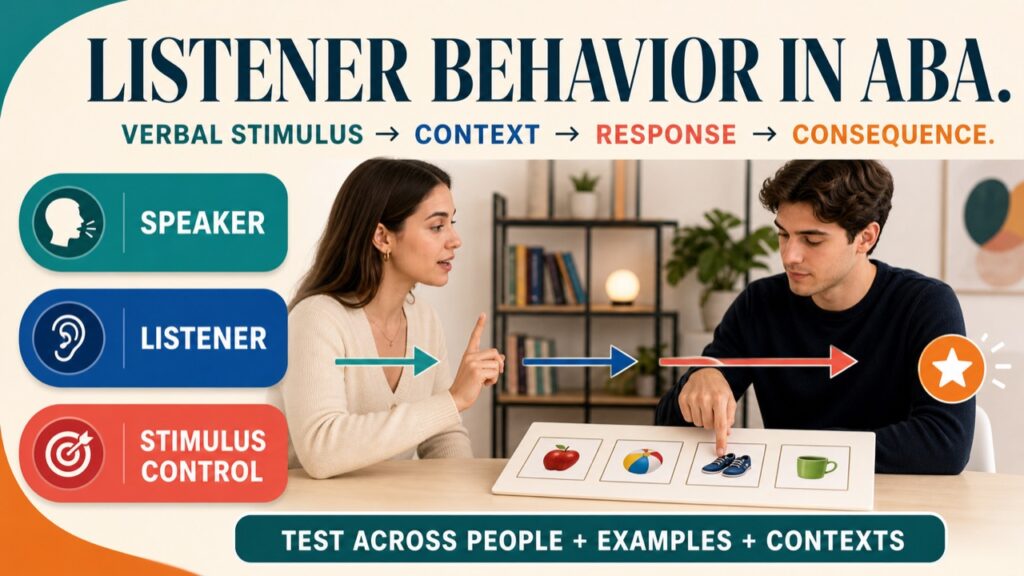
For a careful BCBA-style interpretation of listener behavior aba, connect the term to the observable participant response, the environmental condition, the measurement rule, and the evidence that would support or challenge the conclusion. This extra reasoning step helps prevent a familiar label from replacing the precise answer required by the scenario.
Table of Contents
- What Is Listener Behavior in ABA? A Functional Definition
- Key Components of Listener Responding
- How Listener Behavior Differs From Speaker Behavior
- Distinction From Receptive Language
- How to Measure Listener Behavior
- Common Misconceptions About Listener Behavior
- Stimulus Control and Conditional Discrimination
- Study Checklist for Listener Behavior
- Turn this topic into exam-day practice
- Take the Free BCBA Mock Exam
What Is Listener Behavior in ABA? A Functional Definition
In applied behavior analysis (ABA), listener behavior is defined functionally as the behavior of a person (the listener) that is under the control of verbal stimuli produced by a speaker. The listener’s response often mediates reinforcement for the speaker—for example, by handing over a requested item, following an instruction, or orienting toward a named stimulus. This functional relationship distinguishes listener behavior from simple hearing or passive reception. For instance, when a teacher says “point to the ball” and a child points to the ball, that pointing response is listener behavior. The response is a discriminated operant: it occurs in the presence of a specific verbal stimulus and has been reinforced in similar past situations. Behavior analysts study listener behavior to understand how verbal stimuli control human actions, teach language and communication skills, and design effective interventions. The BACB BCBA Test Content Outline includes verbal behavior and stimulus control, of which listener behavior is a core component.
Key Components of Listener Responding
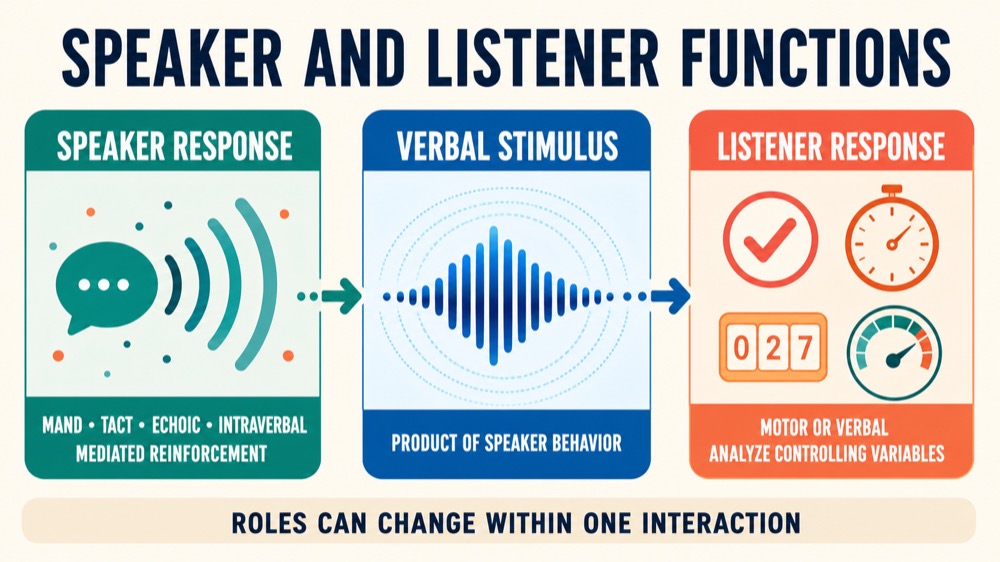
Every instance of listener behavior involves a four-term contingency: the antecedent verbal stimulus, the context, the listener’s response, and the consequence. Below, we break down each component and provide an example.
- Antecedent verbal stimulus: The spoken words or signs produced by a speaker. Examples include mands (requests), tacts (labels), intraverbals (conversational responses), and echoics (repetitions). The stimulus must be verbal—that is, produced by the speaker’s verbal behavior.
- Context: The environmental conditions present during the interaction, including other stimuli that may influence which response occurs. For listener discrimination, the context often involves a choice array (e.g., selecting from multiple objects) or specific setting events (e.g., time of day, presence of other people).
- Listener response: The behavior of the listener. This can be a motor action (e.g., pointing, reaching, turning the head), a verbal response (e.g., answering a question), or a combination. The response must be directly observable and measurable.
- Consequence: The event that follows the listener’s response. Often, the consequence is provided by the speaker (e.g., praise, delivery of an item) or is automatic (e.g., accessing information). The consequence determines whether the response will be maintained or strengthened.
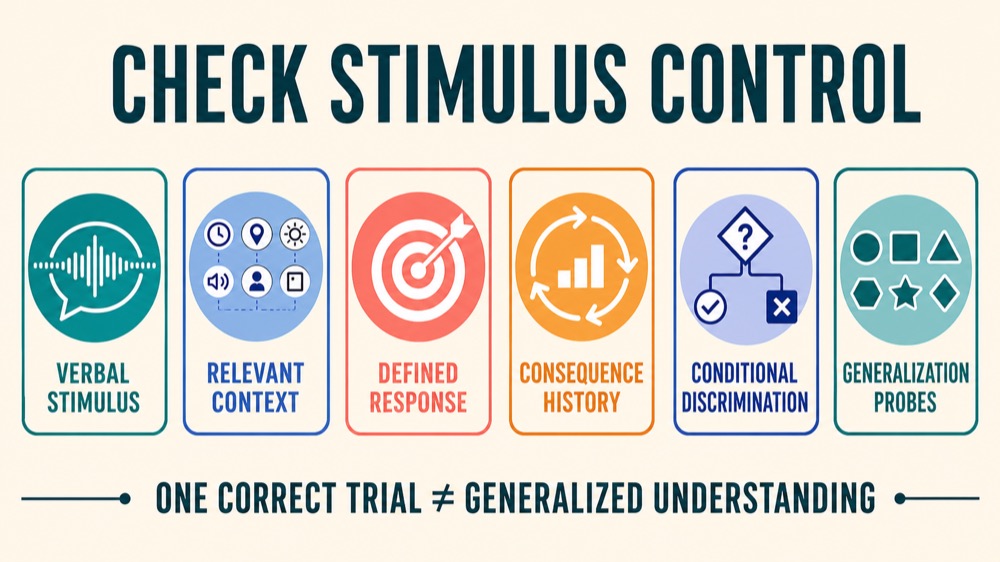
Consider a therapist who says “give me the red car” while a red car and a blue truck are available. The instruction is the verbal stimulus, the array is relevant context, handing over the red car is the response, and the therapist’s reaction is the consequence. Evidence of stimulus control comes from differential responding across instructions and comparison conditions—not from one correct trial. Probe different speakers, exemplars, array positions, and settings before describing the repertoire as generalized. Schlinger’s analysis of listening also cautions against treating every listener response as one simple class; see Listening Is Behaving Verbally.
How Listener Behavior Differs From Speaker Behavior
A speaker’s mand, tact, echoic, or intraverbal is classified from the variables controlling that response and the history of mediated reinforcement. Listener behavior describes what another person does in relation to the speaker’s verbal stimulus. The same person can switch roles within seconds: answering a question is speaker behavior under verbal stimulus control, while selecting an object after an instruction is a listener response.
Skinner treated many listener actions that mediate consequences for a speaker as important but not verbal “in any special sense.” Schlinger later argued that some activity ordinarily called listening may include echoic, intraverbal, or other verbal responding. That is a conceptual debate, not a license to label listener behavior as always verbal or always nonverbal. Analyze the actual controlling variables. If a learner hears “clap” and claps, the motor response is listener responding; saying “clap” with point-to-point correspondence may be an echoic. The current BCBA Test Content Outline separately emphasizes stimulus control, discrimination, verbal operants, and multiple control.
Distinction From Receptive Language
Clinicians sometimes use the term “receptive language” to describe a child’s ability to understand spoken words. However, this structural label does not capture the functional relations of listener behavior. For behavior analysts, the key is the discriminated operant: the listener responds correctly only when the antecedent verbal stimulus controls the response. Receptive language tests often measure correct responses, but without analyzing the controlling variables (e.g., whether the response is under simple or conditional discrimination), they may overstate comprehension. A child who reliably points to “dog” in a set of pictures may fail to do so when the picture of a dog is presented alongside a cat and a ball if the instruction is “show me the one that barks.” True listener behavior requires generalized responding across stimuli, contexts, and people. One correct response to one direction is only narrow evidence; demonstrate differential responding under varied conditions before describing generalized comprehension. The distinction is important for accurate assessment and intervention planning.
How to Measure Listener Behavior
Define the target response and scoring rule before collecting trial-by-trial data. Record accuracy, prompt level, latency, and errors when those dimensions matter. Then probe untrained exemplars, speakers, settings, array positions, and instructions. One mastered item can show a narrow discrimination; it does not establish a generalized class.
Conditional-discrimination probes ask whether one stimulus changes the function of another. A learner who selects blue and large items separately may not yet select the “large blue” comparison when both dimensions matter. Interpret percentages together with trial composition and prompting rather than treating a high aggregate score as proof of generalized understanding. The broader conceptual analysis in Constructs and Events in Verbal Behavior is useful for keeping labels tied to observable relations. The current BACB outline also includes representative measurement, stimulus generalization, and procedures that produce simple and conditional discriminations.
Common Misconceptions About Listener Behavior
Understanding listener behavior requires avoiding several conceptual pitfalls. Below are common traps and how to sidestep them.
- Misconception: Listener behavior is always nonverbal. In fact, listener behavior can include verbal responses, such as answering a question. The key is that the response is controlled by the speaker’s verbal stimulus, not that it is motoric.
- Misconception: Listener behavior is always verbal. Skinner’s original analysis did not classify listener behavior as verbal because it does not require mediated reinforcement. Later perspectives vary, but the functional definition remains central.
- Misconception: Receptive language is a complete functional definition. Receptive language is a structural label that does not capture the controlling variables. A functional account specifies the antecedent verbal stimulus, context, response, and consequence.
- Misconception: One correct direction-following response demonstrates generalized comprehension. Generalized listener behavior requires differential responding across multiple speakers, stimuli, examples, and settings. A single trial is insufficient evidence.
- Misconception: The listener passively receives meaning. Listener behavior is active; the listener must emit a measurable response that is under stimulus control. Hearing alone does not constitute listener behavior.
To practice identifying these traps, consider working through scenarios that involve simple and conditional discriminations. Understanding these nuances will help you apply the concept accurately in clinical settings and on the BCBA exam.
Stimulus Control and Conditional Discrimination
Listener responding is a discriminated operant when a verbal stimulus, in context, changes the probability of a response because of a relevant reinforcement history. An instruction should not be called an SD merely because it occurred before a response; the differential relation must be demonstrated.
In an auditory-visual selection task, the spoken sample may change which comparison is correct. “Point to car” makes the car comparison relevant, whereas “point to truck” changes that relation. Because the function of each comparison depends on the sample, this is a conditional discrimination. Vary comparison position, irrelevant features, wording, and speakers so prompts or fixed layouts do not masquerade as stimulus control. See the site’s Stimulus Control guide and Stimulus Generalization article for related distinctions.
Study Checklist for Listener Behavior
Use this checklist to organize study of listener behavior alongside the broader verbal-behavior and stimulus-control tasks in the current BCBA outline.
- Define listener behavior functionally as behavior under control of a speaker’s verbal stimulus.
- Identify the four components: antecedent verbal stimulus, context, response, and consequence.
- Distinguish listener behavior from speaker behavior (mand, tact, echoic, intraverbal).
- Explain the conceptual debate about whether listening is verbal behavior (Skinner vs. later researchers).
- Give at least three original examples of listener behavior, specifying the antecedent and response.
- Recognize that listener behavior can involve simple or conditional discrimination.
- Describe common misconceptions (passive, one trial proof, confusion with receptive language).
- Explain how stimulus control applies to listener behavior: SD vs. S-delta.
- Know how to measure listener behavior (trial data, probe across exemplars, generalization checks).
- Review the BACB BCBA Test Content Outline for relevant verbal behavior items.
For additional practice, our Free BCBA Mock Exam provides realistic questions with detailed feedback. While the mock exam does not guarantee coverage of this specific topic, it assesses readiness across the full BACB Task List. Combined with the resources above, you will build a solid understanding of listener behavior.
Complete BCBA Exam Prep
Turn this topic into exam-day practice
Practice concepts in context with five full-length 6th Edition mock exams, two bonus practice exams, a 6th Edition study guide, and key-term flashcards—all in one $120 USD package. Get the $120 All-in-One Prep Pack Review everything included on the product page before ordering. No pass guarantee is implied.
Take the Free BCBA Mock Exam
Ready for more practice? Use the free mock exam to keep testing your accuracy with realistic BCBA-style items. Take the Free BCBA Mock Exam



