

What Is Conceptual ABA?
Before you dive into flashcards and practice questions, it helps to step back and ask: what does it mean to understand behavior analysis at a conceptual level? Conceptual ABA refers to the foundational framework that explains why behavior occurs and how to influence it. It is the difference between knowing that a procedure works and understanding the mechanism behind it. For BCBA candidates, this distinction matters because exam questions often test your ability to apply concepts to novel situations, not just recall definitions.
Table of Contents
- What Is Conceptual ABA?
- Core Principles That Define Conceptual ABA
- Bringing Conceptual ABA to Life: Worked Examples
- How Conceptual ABA Appears on the BCBA Exam
- Quick Study Checklist for Conceptual ABA
- Final Thoughts: Mastering Conceptual ABA
- Quick Review Checklist
- Take the Free BCBA Mock Exam
- References
The field of behavior analysis is rooted in the philosophy of behaviorism, which emphasizes that behavior is a natural phenomenon that can be studied scientifically. Applied behavior analysis translates this philosophy into practical interventions. Understanding the conceptual layer helps you see the connection between basic principles and real-world application. When you can think conceptually, you are better prepared to design interventions, predict outcomes, and troubleshoot when things do not go as planned. This article will guide you through the core ideas, illustrate them with examples, and highlight how they appear on the BCBA exam.
The Roots of Behavior Analysis: Behavior analysis emerged from the work of B.F. Skinner and others who argued that behavior is shaped by environmental events. Instead of looking inside the mind, behavior analysts focus on observable actions and the conditions that surround them. This scientific approach is called radical behaviorism, which includes private events like thoughts and feelings as behavior that can be analyzed. For the exam, you need to recognize that behavior is not random but is a function of antecedents and consequences.
Conceptual vs. Technical ABA: It is easy to confuse being technically fluent with being conceptually grounded. Technical ABA refers to knowing the specific procedures, such as differential reinforcement or prompting strategies. Conceptual ABA, on the other hand, is the understanding of why those procedures work. For example, you might know that a token economy is effective, but conceptually you understand that it is a system of conditioned reinforcement. The BCBA exam includes questions that test both, but conceptual questions often require you to analyze a scenario and identify the underlying principle. Keep this distinction in mind as you prepare.
Core Principles That Define Conceptual ABA
At the heart of conceptual ABA are a few key principles that explain how behavior is learned and maintained. These principles operate in every interaction between a person and their environment. By mastering them, you build a strong foundation for interpreting behavior and designing effective interventions. Let’s look at the most important ones for the exam.
Reinforcement is the process by which a behavior is strengthened by its consequences. Punishment, conversely, weakens behavior. Extinction occurs when a previously reinforced behavior no longer produces that reinforcement, leading to a decrease in the behavior. Stimulus control describes how behavior comes under the control of specific antecedents. Understanding how these principles work together is essential for conceptual ABA.
Reinforcement and Punishment: Positive reinforcement involves adding a stimulus after a behavior, which increases the future frequency of that behavior. For example, if a child says “please” and receives a cookie, they are more likely to say “please” in the future. Negative reinforcement involves removing an aversive stimulus, which also increases behavior. For instance, fastening a seatbelt to stop the beeping sound is negatively reinforced. Punishment is the opposite: it decreases behavior. Positive punishment adds an aversive stimulus (e.g., a reprimand), while negative punishment removes a pleasant stimulus (e.g., losing tablet time).
On the exam, you may be asked to identify whether an example represents reinforcement or punishment, and whether it is positive or negative. Pay close attention to the timing and effect on behavior. A common trap is confusing negative reinforcement with punishment—they have opposite effects on behavior.
Extinction and Stimulus Control: Extinction is a procedure where the reinforcing consequence is withheld. If a child tantrums to get attention, and attention is no longer provided, the tantrum should eventually decrease. However, be aware of the extinction burst, where the behavior temporarily increases before decreasing. This is a critical concept for the exam and for practice. Stimulus control occurs when a behavior is emitted in the presence of a discriminative stimulus (SD) but not in its absence. For example, a student raises their hand in class when the teacher is present but not when alone. Understanding stimulus control helps you design teaching environments that promote appropriate behavior.
The Role of the Environment: The conceptual framework of ABA rests on the assumption that behavior is a function of environmental events. This means that to understand behavior, you must examine the circumstances that precede and follow it. The ABC model—Antecedent, Behavior, Consequence—is a useful tool for this analysis. Antecedents are events that occur before the behavior, consequences are events that follow it, and the behavior is the observable action. By identifying these components, you can hypothesize about the function of the behavior and develop an intervention. This environmental perspective is central to conceptual behavior analysis.
Bringing Conceptual ABA to Life: Worked Examples
To truly understand conceptual ABA, it helps to see it in action. Let’s walk through three realistic examples using the ABC format. These examples illustrate how a behavior analyst thinks through a situation, hypothesizes a function, and plans an intervention. Each example also relates to common BCBA exam scenarios.
Example 1: Attention-Seeking Behavior: Imagine a young girl, Maya, who frequently interrupts her mother during phone calls. The antecedent is the mother being on the phone. The behavior is interrupting. The consequence is that the mother stops talking and scolds Maya. The likely function is access to attention. An intervention might involve teaching Maya to appropriately request attention, such as tapping her mother’s arm, and providing attention when she does so. On the exam, you might be asked to identify this function based on the described pattern.
Example 2: Escape from Demands: Another common function is escape. Suppose a teenage boy, Alex, cries and throws his worksheet when given a difficult math problem. The antecedent is the demand, the behavior is crying and throwing, and the consequence is that the teacher removes the worksheet and sends him to the hallway. The hypothesized function is escape from demands. A behavior analyst might implement a strategy to teach Alex to ask for a break appropriately. In exam questions, look for patterns where behavior occurs specifically when tasks are presented.
Example 3: Automatic Reinforcement: Some behavior is reinforced by the behavior itself, without social mediation. For example, a child might flap their hands because the sensory stimulation is enjoyable. This is called automatic reinforcement. The function is not access to attention or escape, but the intrinsic sensory consequence. Identifying automatic reinforcement is crucial because the intervention differs from socially mediated functions. The BCBA exam often includes scenarios where you must decide whether a behavior is maintained by automatic or social reinforcement.
How Conceptual ABA Appears on the BCBA Exam
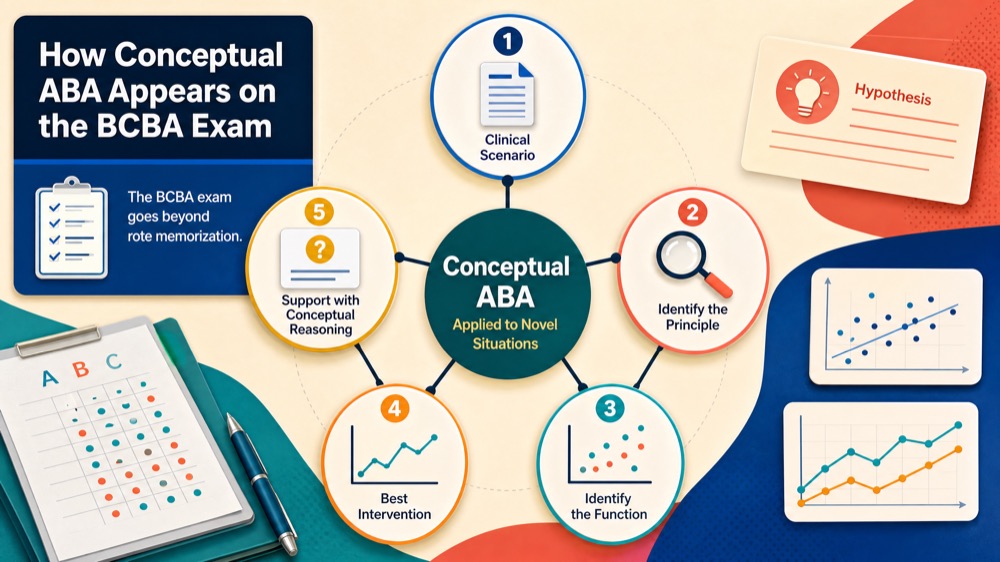
The BCBA exam goes beyond rote memorization. It tests your ability to apply conceptual knowledge to novel situations. Many questions present a clinical scenario and ask you to identify the principle, the function, or the best intervention. Understanding conceptual ABA will help you answer these questions with confidence. Let’s explore the typical formats and the common traps that trip up candidates.
Typical Question Formats: You may encounter multiple-choice questions that ask you to define a term or recognize an example. For instance, a question might describe a scenario and ask which of the following is the reinforcer. More complex questions might present a functional assessment summary and ask you to identify the maintaining variable. Scenario-based questions are particularly common. They allow you to demonstrate your conceptual understanding by analyzing the situation. To prepare, practice breaking down scenarios into their ABC components and identifying the function.
Common Traps to Avoid: One common trap is misidentifying the function of behavior. For example, you might assume a behavior is attention-seeking when it is actually escape-maintained. Another trap is confusing negative reinforcement with punishment. Remember that both negative reinforcement and punishment involve an aversive stimulus, but reinforcement always increases behavior, while punishment decreases it. Also, be careful with extinction: it only works if the reinforcer is completely withheld, and you must plan for the extinction burst. Finally, do not overlook the role of motivating operations; they can alter the value of reinforcers and change behavior in ways that may seem confusing. Being aware of these traps helps you avoid losing points.
Quick Study Checklist for Conceptual ABA
As you near your exam date, a focused review of key concepts can boost your confidence. Use this checklist to ensure you have covered the essential topics. You should be able to define each term, provide an example, and identify it in a scenario.
- Reinforcement: Understand positive and negative reinforcement, and be able to give examples.
- Punishment: Define positive and negative punishment, and know how they differ from reinforcement.
- Extinction: Know the procedure, the expected effects, and the extinction burst.
- Stimulus control: Explain how behavior is influenced by discriminative stimuli.
- Functions of behavior: Recognize the four functions: access to attention, access to tangibles, escape from demands, and automatic reinforcement.
Reviewing these concepts daily will reinforce your learning. Try to explain each one aloud without looking at notes. This active recall is a powerful study method.
Final Thoughts: Mastering Conceptual ABA
Mastering conceptual ABA is not just about passing the exam—it is about becoming a more effective behavior analyst. When you understand the why behind the intervention, you can adapt your approach to each individual and setting. The principles of reinforcement, punishment, extinction, and stimulus control are the building blocks of all behavior change. By studying them conceptually, you set yourself up for success both on the exam and in practice.
As you prepare, remember that the BCBA exam is designed to assess your ability to think like a behavior analyst. Use the worked examples and checklists in this article to guide your study. For more in-depth resources, explore our guide on functions of behavior and the FBA process. These articles reinforce the conceptual foundations you need. Additionally, you can refer to the Behavior Analyst Certification Board’s website for the official task list and ethical guidelines. With consistent practice and a conceptual mindset, you will be well on your way to acing the exam.
Quick Review Checklist
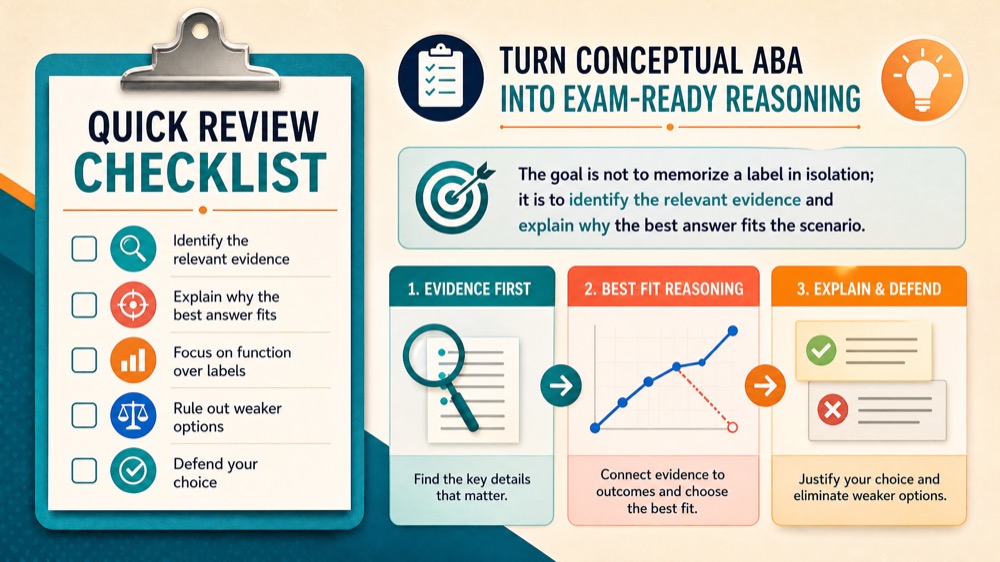
Use this final checklist to turn conceptual ABA into exam-ready reasoning. The goal is not to memorize a label in isolation; it is to identify the relevant evidence and explain why the best answer fits the scenario. Key ideas to review:
- State the central definition or decision point for conceptual ABA in your own words.
- Identify the detail that makes conceptual ABA different from its closest related ABA term.
- Separate the observable facts in a scenario from assumptions that are not supported by the facts.
- Write one example and one nonexample so you can recognize the concept in a new setting.
Exam application checks:
- Ask what the question is actually requesting before comparing the answer choices.
- Mark the antecedent, response, consequence, or other evidence that supports the selected answer.
- Look for a distractor that describes a related process but does not answer the specific question.
Final self-check:
- Explain how you would verify the interpretation with clear observations or data.
- Change one detail in the scenario and decide whether your answer should change.
- Give a one-sentence rationale that a supervisor or study partner could evaluate.
Take the Free BCBA Mock Exam
Ready for more practice? Use the free mock exam to keep testing your accuracy with realistic BCBA-style items. Take the Free BCBA Mock Exam
References
- Behavior Analyst Certification Board (BACB)
- Association for Behavior Analysis International (ABAI)



