
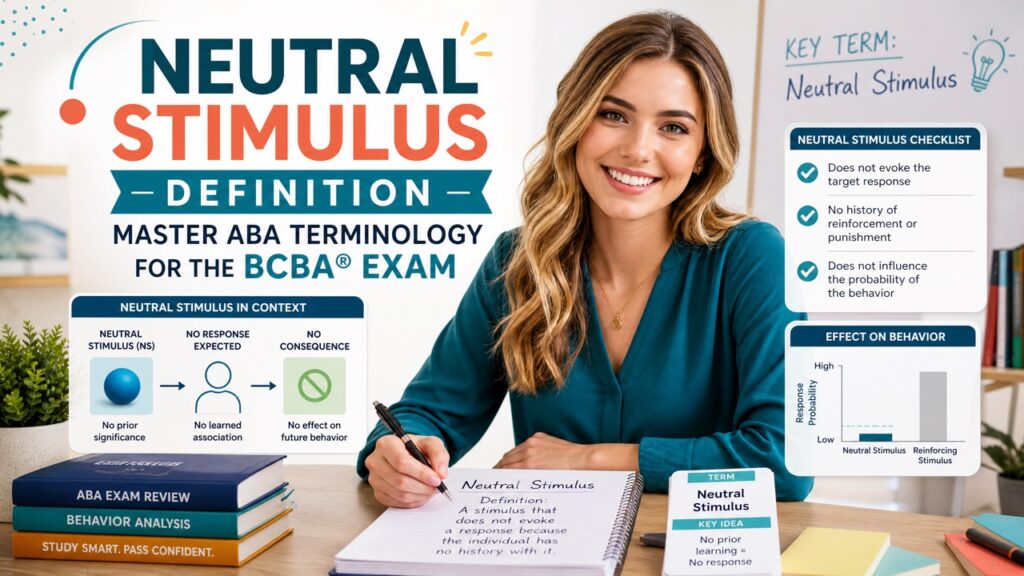
Defining the Neutral Stimulus in Psychology
In psychology, a neutral stimulus is any event or object that does not naturally elicit a response from an organism before conditioning occurs. In ABA terms, it is a stimulus that initially has no effect on the target behavior. For BCBA candidates, understanding this neutral stimulus definition is foundational because it sets the stage for classical conditioning, which is a key component of respondent behavior.
Table of Contents
- Defining the Neutral Stimulus in Psychology
- Classical Conditioning and the Role of the Neutral Stimulus
- Neutral Stimulus Examples in ABA Practice
- Exam Relevance and Common Traps
- Quick Checklist for Neutral Stimulus Mastery
- Summary
- Take the Free BCBA Mock Exam
- References
The concept traces back to Ivan Pavlov’s work. Before conditioning, a bell means nothing to a dog; it does not cause salivation. After repeated pairings with food, the bell alone can trigger salivation. That transition—from neutral to conditioned—is central to how many automatic responses are learned. For exam purposes, you need to recognize that a neutral stimulus becomes a conditioned stimulus only after pairing with an unconditioned stimulus.
Why does this matter for your exam? The BCBA exam often tests your ability to identify which stimuli are neutral in a given scenario. You must also understand how a neutral stimulus can acquire evocative or abative effects through pairing. This is not just theoretical; it applies to real behavior change procedures like systematic desensitization and respondent extinction.
Why This Matters for BCBA Candidates: As a future BCBA, you will encounter clients whose behaviors are influenced by respondent conditioning. For example, a child may feel anxious at the sight of a medical clinic because that setting was previously paired with painful procedures. Recognizing the role of a neutral stimulus helps you design interventions that weaken these conditioned responses. Moreover, the exam may ask you to differentiate between a neutral stimulus and an unconditioned stimulus, which is a common pitfall.
In your study plan, master the vocabulary: neutral stimulus (NS), unconditioned stimulus (US), unconditioned response (UR), conditioned stimulus (CS), and conditioned response (CR). These five terms appear frequently in exam questions. Use our BCBA exam starter guide to build a solid foundation.
Classical Conditioning and the Role of the Neutral Stimulus
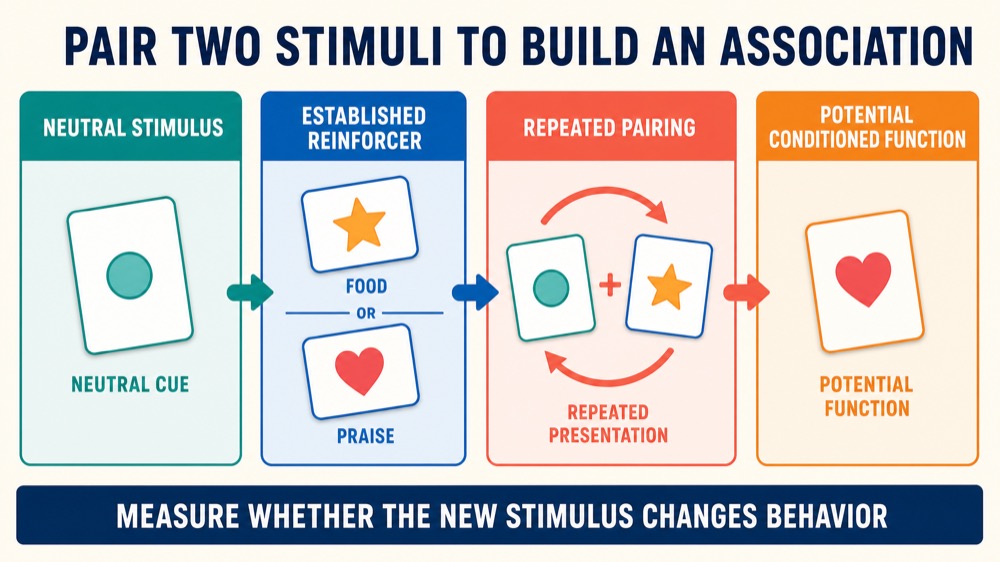
Classical conditioning explains how a neutral stimulus becomes a conditioned stimulus through repeated pairings with an unconditioned stimulus. In ABA, this process is part of respondent behavior, which is elicited by antecedent stimuli rather than emitted based on consequences. Understanding this distinction is critical for the exam because it separates respondent from operant conditioning.
Pavlov’s classic experiment illustrates the process. Food (US) elicits salivation (UR). A bell (NS) does not elicit salivation initially. After pairing the bell with food multiple times, the bell alone produces salivation, now called a conditioned response (CR). At that point, the bell is a conditioned stimulus (CS). The transition from NS to CS is the heart of classical conditioning. Pavlov’s Experiment: From Neutral to Conditioned: Let’s break down the stages:
- Before conditioning: The bell is a neutral stimulus; it produces no salivation. The food is an unconditioned stimulus that reliably elicits salivation (UR).
- During conditioning: The bell is presented just before the food. This pairing is repeated several times. Timing matters: the NS should precede the US by a short interval.
- After conditioning: The bell alone now elicits salivation. It has become a conditioned stimulus. The salivation is now a conditioned response.
For BCBA exam questions, you may be given a scenario and asked to label each element. Remember that a neutral stimulus does not have a natural reflex. If it did, it would be an unconditioned stimulus. Practice identifying these components in everyday examples, such as a tone followed by a puff of air to the eye (eye blink) or a song associated with an emotional memory.
Neutral Stimulus Examples in ABA Practice
Seeing how a neutral stimulus works in real-world ABA settings helps solidify the concept. Here are three examples that demonstrate the transition from NS to CS, along with the implications for behavior change. Example 1: School Setting: A teacher initially claps her hands (NS) to get students’ attention. At first, students do not respond; clapping is arbitrary. Over time, she pairs the clap with a verbal request like “Look here” and then provides praise or a preferred activity. After repeated pairings, the clap alone causes students to orient toward the teacher. The clap is now a conditioned stimulus for attending behavior. In exam terms, you might be asked to identify the discriminative stimulus for attention.
Example 2: Home Setting: A parent says the word “snack” (NS) while showing a preferred food item. Initially, the word has no meaning. After several pairings with the actual snack, the word alone may evoke salivation and approach behavior. This is respondent conditioning, but it can also become an establishing operation if the child is hungry. Be careful on the exam: the word “snack” could function as a conditioned stimulus for physiological responses, but it might also function as a discriminative stimulus for requesting.
Example 3: Clinic Setting: A therapist uses a clicker during discrete trial training. The clicker sound is initially neutral. The therapist clicks immediately before delivering a reinforcer (e.g., a toy or edible). After many pairings, the clicker becomes a conditioned reinforcer, which is a type of conditioned stimulus. In this case, the clicker also serves as a conditioned reinforcer because it signals that reinforcement is coming. On the exam, you may need to differentiate between a conditioned reinforcer and a backup reinforcer.
These examples show that a neutral stimulus can take many forms—sound, word, object, or even a person’s face. The key is that its effect is learned, not innate. For more on how stimuli control behavior, see our article on discriminative stimuli.
Exam Relevance and Common Traps
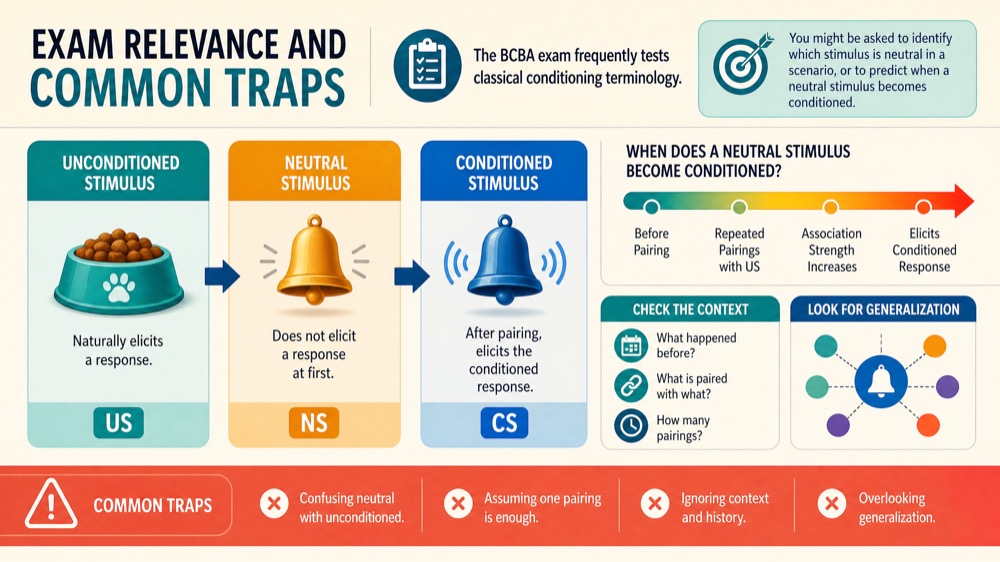
The BCBA exam frequently tests classical conditioning terminology. You might be asked to identify which stimulus is neutral in a scenario, or to predict when a neutral stimulus becomes conditioned. Understanding these traps will save you points.
How the Exam Tests This Concept: Typical questions present a scenario like: “A dog salivates when it hears a bell that was previously paired with food. In this example, the bell is a…” The correct answer is conditioned stimulus. Other variations ask you to identify the unconditioned response or to choose which procedure best weakens a conditioned response. For example, respondent extinction involves presenting the CS without the US until the CR diminishes.
You may also see questions that involve higher-order conditioning, where a second NS is paired with an established CS. For instance, a light (NS) is paired with a bell (CS) that already elicits salivation. After pairing, the light alone elicits salivation. This is a common exam twist.
Common Trap: Confusing Neutral Stimulus with Unconditioned Stimulus: A frequent error is confusing a neutral stimulus with an unconditioned stimulus. Remember: an NS produces no natural response; a US does. Food, water, pain, and air puffs are unconditioned because they naturally elicit reflexes. A bell, a light, or a specific phrase are neutral until conditioned. A quick trick: ask yourself, “Did this stimulus naturally cause the response before any learning?” If yes, it’s a US. If no, it’s neutral. Other Common Pitfalls: Use the points below as a quick study guide.
- Timing errors: The NS must be presented before the US for conditioning to occur. If the US comes first, conditioning is less effective.
- CS vs. CR: The CS is the stimulus (e.g., bell), while the CR is the response (e.g., salivation).
- Operant vs. respondent: A stimulus that signals reinforcement is a discriminative stimulus (operant), not a conditioned stimulus (respondent).
For more on these distinctions, check our guide on S-delta and discriminative stimuli.
Quick Checklist for Neutral Stimulus Mastery
Use this list to review before the exam:
- Definition: A neutral stimulus produces no natural response.
- Pairing: It becomes conditioned only after being paired with an unconditioned stimulus.
- Timing: The NS should precede the US, typically by 0.5–1.0 seconds for optimal conditioning.
- Acquisition: Repeated pairings strengthen the conditioned response.
- Extinction: Repeated presentation of CS without US weakens the CR.
- Generalization: Similar stimuli may also elicit the CR, a phenomenon called stimulus generalization.
- Discrimination: The CR occurs only to the CS, not to other stimuli.
- Higher-order conditioning: A new NS can become conditioned by pairing with an established CS.
Print this checklist and review it daily during your final preparation. For a broader study strategy, see our BCBA exam blueprint guide.
Summary
Mastering the neutral stimulus definition is essential for your BCBA exam. A neutral stimulus is any event that does not naturally elicit a response. Through classical conditioning, it can become a conditioned stimulus that evokes a learned response. This process is fundamental to understanding respondent behavior and has practical applications in ABA interventions.
Remember the key terms: NS, US, UR, CS, CR. Identify them correctly in scenarios. Watch out for common traps like confusing NS with US. Use the checklist to solidify your knowledge. With consistent review, you’ll be ready to answer any question about classical conditioning. For additional resources, explore our articles on extinction and stimulus control. Also, refer to the BACB’s official resources for more on ethics and professional conduct.
Take the Free BCBA Mock Exam
Ready for more practice? Use the free mock exam to keep testing your accuracy with realistic BCBA-style items. Take the Free BCBA Mock Exam



