
What Is a Generalized Reinforcer?
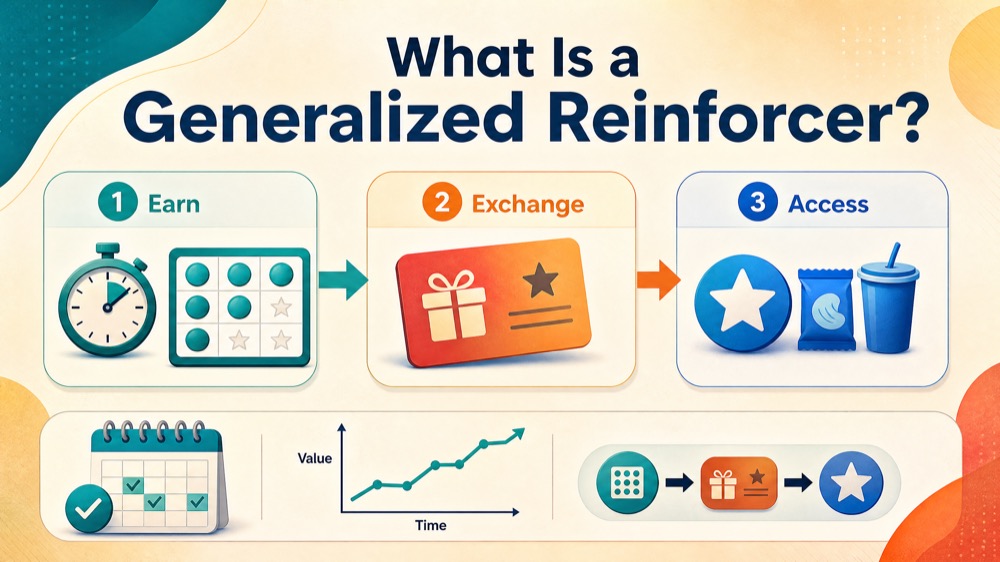
When you’re preparing for the BCBA exam, you’ll often hear about reinforcement types, but one of the most practical concepts is the generalized reinforcer. This term describes a specific kind of conditioned reinforcer that has been paired with a variety of backup reinforcers, making it effective even when those backup items are not currently available.
Table of Contents
- What Is a Generalized Reinforcer?
- Real-World ABA Examples of Generalized Reinforcers
- Why Generalized Reinforcers Matter for the BCBA Exam
- Quick Checklist for Identifying a Generalized Reinforcer
- Key Takeaways for BCBA Candidates
- Take the Free BCBA Mock Exam
Imagine a token that can be exchanged for a snack, extra playtime, or a favorite activity. Because that token is linked to many different reinforcers, it becomes valuable in its own right, no matter what the learner currently prefers. This is why generalized reinforcers are so powerful in applied behavior analysis.
Defining Generalized Reinforcers in ABA: In behavioral terms, a generalized reinforcer is a conditioned reinforcer that has been paired with multiple unconditioned or conditioned reinforcers. Because of this history, it functions as a reinforcer across a wide range of motivating operations and situations. For example, money is a classic generalized reinforcer because it can be exchanged for countless different goods and services.
For the BCBA exam, you need to understand that the effectiveness of a generalized reinforcer does not depend on a single backup. Instead, it is maintained by the variety of backup options available. This makes it more resistant to satiation than a single edible or toy, which is a key exam point.
How Generalized Reinforcers Differ from Other Reinforcers: To truly master this concept, you must distinguish it from unconditioned reinforcers (like food and water, which are innately reinforcing) and conditioned reinforcers that are paired with only one backup. A conditioned reinforcer like a whistle sound that is only paired with a specific treat may lose its effectiveness when the learner is no longer hungry. In contrast, a generalized reinforcer like a token or praise remains effective because it signals access to many different backups. Furthermore, generalized reinforcers are also less likely to be affected by momentary shifts in preference. This is why they are often recommended for token economies and other long-term intervention programs.
Real-World ABA Examples of Generalized Reinforcers
One of the best ways to internalize this concept is to examine concrete examples. Here are three common scenarios you might see in ABA practice or on the exam. Each includes an ABC breakdown to help you visualize the three-term contingency.
Example 1: Token Economy in a Classroom: A child earns tokens for completing assignments. The tokens can be exchanged for stickers, extra computer time, or a homework pass. Because the token is paired with multiple backup reinforcers, it functions as a generalized reinforcer.
- Antecedent (A): The teacher presents a math worksheet.
- Behavior (B): The child completes the worksheet and receives a token.
- Consequence (C): In the future, the child is more likely to complete assignments because the token can be traded for a preferred item.
This example also illustrates why generalized reinforcers are so useful in the classroom: they allow the teacher to avoid running out of a specific backup and keep the learner engaged throughout the session. Example 2: Social Praise in a Therapy Setting: During a therapy session, the therapist says ‘Great job!’ and gives a high-five after a learner requests a toy. Praise has been paired with many other reinforcers, including attention, access to toys, and even edible favorites. Over time, the praise itself becomes a generalized reinforcer.
- Antecedent (A): The therapist asks, ‘What do you want?’
- Behavior (B): The child says ‘car’ and receives praise and the car.
- Consequence (C): The child is more likely to use verbal requests in the future because praise predicts access to a variety of reinforcers.
Not every instance of praise becomes a generalized reinforcer automatically. It depends on the variety of backup reinforcers with which the praise has been paired. This is a subtle point that often appears in exam questions.
Example 3: Money for Household Chores: Teenagers who earn an allowance for completing chores can spend the money on a range of items, from snacks to video games. Because money can be exchanged for so many things, it is a classic generalized reinforcer.
- Antecedent (A): A parent gives the teen a list of chores.
- Behavior (B): The teen completes the chores and receives money.
- Consequence (C): The teen is more likely to complete future chores because the money can be used to buy various preferred items.
Notice that the value of money remains high even if the teen is momentarily not hungry or not interested in a specific item, simply because the range of possibilities is so broad.
Why Generalized Reinforcers Matter for the BCBA Exam
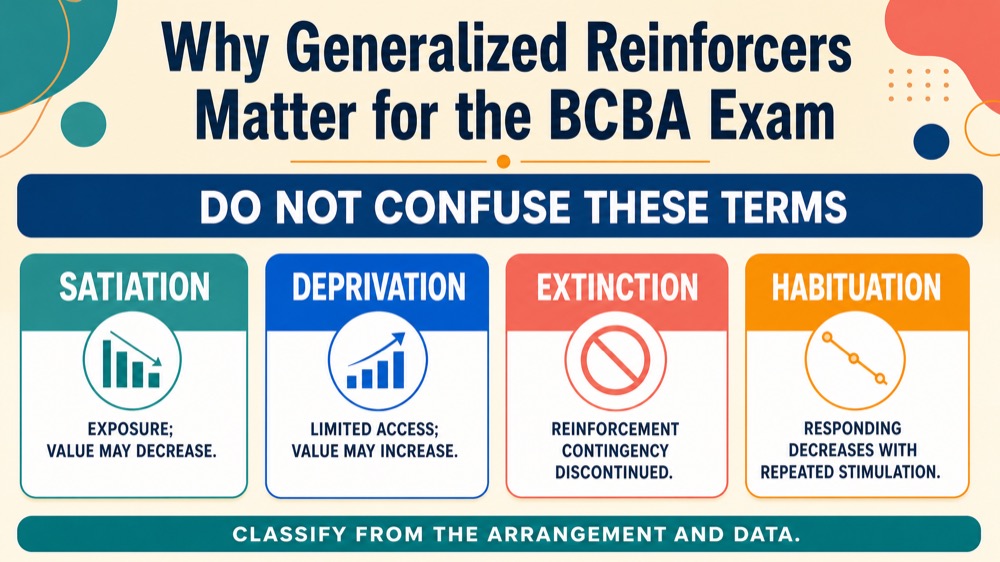
On the BCBA exam, you’ll encounter questions that ask you to identify reinforcer types, design effective intervention plans, or predict the effects of satiation. Understanding generalized reinforcers is crucial because they are a common strategy in behavior reduction and skill acquisition programs.
One of the most frequent exam questions involves a scenario where a client loses interest in a favorite food. If a practitioner is using a single food reinforcer, the intervention may fail. But if a token system is in place, the token remains effective because it is backed by a variety of backup reinforcers. This is exactly why generalized reinforcers are often the recommended choice for maintaining long-term motivation.
How the BCBA Exam Tests This Concept: Exam questions might present a scenario and ask you to identify the type of reinforcer being used. Alternatively, you might be asked which reinforcer is most resistant to satiation or which is most likely to maintain behavior over time. In some cases, you’ll be asked to design a token economy and explain why the tokens are likely to serve as generalized reinforcers.
To prepare, you should be able to differentiate between a generalized reinforcer and a simple conditioned reinforcer by examining their history of pairing. The question may include words like ‘paired with many’ or ‘backed by multiple’ to signal a generalized reinforcer. Common Mistakes Candidates Make: Use the points below as a quick study guide.
- Confusing with unconditioned: Unconditioned reinforcers are innate (food, water), whereas generalized reinforcers are learned. Do not mix them up.
- Assuming all edibles are generalized: An edible is typically an unconditioned reinforcer, not a generalized one, unless it has been paired with other reinforcers, which is rare.
- Ignoring backup reinforcers: The effectiveness of a generalized reinforcer depends on the backup reinforcers it has been paired with. If those backups lose value, the generalized reinforcer may lose its power.
- Overlooking motivating operations: Even a generalized reinforcer can lose effectiveness if the learner is temporarily satiated on all available backups. But the broad range makes it less likely.
Quick Checklist for Identifying a Generalized Reinforcer
Here’s a handy checklist to help you quickly identify whether a stimulus is a generalized reinforcer. Use this during your study sessions or on the exam.
- Is it a conditioned reinforcer? (Has it been learned to function as a reinforcer?)
- Has it been paired with more than one reinforcer? (Multiple backups = more generalized.)
- Does it remain effective across different situations? (If yes, it’s more likely generalized.)
- Is it less susceptible to satiation? (If the behavior persists even when one backup is unavailable, it’s probably generalized.)
- Are there backup reinforcers available? (Even a generalized reinforcer depends on some backup, but the more diverse, the better.)
Keep this checklist in mind when answering any question that involves reinforcer types. It can save you from common pitfalls and help you choose the correct answer more quickly.
Key Takeaways for BCBA Candidates
Understanding the generalized reinforcer is not just about memorizing a definition; it’s about applying it to real-world situations. You should be able to describe why a token, a click, or a specific praise statement can become a powerful reinforcer when it has been paired with a variety of positive outcomes.
As you continue your exam prep, remember that generalized reinforcers are a cornerstone of effective behavior change programs. They offer flexibility, reduce the impact of satiation, and make it easier to maintain behavior in natural settings. For more insights, you might explore our token economy guide or our reinforcement overview to deepen your understanding. Also, be sure to check out the BACB website for the latest exam content and ethical guidelines. And if you want to test your knowledge, try our BCBA mock exams for realistic practice questions. Remember, the key to mastering this concept is to practice identifying it in various scenarios. Good luck with your studies!
Take the Free BCBA Mock Exam
Ready for more practice? Use the free mock exam to keep testing your accuracy with realistic BCBA-style items. Take the Free BCBA Mock Exam



