
Introduction: What is the Dependent Variable?
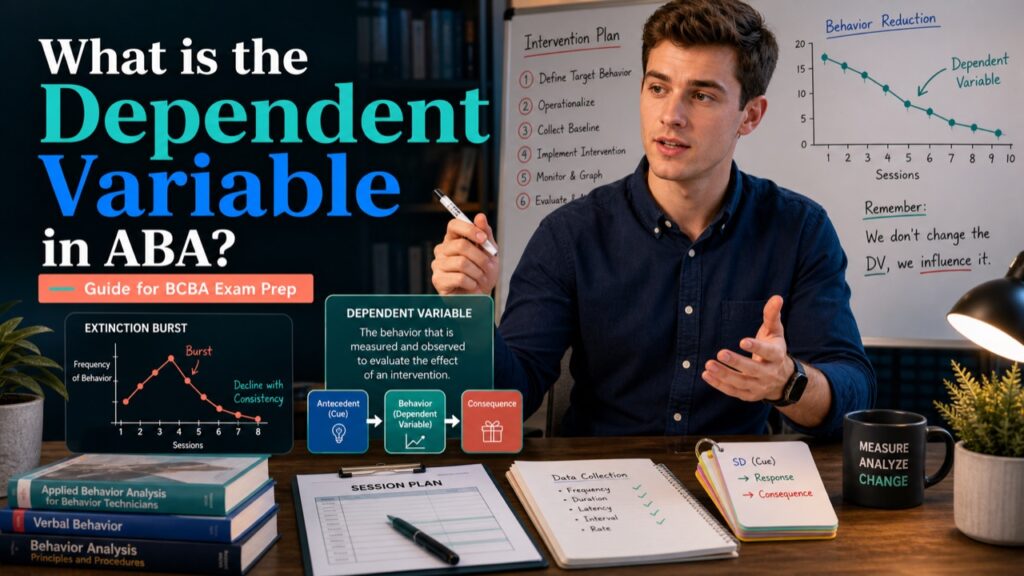
In applied behavior analysis (ABA), every experiment or intervention revolves around measuring change. But what exactly are we measuring? That’s where the dependent variable comes in. Simply put, the dependent variable is the behavior or response that the researcher expects to change as a result of manipulating some other variable. Understanding this concept is crucial for BCBA exam prep because experimental design questions often ask you to identify the dependent variable from a scenario. Without a firm grasp, you risk confusing the measured behavior with the intervention itself.
Table of Contents
- Introduction: What is the Dependent Variable?
- Dependent Variable Definition in ABA
- Example 1: Tangible Reinforcement
- Example 2: Escape from Demands
- Common Exam Traps and Tips
- Quick Checklist for the BCBA Exam
- Summary
- References
In ABA, the dependent variable is always the target behavior—the action you are trying to increase, decrease, or maintain. It is the outcome you track across conditions. For example, if you implement a token economy to increase on-task behavior, on-task behavior is the dependent variable. The token system (independent variable) is what you manipulate to see if on-task behavior changes. This distinction is fundamental to the science of behavior analysis and appears repeatedly on the BCBA exam.
Dependent Variable Definition in ABA
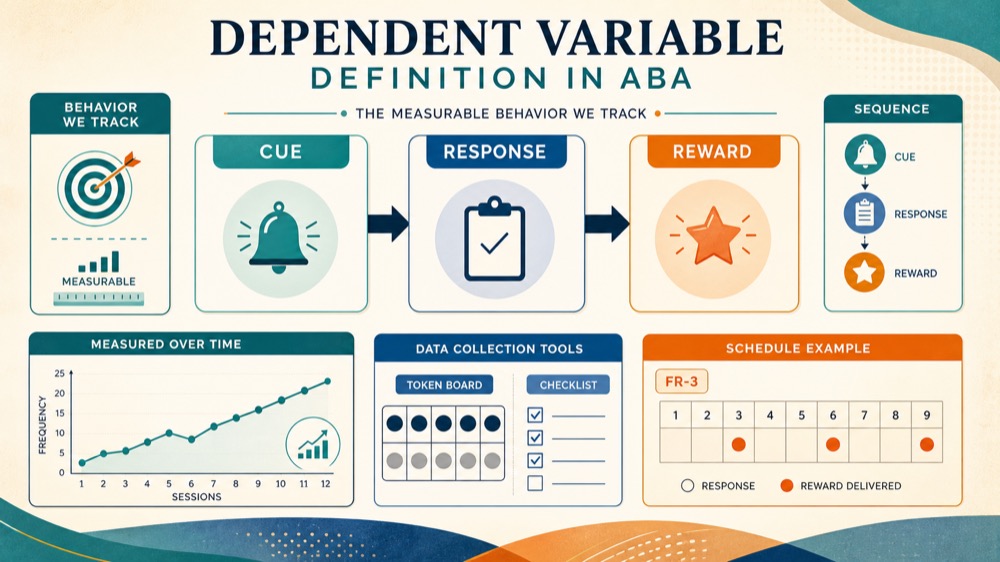
The dependent variable in ABA is defined as the measurable dimension of behavior that is recorded and analyzed to determine the effect of an independent variable. It answers the question: “What behavior are we tracking?” In a typical ABA study, the dependent variable is the behavior that shows change across baseline and intervention phases. The independent variable is the environmental manipulation (e.g., reinforcement schedule, prompting strategy) that is systematically applied to see if it produces a change in the dependent variable.
For example, in a functional analysis, the dependent variable might be the frequency of aggression. The independent variables are the test conditions (attention, escape, alone, tangible). The data collected on aggression (the dependent variable) tell you which condition evokes the most behavior, helping you identify the function. On the exam, you’ll often see scenarios asking: “What is the dependent variable in this study?” The answer is always the measured behavior, not the intervention or consequence.
Operationalizing the Dependent Variable: For the dependent variable to be meaningful, it must be operationalized—defined in objective, measurable terms. Instead of “aggression,” you might define it as “hitting another person with an open hand above the waist.” Operational definitions ensure interobserver agreement and replicability. Common measurement dimensions include frequency, duration, latency, and magnitude. For example, if the dependent variable is “elopement,” you might measure it as the number of times the learner leaves the designated area without permission per session. On the BCBA exam, you may be asked to select the best operational definition for a given target behavior.
Why It Matters for the BCBA Exam: Identifying the dependent variable correctly is essential for experimental design questions. The exam often presents a brief research scenario and asks you to identify the dependent variable, the independent variable, or both. Candidates who mistake the dependent variable for the intervention often lose easy points. Remember: the dependent variable is the outcome you measure, while the independent variable is what you manipulate. Practice reading scenarios and underlining the behavior that is being measured. This skill will also help you design effective interventions in your professional practice.
Example 1: Tangible Reinforcement
Let’s walk through a concrete ABA example. Imagine a child named Leo who frequently screams when his iPad is taken away. A behavior analyst hypothesizes that the screaming is maintained by access to the iPad (tangible function). To test this, they implement an ABC analysis: Antecedent, Behavior, Consequence. The dependent variable here is the screaming behavior—that’s what is being measured and tracked over time.
- Antecedent (A): The therapist tells Leo it’s time to put the iPad away and removes it.
- Behavior (B): Leo screams (the dependent variable).
- Consequence (C): The therapist gives the iPad back to Leo.
In this scenario, the dependent variable (screaming) is the behavior of interest. The independent variable (contingent access to iPad) is manipulated to see if screaming increases when the iPad is returned versus when it is withheld. On the exam, you might be asked: “In this ABC analysis, what is the dependent variable?” The correct answer is screaming, because it is the behavior being measured and expected to change.
Example 2: Escape from Demands
Another common ABA scenario involves escape-maintained behavior. Consider a student named Maria who engages in task refusal when asked to complete math worksheets. The hypothesized function is escape from demands. During a functional analysis, the dependent variable is task refusal—operationally defined as “verbal protest (e.g., ‘No’) or pushing materials away within 5 seconds of instruction.”
- Antecedent (A): The teacher presents a math worksheet and says, “Please complete this.”
- Behavior (B): Maria pushes the worksheet away and says, “I won’t do it” (task refusal, the dependent variable).
- Consequence (C): The teacher removes the worksheet and says, “Okay, we’ll try later.”
Notice that the dependent variable (task refusal) is what is recorded across conditions. The independent variable is the escape contingency—whether or not the demand is removed following refusal. Identifying the dependent variable correctly helps the behavior analyst determine whether the intervention (e.g., providing breaks contingent on compliance) effectively reduces task refusal. For the BCBA exam, practice picking out the target behavior from similar narratives.
Common Exam Traps and Tips
Even experienced candidates sometimes slip up on dependent variable questions. Here are common traps and how to avoid them:
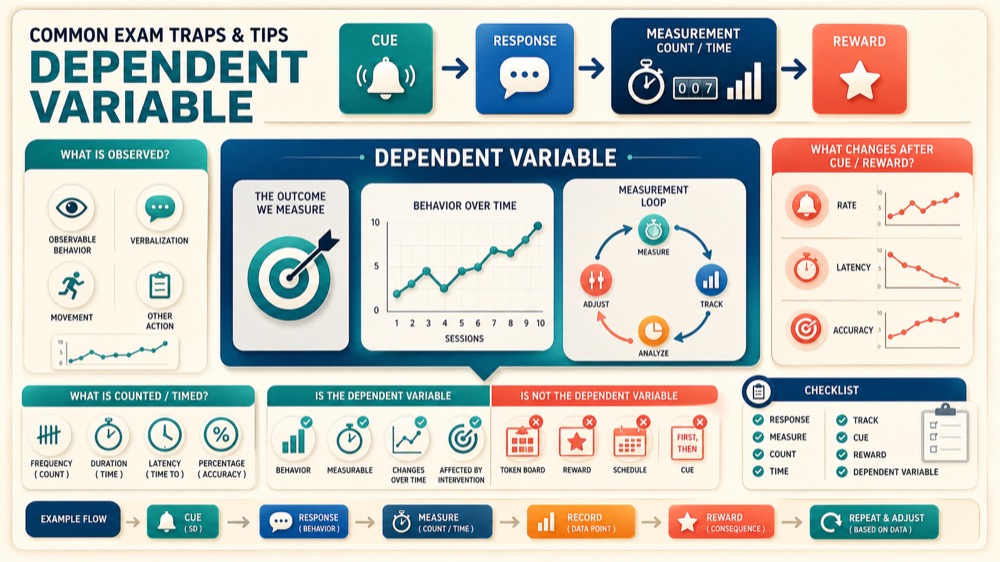
- Trap: Confusing the dependent variable with the intervention. Remember: the dependent variable is the behavior, not the token system, prompt, or reinforcer. If the question describes a token economy to increase eye contact, the dependent variable is eye contact, not the tokens.
- Trap: Misidentifying the consequence as the dependent variable. In ABC data, the consequence is what happens after the behavior. The behavior itself is the dependent variable. For example, if the consequence is “therapist provides attention,” the dependent variable is still the behavior (e.g., hitting), not attention.
- Trap: Confusing the dependent variable with the goal. The goal (e.g., reduce aggression) is what you hope to achieve, but the dependent variable is the actual measured behavior. They are often the same, but the dependent variable is the specific operational definition used in measurement.
To avoid these traps, ask yourself: “What behavior is being counted, timed, or tracked?” That is your dependent variable. Also, look for the words “measured” or “recorded” in exam scenarios—they often signal the dependent variable.
Quick Checklist for the BCBA Exam
Use this checklist when analyzing exam scenarios to identify the dependent variable:
- Identify the target behavior the intervention aims to change.
- Determine which variable is being measured across conditions (e.g., frequency, duration).
- Confirm that the variable is operationally defined—it must be observable and measurable.
- Distinguish it from the independent variable (the manipulated environmental event).
- Check if the dependent variable is the primary outcome of interest in the study.
Practicing with mock exam questions (like those available at BCBA Mock Exam) can help solidify this skill. Every time you read a scenario, pause and ask: “What is the dependent variable?” With repetition, identifying the dependent variable will become automatic.
Summary
The dependent variable is the cornerstone of any ABA experimental design. It is the behavior being measured and expected to change as a result of the independent variable. By operationalizing the dependent variable clearly, you ensure reliable data collection and valid conclusions. On the BCBA exam, you must be able to distinguish the dependent variable from the independent variable and from other components like consequences or goals.
To master this concept, review the examples in this guide, apply the quick checklist, and test yourself with practice questions. For more in-depth study of experimental design and ABA principles, explore our BCBA exam prep guide. Remember: the dependent variable is always the measured behavior—never the intervention. Keep this in mind, and you’ll handle exam questions with confidence.



