

The phrase attitudes of science ABA usually refers to six scientific commitments described in major applied behavior analysis texts: determinism, empiricism, experimentation, replication, parsimony, and philosophic doubt. They are not a recipe that produces an answer automatically. Together, they shape how a behavior analyst asks questions, observes events, tests tentative explanations, and updates conclusions. Understanding the set as a coordinated way of reasoning is more useful than memorizing six isolated definitions.
Table of Contents
- The Six Attitudes of Science in ABA
- How the Six Attitudes Work Together
- Traditional Six Versus the Current BCBA Outline
- Applied Reasoning Example
- Common Distinctions and Study Checks
- References and Further Reading
- Practice Scientific Reasoning
This guide explains each attitude with original examples, shows how the six work together, and distinguishes the traditional list from related philosophical assumptions named in the current BCBA Test Content Outline. The goal is careful scientific reasoning, not certainty. A conclusion can be well supported while remaining open to correction when better measurement, a stronger design, or a successful replication changes the evidence.
The Six Attitudes of Science in ABA
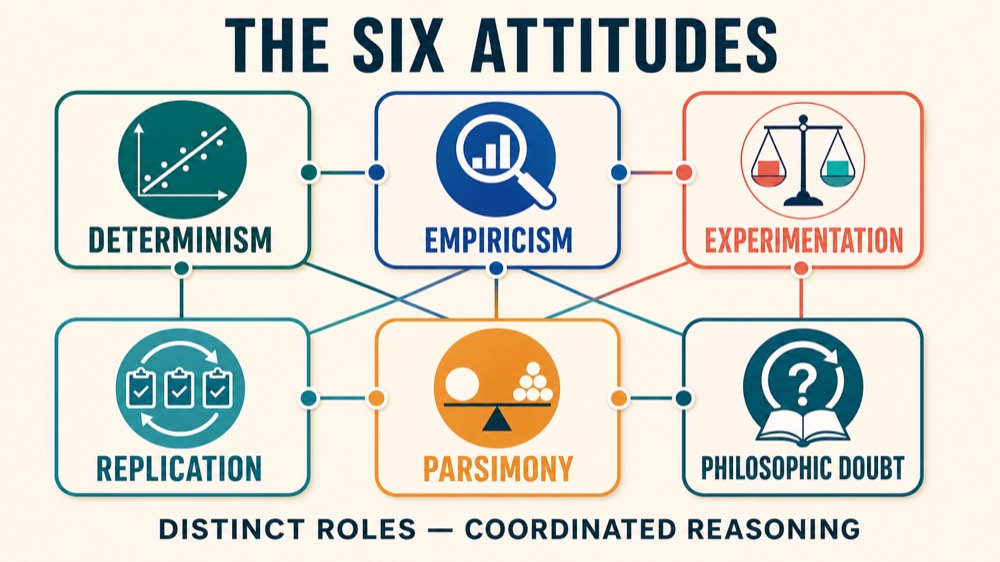
The six attitudes assign different jobs within scientific inquiry. Determinism makes lawful relations worth investigating; empiricism anchors claims in observation; experimentation tests whether arranged changes contribute to an outcome; replication builds confidence; parsimony disciplines explanation; and philosophic doubt keeps conclusions provisional. None substitutes for the others.
Determinism: Determinism is the assumption that behavior occurs in an orderly natural world and is related to other events. It does not require a single cause, perfect prediction, or an analyst who can identify every relevant variable. Behavior may be multiply controlled, and important historical or current variables may be unknown. In practice, determinism supports asking what relations can be investigated instead of treating an outcome as random, mysterious, or explained merely by a label.
Suppose work completion drops during several classroom periods. A deterministic approach does not declare one cause from that pattern. It directs attention to possible relations among task difficulty, instructional cues, reinforcement history, competing activities, sleep, medication changes, and other contextual variables. The lawful-relations assumption motivates assessment; it does not turn an early hypothesis into a finding.
Empiricism: Empiricism places observation and measurement ahead of intuition or authority. The relevant events must be described precisely enough that evidence can be examined rather than accepted because a respected person believes it. Direct observation can be valuable, but interviews, records, rating scales, and permanent products may also contribute when their limitations are understood. Interobserver agreement can strengthen confidence in measurement, yet it is not required for every statement a practitioner makes.
For example, the broad statement “participation improved” is difficult to evaluate. A more empirical account might define participation, specify the observation period, report opportunities and responses, describe the measurement system, and display change over time. Empiricism also requires examining measurement quality. A precise number can still mislead if the response definition drifts or the observation sample does not represent the setting.
Experimentation: Experimentation is the deliberate comparison of conditions in which an independent variable is manipulated and change in a dependent variable is measured. In single-case research, prediction, verification, and replication can help demonstrate a functional relation. Experimentation is more than trying something and noticing improvement, because coincident events, maturation, measurement changes, or sequence effects can offer alternative explanations.
Experimental control is not ethically or practically available for every question. Withdrawal may be inappropriate when a beneficial change cannot be reversed safely, and service decisions must account for consent, risk, feasibility, and stakeholder priorities. A multiple-baseline or changing-criterion arrangement may sometimes fit better than reversal, but the design must match the question and the behavior. When experimentation is not feasible, the analyst should describe conclusions with corresponding restraint.
Replication: Replication means repeating demonstrations to test the reliability and generality of an effect. Direct replication repeats conditions as closely as useful, while systematic replication changes selected features such as participants, responses, settings, materials, or implementers. Within a single-case design, repeated demonstrations of effect can also function as replication. The result need not be numerically identical; meaningful consistency is judged in relation to the design, measurement, variability, and question.
A successful intervention with one learner supports a conclusion about that case under the studied conditions. Similar outcomes across additional demonstrations can increase confidence, while a failed replication is informative rather than embarrassing. It may reveal a boundary condition, implementation difference, measurement problem, or an effect that is less robust than first believed. Replication therefore builds knowledge by confirming and refining claims.
Parsimony: Parsimony favors explanations that make fewer unnecessary assumptions after simpler, plausible accounts have been considered against the evidence. It is not permission to choose a convenient story, ignore biological or cultural variables, or reject complexity merely because it is complex. The more parsimonious account must still fit the observations and remain testable.
If a learner stops responding after materials change, an analyst might first check whether instructions, prompts, discrimination requirements, reinforcer availability, or measurement also changed. That review is more useful than immediately inventing an inaccessible trait. However, the first simple explanation is not automatically correct. Data may support multiple control or a more complex account. Parsimony disciplines the order and economy of explanation; evidence decides which account survives.
Philosophic Doubt: Philosophic doubt is the continuing willingness to question what is treated as fact, including one’s own preferred interpretation. Scientific knowledge is provisional, so confidence should be proportional to the quality and extent of evidence. This attitude is not reflexive disbelief. It asks what observation would weaken a claim, whether alternative explanations remain, and whether new evidence warrants revision.
In practice, philosophic doubt may lead a team to audit treatment integrity before concluding that a procedure failed, examine unexpected adverse effects despite improvement in a target measure, or reconsider a functional hypothesis when responding changes. It also applies to popular procedures and familiar textbooks. A claim does not become immune to evaluation because it is traditional, intuitive, or associated with an expert.
How the Six Attitudes Work Together
The attitudes are easiest to recognize as a sequence of scientific decisions, although real inquiry often moves back and forth among them. Consider a team evaluating whether a revised prompting arrangement increases independent task completion. The team begins with a tentative, testable account; defines and measures performance; arranges an appropriate comparison; repeats demonstrations where possible; prefers an account that explains the data without unsupported assumptions; and remains prepared to revise that account.
- Determinism: Treat the performance pattern as related to investigable variables rather than unexplained chance.
- Empiricism: Define independent completion, sample relevant opportunities, and assess whether measurement is trustworthy.
- Experimentation: Compare conditions in a design capable of addressing the causal question and compatible with participant welfare.
- Replication: Seek repeated demonstrations and examine whether the effect extends across relevant tasks, people, or settings.
- Parsimony: Rule out straightforward procedural and measurement explanations before adding unsupported constructs.
- Philosophic doubt: Look for disconfirming evidence, unintended effects, and conditions under which the conclusion may not hold.
This integration prevents a common error: using one attitude as a substitute for a complete analysis. Data collection without a useful comparison may be empirical but not experimental. A simple explanation may be parsimonious but unsupported. Repeated improvement may be encouraging but still ambiguous if the measurement system changed each time. Strong reasoning depends on the coordinated set.
Traditional Six Versus the Current BCBA Outline
The traditional six and the current certification outline overlap, but they should not be presented as identical lists. The publisher sample chapter for Applied Behavior Analysis describes determinism, empiricism, experimentation, replication, parsimony, and philosophic doubt as attitudes guiding scientific work. By contrast, item A.2 of the BCBA Test Content Outline (6th ed.) asks candidates to explain philosophical assumptions and gives selectionism, determinism, empiricism, parsimony, and pragmatism as examples.
Selectionism emphasizes that behavior and behavioral processes are shaped through selection at phylogenetic, ontogenetic, and cultural levels. Pragmatism evaluates concepts and practices partly by how effectively they support prediction and influence in context. Those ideas are related to scientific reasoning, but swapping them into the traditional six without explanation obscures the difference between two instructional groupings. For a broader treatment of the outline language, see the site’s guide to philosophical assumptions underlying behavior analysis.
Applied Reasoning Example
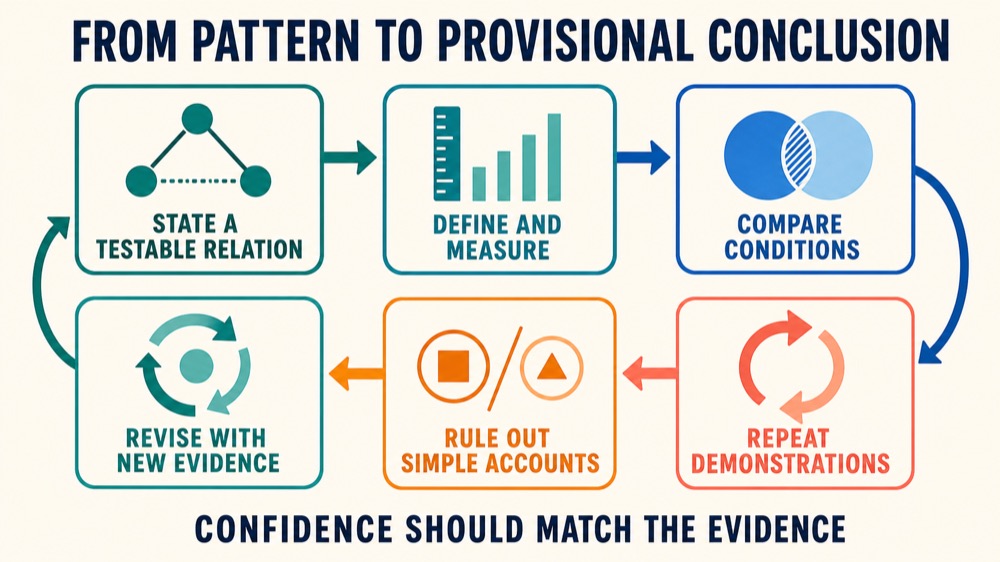
Imagine that a clinic introduces a brief pre-session choice procedure and independent transitions increase during the following week. A scientifically cautious analyst would not credit the procedure solely because improvement followed implementation. The team would define the transition response, review whether observation opportunities and staffing changed, examine level and trend before and after the change, assess implementation, and select a design that can answer the question without withdrawing necessary support.
- State a tentative relation between the arranged choice procedure and independent transitions.
- Check whether the response definition, observers, schedule, prompts, and available reinforcers remained comparable.
- Use a defensible comparison and report when experimental control is limited.
- Repeat demonstrations within the case and, when appropriate, across relevant contexts.
- Consider simpler measurement or implementation explanations before attributing change to a broad internal trait.
- Monitor social validity, treatment integrity, and unintended effects alongside the target outcome.
If the pattern does not replicate, the team should narrow the conclusion. Perhaps the initial change depended on one staff member, a novel material, a temporary motivating operation, or an unrecorded schedule change. Philosophic doubt treats that discrepancy as evidence to investigate. Parsimony discourages inventing a vague explanation when a documented procedural difference accounts for the result.
Common Distinctions and Study Checks
Short scenarios become easier when you identify the scientific action rather than matching a keyword. Ask whether the scenario assumes lawfulness, measures events, manipulates a variable, repeats a demonstration, evaluates explanatory economy, or reopens a conclusion. The following checks preserve important boundaries:
- Determinism is not fatalism: lawful influence does not mean that outcomes are fixed or that one variable controls behavior.
- Empiricism is not measurement alone: the measure must validly and reliably contact the event relevant to the question.
- Experimentation is not casual trial and error: a planned comparison is needed to evaluate a functional relation.
- Replication is not exact duplication: direct and systematic replications answer different questions about reliability and generality.
- Parsimony is not simplistic thinking: fewer assumptions are preferred only when the explanation remains consistent with evidence.
- Philosophic doubt is not indecision: provisional action and continued evaluation can occur at the same time.
A useful study exercise is to write one case and analyze it six ways. Then change one detail and ask which conclusion should change. This method tests discrimination among the concepts without relying on a mnemonic alone. It also reveals how selectionism and pragmatism relate to, but do not replace, the traditional six attitudes.
References and Further Reading
- Applied Behavior Analysis, sample Chapter 1 from the publisher
- Behavior Analyst Certification Board, BCBA Test Content Outline (6th ed.)
Practice Scientific Reasoning
Apply the attitudes to original scenarios by identifying what evidence is available, what conclusion is justified, and what additional observation would change your mind. The Free BCBA Mock Exam offers general practice and feedback across BCBA content areas. Use it to rehearse careful decision making, then return to the source materials when a distinction needs review.
Next step for BCBA exam prep
Turn this topic into exam-day practice
Use this topic as a focused review, then test it in exam-style conditions with a free mock before deciding whether five full-length mocks are the right next step.
Start the Free BCBA Mock ExamContinue with Five Full-Length Mocks — $99
Review the included materials and access details before ordering. No pass guarantee is implied.



