
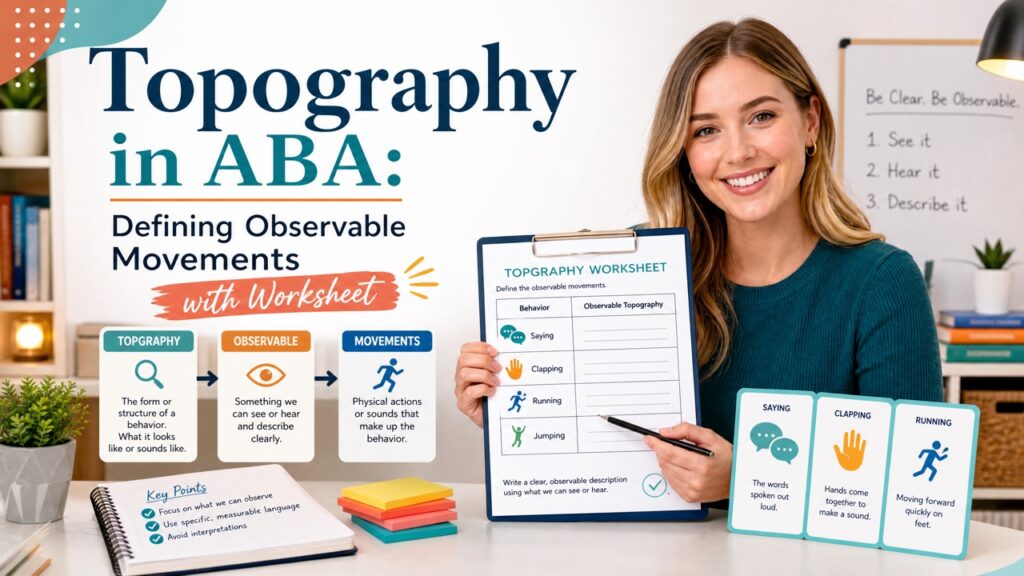
In applied behavior analysis (ABA), topography refers to the physical form or shape of a behavior—the specific movements, postures, and sequences that make up a response. When you describe a behavior’s topography, you are describing what it looks like, not why it happens. This distinction is essential for accurate behavioral assessment, measurement, and intervention. Whether you are a BCBA candidate or a practicing behavior analyst, understanding topography helps you define behaviors objectively, train staff reliably, and design effective interventions. This article breaks down the definition, offers real-world examples, and provides a worksheet to sharpen your skills. Table of Contents
Table of Contents
- What Is Topography in ABA? A Clear Definition
- Objective Description: The Backbone of Topography
- How to Measure Topography: Observation, Not Counting
- Worksheet: Practice Distinguishing Topography and Function
- Topography vs. Function: Why Surface Appearance Can Mislead
- Shaping Within Topography: Refining Movement Forms
- Practical Cautions for Behavior Intervention Plans
- Data Sheet Template for Qualitative Recording
- Study Checklist for BCBA Exam Preparation
- Ready to Test Your Knowledge?
- Reference
What Is Topography in ABA? A Clear Definition
Topography is a fundamental concept in ABA that describes the observable form of behavior. According to the BACB’s BCBA Test Content Outline (6th ed.), measurement and data display are core tasks for behavior analysts, and topography is part of that foundation. When you observe a behavior, you see its topography: the movements, postures, and sequences that define it. For example, “writing” involves gripping a pencil, moving it across paper, and forming letters. Each of those movements is part of the topographical definition.
But why does topography matter? Because behavior analysts must measure behavior objectively. If two observers watch a behavior, they should agree on what they saw. Topography provides the common language. For instance, instead of saying “the child was aggressive,” a topographical description says “the child forcibly swung their right arm in a downward motion, contacting another person’s arm.” This specificity ensures consistent measurement and allows others to replicate observations. Without clear topographical definitions, data collection becomes unreliable, and interventions can fail.
Objective Description: The Backbone of Topography
Writing a topographical description requires objectivity. You must describe movements using measurable terms, avoiding subjective labels. Objective descriptions focus on observable movements and their sequence, not on internal states or motives. For example, “the student was off-task” is subjective; a topographical version describes exactly what the student’s body does. Here are more examples that contrast subjective and objective descriptions:
- Subjective: “The student was off-task.” Objective: “The student’s eyes were oriented away from the worksheet for 10 seconds while the student’s hand was not in contact with a writing utensil.”
- Subjective: “The client tantrummed.” Objective: “The client lay on the floor, kicked both legs alternately, and vocalized at a volume above conversation level for 2 minutes.”
- Subjective: “The child was hyperactive.” Objective: “The child left their seat without permission and ran across the room, arms swinging.”
- Subjective: “The student was defiant.” Objective: “The student folded arms across chest, turned torso away from the teacher, and remained silent for 15 seconds after the instruction.”
When describing topography, focus on observable movements (e.g., “arm raises from side to shoulder height”) and their sequence (e.g., “then the hand opens”). Avoid referencing internal states or motives. For a behavior to be measurable, it must be defined so that two independent observers can agree on its occurrence. This is the foundation of interobserver agreement and reliable data. An operational definition is a precise, objective description of a behavior that allows different observers to identify the same behavior consistently. In the context of topography, an operational definition specifies the exact movements, postures, and sequences that count as an instance of the behavior, ensuring that everyone measures the same thing.
How to Measure Topography: Observation, Not Counting
Topography is a qualitative feature of behavior. Unlike frequency or duration, you don’t count how many times a movement occurs or how long it lasts (though you might count how often a topographically defined response occurs). Instead, you measure topography through careful observation and description. You note the movements, their sequence, and perhaps the force or latency. For example, you might record “the student raises hand so that the palm is visible at the top of the desk” rather than “raises hand three times.” Sometimes you need a data sheet to capture topographical details consistently.
To measure topography accurately, use a narrative recording or a structured observation form. You might also use video recording to review and refine your descriptions. When training staff, you can use behavioral skills training (BST) to teach them to identify and record topography reliably. The following worksheet provides a template for recording behavior descriptions across observation sessions.
Worksheet: Practice Distinguishing Topography and Function
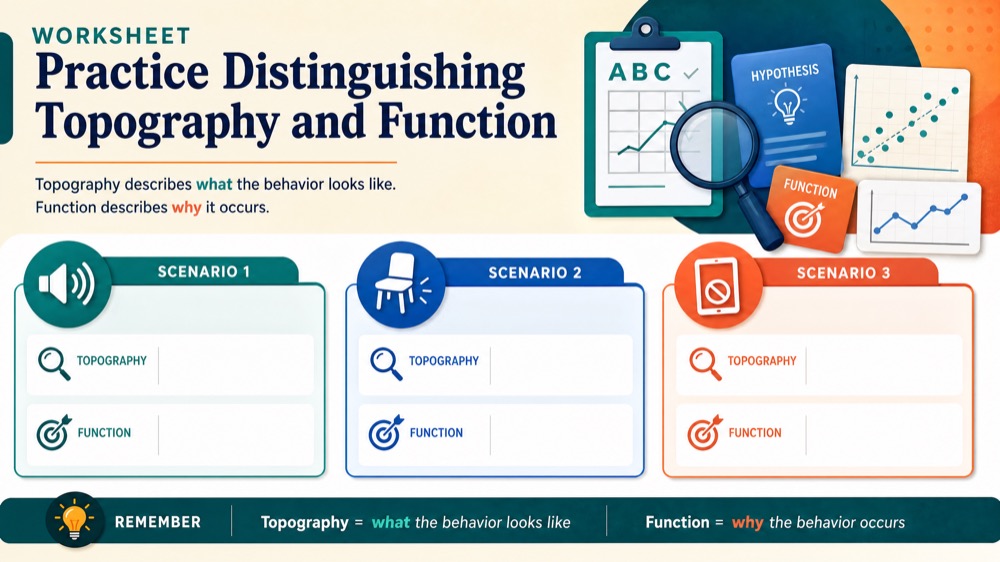
Here is a worksheet to help you apply these concepts. For each scenario, write a topographical description and a plausible function. Remember: topography describes what the behavior looks like; function describes why it occurs (the consequence that maintains it). Complete the table below as practice.
| Scenario | Topographical description (observable movements) | Plausible function (hypothesis) |
|---|---|---|
| A child cries and throws toys during homework. | Child emits high-pitched vocalizations, picks up toys within arm’s reach and throws them downward, releasing them at least 30 cm from body. | Escape from demand (homework). |
| An adult taps their foot during a meeting. | Foot moves up and down at the ankle repeatedly, with each cycle lasting about 1 second. | Automatic/sensory stimulation. |
| A student raises their hand in class. | Left arm is lifted from the side, elbow bends so hand is above head, palm open and facing the teacher. | Access to teacher attention. |
Now try your own. Describe the topography and hypothesize a function for each of the following behaviors: (1) a person taps their pencil on the desk, (2) a child runs out of the room when presented with a worksheet, (3) an adult checks their phone repeatedly. Write your answers in a notebook and then compare with a peer or supervisor. This practice will help you internalize the distinction between form and function.
Topography vs. Function: Why Surface Appearance Can Mislead
One of the most important lessons in ABA is that topography does not determine function. The same behavior can serve different functions, and different behaviors can serve the same function. For example, hitting might serve to escape a demand for one child and to gain attention for another. If you only look at the form of the behavior, you might incorrectly assume its purpose.
Consider a case where a child hits their sibling. A surface impression might suggest attention-seeking, but a functional assessment might reveal that hitting is followed by being sent to a quiet room (escape from a noisy environment). Without examining the consequences, you could design an intervention that inadvertently strengthens the behavior. Therefore, a thorough behavioral assessment should evaluate topography alongside function.
Multiple topographies can serve the same function: a child might cry, whine, or tantrum to gain access to a tablet. Similarly, the same topography might serve different functions depending on context: tapping a table might produce music (automatic reinforcement) or a peer’s laugh (social reinforcement). Topography alone may not be sufficient to determine function. In your exam and practice, consider both.
Shaping Within Topography: Refining Movement Forms
Shaping is a procedure that reinforces successive approximations toward a target topography. For example, to teach a child to say “ball,” you might reinforce any vocalization, then only sounds that approximate “b,” then “ba,” then “ball.” The target is a specific topographical form. In shaping, you must clearly define the target topography and align your reinforcement criteria with observable aspects of the response.
In practice, shaping requires careful observation of topography. You must notice small changes in movement. For instance, to shape a child’s handwriting, you might reinforce increasingly neat letter forms. This is a direct application of topographical definitions. Similarly, shaping can be used to increase the duration of eye contact or to refine the force of a greeting handshake. Always operationally define each approximation so that you can consistently reinforce progress. For more practice on stimulus control and shaping, check out our stimulus control in ABA article.
Practical Cautions for Behavior Intervention Plans
When writing behavior intervention plans (BIPs), it’s critical to define topography precisely to ensure consistent measurement. Vague terms like “aggressive” or “disruptive” are not enough; you must specify the observable movements. For example, instead of “the student will stop being aggressive,” define “aggression” as “any instance of hitting, kicking, or throwing objects that contact another person.” Here are common traps to avoid when describing topography:
- Using vague labels (e.g., “defiant”) instead of observable movements.
- Including subjective judgments (e.g., “angry voice”) rather than objective descriptors (e.g., “vocalization above normal conversational volume”).
- Forgetting to include a movement’s sequence or timing (e.g., “raises hand then waves it”).
- Confusing frequency with topography: stating “hits often” instead of describing what a hit looks like.
- Omitting environmental context that helps clarify the form (e.g., “in the presence of a worksheet”).
By avoiding these traps, you ensure that your BIP is measurable and that staff can implement it with high fidelity.
Data Sheet Template for Qualitative Recording
When measuring topography, you might use a narrative recording sheet. Here is a simple template for capturing topographical details:
- Date/Time: ____________________
- Setting: ____________________
- Behavior observed (topography): Describe movements in sequence, include force or intensity if relevant.
- Antecedent: What happened immediately before the behavior?
- Consequence: What happened immediately after the behavior?
- Observer initials: ____________________
This sheet helps you capture the topographical details and the surrounding events. Even though you’re recording the form, noting antecedents and consequences will help you later analyze function.
Study Checklist for BCBA Exam Preparation

When studying topography in ABA for the BCBA exam, focus on these key points:
- Define topography as the observable form of behavior, not its purpose.
- Write objective, measurable descriptions using only observable movements.
- Differentiate topography from function; one topography can have multiple functions.
- Explain how discriminative stimuli (SD) and S-delta control the occurrence and form of topography.
- Apply shaping procedures that rely on reinforcing successive approximations of target topographies.
- Use topography definitions to improve interobserver agreement and treatment integrity.
Review these concepts with practice questions and real-life examples. For a full-length practice experience, take our free BCBA mock exam. This will help you identify areas of strength and weakness in your knowledge of topography and other core ABA concepts.
Ready to Test Your Knowledge?
Now that you have a solid understanding of topography in ABA, it’s time to apply what you’ve learned. Try writing topographical definitions for everyday behaviors you observe, and then hypothesize their functions. Share your definitions with a colleague and compare your descriptions for reliability.
For more structured practice, sign up for our free BCBA mock exam at bcbamockexam.com. The exam includes questions on measurement, behavior change procedures, and professional conduct. You’ll receive detailed feedback and explanations to guide your study. Don’t forget to review our articles on stimulus control and stimulus generalization for deeper insights. Start your free practice today and take your exam preparation to the next level.



