
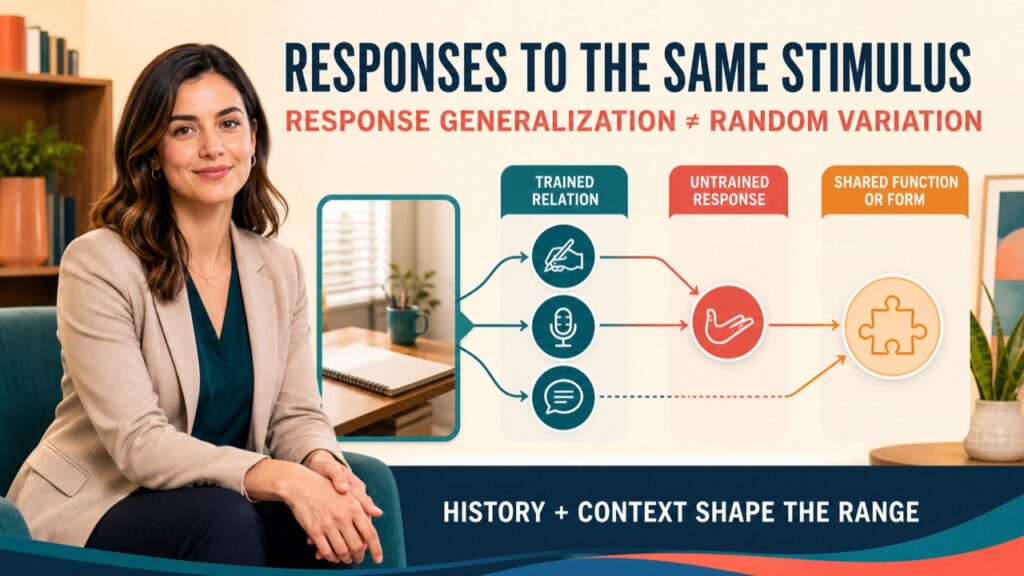
What Is the Range of Possible Responses to a Stimulus?
When a learner encounters a stimulus—such as a teacher’s instruction, a picture card, or a green light—the range of possible responses to a stimulus refers in plain language to the variety of behaviors that could follow. The phrase is not a standalone technical term in applied behavior analysis (ABA). Depending on the question, the relevant concept may be response generalization, a response class, a response repertoire, or response variability. These terms describe different relations and must not be treated as synonyms. Distinguishing them helps an analyst decide whether varied responding reflects an untrained generalization outcome, membership in a defined class, behavior already available in the repertoire, or unrelated variability.
Table of Contents
- What Is the Range of Possible Responses to a Stimulus?
- Response Generalization vs. Stimulus Generalization
- Response Class and Response Repertoire
- Measurement Guidance for the Range of Possible Responses
- Practical Programming Considerations
- Common Traps and Misconceptions
- Study Checklist for BCBA Exam Prep
- Decision Process: Evaluating Whether a New Response Is Genuine Generalization
- Take the Free BCBA Mock Exam
The core idea is that a stimulus does not mechanically cause a single operant response. The probability of any given response depends on the learner’s history of reinforcement, current motivating operations (MOs), contextual stimuli, and available repertoires. For example, a child who sees a cookie might say “cookie,” point to it, reach for it, or sign “cookie.” All these responses occur under the same antecedent stimulus (the cookie), but they differ in topography. The range of possible responses is shaped by past learning: if only one response was reinforced, that response is more likely; if multiple responses were reinforced, the range expands. Understanding this helps practitioners avoid assuming that a stimulus controls a single behavior and instead appreciate the dynamic interplay of variables.
Response Generalization vs. Stimulus Generalization
Two commonly confused concepts in ABA are response generalization and stimulus generalization. Response generalization occurs when a learner emits untrained, functionally equivalent responses under the same stimulus conditions. For instance, a child taught to say “help me” when stuck might later say “I need assistance” or “could you help?” without direct training. Stimulus generalization, on the other hand, occurs when a trained response occurs under novel but similar stimulus conditions. For example, a child who learns to say “hello” when a parent arrives might also say “hello” when a grandparent arrives. Here the response is the same, but the stimulus changes.
To distinguish them, ask: Is the response new or the stimulus new? In response generalization, the stimulus stays relatively constant while the response varies; in stimulus generalization, the response stays constant while the stimulus varies. Both are critical for effective programming. The range of possible responses to a stimulus often includes both previously trained responses and untrained but functionally equivalent responses. Understanding this distinction helps behavior analysts design interventions that promote flexible, adaptive behavior without expecting identical responding every time.
Response Class and Response Repertoire
A response class groups responses by a specified common property. A topographical class shares features of form, whereas a functional response class is defined by a common effect on the environment. Saying “pass the salt,” pointing to the salt, and handing an empty plate toward a dining partner could be candidates for one functional class, but a shared outcome is evidence to assess—not proof by itself. A response repertoire is the collection of behavior a person can currently emit across conditions. It constrains what is likely, yet novel combinations and recombinations of established component skills can emerge without that exact response having been directly taught.
Response variability is related but distinct: it describes how responses differ across opportunities, and variability itself can come under operant control. Analysts may count distinct topographies, calculate the proportion of untrained forms, or examine how responding is distributed across defined options. A richness count alone does not demonstrate response generalization; the analysis must also establish what was trained, the relevant stimulus conditions, and the functional or formal relation that makes a new response an intended generalization outcome.
Measurement Guidance for the Range of Possible Responses
To evaluate whether the range of possible responses reflects genuine generalization or unrelated variability, behavior analysts should measure and analyze data carefully. Key steps include:
- Define the relevant stimulus conditions: Specify the antecedent features, setting events, contextual cues, and motivating operations that matter to the analysis.
- Define candidate responses before probing: State the topographical or functional property that would qualify a response, including safety and social-validity boundaries.
- Separate trained from untrained relations: Document which response forms were directly taught in the target conditions and which are reserved as generalization probes.
- Record opportunity-level data: For each opportunity, record the response form, context, prompts, and contacted consequence rather than keeping only a total variety count.
- Assess functional equivalence: Use appropriate functional evidence; producing the same immediate outcome once does not establish class membership.
- Probe deliberately: Test untrained response forms under the relevant stimulus conditions, and vary contexts separately when evaluating stimulus generalization.
Rate, latency, distinct topographies, and the proportion of untrained forms may all be useful measures, but none proves generalization alone. The inference depends on a predefined relation, an untrained response-in-context, repeated opportunities, and dependable measurement.
Practical Programming Considerations
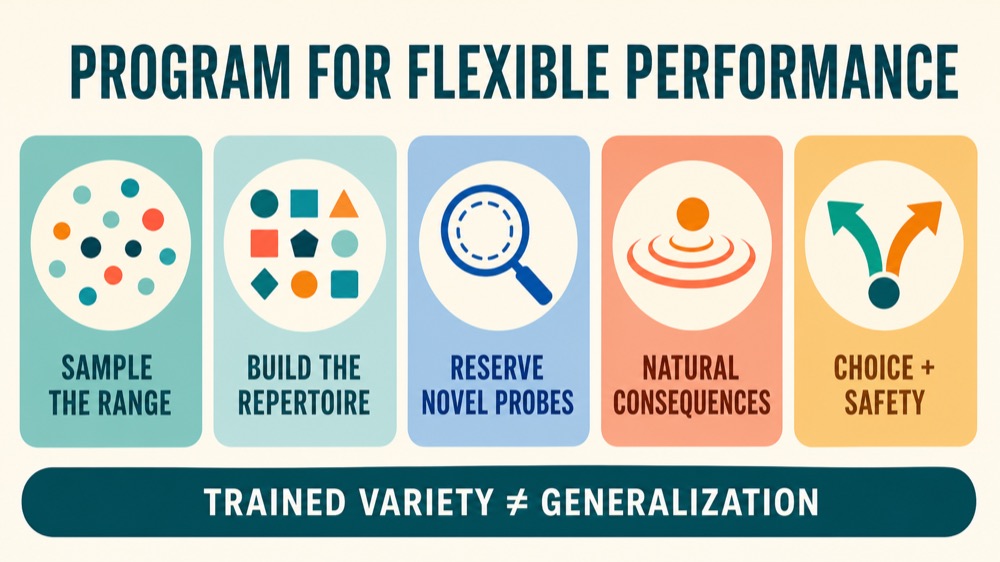
Designing interventions that promote a desirable range of responses requires careful planning. The current BCBA Test Content Outline explicitly includes designing and evaluating procedures to promote stimulus and response generalization in G.15. Research and conceptual background are available in a response-generalization study, a review of multiple-exemplar instruction, an analysis of response classes, and a study of response-class hierarchies:
- Sample the relevant range: Use general-case or multiple-exemplar instruction across important stimulus and response variations while reserving planned, safe examples for later untrained probes.
- Build an adequate repertoire: Directly teach multiple acceptable response forms when flexibility is the goal, then distinguish that trained expansion from later emergence of novel or recombinant forms.
- Use less predictable reinforcement where appropriate: Indiscriminable contingencies may support persistence across unprogrammed conditions, but unpredictability alone does not create response generalization.
- Contact natural maintaining consequences: Arrange for useful responses to work in everyday environments and with relevant communication partners.
- Honor choice, social validity, efficiency, and safety: Define acceptable variation with the learner and stakeholders; do not reinforce novelty for its own sake.
Schedule probes of untrained response-in-context relations and preserve appropriate natural consequences; a probe need not withhold reinforcement arbitrarily. If planned generalization does not occur, expand the sampled range, review stimulus control and component skills, and probe again.
Common Traps and Misconceptions
Misunderstanding the range of possible responses can lead to flawed conclusions. Common traps include:
- Equating variability with generalization: Not all variability is response generalization. A learner may emit different responses simply because they haven’t been reinforced consistently for any one topography. True generalization requires that the alternative responses are functionally equivalent and occur under stimulus control.
- Assuming a stimulus controls only one response: In natural contexts, multiple responses are often acceptable. Recognizing the range allows for more naturalistic teaching.
- Ignoring motivating operations: The range of possible responses can shift dramatically with MOs. For example, when a learner is very hungry, they may only emit the most efficient response (e.g., grabbing food) rather than varied requests.
- Confusing response class with response generalization: A response class is a set of responses that share the same function; response generalization is the process by which untrained members of that class emerge. They are related but not identical.
Study Checklist for BCBA Exam Prep
When preparing for the BCBA exam or reviewing this concept, use the following checklist:
- [ ] Define response generalization and give an original example.
- [ ] Distinguish response generalization from stimulus generalization.
- [ ] Explain the difference between a functional response class and a response repertoire.
- [ ] Identify the trained relation, the untrained response-in-context relation, and the relevant stimulus features.
- [ ] Select measures that capture both response form and opportunity, not variety alone.
- [ ] Evaluate functional relevance, safety, efficiency, and social validity.
- [ ] Reference G.15 in the current BCBA Test Content Outline accurately.
For additional study resources, visit our Free BCBA Mock Exam and explore articles on stimulus control and stimulus generalization.
Decision Process: Evaluating Whether a New Response Is Genuine Generalization
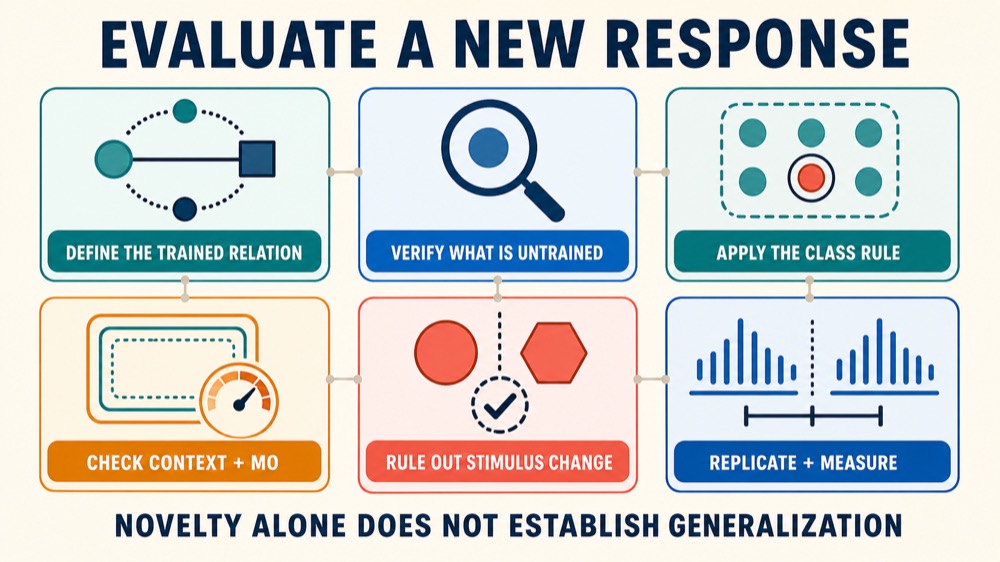
When a learner emits a new response under a familiar stimulus, practitioners must determine whether it is genuine response generalization, a member of an existing functional response class, or unrelated variation. Use this decision process:
- Specify the trained relation: Identify the response, the relevant stimulus conditions, and the consequence used during instruction.
- Verify what is untrained: A response may already exist in the repertoire; the critical question is whether that response-in-context relation was directly taught.
- Apply the predefined class rule: Decide whether the new form shares the relevant function or formal property. One shared outcome is insufficient without supporting evidence.
- Check competing explanations: Changes in prompts, motivating operations, context, or antecedent features may indicate different stimulus control or stimulus generalization.
- Replicate and measure: Observe repeated opportunities and consequences with adequate agreement. Repetition strengthens the evidence but does not replace the definition.
This process separates genuine response generalization from a trained alternative, an existing response-class member appearing under new control, or unrelated variability.
Take the Free BCBA Mock Exam
Ready to test your understanding of response generalization, stimulus control, and related concepts? Try our Free BCBA Mock Exam for realistic practice and personalized feedback. The exam covers key ABA principles and helps you identify areas for further study. Note that it does not guarantee that this exact topic will appear on the live BCBA exam. Use it as one part of a comprehensive study plan.



