
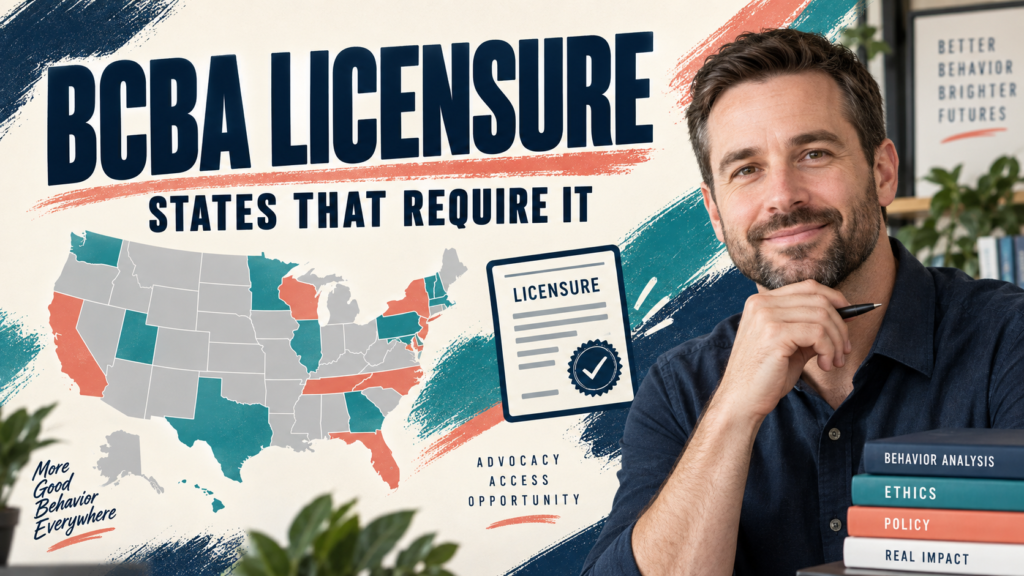
If you are searching for the states that require BCBA licensure, start with one important correction: a BCBA is a national professional certification, while a state license is a separate jurisdictional permission to practice. The exact title, board, exemption, application process, and scope can differ by state. The current BACB U.S. licensure page is the best starting list, but the state board remains the authority for a real application or practice decision.
Table of Contents
- What Is the Difference Between BCBA Certification and State Licensure?
- Which States That Require BCBA Licensure Are Listed by BACB?
- What Does State Licensure Usually Require?
- How Do You Verify a BCBA License Requirement?
- What Exceptions or Complications Should You Watch?
- How Should You Study BCBA Licensure Questions?
- Frequently Asked Questions
- Sources for Further Study
- Take the Free BCBA Mock Exam
BACB’s September 2026 regulatory brief says that 40 U.S. states have enacted laws regulating behavior analysts and that all 40 provide a pathway to licensure for BCBAs. BACB’s web table also lists the District of Columbia. This article is a BCBA study and navigation guide, not legal advice. Always verify the current state rule, implementation date, protected title, setting, payer, and exemption before accepting a case or advertising services.
What Is the Difference Between BCBA Certification and State Licensure?
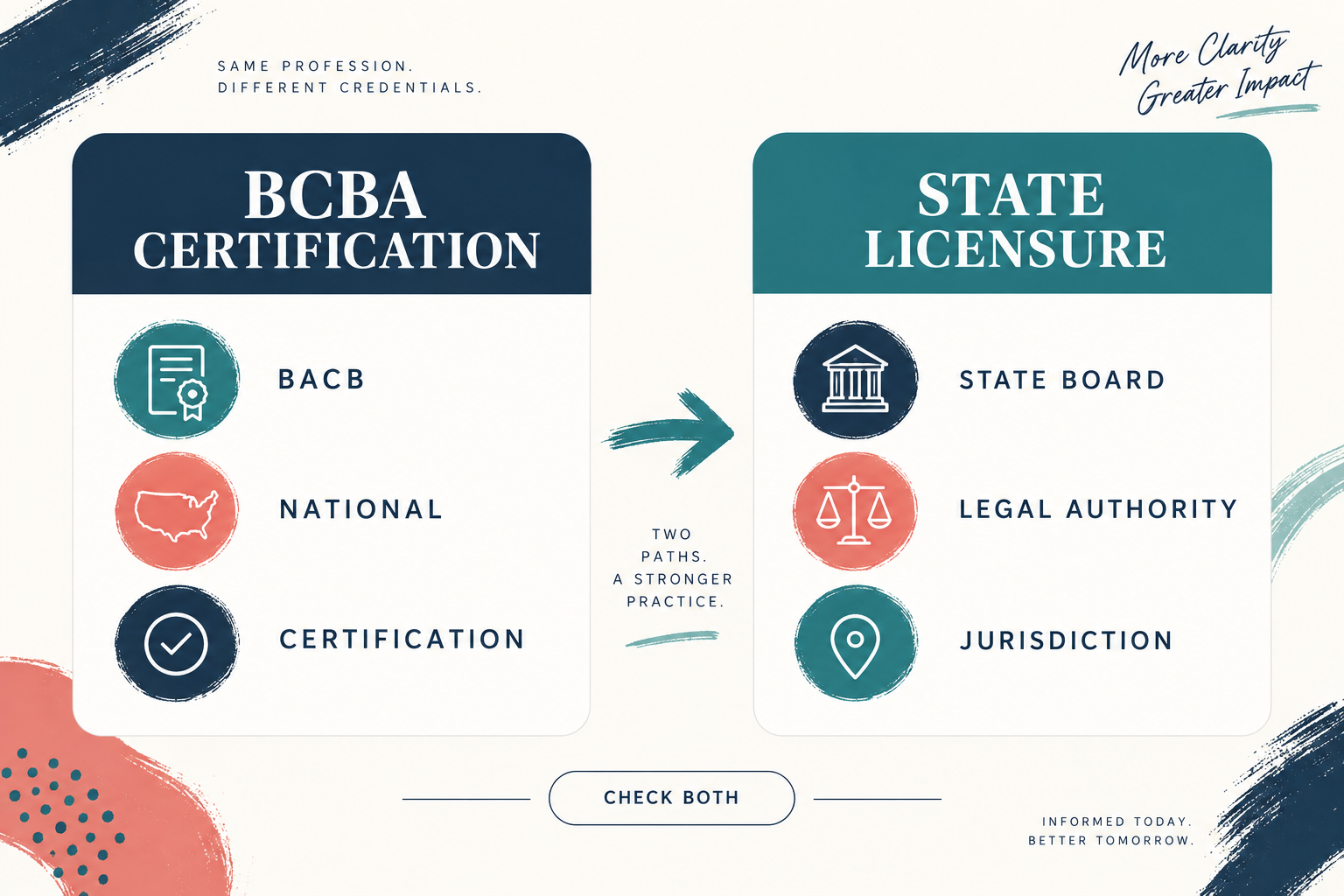
BCBA certification is issued by the Behavior Analyst Certification Board. It signals that a person met the certification organization’s current eligibility, examination, and maintenance requirements. State licensure is issued by a government authority and controls whether, how, and under what title a person may practice behavior analysis in that jurisdiction.
These credentials often work together, but they are not the same document. A person can hold an active BCBA credential and still need a state license before providing services in a regulated state. A state may call the license an LBA, behavior analyst license, licensed behavior analyst credential, or another title. The protected title and the people covered by the law are state-specific.
| Question | BCBA certification | State licensure |
|---|---|---|
| Issuer | BACB, a certification organization. | A state board, department, or other government authority. |
| Geography | A national credential with certification rules. | A state or jurisdiction’s law and rules. |
| Purpose | Shows that certification requirements were met and maintained. | Authorizes regulated practice or use of a protected title under local law. |
| What controls the answer? | Current BACB handbook, outline, and certification standards. | Current state statute, regulations, board guidance, setting, payer, and exemption. |
On an exam, do not choose “the BCBA credential is the license” just because many state applications verify BCBA certification. The correct reasoning is usually that certification and licensure are separate, and the state’s current rules determine whether the second credential is required.
Which States That Require BCBA Licensure Are Listed by BACB?
As checked on September 27, 2026, BACB’s current U.S. licensure page lists these 40 states as having behavior-analyst licensure or regulation laws, plus the District of Columbia. The list below is a study-friendly transcription of that official table; it is not a substitute for the linked state board pages.
| Group | States listed by BACB | How to use the list |
|---|---|---|
| A | Alabama, Alaska, Arizona, Arkansas, Colorado, Connecticut, Georgia, Hawaii, Illinois, Indiana | Open the state board link before relying on the list for an application or job. |
| B | Iowa, Kansas, Kentucky, Louisiana, Maryland, Massachusetts, Michigan, Minnesota, Mississippi, Missouri | Check whether the rule uses a behavior-analyst board, psychology board, or another department. |
| C | Montana, Nebraska, Nevada, New Jersey, New York, North Carolina, North Dakota, Ohio, Oklahoma, Oregon | Confirm application status, protected title, and any transition or reciprocity language. |
| D | Rhode Island, South Dakota, Tennessee, Texas, Utah, Vermont, Virginia, Washington, Wisconsin, Wyoming | Review the rule for the exact role, setting, and service arrangement you plan to use. |
| District of Columbia | District of Columbia | Treat the district as its own jurisdiction; do not assume a neighboring state’s rule applies. |
The phrase “require BCBA licensure” can be misleading because the law may regulate behavior analysts generally, provide a pathway for BCBAs, and use a different title for the state credential. BACB’s regulatory brief says every one of the 40 states with behavior-analyst licensure laws offers a pathway for BCBAs, but that does not mean every person, setting, service, or exemption is handled identically.
What Does State Licensure Usually Require?
Requirements vary, but a state application commonly asks for some combination of the following:
- Active BCBA certification or an accepted equivalent: Many jurisdictions verify the credential directly with BACB.
- Application and fee: The amount, payment method, background-check process, and renewal cycle are state-specific.
- Identity and professional history: The board may ask for legal name, disciplinary history, criminal-background information, or explanations for positive responses.
- Scope or setting information: The rule may distinguish independent practice, supervision, schools, telehealth, insurance-funded services, or other contexts.
- Continuing education and renewal: Some states align renewal with BACB maintenance, while others add state-specific education or renewal dates.
- Reciprocity or endorsement documents: Moving from another state may require license verification and proof that the other credential is comparable.
These are patterns, not a universal checklist. For example, Indiana’s official licensing page requires current BCBA certification for the behavior-analyst application and describes a separate reciprocity route. Another state may use a different application, title, or exemption. Use a pattern list to know what to look for, not to predict approval.
How Do You Verify a BCBA License Requirement?
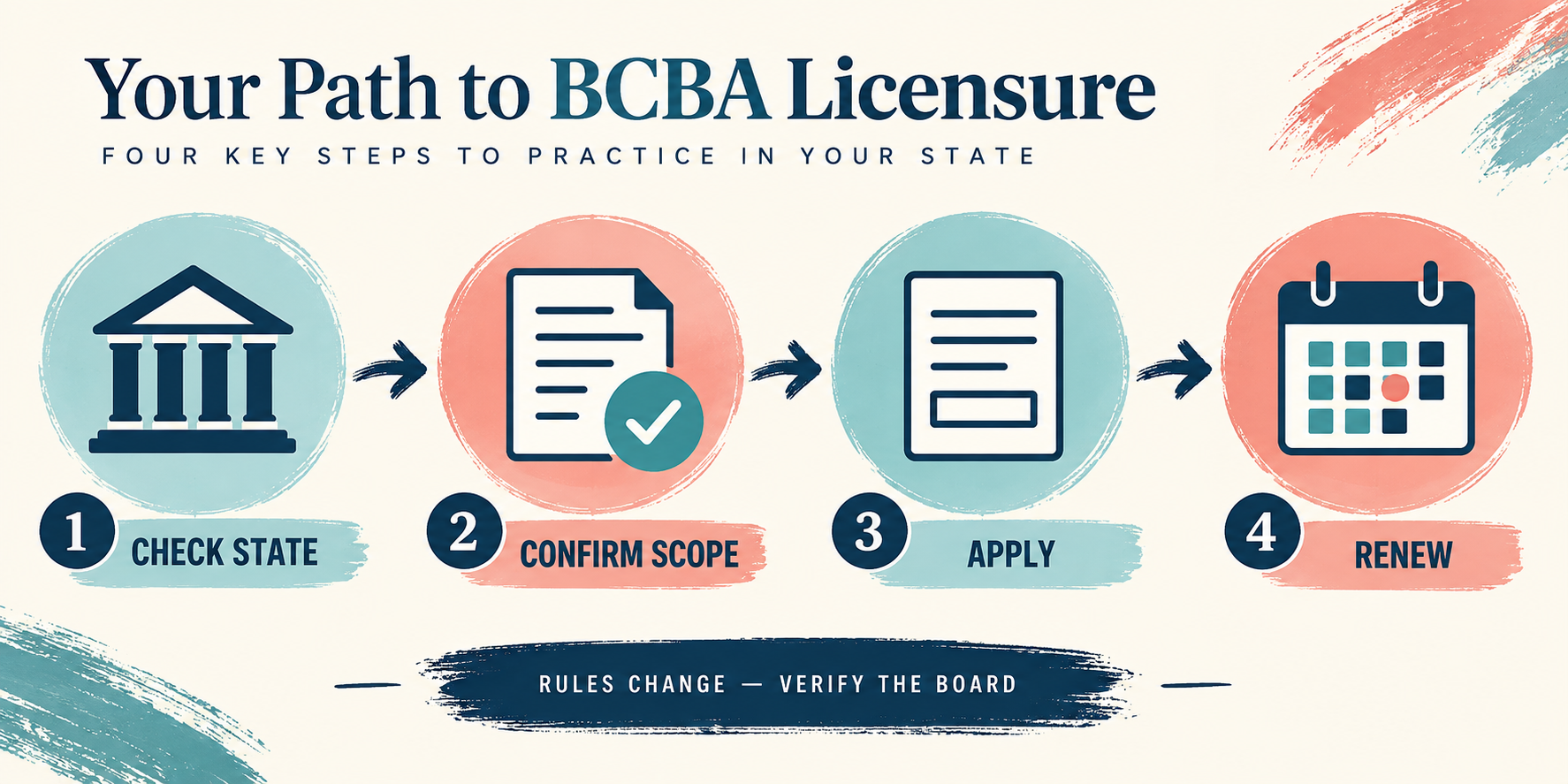
Use a four-source verification routine before giving a definitive answer:
- Start with BACB: Use the current U.S. licensure table to locate the state’s board and law link.
- Open the state authority: Read the official board or department page, application instructions, regulations, and protected-title language.
- Match the real situation: Check the person’s role, service location, telehealth arrangement, employer, payer, supervision relationship, and whether an exemption applies.
- Confirm timing: Look for implementation dates, pending rules, renewal deadlines, and whether the board is accepting applications.
Save the source date and page link in your notes. A search result or old blog post can be useful for finding vocabulary, but it cannot establish current legal authority. If the answer affects a job, contract, billing decision, or client access, ask the state board or qualified legal/professional advisor before acting.
What Exceptions or Complications Should You Watch?
Several details can change the practical answer:
- New laws may not be fully implemented: A statute can exist before the online application or board process is ready.
- Regulation is not always identical to a simple LBA model: Some states place behavior analysis under psychology, counseling, health, or a dedicated board.
- Protected title and practice authority differ: A state may restrict a title, a service, or independent practice in different ways.
- School and payer rules can add another layer: A state license question may be different from a school-employment rule or an insurer’s credentialing rule.
- Telehealth crosses jurisdictions: The client’s location, practitioner’s location, and service setting can all matter.
- Reciprocity is not automatic: A license from one state may need verification, endorsement, or a new application in another.
Do not turn the “40 states” number into a promise that licensure is required for every BCBA activity in every one of those jurisdictions. The official BACB page itself tells readers to review relevant websites and determine whether they fall into an exempt class. That warning is part of the answer.
How Should You Study BCBA Licensure Questions?
For a BCBA exam question, first separate certification from licensure. Then identify whether the stem asks about the credentialing body, the state’s legal authority, an application requirement, or a current rule. The safest answer usually uses the current governing source and avoids treating a state-specific example as a nationwide rule.
- Ask who issues the credential: BACB or a state board.
- Ask whether the question is about certification eligibility or legal permission to practice.
- Look for jurisdiction, setting, protected title, and exemption clues.
- Prefer an answer that tells the reader to verify the current state board when the fact is time-sensitive.
- Do not infer that a BCBA credential alone overrides state law.
The BACB BCBA overview helps define the national credential, while the licensure page supplies the state-regulation map. For additional exam practice, the free BCBA mock exam can provide study scenarios. It is not official BACB content or legal advice.
Frequently Asked Questions
Is a BCBA a license?: No. BCBA is a certification issued by BACB. A state license is a separate government credential that may be required for regulated practice in a particular jurisdiction. How many states require BCBA licensure?: BACB’s September 2026 regulatory brief says 40 U.S. states have enacted laws regulating behavior analysts and that all 40 offer a pathway to licensure for BCBAs. BACB’s web table also lists the District of Columbia. The practical requirement still depends on the state rule, role, setting, and exemptions.
Can I practice in a state with my BCBA certification but no state license?: Do not assume so. If the state regulates the activity or title, you may need the state credential. If you are unsure, check the official state board and the specific service arrangement before practicing or billing. Does every state call the credential an LBA?: No. LBA is common, but states use different titles and regulatory structures. Read the state’s official terminology instead of treating LBA as a universal label. Where should I verify the current requirement?: Start with BACB’s U.S. licensure page, follow the state-board link, and confirm the current application, law, scope, exemption, and implementation information directly with the jurisdiction.
Sources for Further Study
- BACB: U.S. Licensure of Behavior Analysts — current state and district list with board links.
- BACB Regulatory Brief: A Summary of U.S. Behavior Analyst Licensure Laws — current count and structural summary.
- BACB: Board Certified Behavior Analyst — national certification context.
- Indiana Professional Licensing Agency — example of a state application and reciprocity page.
- BACB: For Regulators — regulatory resources and links to state information.
Take the Free BCBA Mock Exam
If you want a low-pressure way to check your recall, use the free practice resource below. Take the Free BCBA Mock Exam



