
ABA interventions for inappropriate touching should begin with safety, an objective definition, and a functional assessment—not a reflexive punishment or a generic “stop” instruction. The goal is to protect everyone’s boundaries while teaching a socially meaningful, dignity-preserving alternative that the learner can use across settings.
Table of Contents
- What Does Inappropriate Touching Mean in ABA?
- Why Assessment Comes Before Intervention
- ABA Interventions for Inappropriate Touching
- How to Choose and Sequence an Intervention
- Data Collection, Consent, and Dignity
- BCBA Exam Connections
- Inappropriate Touching Intervention FAQ
- Take the Free BCBA Mock Exam
This article is an educational BCBA study guide, not an individualized treatment plan. Unwanted touching can reflect very different variables, including limited communication, attention, sensory reinforcement, social-skill deficits, impulsivity, imitation, trauma, medication or medical factors, or a misunderstanding of consent and personal space. A qualified BCBA and the relevant safeguarding, medical, educational, and legal professionals should guide any real case. Table of Contents
What Does Inappropriate Touching Mean in ABA?
“Inappropriate touching” is not an operational definition by itself. It is a label that may hide several topographies and several different risks. A usable definition should describe exactly what was observed, who was touched, where contact occurred, whether permission was requested, what happened immediately before and after, and what level of force or risk was present.
For example, “touches another person’s arm or torso with an open hand without that person saying yes, during group activities, within 3 seconds of approaching” is more measurable than “invades personal space.” A separate definition may be needed for grabbing, repeated contact, touching private areas, exposing one’s body, or contact that causes injury. The distinction matters because a plan for a brief hand-on-shoulder greeting should not automatically be used for coercive, dangerous, or sexually abusive behavior. Start by separating three questions:
- What happened? Describe the observable response without assuming intent.
- How serious is the immediate risk? Consider injury, coercion, vulnerability, age, power differences, and possible abuse or exploitation.
- What skill or support is missing? The learner may need communication, discrimination, consent, self-management, social initiation, privacy, or regulation skills.
If there is an allegation of abuse, a disclosure, immediate danger, or a legal reporting obligation, follow the applicable safeguarding and reporting procedures first. A behavior plan does not replace emergency protection, medical evaluation, a mandated report, or a law-enforcement response.
Why Assessment Comes Before Intervention
The strongest answer to an intervention question is rarely “use technique X.” The literature on inappropriate sexual behavior in people with intellectual and developmental disabilities includes multiple procedures and cautions that no single response-suppression method should be treated as an overarching solution. The review by Clay, Bloom, and Lambert found that behavior-analytic approaches can be effective while also emphasizing function-based intervention and the limits of the available evidence.
A BCBA should first ask what variables are maintaining the touching or what conditions make it more likely. Direct observation, interviews, scatterplots, ABC data, skill assessments, and medical or contextual review may all be relevant. The function is a hypothesis to test, not a guess based on the topography.
| Assessment question | What to examine | Possible teaching direction |
|---|---|---|
| What happens before contact? | Crowding, denied access, transitions, unstructured time, social approach, task demand, or a specific person. | Preview routines, offer space, teach a request, or change the antecedent. |
| What follows the touching? | Attention, conversation, escape, movement, access to an item, laughter, or a sensory consequence. | Reinforce a safe replacement that produces the same function when appropriate. |
| What does the learner already know? | Communication, consent signals, body-part discrimination, privacy rules, waiting, and self-management. | Teach a concrete replacement and practice it with varied people and settings. |
| Are medical or safeguarding variables present? | Pain, sleep, medication changes, puberty, trauma indicators, exploitation, or an immediate safety concern. | Pause routine programming and coordinate the appropriate professional response. |
ABA Interventions for Inappropriate Touching
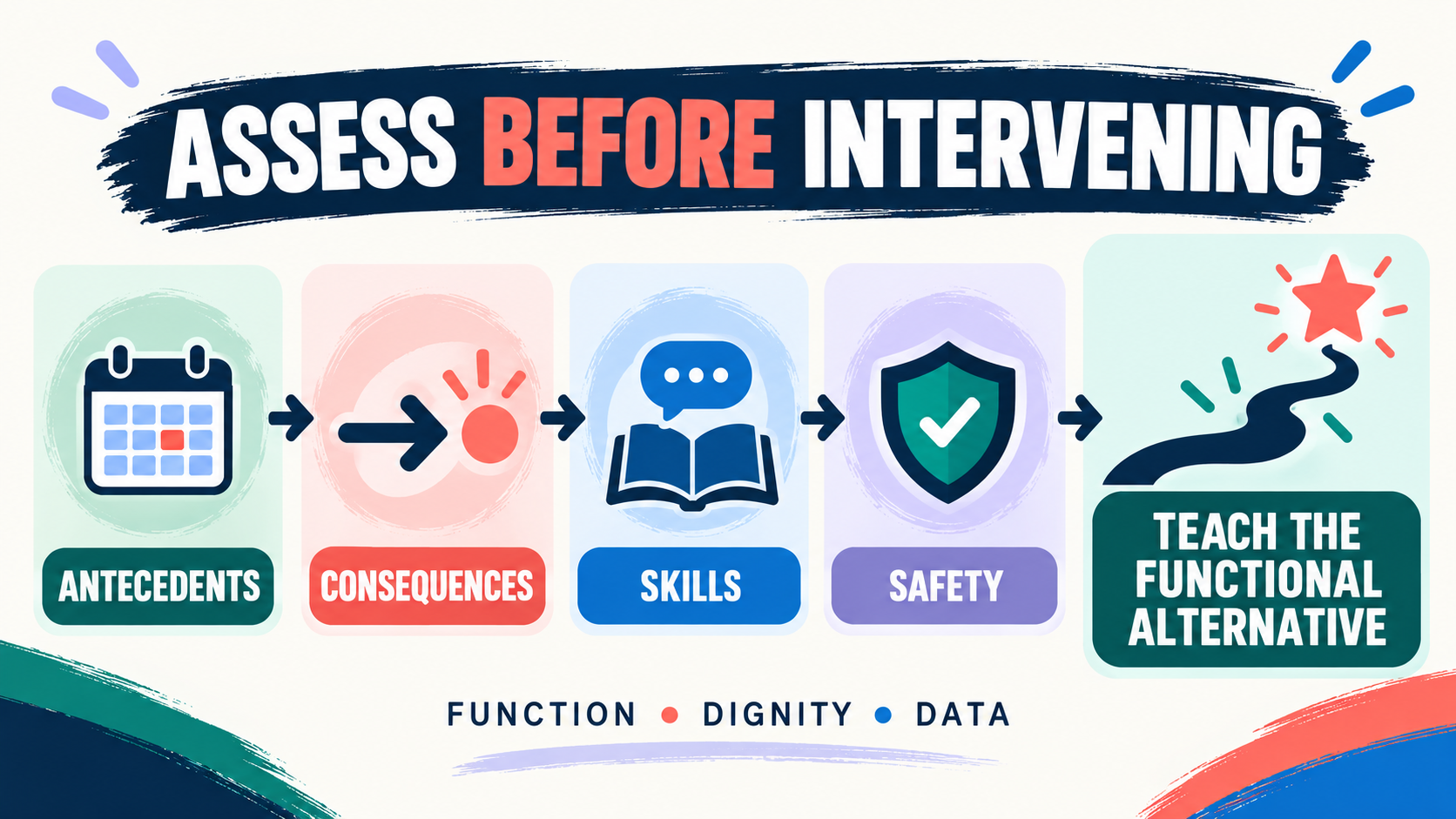
The intervention should be matched to the assessed function, the learner’s communication and developmental profile, the people affected, and the level of risk. The following intervention families are study concepts, not a menu to apply without supervision.
1. Teach a functional communication response: If touching reliably produces attention, interaction, help, access, or escape, teach a response that can contact that same outcome safely. The replacement might be saying “excuse me,” presenting a break card, asking “Can I hug you?” waiting for an answer, tapping a visual “talk” icon, or moving to a designated support area. The exact response should be usable by the learner, not merely convenient for adults.
Functional Communication Training is strongest when the team honors the replacement response consistently and reinforces it quickly enough for the learner to contact the same meaningful outcome. If the learner is asking for interaction, teach several appropriate ways to initiate it. If the learner is escaping crowding or a difficult task, teach a break request and make the environment safer while the team evaluates the demand.
2. Teach body boundaries, consent, and discrimination: Do not rely on the vague instruction “keep your hands to yourself.” Teach observable distinctions: public versus private spaces, personal versus shared materials, a person’s “yes,” “no,” and “not now” signals, how to ask before touching, and how to respond when the answer is no. Use communication modes that fit the learner, including speech, signs, AAC, pictures, gestures, or a reliable response system.
Practice should preserve the learner’s own bodily autonomy. A lesson about consent should not require unwanted physical contact to demonstrate it. The learner should be allowed to decline practice, and adults should model that a refusal is honored. The BACB Ethics Code defines assent as vocal or nonvocal behavior that can indicate willingness to participate for someone who cannot provide informed consent. Its broader standards also address informed consent, effective treatment, minimizing risk, client involvement, data, and continual evaluation.
3. Adjust antecedents and the environment: Antecedent strategies may reduce the need for touching before it occurs. Examples include increasing personal space, arranging seating, previewing a transition, providing a visual boundary, reducing confusing crowding, using a predictable greeting routine, scheduling movement, or giving the learner a clear way to request interaction. If the behavior occurs during unstructured periods, a structured choice board or activity schedule may increase predictability.
Antecedent changes should not become a permanent exclusion of the learner. The goal is to create conditions in which the person can participate safely while the team teaches skills and gradually tests generalization. Track whether the support changes the opportunity, not just whether the touching count falls.
4. Reinforce safe alternatives and incompatible behavior: Differential reinforcement may be appropriate when the alternative is clearly defined and socially meaningful. A team could reinforce asking before contact, keeping hands on one’s own materials during a group activity, using a break request, or greeting with a wave when a wave is the learner’s chosen greeting. The reinforcer should matter to the learner and should not be contingent on surrendering basic rights, privacy, or communication.
Be careful with DRO-style plans that reinforce the absence of touching without teaching what the learner should do instead. A no-contact interval may be useful as one measurement or safety component, but it does not automatically teach consent, communication, or social participation. If the target behavior serves a powerful function, withholding all meaningful interaction can increase frustration or make the plan less humane and less effective. 5. Use interruption and redirection only when justified
When immediate contact creates a clear safety risk, a trained adult may need to block or interrupt it in the least intrusive way allowed by the plan, then prompt a safe replacement and reinforce it. The response should be brief, predictable, respectful, and consistent with the person’s rights, organizational policy, and applicable law. Physical management should never be improvised by untrained staff.
The review literature includes response interruption and other response-suppression procedures, but evidence for a particular procedure does not erase the need for functional assessment, consent, risk analysis, supervision, and outcome monitoring. If an intervention produces distress, escalation, injury, or a new form of avoidance, the BCBA should reassess rather than simply intensify it.
How to Choose and Sequence an Intervention
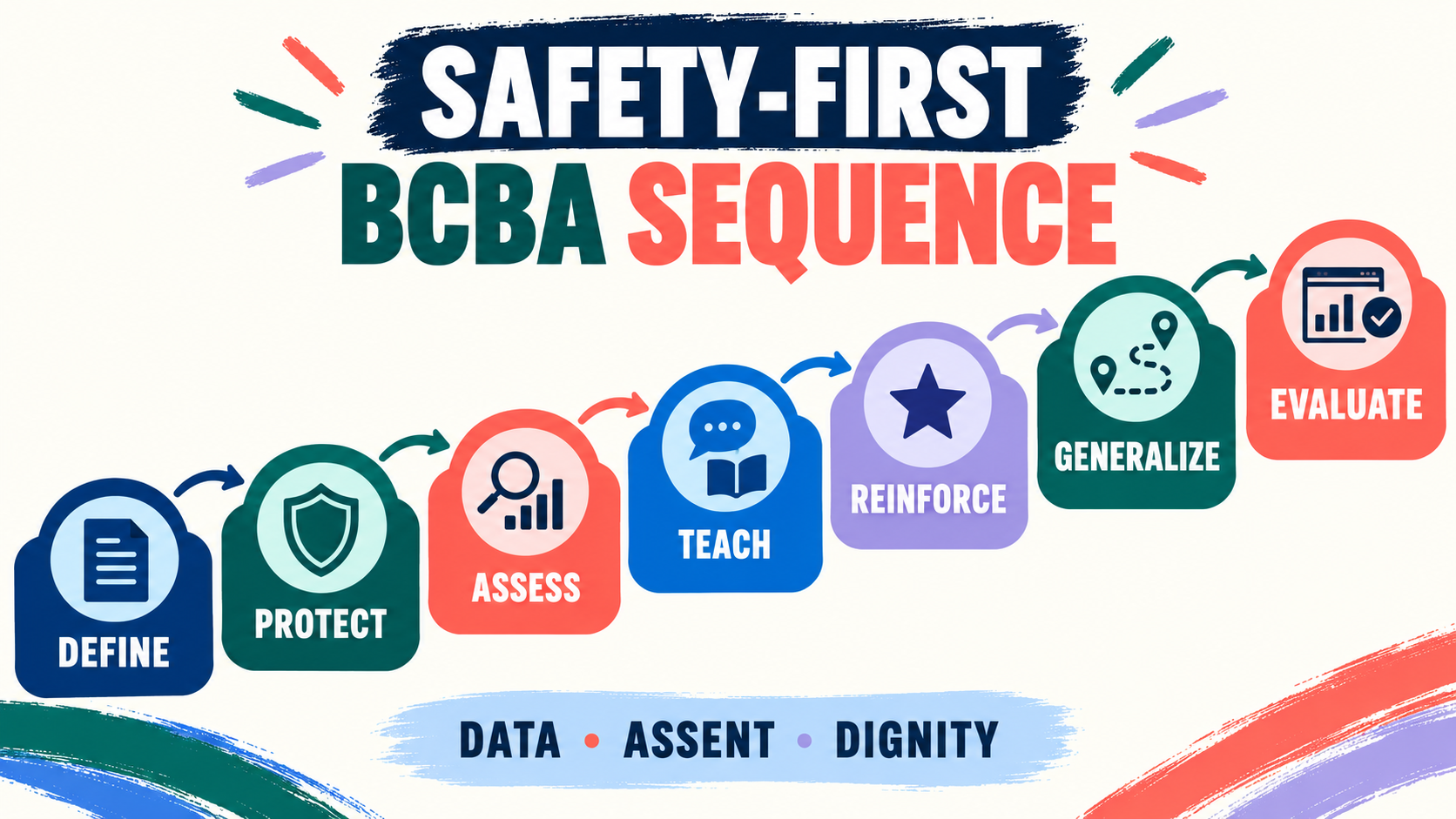
A simple sequence helps prevent the common error of choosing a consequence before understanding the behavior. Start with the least intrusive effective support that can protect safety and teach a meaningful alternative. Then review data frequently enough to detect both progress and unintended effects.
- Define: Write the observable topography, context, and risk level.
- Protect: Address immediate danger, safeguarding, medical, and reporting needs.
- Assess: Test hypotheses about antecedents, consequences, skills, and setting events.
- Teach: Select a communication, boundary, privacy, or self-management replacement.
- Reinforce: Make the safe alternative efficient and meaningful.
- Generalize: Practice with different people, routines, locations, and communication partners.
- Evaluate: Review frequency, severity, opportunities, replacement use, assent, and quality-of-life indicators.
The published treatment-selection model by Davis and colleagues is useful because it frames this work as careful selection among possible interventions rather than a universal recipe. It also supports a broader point for BCBA candidates: the correct answer is usually the one that connects assessment, function, skill acquisition, ethics, and measurement.
Data Collection, Consent, and Dignity
Count more than the target response. Depending on the case, measure opportunities to interact, requests for permission, independent use of a replacement, latency to disengage after a “no,” successful participation, severity, and the amount of adult prompting. A falling frequency can be misleading if the learner is simply being isolated or if staff are recording fewer opportunities.
Document who consented, how assent or refusal was communicated, what information was shared, how privacy was protected, and what the team will do if the learner withdraws cooperation. The BACB’s Ethics Code for Behavior Analysts requires behavior analysts to work within competence, protect clients, involve clients and stakeholders, minimize risk, collect and use data, and continually evaluate behavior-change interventions.
Dignity is not an optional tone choice. Avoid public correction, shaming language, unnecessary disclosure, forced apologies, and procedures that teach the learner that their body or communication is bad. Correct the boundary, protect the person affected, teach the missing skill, and preserve the learner’s right to understandable information and respectful participation.
BCBA Exam Connections
For the BCBA exam, this topic can test several concepts at once:
- Operational definitions: Replace a judgmental label with observable, measurable behavior.
- Functional assessment: Do not select an intervention from topography alone.
- FCT and differential reinforcement: Reinforce an alternative that serves the relevant function.
- Ethics: Consider informed consent, assent, dignity, competence, risk, and client involvement.
- Generalization and maintenance: Program the skill beyond one therapist, room, or scripted practice.
- Data-based decisions: Monitor both reduction of risk and improvement in meaningful participation.
When two options appear plausible, prefer the one that is assessment-based, least intrusive while effective, socially valid, teachable, and evaluated with data. A procedure that suppresses contact without teaching communication or boundaries is usually an incomplete answer.
Inappropriate Touching Intervention FAQ
What is the best ABA intervention for inappropriate touching?: There is no single best procedure for every case. A BCBA should define the behavior, address immediate safety, assess its function and context, and teach a meaningful replacement such as asking for interaction, requesting a break, or responding to consent signals. The plan should be individualized and monitored for dignity, assent, safety, and effectiveness. Should staff ignore inappropriate touching?
No. Ignoring may be unsafe, may fail to protect another person’s boundary, and may not address the function. Staff should follow the supervised safety plan, interrupt risk when necessary, provide a brief neutral response, prompt a safe alternative, and document what occurred. Can a BCBA teach consent and personal boundaries?
Yes, when the BCBA has the relevant competence and collaborates with caregivers, educators, medical professionals, and other specialists as needed. Teaching should use accessible communication, honor refusal, protect privacy, and distinguish consent from compliance. The learner’s own boundaries must be respected during instruction. Is punishment appropriate for inappropriate touching?
A generic punishment-first answer is not appropriate. Immediate safety may require a trained protective response, but the intervention should still be based on assessment, minimize risk, teach a replacement, and comply with ethics, law, policy, and supervision requirements. The evidence does not support treating one response-suppression technique as a universal solution.
Where can I practice the BCBA reasoning?: Use the free BCBA mock exam to practice identifying the function, selecting an ethical replacement, and separating an operational definition from a judgmental label. It is independent study support, not official BACB material.
In short, good ABA interventions for inappropriate touching protect everyone’s safety while teaching the learner what to do instead. The durable solution is not a louder “no”; it is precise assessment, accessible communication, consent and boundary skills, respectful environmental support, careful reinforcement, and data-based review under qualified supervision.
Take the Free BCBA Mock Exam
When you are ready to apply the idea, use the free practice resource below for additional feedback. Take the Free BCBA Mock Exam



