
If you are searching for sustained play ABA, the practical question is usually not “How do I make a child play longer?” It is “What exactly counts as play, when does it start and stop, and how will the team know whether the skill is improving?” A useful ABA program defines the observable play response, measures engagement consistently, and teaches a meaningful routine without turning the learner’s interests into a forced endurance test.
Table of Contents
- What Does Sustained Play ABA Mean?
- How Should Sustained Play Be Operationally Defined?
- Which Measurement System Fits Sustained Play?
- How Do You Write a Sustained Play Goal?
- How Can ABA Teach Longer, More Meaningful Play?
- How Should You Interpret Sustained Play Data?
- What Mistakes Should You Avoid?
- What Should You Remember for the BCBA Exam?
- Frequently Asked Questions
- Sources for Further Study
- Take the Free BCBA Mock Exam
Sustained play can involve independent play, functional play with materials, pretend play, or continued social play with a partner. The best target depends on the learner and context. This guide focuses on operational definitions, goal writing, measurement choices, teaching arrangements, prompt fading, generalization, and BCBA exam distinctions. It is a study and planning resource, not a replacement for individualized clinical supervision or assent-based decision making.
What Does Sustained Play ABA Mean?
In ABA, sustained play generally means that a learner remains engaged with a play activity for a defined period or across a defined series of opportunities. “Engaged” must be observable. Looking toward a toy once, sitting near a table, or holding an item without using it may not meet the definition. A program might instead define engagement as manipulating materials in a functional way, completing an activity sequence, responding to a partner, or using an appropriate communication response while remaining with the activity.
The target can be independent or social. Independent sustained play might mean assembling pieces, building with blocks, or completing a simple pretend-play routine without continuous adult prompts. Social sustained play might mean taking turns with a peer, responding to a partner’s play bids, or staying in a shared activity while using a taught communication response. These are different skills and should not be collapsed into one vague “plays appropriately” label.
Duration is often relevant because the clinically important dimension is how long the engagement lasts. However, a longer duration is not automatically a better outcome. A learner should not be required to continue an unpleasant activity simply to make a graph rise. Define the socially meaningful activity, include choice where possible, and consider whether the learner can pause, request help, request a break, or switch activities appropriately.
How Should Sustained Play Be Operationally Defined?
Start with the response and its boundaries. A strong definition states the materials or activity, the observable actions that count, the onset rule, the offset rule, and the minimum duration or continuity requirement. If a learner briefly looks away while staying oriented to the activity, you might allow that pause. If the learner leaves the area, begins an unrelated activity, or engages in a competing response for a specified interval, the episode may end. The team must agree before collecting baseline data.
| Definition element | Question to answer | Example |
|---|---|---|
| Activity | What materials or routine are available? | A six-piece vehicle puzzle placed on the table. |
| Engagement | Which observable actions count? | Selects a piece, orients it, and places it into the puzzle. |
| Onset | When does timing begin? | When the learner independently contacts the first puzzle piece after the activity is presented. |
| Offset | When does the episode end? | After 10 seconds without puzzle-related action, leaving the area, or requesting a break. |
| Prompt rule | Does prompted engagement count, and how is it recorded? | Record duration and prompt level separately so independence is visible. |
Write the definition so a second observer could identify the same episode without guessing. For example: “During the selected puzzle activity, sustained engagement is any continuous period in which the learner manipulates a puzzle piece, visually scans the puzzle to select a piece, or places a piece into the board. The episode begins with the first activity-related action and ends after 10 consecutive seconds without an activity-related action, leaving the area, or appropriately requesting a break.” The exact wording should be individualized and reviewed by the supervising clinician.
Which Measurement System Fits Sustained Play?
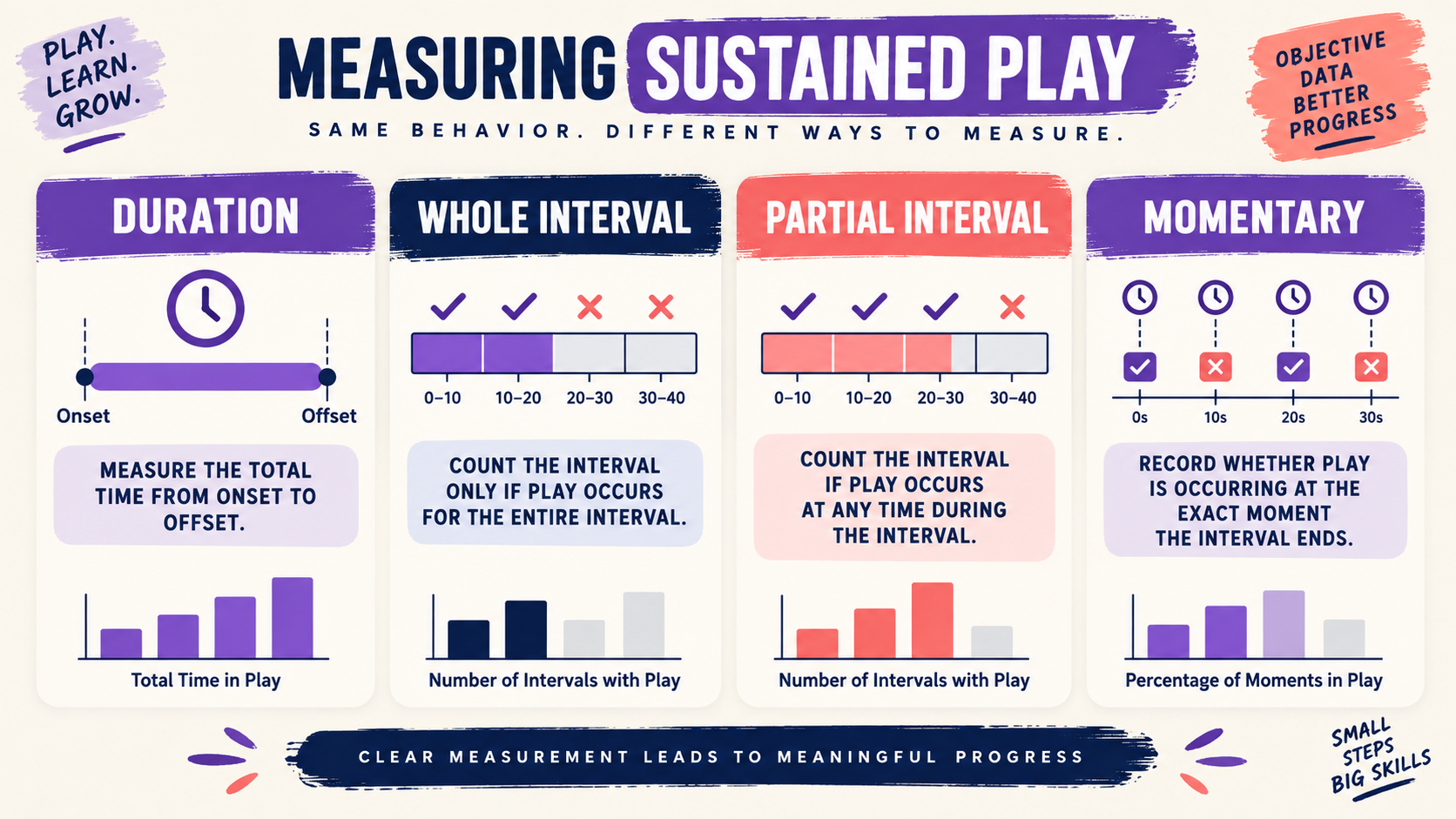
Choose measurement based on the response dimension, observation resources, and question you need to answer. If the question is “How long did each play episode last?” continuous duration recording is direct. If the team cannot continuously time every episode, an interval system may provide an estimate. A sampling procedure can be practical, but it can also overestimate or underestimate behavior depending on the procedure and the target’s pattern.
| System | What is recorded? | Useful when | Main caution |
|---|---|---|---|
| Duration recording | Time from onset to offset, or total time engaged. | The length of engagement is the central question. | Requires clear boundaries and continuous observation. |
| Whole-interval | Whether engagement occurred for the entire interval. | Building continuous engagement or estimating a high standard for staying with an activity. | May underestimate behavior that is valuable but briefly interrupted. |
| Partial-interval | Whether engagement occurred at any time in the interval. | Capturing occurrence when continuous timing is not feasible. | Can overestimate engagement because a brief response marks the interval. |
| Momentary time sampling | Whether engagement is occurring at the exact observation moment. | Efficient sampling across a longer routine or group setting. | A snapshot does not show what happened between observations. |
Suppose the session lasts 20 minutes and the learner is engaged for 12 minutes across several episodes. You could report total duration as 12 minutes, mean episode duration if each episode is timed, or percentage of session time as total engaged time ÷ total observation time × 100. Do not switch among these measures without labeling the change. A percentage of intervals engaged is not the same as percentage of total time engaged.
For a focused review of measurement terminology, link this article to the site’s duration recording guide and interval recording guide. Those pages own the general measurement procedures; this article applies them to programming sustained play.
How Do You Write a Sustained Play Goal?
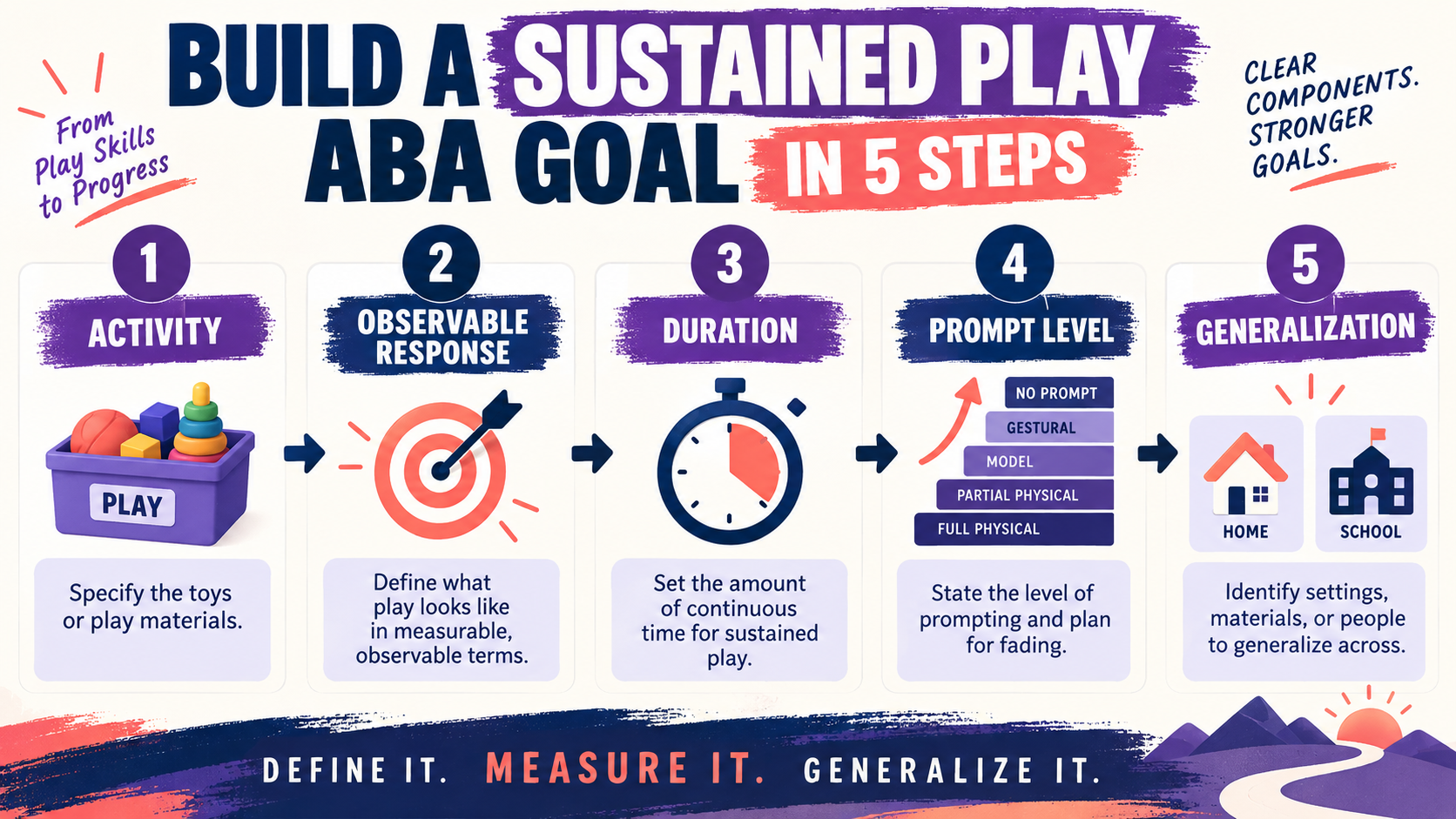
A good goal combines a context, an observable response, a duration or performance criterion, a prompt condition, and a mastery rule. Avoid a target such as “will play appropriately for 10 minutes” unless the document explains what play looks like. A learner may sit silently beside materials for 10 minutes and still not demonstrate the intended skill.
- Name the activity: Identify the selected materials, routine, or social context.
- Define the response: Describe the actions that show functional, pretend, independent, or social play.
- Set the initial criterion: Use baseline data to choose a reachable next step, such as two minutes of engagement rather than an arbitrary adult-selected number.
- Specify prompts: State whether the target is independent, gesturally prompted, verbally prompted, or physically guided, and record prompt level separately.
- Add generalization: Identify another person, material, setting, or activity where the skill should occur.
- Define mastery and maintenance: State how many sessions, opportunities, or settings must meet the criterion and when follow-up checks occur.
Example format: “Given a choice of two developmentally appropriate construction activities, the learner will select one, manipulate the materials according to the activity routine, and remain engaged for four consecutive minutes with no more than one gestural prompt, in four of five opportunities across three sessions, with a second adult and a novel material.” This is a template, not a universal goal. The team should adjust the activity, response definition, prompt level, and criterion to the learner’s assessment data and preferences.
How Can ABA Teach Longer, More Meaningful Play?
Begin with an activity that is likely to contact reinforcement. A brief preference assessment or observation can help identify materials the learner approaches and engages with, but approach is not identical to sustained play. Offer choices, keep the starting requirement reasonable, and arrange the environment so the learner can contact the relevant materials without unnecessary barriers.
- Model the routine: Demonstrate one small play action, then give the learner an opportunity to respond.
- Prompt only as needed: Use the least intrusive effective prompt and plan how it will be faded.
- Reinforce the skill: Deliver natural consequences such as the activity continuing, a completed product, social interaction, or access to a preferred variation.
- Shape gradually: Increase duration, response complexity, or social reciprocity in small steps when the current step is stable.
- Teach communication: Ensure the learner can request help, a different material, attention, or a break.
- Vary practice: Rotate materials and partners after the learner can perform the response reliably in the initial context.
Teaching sustained play is not the same as withholding every alternative until the learner complies. Watch for signs of distress, honor appropriate communication, and review whether the target is socially meaningful. The goal is a more flexible and accessible play repertoire, not simply a longer period of adult-directed sitting.
How Should You Interpret Sustained Play Data?
Start with the graph’s level, trend, and variability. If median episode duration increases while prompt levels decrease, that may indicate an important change in independence. If total duration rises only because the adult is providing more prompts, the data should not be described as independent progress. If interval percentages rise but the learner is engaging in a repetitive or low-quality response, revisit the definition and social validity of the target.
Compare baseline and intervention only when the conditions are described accurately. Check whether the activity, materials, observer, session length, reinforcement arrangement, and prompt procedure changed. A longer session naturally creates more opportunity for total duration, so report a rate or percentage when session length varies. Also inspect whether the learner is generalizing to people and materials that matter outside the teaching table.
Interobserver agreement can help determine whether observers apply the onset, offset, and engagement rules consistently. An agreement percentage is not proof that the definition is valid, but disagreement is a signal to refine training or the definition. For foundational data-collection context, the site’s data collection guide can be used as a related resource.
What Mistakes Should You Avoid?
- Using a vague label: “Appropriate play” is not an operational definition.
- Counting proximity as engagement: Being near a toy does not necessarily mean the play response occurred.
- Reporting only total minutes: Total duration can be misleading when session length or opportunity count changes.
- Ignoring prompts: Duration and independence are separate dimensions; record both when relevant.
- Choosing an arbitrary criterion: Use baseline, learner preference, functional need, and attainable shaping steps.
- Confusing partial and whole interval: “Any time in the interval” and “the entire interval” produce different measurement biases.
- Forcing an aversive routine: Appropriate communication and assent-related signals should influence the plan.
- Skipping generalization: A skill limited to one adult and one toy may not transfer to daily life.
What Should You Remember for the BCBA Exam?
For an exam question, identify the dimension the stem asks you to measure. If the question asks how long a play episode lasts, duration recording is the direct answer. If it asks whether play occurred during the entire interval, whole-interval recording fits. If play occurring at any point marks the interval, partial-interval recording fits. If the observer checks only at the end or a predetermined moment, the procedure is momentary time sampling.
- Separate the topography of play from the measurement system.
- Look for onset and offset clues when the stem describes duration.
- Remember that whole-interval tends to underestimate and partial-interval tends to overestimate continuous behavior.
- Report prompt level separately when the question is about independence.
- Choose a socially meaningful and observable target instead of an abstract “plays appropriately” label.
Use the current BACB Test Content Outline and task-list resources for the official study scope. The worked examples in this article are original illustrations and are not official BACB questions. For scenario practice, the free BCBA mock exam is available as a study supplement.
Frequently Asked Questions
What is sustained play in ABA?: It is a defined period or pattern of continued engagement with a play activity. The program must state which observable actions count, when engagement begins and ends, and how prompts or breaks are recorded.
Is sustained play measured only with duration recording?: No. Duration is direct when the length of engagement is the main question, but whole-interval, partial-interval, or momentary time sampling may be selected when continuous timing is not feasible or when the clinical question is different.
How do I increase sustained play?: Start with meaningful activities, offer choices, teach small response steps, use effective prompts, fade them systematically, reinforce engagement naturally, and teach functional communication for help or breaks. The target should be individualized and supervised.
Does longer play always mean better progress?: No. A longer duration may reflect more prompting, a longer session, or engagement with a repetitive response that does not match the goal. Interpret duration with independence, response quality, variability, and generalization.
Sources for Further Study
- Behavior Analyst Certification Board: Test Content Outlines and Task Lists — current certification-study scope.
- Beyond Trial Counts: Considerations for Measuring Play and Engagement During Early Intervention — measurement of play and engagement.
- Parents Are People Too: Implementing Empirically Based Strategies During Daily Interactions — observing sustained item engagement in natural routines.
- Raven Health: Duration Recording in ABA — onset, offset, and duration concepts.
- IRIS Center: Measuring Behavior — examples of behavior measurement and time sampling.
- Childwise ABA: Whole-Interval Recording — whole-interval use for sustained engagement.
- Beyond Trial Counts: Play and Engagement Journal Club PDF — individualized play-duration and joint-engagement considerations.
Take the Free BCBA Mock Exam
If you want a low-pressure way to check your recall, use the free practice resource below. Take the Free BCBA Mock Exam



