

Contrived reinforcers ABA are reinforcers deliberately arranged by a practitioner or caregiver to increase a target response. They can create an early learning opportunity, but a good plan also asks how the response will contact natural reinforcement and how the arranged reinforcer will be faded.
Table of Contents
- What Are Contrived Reinforcers ABA?
- What Is the Difference Between Natural and Contrived Reinforcement?
- When Might a Contrived Reinforcer Be Useful?
- How Do You Pair, Fade, and Transfer a Contrived Reinforcer?
- What Risks Should You Check?
- What Is a Practical Decision Checklist?
- What Does the BCBA Exam Test?
- What Is the Bottom Line?
- Quick Review Checklist
- Take the Free BCBA Mock Exam
In applied behavior analysis, a contrived reinforcer is arranged for teaching rather than naturally produced by the activity. A token delivered after a communication response, a planned edible after a difficult step, or a specially prepared choice board may be contrived. The label describes the arrangement, not whether the item is inherently reinforcing. Something arranged by an adult is useful only if it actually increases the future probability of the target response for that learner in that context.
This distinction matters because early teaching and long-term participation do not always have the same reinforcement conditions. The BCBA Test Content Outline includes reinforcement, generalization, maintenance, transferring to natural reinforcers, and mitigating unwanted effects. A contrived reinforcer is therefore not the endpoint of a program. It is one possible arrangement in a larger plan.
What Are Contrived Reinforcers ABA?
Contrived reinforcers are deliberately introduced or scheduled to strengthen a response. The practitioner may control the timing, amount, or delivery because the natural consequence is delayed, unavailable, too weak, or not yet connected to the learner’s response. For example, a token may bridge the delay between completing a task and accessing a preferred activity. A planned choice of music may reinforce a learner for using a functional communication response when the natural activity is not yet available.
“Contrived” does not mean fake, harmful, or automatically inferior. It means the contingency is arranged. The important questions are whether the reinforcer is effective, whether it is socially meaningful, whether the learner has a reasonable way to access it, and whether the procedure supports rather than replaces natural participation.
What Is the Difference Between Natural and Contrived Reinforcement?
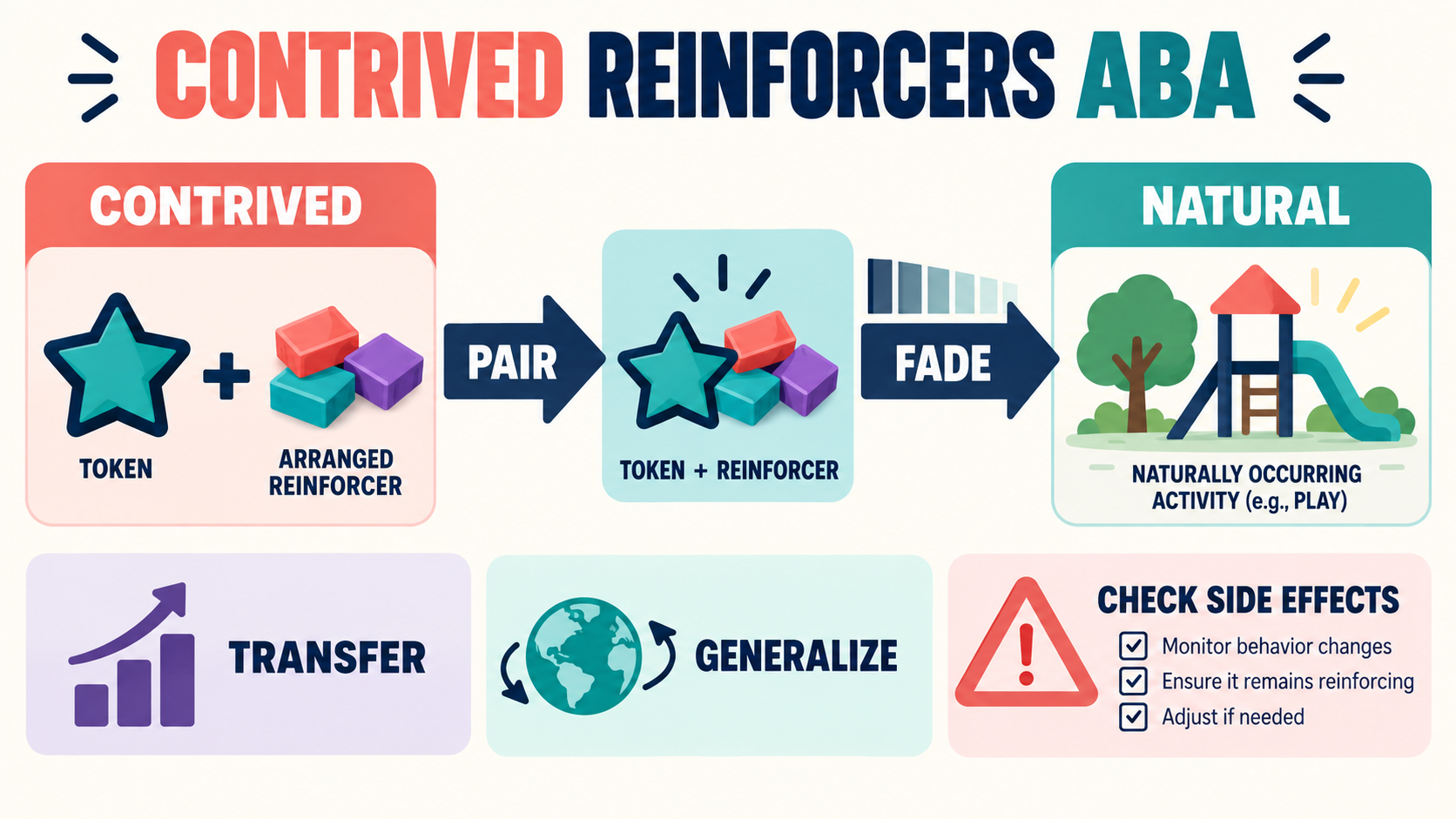
Natural reinforcement follows from the activity or social context. If a learner asks for a turn and receives the turn, access to the activity is a natural consequence of the communication. Contrived reinforcement is added or deliberately scheduled by the teaching team. A sticker after the same request may be useful as an additional consequence, but it is not the natural activity outcome.
| Question | Natural reinforcer | Contrived reinforcer |
|---|---|---|
| Where does it come from? | The response contacts an outcome already related to the activity. | A practitioner or caregiver arranges the consequence. |
| Example | Requesting a toy produces access to that toy. | Completing a step produces a token exchangeable for a chosen activity. |
| Why use it? | It supports functional participation and transfer. | It can strengthen an early response or bridge a delay. |
| Main planning question | Does the natural outcome reliably follow the response? | How will the arranged consequence be paired, faded, and transferred? |
The terms are not mutually exclusive within a program. A practitioner may use a token as a temporary bridge while also delivering the natural outcome. For a communication goal, the learner might receive the requested item immediately and also earn a token toward a larger activity. The plan should make clear which consequence is expected to maintain the response and how the added arrangement will be reduced.
When Might a Contrived Reinforcer Be Useful?
A contrived arrangement may be helpful when the natural consequence is delayed, difficult to access, or not yet reinforcing for the learner. It can support a new response, increase the number of practice opportunities, or make a low-probability step worth attempting. A token system can also make progress visible across several small steps when the final activity outcome cannot occur after every response.
Use the smallest effective arrangement. First identify the response and the decision. If the learner needs to complete a short safety routine before accessing a preferred activity, a clear visual sequence and immediate natural outcome may be enough. Adding tokens, edibles, or extra adult attention without a reason can create unnecessary complexity. The Oklahoma Autism Handbook describes situations in which a contrived reinforcer may be appropriate temporarily while emphasizing the importance of natural reinforcers and careful transition planning.
How Do You Pair, Fade, and Transfer a Contrived Reinforcer?
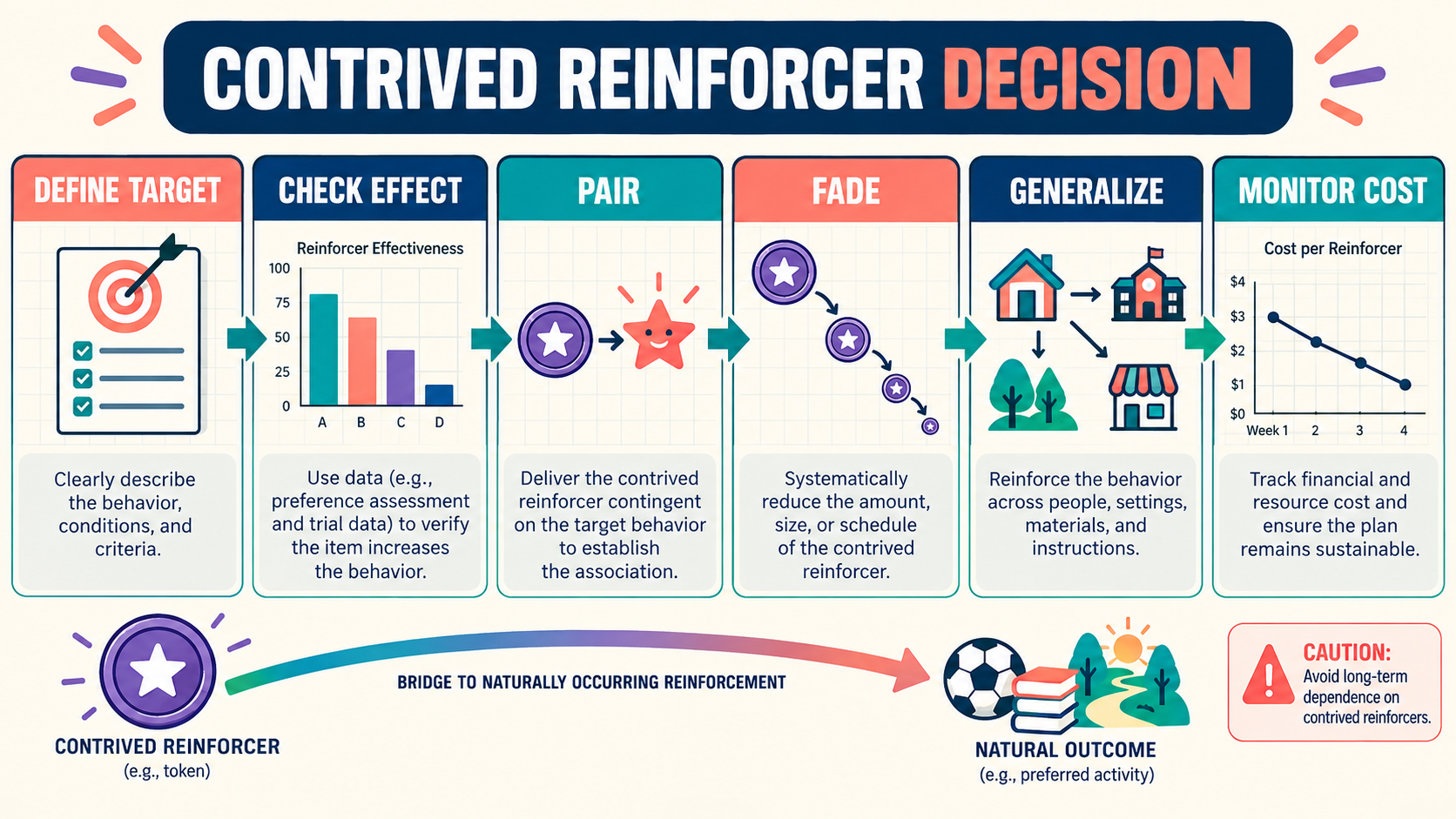
A practical sequence is:
- Define the target: specify the response, the opportunity, the prompt rule, and the criterion for reinforcement.
- Confirm effectiveness: use preference information and data to see whether the arranged consequence changes responding for this learner.
- Pair with the natural outcome: deliver the token, praise, or other arranged consequence together with the activity or social result whenever appropriate.
- Thin or fade deliberately: reduce the number, size, immediacy, or predictability of the contrived consequence while preserving successful responding.
- Transfer across contexts: practice with other people, materials, settings, and naturally available outcomes.
- Monitor maintenance: check whether the response continues when the added reinforcer is no longer present.
Fading is not simply removing the reinforcer on a chosen date. If the response falls sharply, the team needs to analyze whether the natural outcome is available, whether the task is too difficult, or whether the arranged reinforcer was doing all of the work. Adjust the schedule, response effort, or teaching context based on data rather than assuming dependence is the only explanation.
For a learner who is learning to request a turn, the adult might initially pair a token with immediate access to the game. Over time, the token could be delivered less often while the learner continues to receive the turn. Eventually, requesting and participating in the game should contact social and activity-based outcomes in ordinary settings. The token is a bridge, not the destination.
What Risks Should You Check?
Contrived reinforcers can produce unintended effects. The learner may become satiated, work only for the arranged item, lose access to a naturally meaningful activity, or experience increased response effort. A powerful edible may suppress other choices or create health and family concerns. A token board may become so complex that staff implement it inconsistently. An adult may also withhold a reasonable natural outcome until a token requirement is met, turning a helpful bridge into an unnecessary barrier.
Review whether the procedure is respectful, understandable, and proportionate to the goal. The BACB Ethics Code supports individualized, effective practice and attention to unwanted effects. Obtain relevant consent and collaborate with caregivers and other professionals when the reinforcer affects diet, communication, access to activities, or daily routines.
Use data that can detect both improvement and cost. Track independent responses, prompted responses, latency, problem behavior, learner preference, and what happens after the contrived reinforcer is thinned. A higher response count is not enough if the learner is distressed, the skill does not generalize, or the natural activity has stopped being meaningful.
What Is a Practical Decision Checklist?
- Is the target response clearly defined and socially important?
- What natural consequence should eventually maintain it?
- Why is the natural consequence not enough at this teaching stage?
- How will the arranged reinforcer be paired with the natural outcome?
- What exact data will tell the team to thin or change the arrangement?
- Could the plan create satiation, dependence, exclusion, or another unwanted effect?
- Will the response contact reinforcement with other people and in ordinary settings?
What Does the BCBA Exam Test?
- Contrived means arranged: it does not mean that an item is always artificial or ineffective.
- Natural reinforcement is related to the response: access to the requested activity is different from an unrelated prize.
- Pair and transfer: a contrived consequence should be connected with natural outcomes and faded when possible.
- Evaluate effects: monitor satiation, dependence, problem behavior, and generalization.
- Use the least complex effective plan: extra reinforcers should solve a defined problem, not merely decorate a procedure.
- Individualize: what functions as a reinforcer is determined by its effect on behavior for that learner and context.
What Is the Bottom Line?
Contrived reinforcers ABA can help a learner contact success when natural reinforcement is delayed, weak, or not yet available. Define the target, select an effective and respectful arrangement, pair it with the natural outcome, fade it using data, and check maintenance and generalization. The strongest plan makes the learner’s everyday activity more reinforcing rather than creating permanent dependence on an adult-controlled reward. For more practice with reinforcement and generalization questions, try the free BCBA mock exam.
For targeted review, use our contrived reinforcers ABA practice questions to apply the concept in exam-style scenarios.
Quick Review Checklist
Use this final checklist to turn contrived reinforcers ABA into exam-ready reasoning. The goal is not to memorize a label in isolation; it is to identify the relevant evidence and explain why the best answer fits the scenario. Key ideas to review:
- State the central definition or decision point for contrived reinforcers ABA in your own words.
- Identify the detail that makes contrived reinforcers ABA different from its closest related ABA term.
- Separate the observable facts in a scenario from assumptions that are not supported by the facts.
- Write one example and one nonexample so you can recognize the concept in a new setting.
Exam application checks:
- Ask what the question is actually requesting before comparing the answer choices.
- Mark the antecedent, response, consequence, or other evidence that supports the selected answer.
- Look for a distractor that describes a related process but does not answer the specific question.
Final self-check:
- Explain how you would verify the interpretation with clear observations or data.
- Change one detail in the scenario and decide whether your answer should change.
- Give a one-sentence rationale that a supervisor or study partner could evaluate.
Take the Free BCBA Mock Exam
If you want a low-pressure way to check your recall, use the free practice resource below. Take the Free BCBA Mock Exam



