
Task refusal interventions in ABA should begin with a functional question: what does the refusal change, delay, or communicate in this context? A useful plan may combine task modification, choice, functional communication, reinforcement, and skill teaching—but it should be individualized and measured rather than selected from a generic compliance list.
Table of Contents
- What Should Task Refusal Interventions ABA Include?
- Why Should You Assess Refusal Before Choosing an Intervention?
- What If Task Refusal Is Maintained by Escape?
- How Can You Choose an Intervention From the Pattern?
- How Can Choice and Task Fit Reduce Barriers?
- How Should Functional Communication Be Taught?
- How Do Reinforcement and High-Probability Sequences Fit?
- How Should You Measure Task Refusal and Participation?
- What Should You Avoid When Addressing Refusal?
- How Can Interventions Be Faded and Generalized?
- How Is Task Refusal Tested on the BCBA Exam?
- What Is the Bottom Line?
- Quick Review Checklist
- Take the Free BCBA Mock Exam
“Task refusal” can describe many different responses: pushing materials away, saying “no,” leaving, dropping to the floor, delaying, or not responding after an instruction. The same topography can have different variables across settings. Refusal during a difficult worksheet may not have the same function as refusal during a transition, a sensory routine, or an activity the learner does not understand. In practice, task refusal interventions ABA teams consider should be tied to the learner’s communication, skills, context, and welfare rather than to the label alone.
A BCBA should therefore define the behavior, review direct and indirect information, and consider the learner’s communication, preferences, skill level, and safety. The current BACB ethics resources and official task list provide the professional context; the exact intervention belongs to the individualized assessment and treatment plan.
What Should Task Refusal Interventions ABA Include?
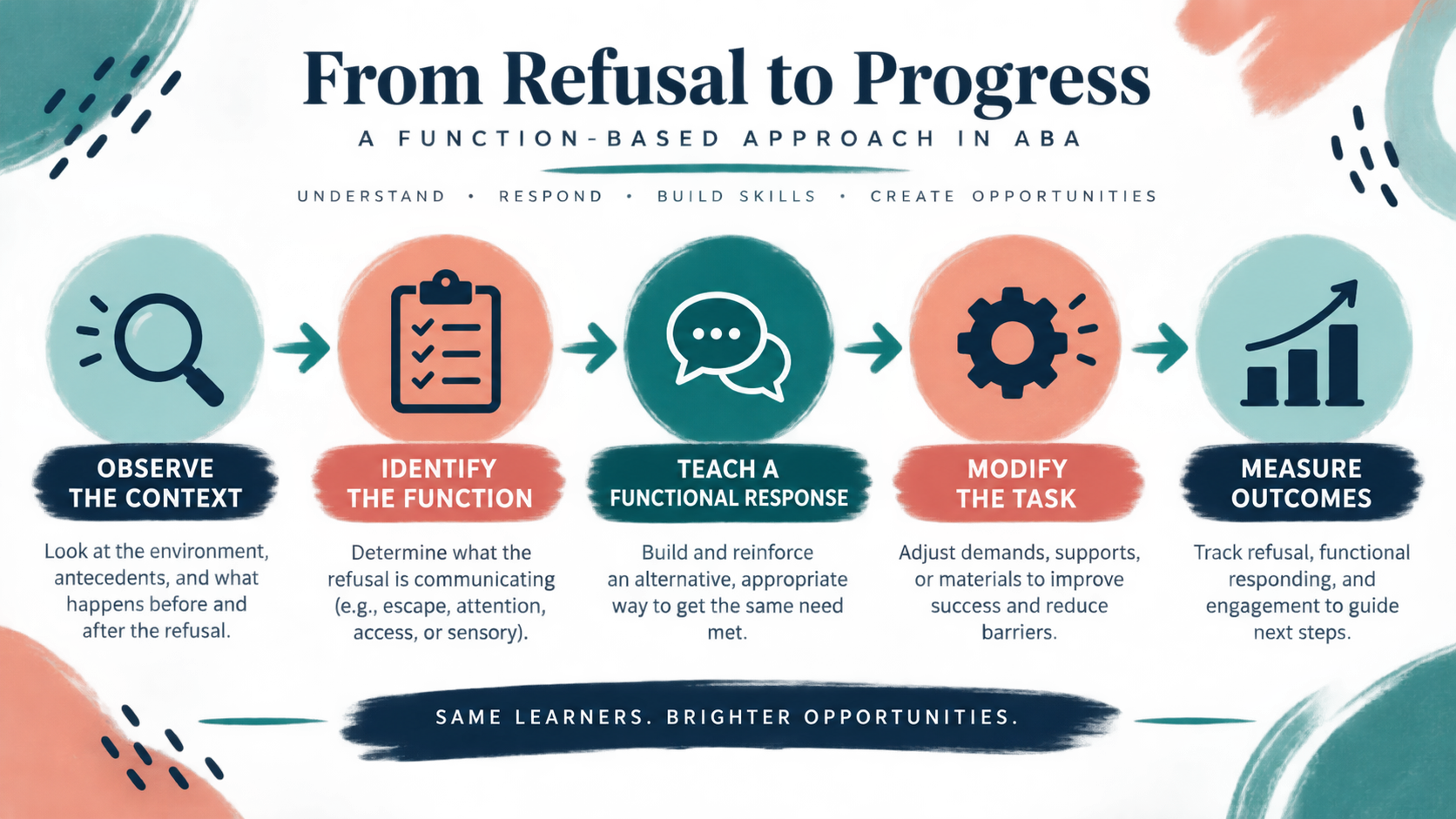
Task refusal interventions in ABA are function-based procedures designed to improve meaningful participation, teach an effective alternative response, or change the conditions that make a task difficult. The aim is not simply to make refusal disappear. A successful plan should help the learner communicate, access appropriate support, acquire the relevant skill, or participate in a routine that is reasonable and socially important.
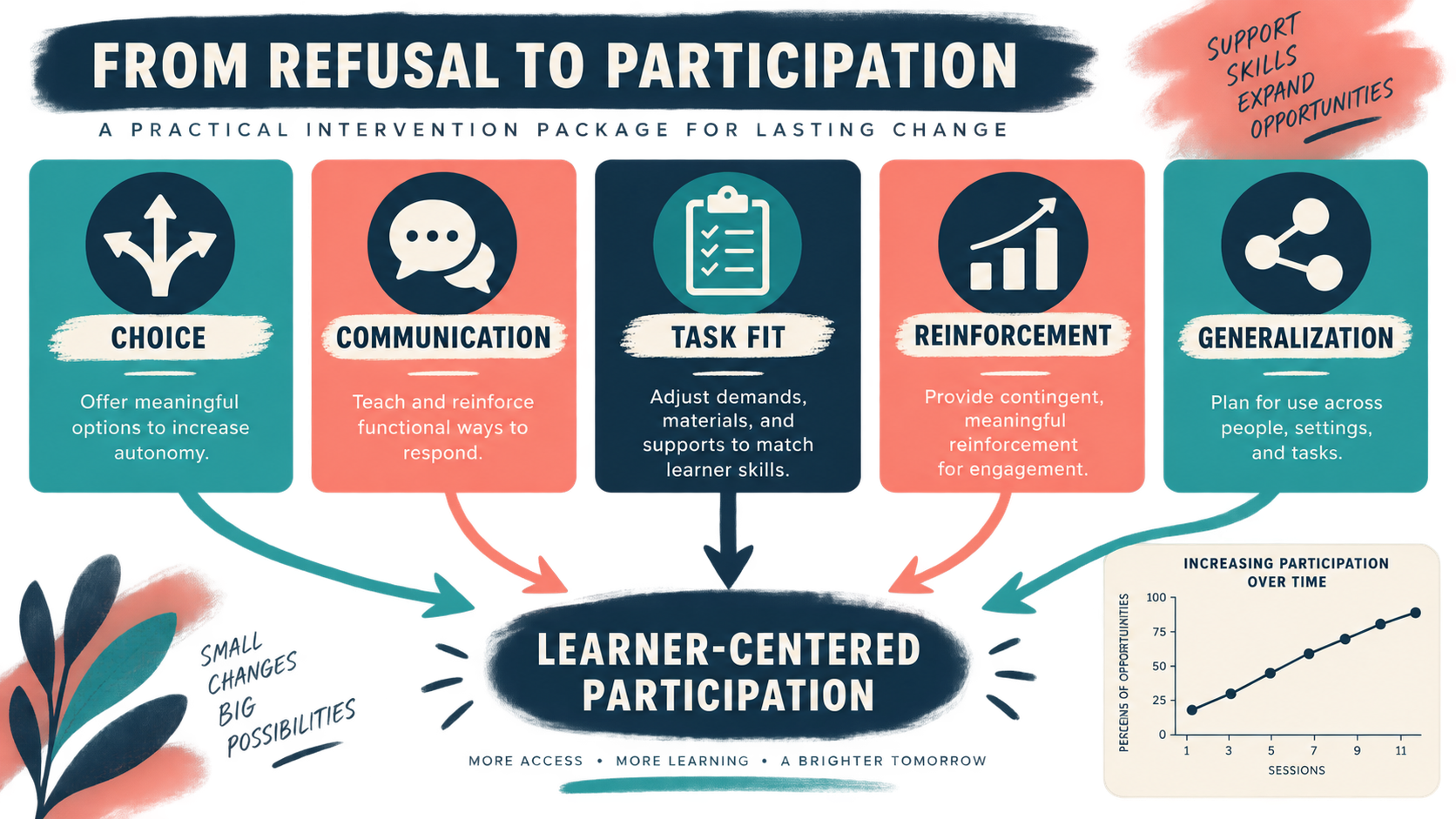
Possible components include reducing unnecessary response effort, offering a meaningful choice, teaching a request for help or a break, arranging reinforcement for the target response, using a high-probability sequence when appropriate, and teaching prerequisite skills. These components are not interchangeable. The assessment should explain why each is included and how the team will know whether it helps.
Why Should You Assess Refusal Before Choosing an Intervention?
Refusal is an observable response, not a functional explanation. Observe what happens before and after it, what task is presented, whether the learner has the required skill, how demands are delivered, and what changes immediately follow the response. Interview information can add context, but direct observation helps test whether the reported pattern appears in the referred setting.
Ask whether the learner can complete the task under easier conditions. A refusal may reflect missing prerequisite skills, unclear instructions, excessive response effort, poor stimulus control, pain or fatigue, sensory discomfort, limited communication, or a history in which refusal reliably produces a break. Different variables call for different decisions. An intervention chosen only because the behavior is labeled “noncompliance” can miss the actual problem.
What If Task Refusal Is Maintained by Escape?
If assessment suggests that refusal is followed by a reduction, delay, or removal of a difficult demand, escape may be relevant. That does not mean the learner is manipulating adults or that all breaks should be removed. It means the team should teach a more efficient and acceptable way to communicate the need for help, pause, modification, or completion under a plan that can be faded responsibly.
Functional communication training is one possible component. The response could be a word, sign, card, AAC selection, gesture, or other form that the learner can use reliably. Teach it under safe, low-risk conditions, reinforce it according to the plan, and make sure the communication response is not harder than the problem behavior. The team should also evaluate whether the task itself needs to be changed.
How Can You Choose an Intervention From the Pattern?
The data should narrow the decision rather than produce a one-size-fits-all answer.
| Pattern to investigate | Possible next question | Potential plan component |
|---|---|---|
| Refusal follows difficult or long demands | Are the task level, pacing, and prerequisites matched to current skills? | Adjust task size, teach prerequisites, offer help, and reinforce functional communication. |
| Refusal follows transitions or unexpected changes | Does the learner have information and a workable way to request support? | Use advance information, choice, transition support, and a predictable communication response. |
| Refusal occurs when materials or communication are inaccessible | Is the learner being asked to respond without an efficient form of access? | Coordinate with relevant professionals and improve access before increasing demands. |
| Refusal continues after task changes | Are there other variables, competing reinforcement histories, or unobserved conditions? | Return to assessment, review implementation fidelity, and avoid escalating without new information. |
How Can Choice and Task Fit Reduce Barriers?
Choice can give the learner meaningful control over materials, order, location, partner, or break timing while preserving the learning objective. The choice must be real: if every option leads to the same immediate demand with no way to communicate “not now” or “help,” the procedure may function as a disguised demand.
Task fit includes the amount of work, response effort, clarity of instructions, materials, pace, reinforcement history, and prerequisite skills. Consider interspersing mastered responses, shortening the initial response requirement, modeling the first step, or teaching a missing skill. These changes should be evaluated by their effect on independent, meaningful participation—not only by whether the learner stops objecting.
How Should Functional Communication Be Taught?
Define the communication response and the outcome it accesses. A learner might request a break, help, a different way to respond, more information, or an alternative activity when that option is appropriate. Teach the response before the situation becomes urgent, prompt it carefully, and reinforce it consistently enough that it competes with refusal.
Plan what happens after the request. A break should have a clear duration or return condition that the learner can understand, and the team should review whether the break schedule is realistic. If communication always results in an immediate, indefinite escape, the learner may not contact the instructional goal. If communication never works, it is unlikely to replace refusal. Schedule thinning and generalization require data and careful individualized planning.
How Do Reinforcement and High-Probability Sequences Fit?
Reinforcement should be connected to the meaningful target response, such as beginning a task, completing a reasonable step, using communication, or tolerating a clearly defined part of a routine. Identify what is valuable to the learner and whether the reinforcer remains effective. Do not assume that praise or a token board is reinforcing simply because an adult selected it.
A high-probability request sequence may involve a few easy responses before a more difficult response. Research has examined this procedure as an antecedent-based intervention, but it still needs to fit the learner, task, and goal. It should not become a long chain of demands used to override communication or refusal. Monitor whether the easy-response sequence improves participation and whether the effect transfers to the natural task.
How Should You Measure Task Refusal and Participation?
Measure both the response you want to reduce and the skills you want to increase. Depending on the referral question, collect frequency, duration, latency to begin, percentage of steps completed, independent communication, prompt level, or number of appropriate break requests. Define the observation period and the opportunity so the data can be interpreted.
Look for side effects. Refusal may decrease while distress, prompt dependence, or passive compliance increases. A plan should be reviewed if the learner loses communication, the task becomes more restrictive, or participation occurs only with intrusive prompts. Include learner and caregiver feedback when deciding whether the outcome is socially meaningful.
What Should You Avoid When Addressing Refusal?
- Starting with a consequence package before assessment: the label does not identify the maintaining variable.
- Equating quiet behavior with success: a learner may stop protesting without gaining a useful skill or meaningful choice.
- Removing every break: a safe, functional request for pause or help can be an important replacement behavior.
- Using physical guidance as the default: consider safety, assent, competence, and less intrusive ways to teach the response.
- Ignoring task difficulty: if the task exceeds current skills, more insistence is not a skill-acquisition plan.
- Failing to check fidelity: inconsistent prompting, reinforcement, or break delivery can make a good plan look ineffective.
How Can Interventions Be Faded and Generalized?
Plan fading from the beginning. Gradually vary materials, people, settings, task lengths, and the delay between a request and a break when the learner is ready. Transfer control to natural cues and reinforcement while preserving a functional way to request assistance or a pause.
Generalization should not mean requiring the same performance everywhere without support. It means the learner can use the relevant skill across meaningful conditions. Review data by setting and task, and ask whether the procedure remains practical for teachers, caregivers, and the learner.
How Is Task Refusal Tested on the BCBA Exam?
Exam questions may present refusal after a demand, a transition, or restricted access and ask which intervention is most appropriate. Identify the function suggested by the data, check whether the proposed replacement response serves the same outcome, and look for the least intrusive evidence-based option that teaches a meaningful skill. The best answer usually matches assessment, communication, reinforcement, measurement, and ethical safeguards rather than simply demanding compliance.
Be cautious when a question gives no functional information but an answer immediately selects extinction or punishment. First determine whether assessment, task analysis, communication teaching, or a change in the antecedent is needed. Also distinguish a learner’s appropriate refusal or request for help from behavior that creates immediate safety risk; those cases require different priorities and professional judgment.
What Is the Bottom Line?
Task refusal interventions in ABA work best as individualized, function-based support: define the response, examine context, identify relevant variables, teach an effective communication or participation skill, adjust the task, reinforce meaningful progress, and measure outcomes. Respectful treatment does not mean abandoning learning goals; it means making goals functional, accessible, and responsive to the learner’s communication and welfare. For another structured BCBA practice session, you can try the free BCBA mock exam. Use practice questions to review function-based intervention selection, not to substitute a generic protocol for an individualized assessment.
For targeted review, use our task refusal interventions ABA practice questions to apply the concept in exam-style scenarios.
Quick Review Checklist
Use this final checklist to turn task refusal interventions ABA into exam-ready reasoning. The goal is not to memorize a label in isolation; it is to identify the relevant evidence and explain why the best answer fits the scenario. Key ideas to review:
- State the central definition or decision point for task refusal interventions ABA in your own words.
- Identify the detail that makes task refusal interventions ABA different from its closest related ABA term.
- Separate the observable facts in a scenario from assumptions that are not supported by the facts.
- Write one example and one nonexample so you can recognize the concept in a new setting.
Exam application checks:
- Ask what the question is actually requesting before comparing the answer choices.
- Mark the antecedent, response, consequence, or other evidence that supports the selected answer.
- Look for a distractor that describes a related process but does not answer the specific question.
Final self-check:
- Explain how you would verify the interpretation with clear observations or data.
- Change one detail in the scenario and decide whether your answer should change.
- Give a one-sentence rationale that a supervisor or study partner could evaluate.
Take the Free BCBA Mock Exam
When you are ready to apply the idea, use the free practice resource below for additional feedback. Take the Free BCBA Mock Exam



