

If you searched for a skill acquisition plan sample ABA, the most useful answer is not a blank template by itself. A strong plan connects one socially meaningful skill to an observable target, a baseline, a teaching arrangement, prompt and reinforcement decisions, data rules, mastery criteria, and opportunities for generalization. The plan should make it possible for a trained team to understand what to teach, how to respond, and when to adjust instruction.
Table of Contents
- What Is a Skill Acquisition Plan in ABA?
- What Should a Skill Acquisition Plan Sample ABA Include?
- How Do You Write a Measurable Skill-Acquisition Target?
- How Do Baseline, Teaching, Prompting, and Reinforcement Fit Together?
- How Do You Use Data to Adjust a Skill Acquisition Plan?
- What Does a Fictional Sample Plan Look Like?
- How Do You Plan for Generalization and Maintenance?
- What Mistakes Weaken a Skill Acquisition Plan?
- How Should You Study Skill Acquisition Plans for the BCBA Exam?
- Frequently Asked Questions
- Sources for Further Study
- Take the Free BCBA Mock Exam
This is an educational BCBA study guide, not a universal clinical protocol. A real plan must be individualized, assent-aware, culturally responsive, and supervised by qualified professionals. The current BACB Test Content Outline and task-list resources should remain the source of truth for certification preparation. Do not copy a sample plan into a learner’s record without assessment, stakeholder input, and appropriate authorization.
What Is a Skill Acquisition Plan in ABA?
A skill acquisition plan is a written teaching plan for helping a learner acquire a new response or response class. In applied behavior analysis, “skill” might refer to functional communication, listener responding, self-care, safety, academic behavior, social interaction, play, vocational behavior, or another meaningful area. The label is broad; the quality comes from the operational detail.
A plan is stronger than a goal statement such as “improve communication.” It identifies what the learner will do, under which conditions, what counts as a correct response, how assistance will be delivered, how progress will be measured, and what happens next. It also explains how instruction will move beyond one therapist, one room, one material, or one memorized example.
For exam questions, separate skill acquisition from behavior reduction. Skill acquisition teaches a new or improved response. Behavior reduction addresses a response that presents a problem or risk. The two can be related—for example, teaching a request may be part of a comprehensive plan—but they are not interchangeable categories.
What Should a Skill Acquisition Plan Sample ABA Include?
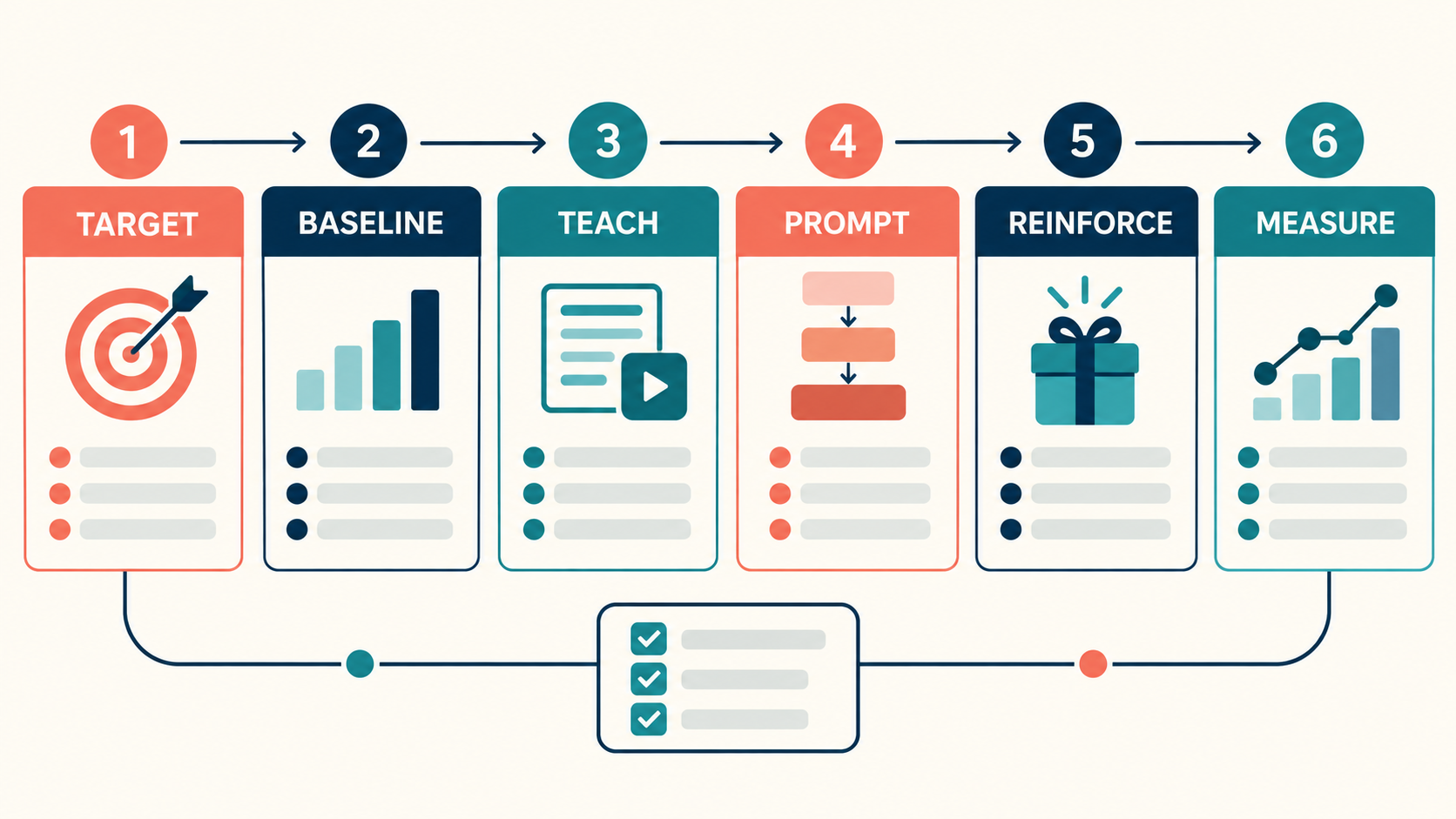
A practical sample should show the relationship between the following fields. Different organizations use different forms, but the instructional logic should remain visible.
| Plan field | What to specify | Why it matters |
|---|---|---|
| Socially meaningful outcome | The daily-life reason the skill matters and whose priorities informed it. | Prevents teaching an isolated performance that has little value to the learner. |
| Operational target | Antecedent or opportunity, observable response, context, and mastery rule. | Allows different instructors to identify the same response and score it consistently. |
| Baseline | The initial level, conditions, materials, and measurement method. | Shows where instruction starts and gives later decisions a comparison point. |
| Teaching arrangement | Materials, instruction, response opportunity, prompting, consequence, and error correction. | Turns “practice” into a reproducible teaching procedure. |
| Data and decision rules | Measure, schedule, mastery criterion, generalization checks, and what will trigger a change. | Connects data to action instead of collecting numbers without a plan. |
A sample is therefore a model for reasoning, not a promise that one prompt sequence or percentage criterion fits everyone. The plan should identify who will implement it, how fidelity will be checked, how the learner’s assent or communication will be respected, and how concerns will be escalated.
How Do You Write a Measurable Skill-Acquisition Target?
Start with the opportunity and the response, not with an abstract trait. A useful target states the conditions under which the learner has a chance to respond and describes behavior that an observer can see or hear.
- Define the opportunity: Identify the routine, cue, material, person, or naturally occurring situation. Avoid a vague phrase such as “when needed” unless the opportunity is defined.
- Define the response: State exactly what the learner will do. For communication, include an acceptable modality such as speech, sign, picture, device, gesture, or another established response form when appropriate.
- Define independence: Specify whether the response must occur without a prompt, after a natural cue, within a time window, or with a permitted level of support.
- Define the measurement: Select a measure that fits the response, such as percentage of opportunities, frequency, duration, latency, task-analysis steps, or a permanent product.
- Define mastery carefully: State the criterion, number of sessions or opportunities, materials, people, and settings involved. A single high score in one context may not demonstrate a durable skill.
Compare “will improve requesting” with “given a visible choice of two preferred items during snack, the learner will independently use an established communication response to request one item within 10 seconds in at least 80% of opportunities across three sessions.” The second statement still needs individual review, but it gives the team something observable to teach and measure.
How Do Baseline, Teaching, Prompting, and Reinforcement Fit Together?
Baseline answers “what happens before this teaching arrangement begins?” It should be collected under conditions that are relevant to the target and described well enough to interpret. Baseline is not a test of worth or effort; it is information for selecting a starting point.
Teaching then arranges repeated opportunities for the target response. A complete procedure usually identifies the instruction or natural cue, the time allowed for a response, the prompt hierarchy, what happens after a correct response, what happens after an error or no response, and how the next opportunity begins. It should also state whether the procedure is naturalistic, trial-based, task-analyzed, or a combination.
- Prompting: Choose a prompt strategy that supports success and includes a plan for prompt fading. More help is not automatically better help.
- Reinforcement: Identify what consequence will make the response valuable in that context. Preferences should be assessed rather than assumed, and reinforcement should not be described as a bribe.
- Error correction: State how the instructor will respond neutrally and how another opportunity will be provided. Avoid procedures that create unnecessary frustration or remove meaningful communication.
- Fidelity: Define the essential steps so a supervisor can check whether the written procedure was implemented as intended.
The point is not to make every plan long. The point is to make the important decisions visible. A short plan can be excellent when another trained person can implement it, score it, and recognize when it needs revision.
How Do You Use Data to Adjust a Skill Acquisition Plan?
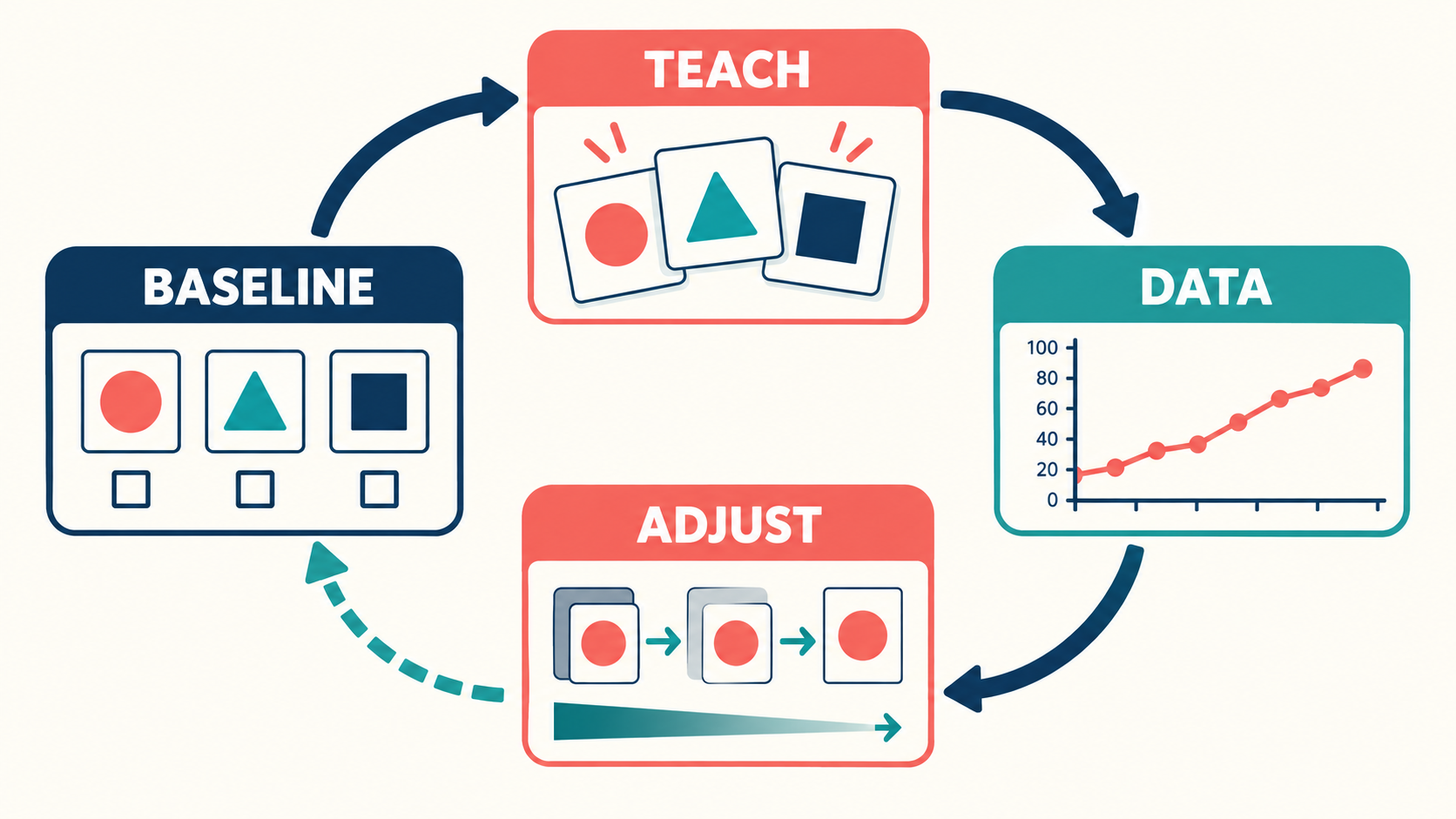
Data become useful when they answer a decision question. Before teaching starts, write down what different patterns would mean and what action each pattern would trigger. This prevents a team from changing several variables at once and then guessing why performance changed.
| Pattern in the data | Questions to check first | Possible plan review |
|---|---|---|
| Flat performance | Is the target defined? Are opportunities available? Is the measurement reliable? | Review prerequisite skills, materials, cue clarity, prompt level, and implementation fidelity. |
| Fast improvement only with prompts | Is the learner contacting reinforcement for independence, or only following assistance? | Review prompt fading, transfer to the natural cue, and the independence definition. |
| Strong clinic performance, weak daily-life performance | Are people, settings, materials, and cues too narrow? | Plan generalization probes and teach the skill in relevant routines with stakeholder input. |
Also check the quality of the data. If two trained observers disagree often, the problem may be the definition or recording system rather than the learner’s performance. If the teaching procedure changed midway, mark that change. If motivation, health, schedule, communication access, or environmental conditions changed, document it instead of hiding it inside a single percentage.
What Does a Fictional Sample Plan Look Like?
The following is a fictional teaching-plan sketch for study. It is not a clinical recommendation and does not prescribe a fixed mastery percentage.
| Field | Fictional example | What still needs individualization |
|---|---|---|
| Skill | Request help during a difficult classroom task using the learner’s established communication system. | The communication form, task, wording, access, and learner preference. |
| Opportunity | A planned routine includes a known challenge while help remains available. | The challenge must be safe, meaningful, and not manufactured solely to produce errors. |
| Data | Independent requests, prompted requests, no response, and relevant context are recorded per opportunity. | The recording form, observer training, review schedule, and privacy safeguards. |
| Next decision | Review the data with the team before changing prompts, tasks, or reinforcement. | The supervising professional sets the decision rule with stakeholder input. |
Notice what the sample does not do: it does not assume that one communication mode is superior, call refusal a failure, or set a universal criterion without context. A skill-acquisition plan should expand effective communication and participation, not force compliance at the expense of dignity or safety.
How Do You Plan for Generalization and Maintenance?
Generalization means the skill occurs with relevant changes in people, settings, materials, cues, or examples. Maintenance means it continues after teaching intensity or reinforcement arrangements change. Include both in the plan from the beginning rather than adding them after a target appears “mastered.”
- Vary examples and materials while keeping the defining features of the skill stable.
- Program practice with more than one trained person and in routines that matter to the learner.
- Test natural cues and natural consequences instead of relying only on therapist prompts.
- Schedule follow-up checks after a target meets its initial criterion.
- Ask stakeholders whether the skill is useful, acceptable, and actually happening outside sessions.
What Mistakes Weaken a Skill Acquisition Plan?
Common weaknesses are usually planning problems, not failures of the learner. Watch for these traps:
- Vague targets: “Improve independence” cannot be scored until the routine and response are defined.
- Teaching without baseline: Without a starting comparison, the team may mistake familiarity or prompt dependence for acquisition.
- Prompting without fading: A learner may perform only when the adult supplies the cue.
- Data without decisions: A graph is not a plan unless the team knows how it will guide instruction.
- No generalization check: Clinic performance may not transfer to home, school, work, or community routines.
- Copying a generic template: A form cannot replace assessment, assent, culturally responsive practice, or supervision.
How Should You Study Skill Acquisition Plans for the BCBA Exam?
On a BCBA question, first identify the target response and the measurement. Then ask what part of the plan the stem is testing: operational definition, baseline, prompting, reinforcement, error correction, measurement, mastery, generalization, or treatment integrity. Many distractors sound helpful but skip the decision rule or confuse prompted responding with independent acquisition. A compact study sequence is:
- Underline the antecedent or opportunity and the observable response.
- Identify whether the data measure independent performance, prompted performance, or both.
- Check whether the proposed change is tied to a pattern in the data.
- Look for prompt fading, generalization, maintenance, and stakeholder relevance.
- Reject answers that treat a generic template as a substitute for individualized assessment or current BACB requirements.
For extra practice, the free BCBA mock exam can provide study scenarios. It is not official BACB content, a clinical protocol, or a guarantee of passing.
Frequently Asked Questions
What is the most important part of a skill acquisition plan?: The most important part is the connection between a meaningful target, an observable definition, a fitting measurement system, and a clear decision process. A beautiful form is not useful if the team cannot tell what to teach or when to change it.
Can I use an ABA skill acquisition plan template for every learner?: Use a template as a reminder of fields, not as a ready-made intervention. Targets, communication methods, prompts, reinforcers, mastery rules, cultural context, safety, and stakeholder priorities must be individualized.
What is the difference between a skill acquisition plan and a behavior intervention plan?: A skill acquisition plan focuses on teaching a new or improved response. A behavior intervention plan may address behavior reduction and replacement behavior within a broader assessment and treatment process. One plan can reference the other, but the purposes are different.
Should a plan include prompt fading?: Usually, yes. If independence is the goal, the plan should explain how prompts will be transferred to natural cues and systematically reduced or changed. The exact fading method depends on the learner, target, and data.
How many sessions are needed to master a skill?: There is no universal number. Mastery should be defined with relevant people, materials, settings, response quality, and follow-up checks rather than a single arbitrary session count.
Sources for Further Study
- BACB Test Content Outlines and Task Lists — current certification-study scope.
- BACB Ethics Codes — current professional and client-protection requirements.
- BACB: About Behavior Analysis — official context for behavior-analytic practice.
- Mastering ABA: Skill Acquisition Programs — competitor reference reviewed for topic coverage and gaps.
- Passage Health: Skill Acquisition Plan in ABA — competitor reference reviewed for topic coverage and gaps.
Take the Free BCBA Mock Exam
If you want a low-pressure way to check your recall, use the free practice resource below. Take the Free BCBA Mock Exam



