

ABA teamwork is the coordinated behavior of professionals, caregivers, and learners who share meaningful goals, clarify responsibilities, exchange useful information, and adjust support from data. For a BCBA, teamwork is a clinical and professional skill—not just a pleasant attitude.
Table of Contents
- What Does ABA Teamwork Mean?
- Why Does Teamwork Matter in ABA?
- Who Is Part of an ABA Team?
- How Should a BCBA Set Shared Goals?
- What Does Effective ABA Teamwork Look Like?
- How Should an ABA Team Share Data?
- How Can a BCBA Handle Different Opinions?
- How Does Teamwork Protect Scope and Ethics?
- What Gets in the Way of ABA Teamwork?
- How Can You Improve ABA Teamwork in Practice?
- How Is ABA Teamwork Tested on the BCBA Exam?
- What Is the Bottom Line on ABA Teamwork?
- Quick Review Checklist
- Take the Free BCBA Mock Exam
Applied behavior analysis rarely happens in only one room or through only one person. A learner may practice communication with a speech-language pathologist, participate in academic routines with a teacher, work on daily living skills with a caregiver, and receive behavior-analytic assessment and coaching from a BCBA. If those people use unrelated goals, conflicting prompts, or different definitions of success, the learner experiences a fragmented plan.
Research on interprofessional practice describes collaboration as more than putting several disciplines in the same building. The team needs shared expectations, role clarity, communication routines, and a way to use data together. The current BACB ethics resources should guide professional boundaries and client welfare; the teamwork process should make those principles observable in day-to-day behavior.
What Does ABA Teamwork Mean?
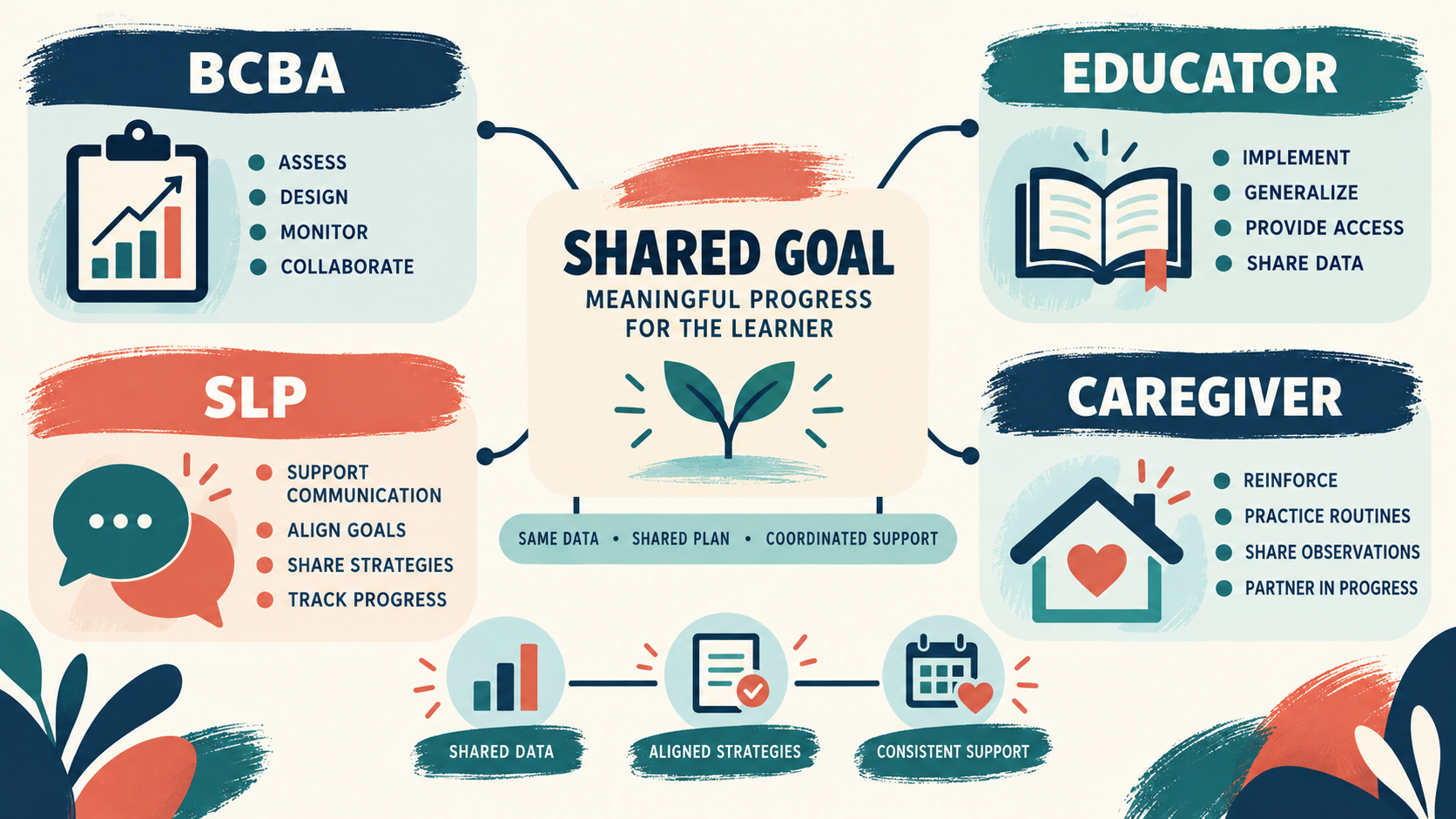
ABA teamwork means coordinating behavior-analytic goals and procedures with the people who have relevant expertise, access, responsibilities, or knowledge of the learner’s context. The team does not need to make every decision together. It does need to understand which decisions are shared, which are discipline-specific, who is responsible for implementation, and how the group will know whether the plan is helping.
Good teamwork is visible in small behaviors: using the same operational definition, asking a colleague for information before making an assumption, documenting a change, teaching an implementer to use a procedure, and bringing outcome data back to the team. It also includes listening when the learner or family reports that a goal is impractical, unwanted, or inconsistent with daily life.
Why Does Teamwork Matter in ABA?
Collaboration improves the chance that a goal is socially meaningful and can be used outside the training context. A behavior change that appears during one provider’s session may not generalize if the relevant materials, communication partners, reinforcement, or routines are absent elsewhere. Team members can identify those differences and plan for them instead of assuming that a lack of generalization reflects a learner deficit.
Teamwork also reduces contradictory contingencies. For example, one provider might prompt a communication response while another immediately speaks for the learner, or one adult might reinforce a request while another only responds to problem behavior. A respectful team conversation can identify the mismatch, test a consistent plan, and preserve each professional’s expertise.
Who Is Part of an ABA Team?
The exact team depends on the learner and setting. The table below describes common contributions without suggesting that one profession replaces another.
| Team member | Possible contribution | Boundary to clarify |
|---|---|---|
| BCBA | Behavior-analytic assessment, measurement, intervention design, training, and data-based review. | Do not present behavior analysis as a substitute for another discipline’s specialized evaluation. |
| Educator | Classroom routines, curriculum access, academic opportunities, and information about naturally occurring conditions. | Agree on what can be implemented within the classroom without adding an unrealistic burden. |
| Speech-language pathologist | Communication assessment, language goals, AAC expertise, and communication-partner strategies. | Coordinate behavioral supports with the communication plan rather than changing the language target casually. |
| Caregiver or learner | Preferences, routines, priorities, observations, consent, and information about whether goals matter in daily life. | Treat lived experience and communication about assent or refusal as meaningful information, not as an obstacle to ignore. |
How Should a BCBA Set Shared Goals?
Start with an outcome that matters in the learner’s actual environment. Ask what the learner will do, where the behavior should occur, who will benefit, and how the learner can communicate a preference, request, or need for a break. A goal such as “increase compliance” is too broad to coordinate well. A goal describing a functional communication response during a specific routine gives the team something observable to teach and measure.
Invite each relevant person to describe the current context. The teacher may know when academic demands become difficult, the SLP may know which communication form is accessible, and the caregiver may know what happens during mornings or community routines. The BCBA contributes behavior-analytic measurement and assessment, but the shared plan should reflect the whole context.
What Does Effective ABA Teamwork Look Like?
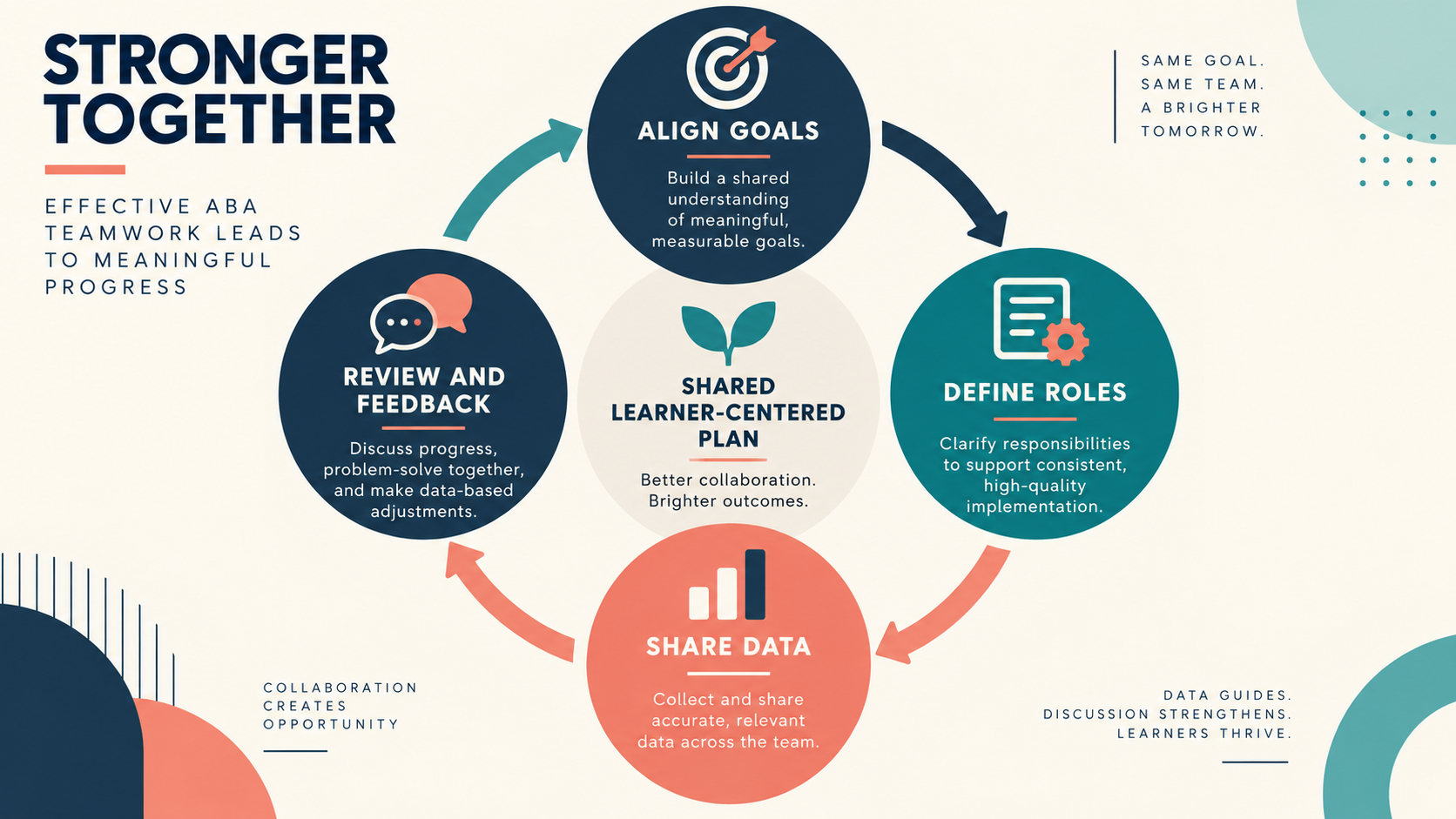
Effective ABA teamwork can be organized as a repeating loop: align goals, define roles, share data, and review feedback. The loop prevents a one-time meeting from becoming a plan that no one revisits. It also makes collaboration measurable. If the team says it will share data weekly, define what gets shared, who sends it, and what decision follows the review.
- Align goals: agree on a meaningful target and a definition of success.
- Define roles: identify who assesses, teaches, records, communicates, and reviews.
- Share data: exchange the smallest useful set of observations and outcome measures.
- Review feedback: ask what worked, what did not, and what the learner or family experienced.
How Should an ABA Team Share Data?
Share data that can answer a decision question. A team rarely needs every note from every session in every meeting. It may need frequency across settings, independent response levels, prompt levels, latency, duration, or a brief record of contextual changes. Define the measurement system so that the numbers mean the same thing to everyone.
Pair quantitative data with concise context. A graph may show that independent communication decreased, while a teacher explains that the learner’s AAC device was unavailable for two days. Context does not replace measurement; it helps the team interpret it responsibly. Protect privacy, use appropriate communication channels, and share only what the team needs for the agreed purpose.
How Can a BCBA Handle Different Opinions?
Disagreement is not automatically a teamwork failure. It can reveal different observations, values, or predictions that the team should make explicit. A BCBA can start by restating the shared outcome, asking what evidence supports each view, and separating a procedural question from a scope-of-practice question.
Use a small test when appropriate. Write the competing predictions, choose a respectful measure, define the time period, and agree on how the result will inform the next step. Do not turn the learner into a debate tool or run a procedure merely to prove a colleague wrong. If the disagreement concerns safety, consent, legal requirements, or professional competence, follow the applicable policy and ethics pathway rather than relying on an informal vote.
How Does Teamwork Protect Scope and Ethics?
Collaboration does not erase professional boundaries. A BCBA should communicate what behavior analysis can contribute, seek consultation when a decision falls outside current competence, and avoid directing another professional to practice outside that professional’s role. The same expectation applies in the other direction: team members should not ask the BCBA to make a medical, speech-language, or occupational determination that requires expertise the BCBA does not have.
Ethical teamwork also means documenting meaningful decisions, protecting confidential information, and responding to concerns about the learner’s welfare. The learner and family should have a voice in goals and implementation. A plan that is technically consistent but impossible, distressing, or irrelevant to the person’s priorities needs more discussion—not simply stricter enforcement.
What Gets in the Way of ABA Teamwork?
- Undefined ownership: everyone assumes someone else is collecting or reviewing the data.
- Jargon without translation: team members agree verbally but leave with different meanings.
- Conflicting reinforcement: people respond differently to the same communication or problem behavior.
- Meeting-only collaboration: the team talks about coordination but does not build a routine for follow-through.
- Role competition: one discipline treats another’s input as interference instead of information.
- Data without context: a number is interpreted without checking changes in access, staffing, materials, or routine.
How Can You Improve ABA Teamwork in Practice?
Choose a small collaboration behavior to improve first. A team might standardize one operational definition, use a shared one-page data summary, or add a five-minute end-of-session handoff. Make the behavior observable and review whether it improves consistency or decision speed.
- Write the shared learner-centered outcome in plain language.
- List each person’s contribution, decision authority, and communication route.
- Choose one or two measures that can reveal progress in the natural setting.
- Schedule a review point and decide what result would trigger an adjustment.
- Ask the learner and family what the plan feels like in daily life.
How Is ABA Teamwork Tested on the BCBA Exam?
On a BCBA exam question, teamwork may appear through a supervision scenario, an interdisciplinary disagreement, a caregiver concern, or a request that exceeds a professional role. Identify the client-centered objective first. Then look for the option that uses relevant expertise, communicates clearly, stays within competence, protects confidentiality, and bases the next decision on data rather than authority alone.
Be cautious with answers that sound collaborative but skip consent, documentation, or role boundaries. Also be cautious with answers that claim the BCBA must make every decision independently. Ethical collaboration is not the absence of leadership; it is leadership that makes the team’s expertise and responsibilities clearer.
What Is the Bottom Line on ABA Teamwork?
ABA teamwork is a coordinated set of behaviors: align meaningful goals, define roles, share useful data, invite feedback, and revise support with the learner’s welfare in view. When collaboration is treated as a measurable implementation skill, the team can improve consistency without flattening professional differences. For BCBA candidates, that distinction connects teamwork to assessment, behavior change, supervision, ethics, and generalization. For another structured BCBA practice session, you can try the free BCBA mock exam. Use practice results to identify reasoning gaps, and keep current BACB materials as the authority for certification and ethics requirements.
For targeted review, use our ABA teamwork practice questions to apply the concept in exam-style scenarios.
Quick Review Checklist
Use this final checklist to turn ABA teamwork into exam-ready reasoning. The goal is not to memorize a label in isolation; it is to identify the relevant evidence and explain why the best answer fits the scenario. Key ideas to review:
- State the central definition or decision point for ABA teamwork in your own words.
- Identify the detail that makes ABA teamwork different from its closest related ABA term.
- Separate the observable facts in a scenario from assumptions that are not supported by the facts.
- Write one example and one nonexample so you can recognize the concept in a new setting.
Exam application checks:
- Ask what the question is actually requesting before comparing the answer choices.
- Mark the antecedent, response, consequence, or other evidence that supports the selected answer.
- Look for a distractor that describes a related process but does not answer the specific question.
Final self-check:
- Explain how you would verify the interpretation with clear observations or data.
- Change one detail in the scenario and decide whether your answer should change.
- Give a one-sentence rationale that a supervisor or study partner could evaluate.
Take the Free BCBA Mock Exam
If you want a low-pressure way to check your recall, use the free practice resource below. Take the Free BCBA Mock Exam



