

Pivotal response training ABA is a naturalistic behavioral intervention that teaches pivotal behaviors—such as motivation, responding to multiple cues, self-initiation, and self-management—so improvements can spread to other skills and settings. It is structured, data-based teaching, not simply unplanned play.
Table of Contents
- What Is Pivotal Response Training ABA?
- What Are the Core Features of PRT?
- How Does a PRT Teaching Opportunity Work?
- How Does PRT Compare With DTT and NET?
- What Does the Evidence and Individualization Require?
- What Does the BCBA Exam Test?
- What Is the Bottom Line?
- Quick Review Checklist
- Take the Free BCBA Mock Exam
If you are asking what is pivotal response training ABA, start with the word “pivotal.” PRT does not try to teach only one isolated topography at a time. It targets a behavior that can influence many other responses. For example, improving motivation and learner choice may create more opportunities to communicate, persist, respond, and generalize skills.
The AFIRM Pivotal Response Training evidence brief describes PRT as an approach that integrates child development principles with applied behavior analysis. The learner’s interests and choices help arrange instruction, while the practitioner still defines the target, creates an opportunity, delivers a consequence, and records data. That balance is what separates PRT from an activity that is merely “fun” or “child-led.”
What Is Pivotal Response Training ABA?
PRT is a naturalistic intervention built around pivotal areas of behavior. A practitioner arranges motivating materials, offers meaningful choices, presents opportunities in a natural activity, and reinforces the learner’s response with a consequence related to that response. The exact teaching plan should be individualized to the learner, communication system, context, and socially meaningful outcome.
PRT can be used with children and adolescents and can address communication, play, social interaction, academic engagement, and related skills. “Naturalistic” does not mean that the adult waits passively for behavior. The adult engineers the environment, captures motivation, gives a clear opportunity, and responds contingently. The teaching is flexible in form but precise in its decision rules.
What Are the Core Features of PRT?
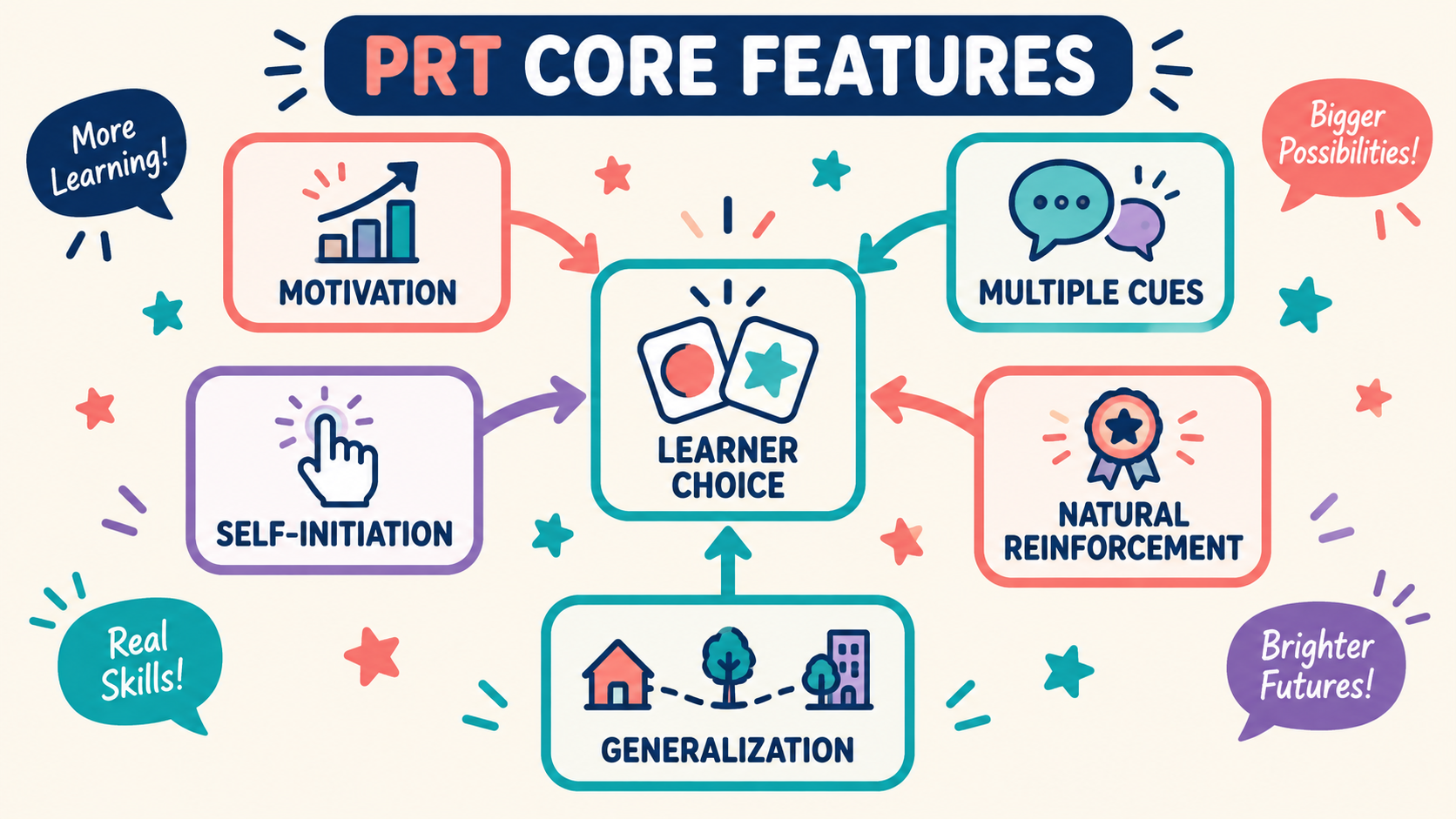
PRT programs vary by learner and goal, but several features are consistently associated with the approach. A practical summary is:
| Feature | What the practitioner does | What to observe |
|---|---|---|
| Motivation | Uses preferred materials, varied tasks, and a meaningful reason to respond. | The learner approaches, requests, persists, or shows an observable change in engagement. |
| Choice | Offers a genuine choice among materials, actions, or topics when appropriate. | The learner’s selection affects the next activity or consequence. |
| Multiple cues | Varies relevant people, materials, instructions, and examples. | The response occurs across cues rather than only with one memorized prompt. |
| Self-initiation | Creates opportunities for the learner to start communication or activity. | The learner initiates without waiting for a full adult prompt. |
| Natural reinforcement | Delivers an outcome connected to the response, such as access to the requested item. | The consequence is meaningful and follows the target response quickly. |
| Generalization | Plans practice across people, settings, materials, and examples. | The skill appears beyond the exact teaching arrangement. |
Choice must be real, not decorative. If the learner points to a toy but the adult always presents the same task, the selection did not meaningfully change the contingency. Likewise, natural reinforcement is not simply any praise delivered after a response. If a learner requests bubbles, access to bubbles is a more directly related consequence than an unrelated sticker, although additional consequences may be useful when carefully paired and individualized.
How Does a PRT Teaching Opportunity Work?
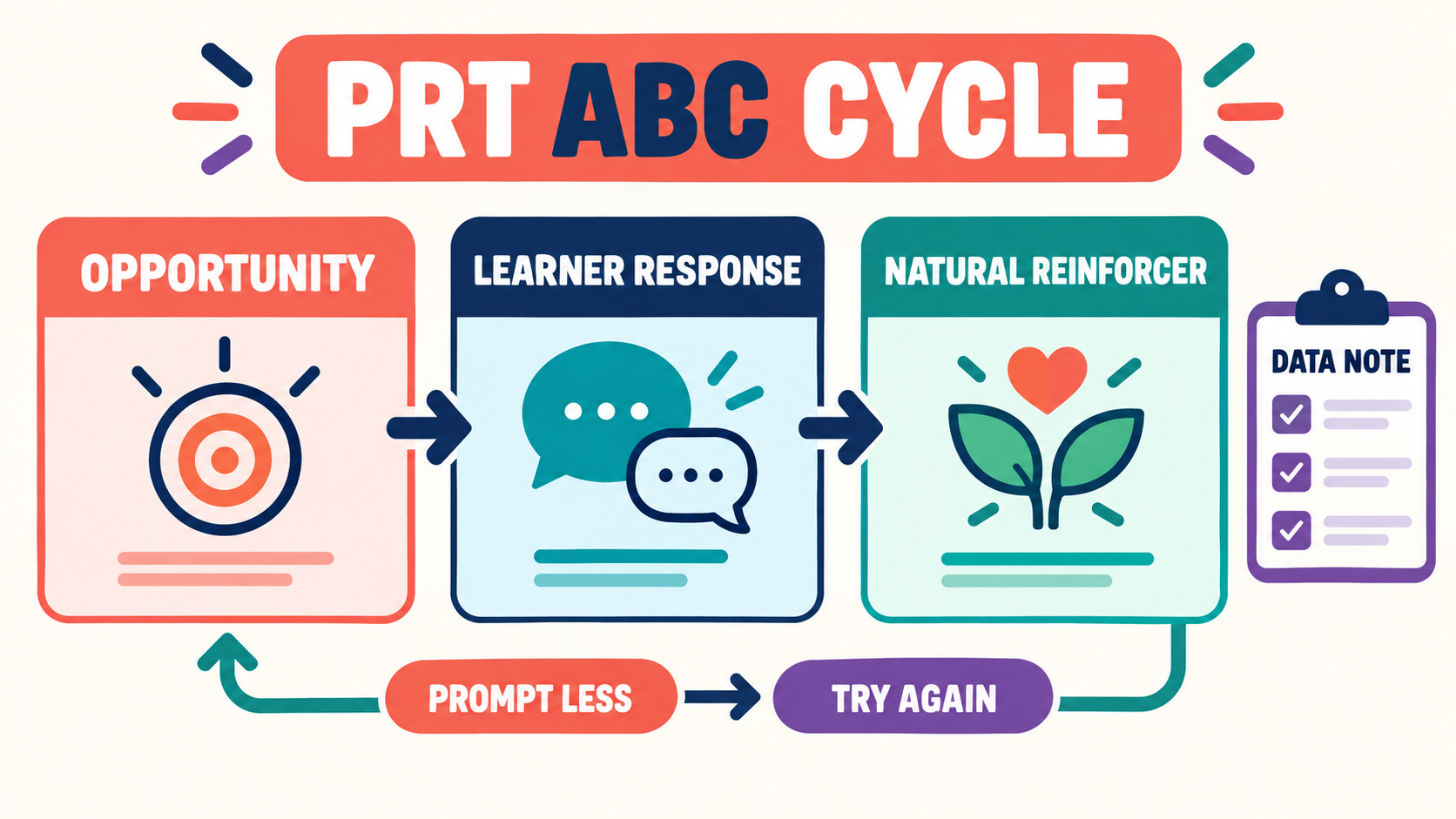
A simple PRT opportunity follows an ABC-like sequence:
- Arrange an opportunity: place a motivating item or activity in view, offer a choice, or pause at a natural point.
- Define the response: specify what counts, such as a spoken word, sign, picture exchange, device selection, approach, or other functional communication form.
- Prompt only as needed: use the least intrusive prompt that helps the learner contact the contingency, and record the prompt level if it matters to the goal.
- Reinforce the response: deliver the relevant item, action, or continuation promptly and contingently.
- Repeat and vary: create more opportunities while varying people, materials, and cues so the behavior is not tied to one exact arrangement.
Suppose a learner reaches toward a wind-up toy. The practitioner holds the toy, presents a choice between two toys, and waits for the learner’s communication response. If the target is selecting the “car” picture, the practitioner can prompt the selection when necessary, then immediately provide the car and activate it. The next trial may use a different toy, partner, or position. The data note should record whether the learner selected independently, needed a prompt, or did not respond.
PRT is not “reinforce everything.” The response requirement, prompt plan, and consequence should be clear enough that another trained practitioner can implement the opportunity. If the adult gives access before the learner responds, the arrangement may no longer test the target response. If the response requirement is too difficult, motivation can fall and the data may reflect an over-demanding plan rather than the learner’s skill.
How Does PRT Compare With DTT and NET?
PRT, discrete-trial teaching (DTT), and natural environment teaching (NET) can all be behavior analytic and can be combined in an individualized program. They are not three mutually exclusive “teams.” The distinction is the teaching arrangement and the behavior being targeted.
| Approach | Typical emphasis | Common exam distinction |
|---|---|---|
| PRT | Pivotal behaviors, motivation, choice, varied cues, self-initiation, and natural consequences. | A defined naturalistic package, not simply an informal play session. |
| DTT | Clearly separated trials, antecedent, response, consequence, and repeated practice. | Often more adult-led and trial-structured, although reinforcement and prompting remain individualized. |
| NET | Teaching functional skills in naturally occurring routines and activities. | A broad naturalistic teaching arrangement; PRT is a more specific intervention model. |
The wrong exam answer often treats a broad setting label as if it were a complete intervention. “Play-based” does not identify the target, contingency, prompting plan, or data system. Look for the component that makes the procedure recognizable: a pivotal target, learner motivation and choice, response-contingent natural reinforcement, and planned variation/generalization.
What Does the Evidence and Individualization Require?
The AFIRM brief reports an evidence base for PRT and includes implementation and data-collection materials. That does not mean every PRT procedure will work for every learner or that a positive outcome in one study guarantees an outcome in a new context. Select goals that matter to the learner and family, define measurable outcomes, monitor response and prompt data, and adjust the plan when progress stalls.
The BACB Test Content Outline connects reinforcement, motivating operations, generalization, maintenance, treatment integrity, and evidence-informed practice. A PRT plan should reflect the same logic. Ask whether the choice is meaningful, whether the reinforcer is actually effective, whether the learner can use the skill with another person, and whether the procedure creates unwanted dependence on a specific toy or prompt.
Also coordinate communication goals with the relevant professionals and caregivers. The ASHA/NJC resource on ABA and communication services emphasizes the importance of collaborative, individualized communication support. PRT should expand functional communication and participation, not force one mode of responding or remove a learner’s effective communication system.
What Does the BCBA Exam Test?
- Pivotal is not vague: identify the target behavior and explain why changing it may affect other behaviors.
- Naturalistic is still planned: the practitioner arranges motivation, defines the response, and delivers a contingent consequence.
- Choice must change the contingency: a decorative choice that does not affect the activity is not a meaningful choice.
- Natural reinforcement is response-related: the consequence should connect to what the learner did when possible.
- Generalization must be planned: vary people, cues, materials, and contexts rather than assuming transfer.
- Collect data: record independence, prompt level, initiation, response quality, and generalization when those dimensions matter.
What Is the Bottom Line?
Pivotal response training ABA is a structured naturalistic approach that uses motivation, choice, multiple cues, self-initiation, natural reinforcement, and planned generalization to influence pivotal behavior. It is not a synonym for free play. Define the target, arrange a real opportunity, reinforce the learner’s response, vary the context, and use data to decide whether the skill is improving and transferring. For more practice with reinforcement, generalization, and intervention-design questions, try the free BCBA mock exam.
For targeted review, use our what is pivotal response training ABA practice questions to apply the concept in exam-style scenarios.
Quick Review Checklist
Use this final checklist to turn what is pivotal response training ABA into exam-ready reasoning. The goal is not to memorize a label in isolation; it is to identify the relevant evidence and explain why the best answer fits the scenario. Key ideas to review:
- State the central definition or decision point for what is pivotal response training ABA in your own words.
- Identify the detail that makes what is pivotal response training ABA different from its closest related ABA term.
- Separate the observable facts in a scenario from assumptions that are not supported by the facts.
- Write one example and one nonexample so you can recognize the concept in a new setting.
Exam application checks:
- Ask what the question is actually requesting before comparing the answer choices.
- Mark the antecedent, response, consequence, or other evidence that supports the selected answer.
- Look for a distractor that describes a related process but does not answer the specific question.
Final self-check:
- Explain how you would verify the interpretation with clear observations or data.
- Change one detail in the scenario and decide whether your answer should change.
- Give a one-sentence rationale that a supervisor or study partner could evaluate.
Take the Free BCBA Mock Exam
If you want a low-pressure way to check your recall, use the free practice resource below. Take the Free BCBA Mock Exam



