
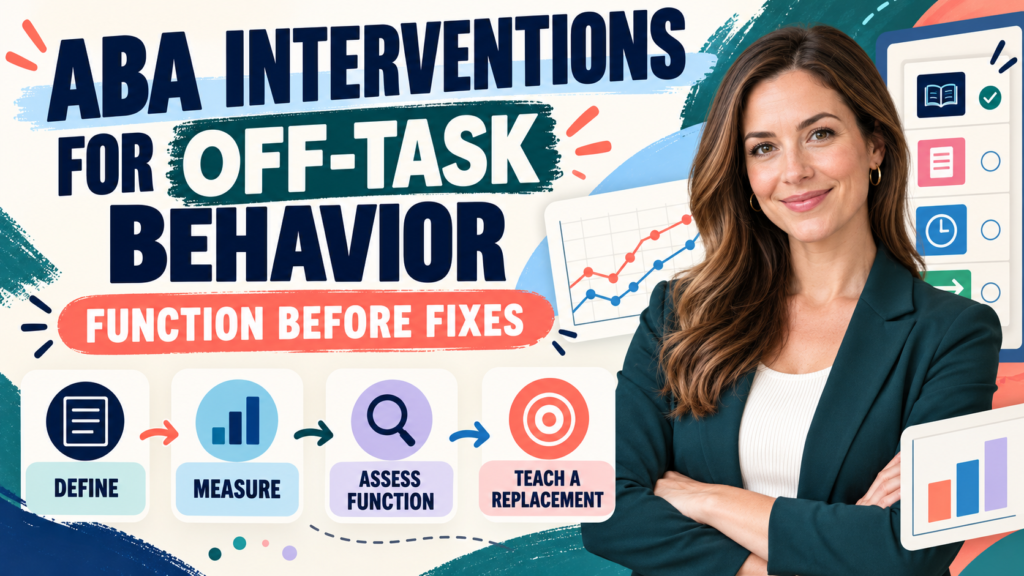
ABA interventions for off task behavior should begin with a precise definition and a quick look at what happens before and after disengagement. “Off task” is not one universal topography or function. A learner may look away because the task is too difficult, seek adult attention, escape an aversive demand, need a sensory break, or lack a teachable way to request help. The best BCBA exam answer matches the intervention to the assessment rather than choosing a favorite strategy.
Table of Contents
- What Counts as Off-Task Behavior in ABA?
- How Should Off-Task Behavior Be Measured?
- Why Does Function Matter?
- What Are Common ABA Interventions for Off Task Behavior?
- How Do You Match an Intervention to the Function?
- How Do You Evaluate Whether It Worked?
- What Are the BCBA Exam Traps?
- ABA Interventions for Off-Task Behavior FAQ
- Take the Free BCBA Mock Exam
This study guide explains how to define off-task behavior, select function-based supports, measure change, and avoid common exam traps. It is educational content, not a treatment plan. Real services require qualified assessment, client assent, individualized goals, safety planning, and ongoing review of socially meaningful outcomes. Table of Contents
What Counts as Off-Task Behavior in ABA?
In ABA, off-task behavior is a measurement label, not a diagnosis. It usually describes behavior that is not directed toward the current instructional or work requirement for a defined period. Examples might include looking away from the assigned materials, talking about unrelated topics, playing with an unrelated object, leaving the work area, or pausing without beginning the next response. A strong definition names what an observer can see and hear instead of using a judgment such as “unmotivated” or “not trying.”
The context matters. Looking away for two seconds while checking a visual schedule may be part of task engagement, whereas looking away for 10 consecutive seconds after an instruction might meet a program’s operational definition. The definition should also state when the behavior starts and stops. Without those boundaries, two observers may record different behavior while believing they are measuring the same thing.
Before selecting ABA interventions for off-task behavior, ask what skill the learner is expected to perform. If the task is reading, “on task” might mean orienting to the text, responding to a comprehension item, or using an approved help response. If the task is a vocational routine, the relevant behavior may be completing the next step, checking a schedule, or requesting clarification. The intervention should increase meaningful participation, not simply force a particular posture or eye gaze.
How Should Off-Task Behavior Be Measured?
Measurement gives the team a way to distinguish a real change from a good-looking session. The measure should fit the behavior and the question. Frequency may be useful when off-task episodes are brief and countable. Duration can be useful when one episode continues for several minutes. Partial-interval or momentary time sampling can estimate the percentage of intervals with off-task behavior during classroom or group instruction, but the sampling rule must be stated clearly.
Record enough context to interpret the data. A simple observation form might include the task, difficulty, materials, instructor, peers present, antecedent, observable response, consequence, prompt level, and whether the learner used an alternative response. If the goal is to increase engagement, collect a compatible measure of on-task behavior rather than reporting only the absence of off-task behavior. A learner can stop looking away because they are staring at the worksheet without responding; the outcome still needs interpretation.
- Define the response: describe the topography, duration threshold, start, stop, and examples and nonexamples.
- Choose a sensitive measure: use frequency, duration, latency, interval recording, or a skill-acquisition measure that matches the question.
- Sample across contexts: compare tasks, times, instructors, settings, and levels of difficulty when those variables may matter.
- Check agreement and integrity: use observer agreement when appropriate and record whether the planned intervention was implemented as written.
For BCBA exam questions, measurement is often the first clue. If the stem gives a clear definition and says the learner is off task during difficult writing assignments, do not jump directly to a generic reward system. First identify the pattern and the likely maintaining consequence.
Why Does Function Matter?
Off-task behavior can look similar while serving different functions. A learner who talks to peers to obtain attention needs a different plan from a learner who leaves the table to delay difficult work. A learner who repeatedly manipulates materials may be accessing automatic sensory consequences, while another learner may be avoiding a task because prerequisite skills are missing. Functional assessment helps the BCBA decide what to teach, change, or reinforce.
School-based evidence illustrates why this distinction matters. Function-based interventions may use interviews, record review, direct observation, and experimental or descriptive assessment to identify whether attention, escape, or another consequence is related to off-task responding. The What Works Clearinghouse study summary describes FBA-based intervention components that differed across students because their observed patterns differed. That is a useful exam principle: the same label does not guarantee the same function.
| Pattern to investigate | Possible relation | Study direction |
|---|---|---|
| More off-task behavior when work becomes difficult | Escape or delay may be involved; skill deficits may also contribute. | Teach help or break requesting, adjust task demands, and reinforce task engagement according to the plan. |
| Off-task talk increases when an adult or peer responds | Attention may be reinforcing the behavior. | Teach an appropriate attention or interaction response and reinforce it while arranging instruction for success. |
| Engagement changes with materials or sensory conditions | Automatic or stimulus variables may affect responding. | Review the environment and teach a practical alternative without assuming a function from appearance alone. |
What Are Common ABA Interventions for Off Task Behavior?
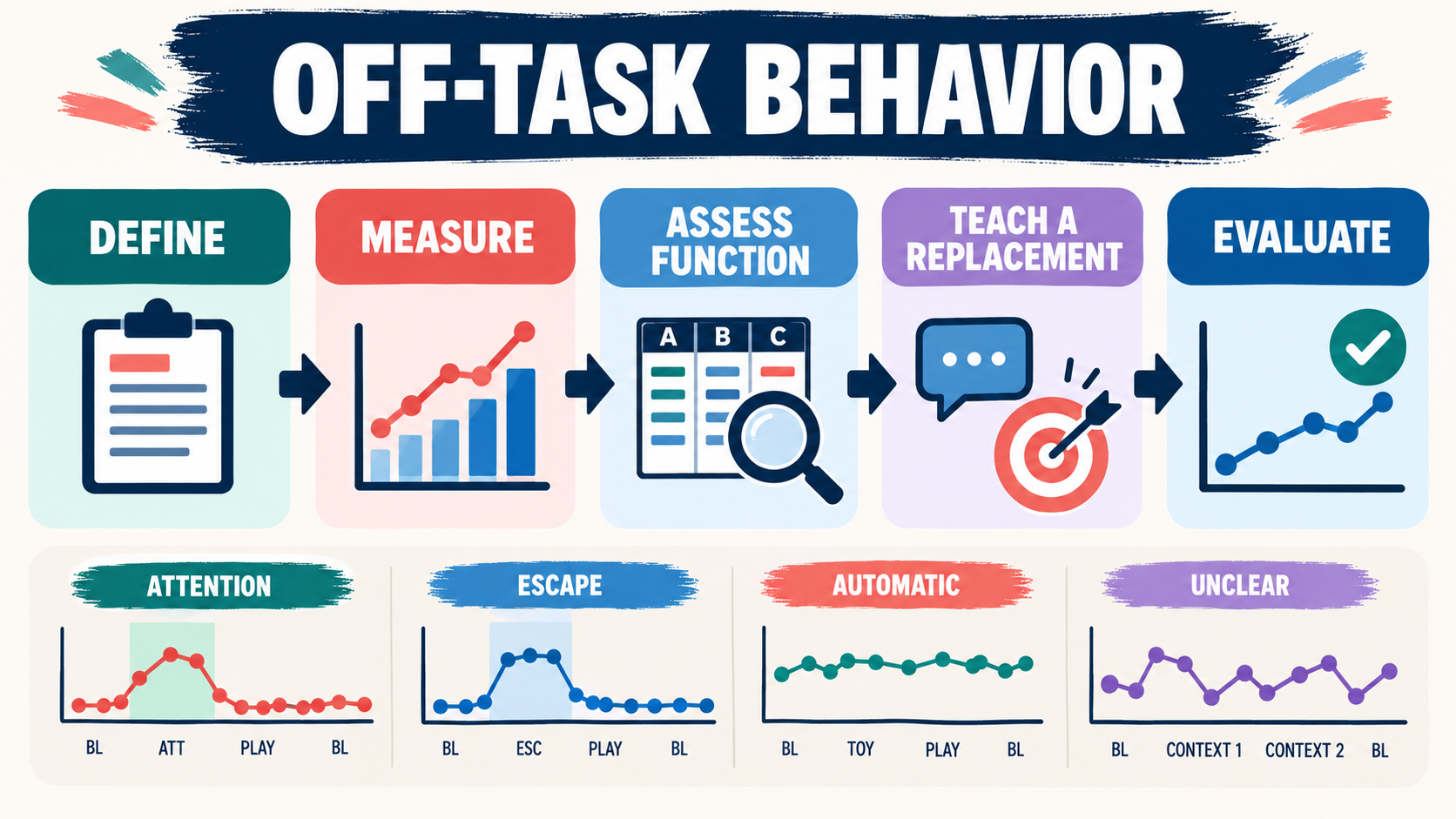
There is no single “best” off-task intervention. Function-based plans often combine antecedent supports, skill teaching, reinforcement, and data-based adjustment. The intervention should be as minimally intrusive as possible while still effective, and the learner should have a meaningful way to communicate difficulty, ask for help, or request a break when appropriate.
Antecedent supports can make the expected response clearer and more achievable. Examples include breaking a long assignment into smaller units, using a visual schedule, offering a choice between equivalent tasks, arranging materials before instruction, adjusting task difficulty, providing a model, or previewing the response requirement. These supports are not bribes; they change the conditions under which learning occurs. Their use still needs to be evaluated against the learner’s goals and preferences.
Reinforcement and differential reinforcement can increase on-task behavior or a replacement response. A plan may reinforce completed work, appropriate help requests, or a specified period of engagement. The criterion should be observable and gradually adjusted only when the learner is successful. Reinforcement should not depend on suppressing communication or tolerating distress. It should support independence, participation, and access to meaningful outcomes.
Skill acquisition and self-management are often more durable than repeated correction. Teach the learner how to check a task list, use a timer or visual cue, request clarification, mark completed steps, or self-record on-task intervals when those skills are appropriate. Prompt the replacement skill according to the written plan, then fade prompts so the natural task cues and reinforcers control responding. Prompt dependency is a possible side effect when fading is ignored.
Instructional and environmental changes may include shorter response requirements, interspersing mastered and new items, increasing opportunities to respond, arranging active supervision, or changing the location when distractions are relevant. These are hypotheses to test, not universal prescriptions. If a strategy works only with one adult or one worksheet, the team should assess generalization rather than declaring the problem solved.
How Do You Match an Intervention to the Function?
Use a simple decision sequence. First, identify the observable behavior and the relevant context. Second, examine what reliably happens before and after it. Third, state a tentative functional hypothesis in measurable language. Fourth, teach or arrange a replacement response that produces an appropriate version of the same outcome when feasible. Finally, measure both the target behavior and the replacement so that a decrease is not mistaken for improvement if communication or participation also declines.
- If escape is suspected: teach help or break communication, adjust the task to the learner’s current repertoire, reinforce returning or completing an agreed step, and avoid making the replacement less efficient than disengagement.
- If attention is suspected: arrange appropriate attention bids, teach an acceptable interaction response, reinforce it quickly, and define how adult attention will be delivered consistently.
- If the learner lacks a prerequisite skill: use task analysis, modeling, prompting, error correction, and reinforcement to teach the missing response instead of labeling the learner as defiant.
- If the pattern is unclear: improve the definition and measurement, gather more descriptive data, consult qualified supervision, and avoid selecting a function based only on topography.
Ethics and assent belong in the decision. A technically efficient plan can still be poor practice if it ignores communication, dignity, cultural variables, or the learner’s ability to indicate discomfort. The current BACB Ethics Code information is the appropriate place to verify current professional obligations; a study article should not replace supervision or a case-specific review.
How Do You Evaluate Whether It Worked?
Graph the selected measure across baseline, intervention, and follow-up when the design permits. Look for changes in level, trend, variability, and consistency, but also ask whether the replacement skill increased and whether the result generalized to the setting that matters. A plan that reduces off-task behavior only by increasing prompts may not be a durable success. A plan that produces slightly slower work but much more independent communication may be more socially meaningful.
Review treatment integrity before changing the hypothesis. Were the task modifications delivered? Was reinforcement available when the replacement occurred? Were prompts delivered and faded as written? Did the observation system change? If the data are unclear, collect better information rather than adding more procedures at random. The BACB Test Content Outline is a useful anchor for studying measurement, assessment, intervention, and data interpretation as connected tasks.
What Are the BCBA Exam Traps?
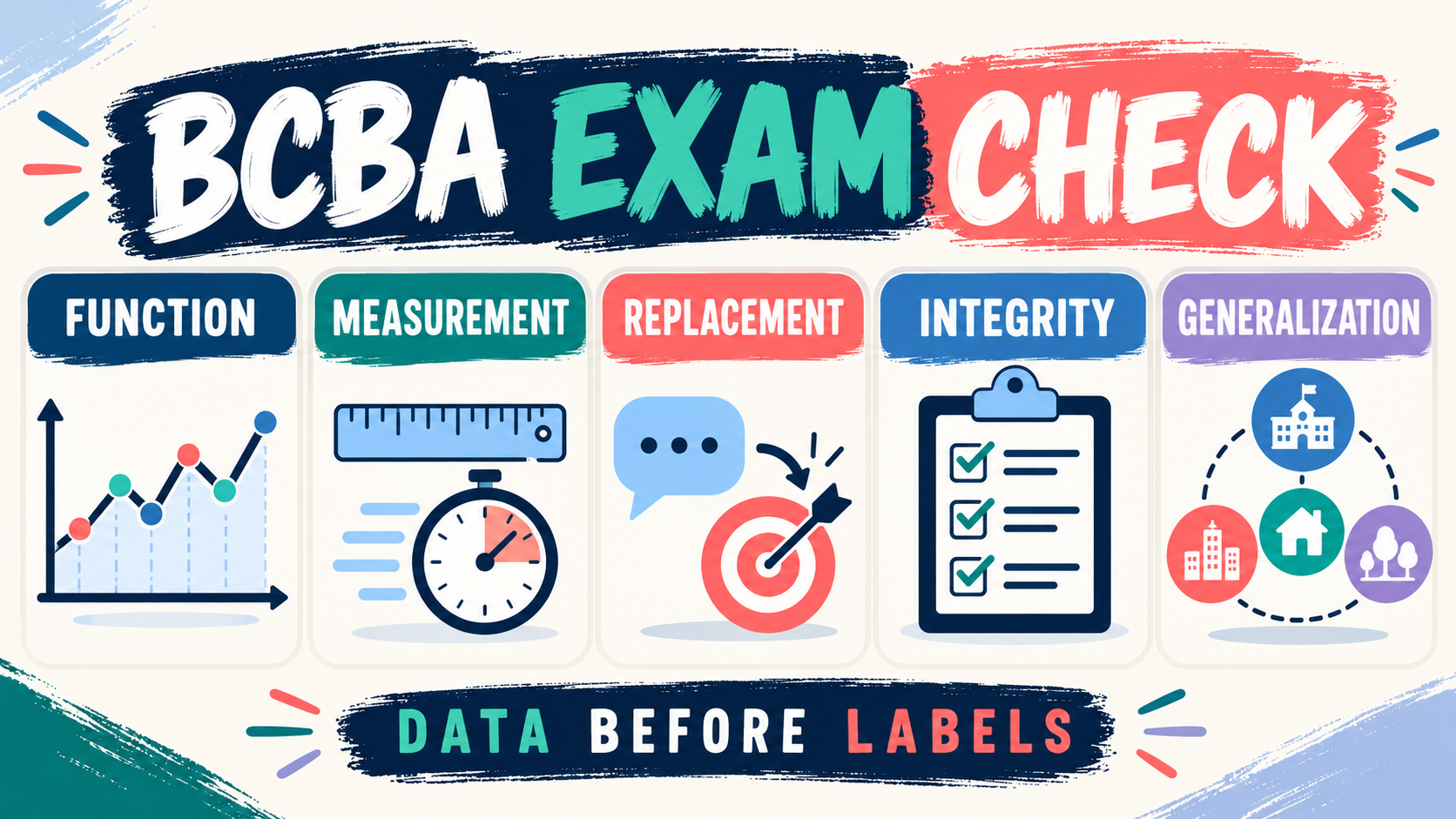
When a question asks about ABA interventions for off-task behavior, read the function and measurement details before choosing an answer. Common traps include:
- Using punishment first: the strongest answer usually begins with assessment, antecedent support, skill teaching, and reinforcement of an appropriate alternative.
- Assuming all off-task behavior is escape: the same topography can be maintained by attention, automatic variables, task difficulty, or a missing skill.
- Defining a private judgment: “not motivated” or “lazy” is not an operational definition.
- Ignoring communication: removing every break or help request can suppress a valid replacement rather than improve participation.
- Measuring only compliance: examine independence, engagement, task accuracy, communication, and generalization.
The exam-ready answer is usually the one that is specific, function-based, measurable, least intrusive, and responsive to the learner’s context. If the stem does not provide enough evidence for a functional conclusion, acknowledge the uncertainty and select the assessment step that would clarify it.
ABA Interventions for Off-Task Behavior FAQ
What is the first step before choosing an ABA intervention for off-task behavior?: Define the behavior in observable terms and collect information about when it occurs, what happens before it, and what follows it. Without a clear target and context, an intervention cannot be matched or evaluated reliably.
What is a function-based intervention for off-task behavior?: It is a plan selected because assessment suggests a relationship between the behavior and its consequences or setting events. It teaches or reinforces an appropriate response that addresses the same practical need when possible.
Should a BCBA always use a token system for off-task behavior?: No. A token system may be useful for some learners and goals, but it is not automatically function based. The BCBA should consider the learner’s preferences, the response effort, the reinforcer, the data, and whether a simpler natural consequence would support independence.
How do you know whether the intervention worked?: Use a measure that reflects the goal, review level and trend across relevant conditions, check treatment integrity, monitor the replacement response, and assess generalization and maintenance. A short-term decrease alone is not enough. For additional scenario practice, try the free ABA interventions for off task behavior BCBA mock exam. It is independent study support, not official BACB material. The central idea is simple: define off-task behavior precisely, identify the relation that maintains it, teach an effective alternative, reinforce meaningful engagement, and let the data—not the label—guide the next decision.
Take the Free BCBA Mock Exam
If you want a low-pressure way to check your recall, use the free practice resource below. Take the Free BCBA Mock Exam



