
Is ABA psychotherapy? Usually, no—not as a blanket label. Applied behavior analysis (ABA) is a broad behavior-analytic field, while psychotherapy is a psychological treatment term. But the categories can overlap: the Behavior Analyst Certification Board (BACB) recognizes clinical behavior analysis as an ABA subspecialty that may address depression, anxiety, stress, relationship concerns, substance misuse, and other problems traditionally described as mental disorders.
Table of Contents
- Is ABA Psychotherapy? The Short Answer
- What Does Psychotherapy Usually Mean?
- What Does ABA Mean?
- Where Does Clinical Behavior Analysis Fit?
- Why Do People Call ABA a Therapy?
- What Boundaries Matter for a BCBA?
- What Ethical Questions Should Be Asked?
- How Does This Show Up on the BCBA Exam?
- ABA and Psychotherapy Checklist
- Quick Review Checklist
- Take the Free BCBA Mock Exam
That is why the most accurate answer has several parts. ABA is not automatically psychotherapy, and a BCBA credential is not automatically a psychotherapy license. At the same time, a qualified behavior analyst may practice in a clinical area when the work is behavior analytic, the person has the required competence and authorization, and the service follows applicable law, ethics, consent, and referral requirements. This article explains the terminology for families, students, and BCBA candidates. It is educational information—not a diagnosis, treatment recommendation, licensing opinion, or substitute for checking the rules in a specific state or country. Table of Contents
Is ABA Psychotherapy? The Short Answer
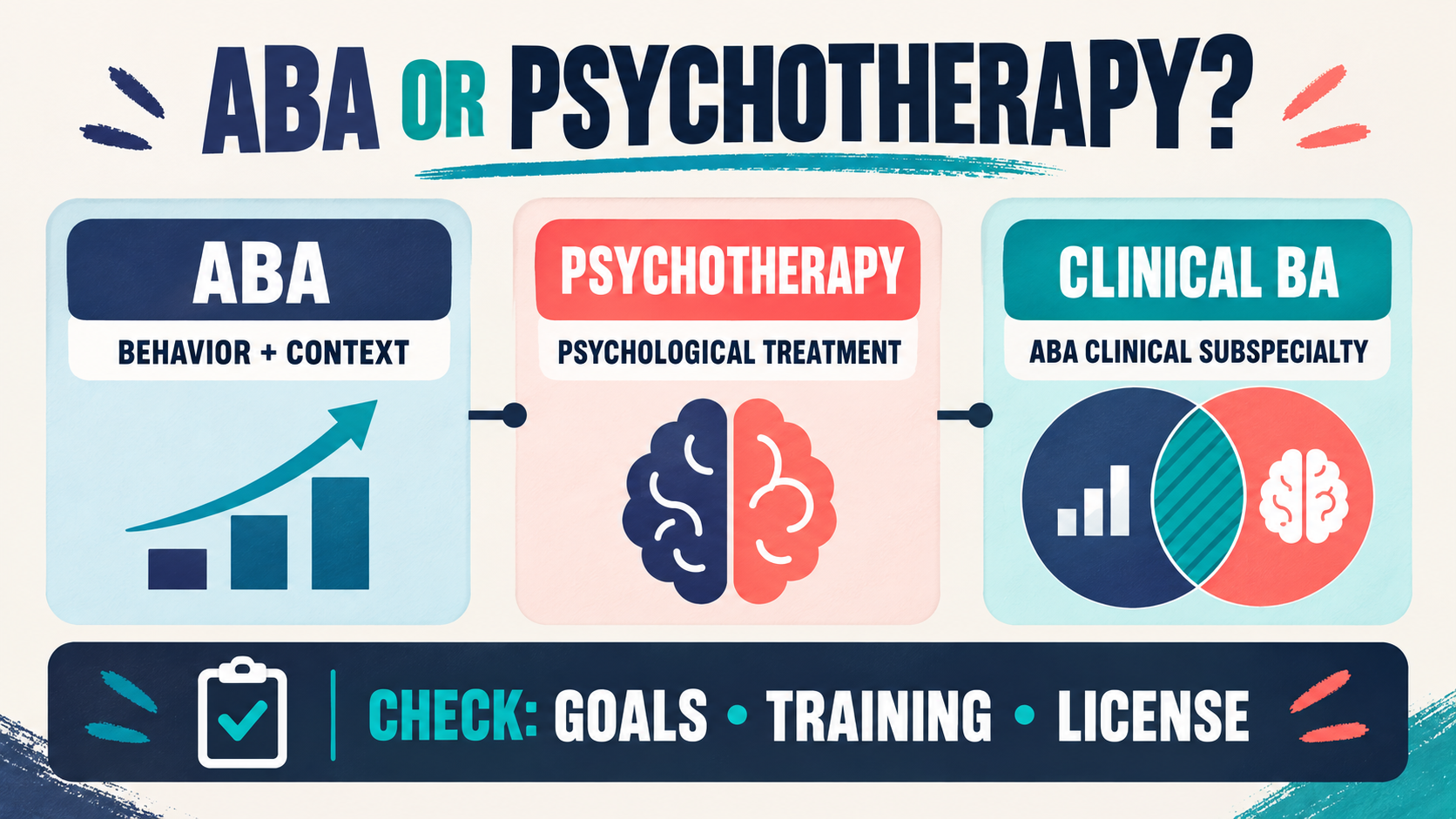
The safest short answer is: ABA and psychotherapy are related in some applications, but they are not interchangeable labels. “ABA” names a science and professional approach centered on behavior and the environmental variables that influence it. “Psychotherapy” usually names a psychological treatment relationship in which a trained professional helps a person address emotional, behavioral, or mental-health concerns. There are three reasons a simple yes or no becomes misleading:
- The same behavioral principle can appear in different professions. Behavioral methods may be used by a psychologist, counselor, psychiatrist, social worker, or behavior analyst. The method alone does not establish the provider’s profession or legal scope.
- ABA is a large field. A behavior-analytic service might focus on communication, daily living, education, workplace performance, safety, health behavior, or mental health. Those goals and settings are not identical.
- Licensure is local. Whether a person may advertise or deliver psychotherapy depends on jurisdiction, credential, training, employer rules, and the service being provided—not simply on the word “therapy” in a job title.
So, if someone asks whether a particular service is psychotherapy, ask what the provider is trained and licensed to do, what the stated goals are, which procedures are being used, and how the service is regulated. Calling every ABA service psychotherapy is too broad; insisting that no clinical behavior-analytic work can ever be therapy is also too broad.
What Does Psychotherapy Usually Mean?
The American Psychological Association’s Dictionary of Psychology describes psychotherapy as a psychological service provided by a trained professional that uses communication and interaction to assess, diagnose, and treat dysfunctional emotional reactions, ways of thinking, and behavior patterns. The APA also presents psychotherapy as a collaborative treatment based on the relationship between a person and a psychologist, with dialogue and validated procedures playing important roles.
These descriptions do not mean every psychotherapy session looks the same. Psychotherapy may be individual, family, couple, or group based. It may include cognitive, behavioral, interpersonal, humanistic, psychodynamic, acceptance-based, or integrative methods. It may also include behavioral interventions. The word is broad, but it still points to a psychological treatment service with its own training, professional, and jurisdictional context.
For searchers, the practical takeaway is to separate technique from professional service. Reinforcement, exposure, behavioral activation, skills practice, and functional assessment can appear in more than one discipline. A technique does not tell you whether the provider is practicing psychotherapy, behavior analysis, or another regulated service.
What Does ABA Mean?
The BACB describes behavior analysis as a science concerned with behavior and the circumstances in which behavior occurs. Applied behavior analysis uses behavior-analytic principles and procedures to improve meaningful behavior in real-world contexts. Depending on the setting, that may involve assessment, teaching, caregiver or staff training, environmental arrangement, data collection, and evaluation of behavior-change procedures.
“ABA” therefore does not identify one diagnosis, one age group, one service intensity, or one set of goals. A behavior analyst may work in education, health, organizational behavior management, public health, developmental disability services, or clinical behavior analysis. The correct question is not simply “Is this ABA?” but “What behavior-analytic service is being provided, by whom, for which goal, under which safeguards?”
The BACB also notes that, for its certifications and examinations, ABA is defined through the content of the BCBA, BCaBA, and RBT Task Lists. That exam definition is useful for studying, but it should not be mistaken for a universal legal definition of psychotherapy in every jurisdiction.
Where Does Clinical Behavior Analysis Fit?
Clinical behavior analysis is the clearest bridge between the two terms. The BACB identifies it as an ABA subspecialty applying behavior-analytic tools to problems traditionally characterized as mental disorders. Its fact sheet names areas such as depression, anxiety, stress, relationship discord, substance misuse, sleep disturbance, and chronic pain, and lists approaches including behavioral activation, acceptance and commitment therapy, contingency management, dialectical behavior therapy, and functional analytic psychotherapy.
This does not make every ABA provider a psychotherapist, nor does it make the two fields identical. It means that behavior analysis can have a clinical mental-health application. A practitioner working in that area needs relevant training, competence, supervision or consultation when needed, informed consent, and compliance with the laws and professional rules that apply where the service is delivered.
It is also important to distinguish clinical behavior analysis from the phrase ABA therapy as it is used in everyday marketing. A family may see “ABA therapy” on a clinic website and still need to ask which professional is responsible, what the service includes, whether it is behavior analytic, whether mental-health treatment is being claimed, and which license or payer rules govern it.
Why Do People Call ABA a Therapy?
“Therapy” is an everyday word for help intended to improve functioning. It is not always a precise credential or scope statement. Clinics may use “ABA therapy” to describe structured behavior-analytic services; a psychologist may use “behavior therapy” within psychotherapy; and a clinical behavior analyst may deliver a behavioral treatment in a mental-health setting. The shared word does not erase the professional differences.
| Question | ABA / behavior analysis | Psychotherapy |
|---|---|---|
| Primary frame | Behavior, context, learning history, and consequences. | Psychological treatment through a professional therapeutic relationship and selected clinical methods. |
| Possible goals | Communication, adaptive skills, participation, safety, health behavior, organizational performance, or clinical concerns. | Emotional distress, mental-health symptoms, coping, relationships, behavior patterns, and quality of life. |
| What determines scope? | Training, competence, certification, licensure, setting, consent, and applicable rules. | Professional training, license, clinical competence, treatment purpose, and applicable rules. |
| Can methods overlap? | Yes. Some behavioral methods are used in clinical behavior analysis and psychotherapy. | Yes. Behavioral techniques can be part of cognitive-behavioral or other psychological treatments. |
The table is a map, not a replacement for checking a provider’s credentials. A “yes” in the methods column does not answer the licensing question.
What Boundaries Matter for a BCBA?
A BCBA should begin with competence and the actual service, not with a marketing label. The Ethics Code for Behavior Analysts requires behavior analysts to work within their education, training, and experience, protect client welfare, obtain informed consent, and take appropriate action when a case exceeds their competence. It also matters whether local law requires a separate mental-health or psychotherapy license. In practice, boundary questions include:
- What is the referral question? Is the person asking for behavior-analytic skill teaching, psychotherapy, diagnostic assessment, medication advice, crisis care, or something else?
- What is the provider qualified to do? A BCBA credential supports behavior-analytic practice; it does not by itself establish authority to diagnose or provide every kind of mental-health treatment.
- What does the plan promise? The provider should describe goals, methods, limits, risks, alternatives, and who will handle needs outside the provider’s scope.
- When is referral needed? A client may need collaboration with a licensed psychologist, psychiatrist, physician, counselor, speech-language pathologist, occupational therapist, or another professional.
- Does the service stay behavior analytic? The BACB handbook distinguishes behavior-analytic fieldwork from nonbehavioral interventions. The same discipline should be clear about which activities are actually being provided and supervised.
These are not arguments against clinical behavior analysis. They are safeguards against false equivalence and scope drift. A provider can be highly skilled and still need consultation or referral for a different clinical question.
What Ethical Questions Should Be Asked?
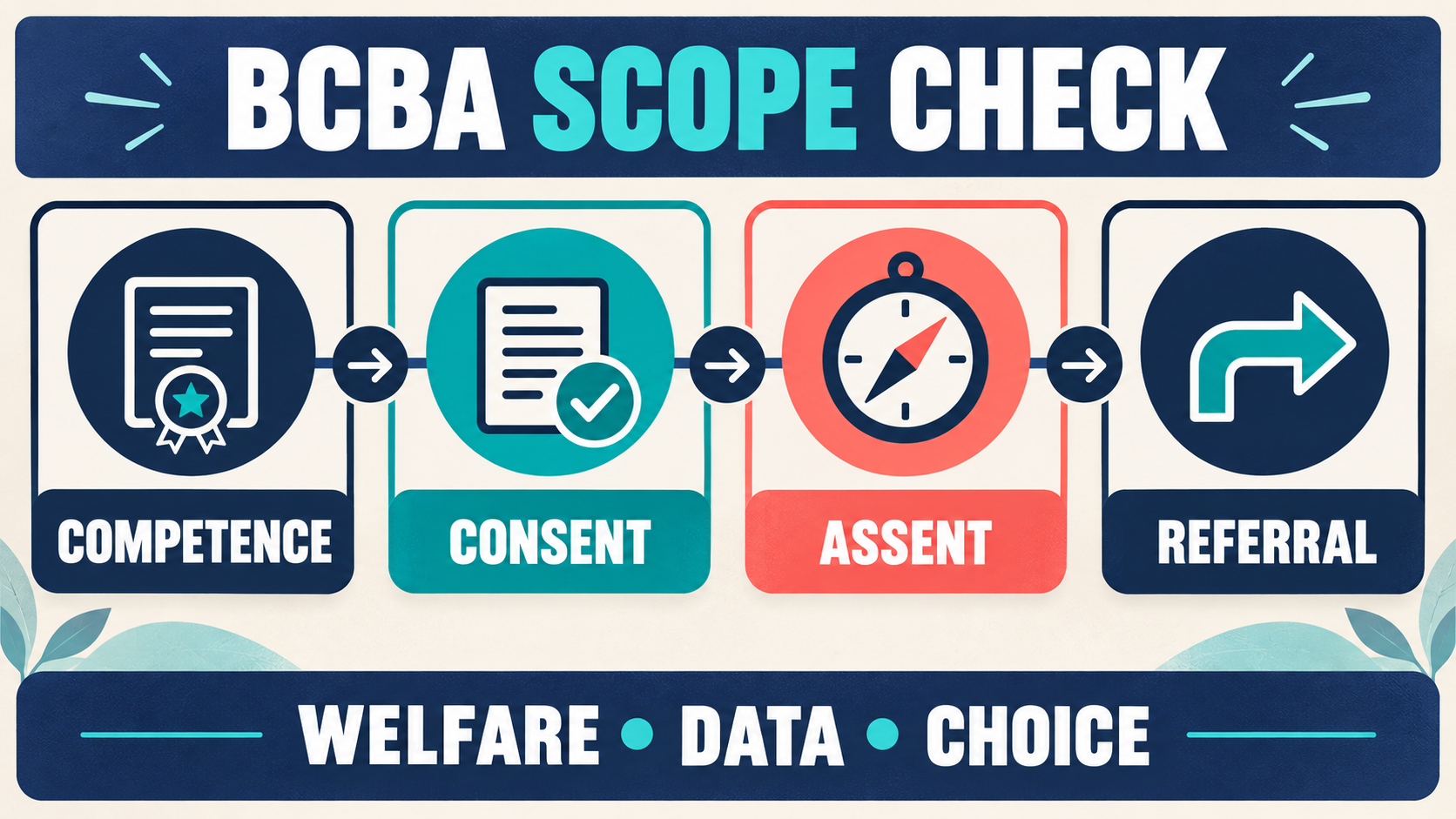
The label matters less than whether the service is understandable, voluntary where possible, competent, and beneficial to the person. Before starting or continuing a service, ask:
- What outcome does the person want? A socially significant goal should not be selected only because it makes other people more comfortable.
- How will consent and assent work? The person or legally authorized decision-maker should understand the purpose, procedures, likely benefits, risks, alternatives, privacy limits, and right to ask questions. When a person cannot provide legal consent, meaningful assent and signals of refusal still matter.
- How will progress and harm be monitored? Data should be paired with the person’s experience, preferences, and feedback. A higher response count is not automatically a better quality of life.
- What happens if the service is not helping? The team should explain how it will review the plan, reduce risk, seek consultation, change goals, or make a referral.
- Is the language accurate? A website should not imply that a credential, method, or outcome guarantees psychotherapy, diagnosis, or a particular result.
These questions reflect both sides of the distinction: behavior analysis has its own ethical obligations, and psychotherapy has its own professional and legal context. The person receiving services should not have to decode a vague “therapy” label to learn what is actually happening.
How Does This Show Up on the BCBA Exam?
The BCBA exam may not ask “Is ABA psychotherapy?” as a vocabulary question. It can test the underlying reasoning through a scenario about competence, referral, informed consent, risk, public statements, assessment, or legal requirements. The BCBA Test Content Outline is the controlling exam reference, so use the exact current outline when studying. When a question mixes ABA with mental-health language, use this sequence:
- Identify the service being requested and the person’s actual need.
- Ask whether the behavior analyst has the competence and authorization to provide that service.
- Check consent, assent, client welfare, confidentiality, and cultural responsiveness.
- Choose consultation or referral when the need exceeds the analyst’s scope.
- Use precise public language; do not overstate credentials, outcomes, or what ABA can do.
For additional scenario practice, the free BCBA mock exam can be used as a study aid. It is not official BACB guidance and does not replace supervised experience, coursework, or professional consultation.
ABA and Psychotherapy Checklist
When someone asks, “is ABA psychotherapy?”, check the specific service rather than the slogan:
- Is the provider describing ABA, clinical behavior analysis, psychotherapy, or a combination?
- What credential, license, training, and jurisdictional authority does the provider have?
- What goals, procedures, risks, alternatives, and outcomes are written in the plan?
- How can the person consent, assent, refuse, pause, or request a change?
- What data and lived-experience feedback will determine whether the service is helping?
- When will the provider consult or refer to another professional?
- Does the public description avoid promising a diagnosis, cure, or guaranteed result?
The cleanest conclusion is this: ABA is not automatically psychotherapy, but clinical behavior analysis shows that behavior analysis can be used in clinical mental-health contexts. The deciding factors are the actual service, the provider’s competence and authorization, the person’s informed participation, and the rules that govern practice where the service occurs.
Quick Review Checklist
Use this final checklist to turn is aba psychotherapy into exam-ready reasoning. The goal is not to memorize a label in isolation; it is to identify the relevant evidence and explain why the best answer fits the scenario. Key ideas to review:
- State the central definition or decision point for is aba psychotherapy in your own words.
- Identify the detail that makes is aba psychotherapy different from its closest related ABA term.
- Separate the observable facts in a scenario from assumptions that are not supported by the facts.
- Write one example and one nonexample so you can recognize the concept in a new setting.
Exam application checks:
- Ask what the question is actually requesting before comparing the answer choices.
- Mark the antecedent, response, consequence, or other evidence that supports the selected answer.
- Look for a distractor that describes a related process but does not answer the specific question.
Final self-check:
- Explain how you would verify the interpretation with clear observations or data.
- Change one detail in the scenario and decide whether your answer should change.
- Give a one-sentence rationale that a supervisor or study partner could evaluate.
Take the Free BCBA Mock Exam
If you want a low-pressure way to check your recall, use the free practice resource below. Take the Free BCBA Mock Exam



