

Repeated acquisition design ABA is a way to study learning across new but comparable skill sets without relying on a treatment withdrawal. Instead of returning to the same target again and again, the analyst repeatedly measures acquisition of different sets under planned conditions.
Table of Contents
- What Is Repeated Acquisition Design ABA?
- How Does the Procedure Work?
- Why Use RAD for Skill Acquisition?
- How Do You Choose Equivalent Skill Sets?
- What Data Should You Collect?
- How Do You Read a Repeated Acquisition Graph?
- What Threats to Interpretation Matter?
- How Is RAD Different From Other Single-Case Designs?
- What Does the BCBA Exam Test?
- What Is the Bottom Line?
- Take the Free BCBA Mock Exam
Repeated acquisition design ABA, often shortened to RAD, is a single-case arrangement built around rapid learning of new, discrete skills or response sequences. The central idea is simple: teach or expose a learner to one set of targets, measure performance with a defined pre- or post-intervention probe, and repeat the process with another comparable set. The design can be useful when the target is expected to be learned, maintained, or changed in a way that would make withdrawing an effective intervention a poor fit.
The BCBA Test Content Outline places experimental design, measurement, and data-based decisions in a broader behavior-analytic framework. For an exam question, identify what is repeated, what is measured, and what alternative explanations remain before deciding what a graph demonstrates.
What Is Repeated Acquisition Design ABA?
A repeated acquisition design teaches or evaluates multiple sets of equivalent targets over repeated cycles. A set might contain unfamiliar words, academic items, motor sequences, listener responses, or steps in a behavioral chain. The learner is assessed on a defined set, receives the planned instructional procedure, and is then assessed again. A later cycle uses another set that is intended to be comparable in difficulty and response requirements.
RAD is not merely “doing many trials.” The design needs a planned sequence, repeated measurement, and a rationale for why the target sets can be compared. If the first set contains easy items and the next set contains much harder items, a lower score in the second cycle may reflect target difficulty rather than the intervention. The repeated-acquisition literature describes equivalent discrete skill sets and comparable pre- and post-intervention probes as core features.
How Does the Procedure Work?
Begin by defining the skill, the target sets, the probe timing, and the intervention. For example, a team could prepare several sets of unfamiliar vocabulary words. On the first probe, the observer measures correct responses before instruction. The teacher then provides a consistent teaching package for a scheduled period. On the post-probe, the observer presents the same set under the same scoring rule. The next cycle repeats the structure with a new set.
The procedure may be organized by session, day, week, or another interval that fits the instructional context. The interval is not the defining feature; comparability is. Keep the opportunity count, materials, response definition, prompt rules, consequence rules, and probe conditions as stable as possible. If one cycle includes extensive prompting and another does not, the data no longer answer one clean question.
| RAD element | What to define | Why it matters |
|---|---|---|
| Target sets | Number, difficulty, and response form | Supports meaningful comparison across cycles |
| Probe | When and how each target is tested | Protects the denominator and timing |
| Instruction | Procedure, prompts, reinforcement, and duration | Makes the intervention reproducible |
| Outcome | Accuracy, errors, latency, or trials to criterion | Connects the graph to the decision |
Why Use RAD for Skill Acquisition?
Repeated acquisition can be a good match when the behavior is not easily reversible. Once a learner acquires a word, chain, or discrimination, withdrawing instruction does not reliably return the learner to the earlier state. A traditional reversal may therefore be impractical or ethically uncomfortable. RAD offers repeated opportunities to evaluate learning across new targets while keeping the intervention available.
The design can also be sensitive to quick changes in rate or accuracy. If each new set begins at a low baseline and improves after teaching, the pattern may show that the procedure supports acquisition. It can also reveal whether learning slows as targets become more difficult, whether errors cluster at a particular step, or whether a new instructional variation changes the speed of acquisition.
- Use RAD when targets are new: the cycle should represent acquisition, not a repeated test of already mastered material.
- Use repeated probes: each set needs a consistent way to show performance before and after the planned instruction.
- Protect target equivalence: compare sets that are similar in response effort, difficulty, and scoring demands.
- Match the outcome to the question: accuracy may fit one question, while errors to criterion or learning rate fits another.
How Do You Choose Equivalent Skill Sets?
Equivalent does not mean identical. Two sets can contain different items while still having similar response requirements, number of targets, stimulus features, and expected difficulty. Document how the sets were selected. If a vocabulary set contains common words and another contains rare words, the sets may not be comparable even if both contain ten items.
Consider the learner’s history and exposure. A target that appears unfamiliar to the clinician may already be known to the learner. Pre-probes can help identify floor performance, but a pre-probe itself can also become a learning event. Use the same instructions and scoring rules across sets, and record whether the learner had prior contact with the materials.
For a chain, sets might be different but functionally comparable sequences. For academic tasks, sets might contain equal numbers of problems with similar operations. For communication targets, the team might compare opportunities that require the same response form but different exemplars. The purpose is not to create artificial perfection; it is to reduce obvious target-set confounds so the interpretation is grounded.
What Data Should You Collect?
Choose a dependent variable that reflects the learning decision. Percentage correct is easy to understand when each set has the same number of opportunities. Errors per trial may be more sensitive when errors are rare. Trials to criterion or time to acquisition may show efficiency, but they require a clearly stated mastery rule. If prompting is part of instruction, record prompt level separately so a correct response is not mistaken for an independent response.
Keep the data sheet close to the procedure. Record the set identifier, probe date, number of opportunities, response outcome, prompt, and any deviation that could change interpretation. Do not silently omit a difficult trial, substitute a material, or add a correction opportunity without documenting it. A small context note can protect a graph from being overread later.
- Set identifier: label the target set so the graph does not collapse different learning histories together.
- Probe condition: note the timing, materials, instructions, and available prompts.
- Response outcome: distinguish independent, prompted, incorrect, and no-response outcomes when relevant.
- Integrity note: record interruptions, material changes, or procedural deviations before interpreting the trend.
How Do You Read a Repeated Acquisition Graph?
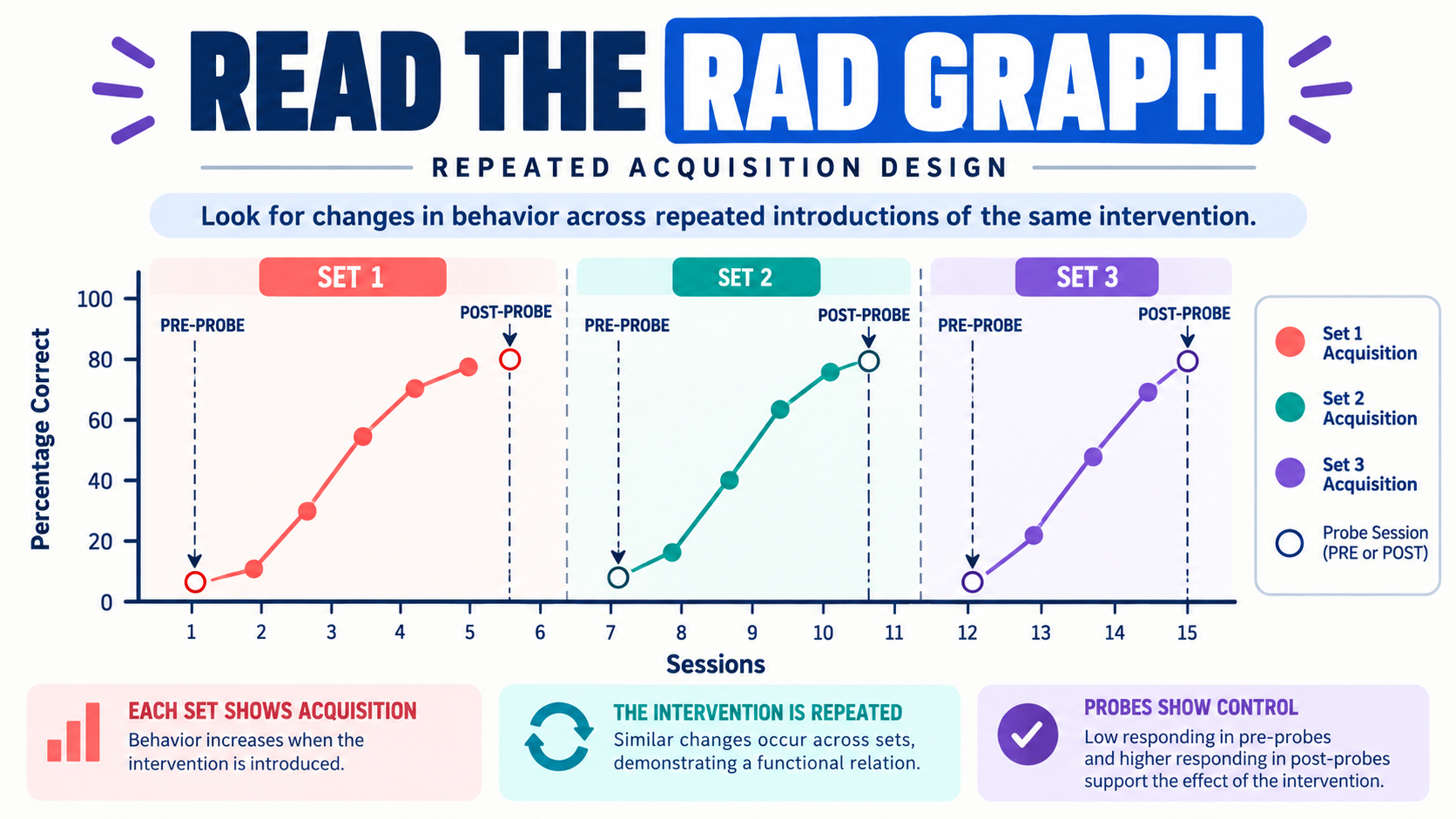
Start by identifying the unit of repetition. Each connected pre-to-post pair may represent one target set or one acquisition cycle. Ask whether the pre-probe scores are similar enough to compare and whether improvement appears after the intervention in more than one set. A graph that shows one dramatic improvement and several flat cycles does not support the same conclusion as a graph showing a repeated pattern.
Next, inspect level, trend, variability, and immediacy. Is the post-probe change large enough to matter? Does it occur within the expected instructional interval? Do later sets improve at a similar rate, or does the learner require more teaching each time? A steep line can be visually impressive but still misleading if the sets differ in difficulty or the y-axis changes between panels.
Do not read RAD as a single ABAB graph. The repeated units may be new target sets, and the key question is whether the same instructional relation is reproduced across those sets. A useful graph labels the set, phase or probe, number of opportunities, outcome measure, and any intervention change.
What Threats to Interpretation Matter?
Repeated acquisition designs have distinctive threats. Pretest effects can occur when the initial probe exposes the learner to the target and makes later responding easier. History or maturation can affect performance across a long series of cycles. Target-set inequivalence can make one intervention appear stronger simply because one set was easier. Practice, fatigue, changing motivation, and observer drift can also influence the pattern.
Reduce these threats with consistent probe procedures, carefully selected target sets, treatment-integrity checks, and transparent notes. The RAD research literature also emphasizes that design quality is not automatic; the analyst must show why the repeated cycles support the inference. If the data do not rule out plausible alternatives, describe the result as suggestive rather than definitive.
Client welfare remains central. A research arrangement should not delay useful instruction or create unnecessary frustration simply to make a graph cleaner. The BACB Ethics Code provides the professional context for selecting procedures that respect the learner and the responsibilities of the practitioner.
How Is RAD Different From Other Single-Case Designs?
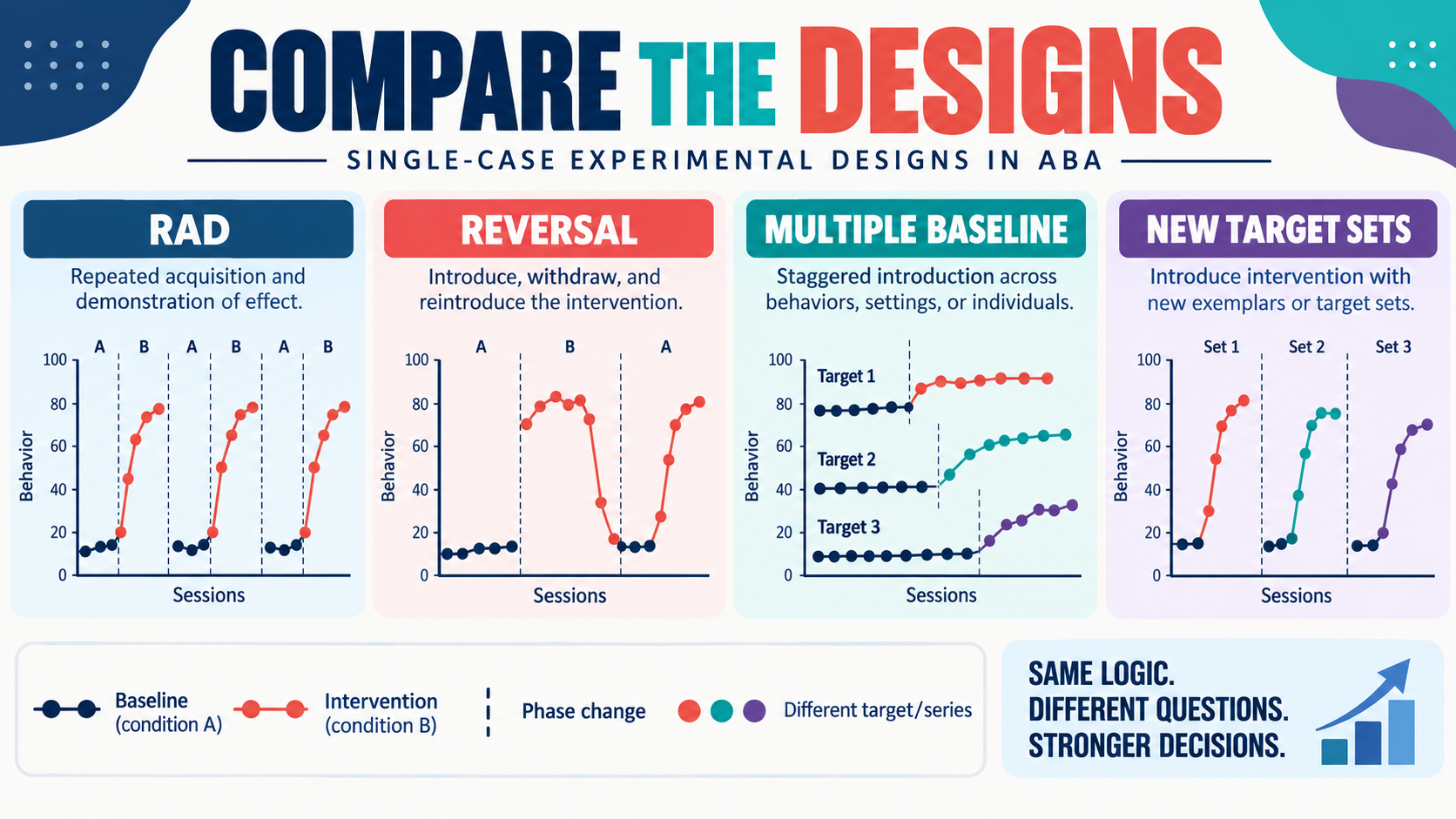
A reversal design repeatedly introduces and withdraws a condition. A multiple-baseline design staggers the intervention across behaviors, people, or settings. An alternating-treatments design rapidly compares conditions. Repeated acquisition design ABA instead repeats the acquisition test across comparable target sets, which makes it attractive when the learned behavior is not reversible or when the question concerns learning rate across new material.
The names can overlap in casual study notes, so focus on the logic. Ask whether the same target is being returned to, whether conditions are alternating, whether treatment is staggered, or whether new equivalent targets are repeatedly probed. Then identify the evidence for a functional relation and the limits of the inference.
| Design | What repeats | Common reason to choose it |
|---|---|---|
| Reversal | Conditions with the same target | Test a reversible relation |
| Multiple baseline | Staggered intervention starts | Avoid withdrawing a beneficial procedure |
| Repeated acquisition | New but comparable skill sets | Study learning of nonreversible targets |
What Does the BCBA Exam Test?
- Recognize the unit: RAD repeats acquisition cycles across target sets, not necessarily the same target.
- Look for equivalent sets: different materials must still be comparable enough to support interpretation.
- Track the denominator: percentages require a stable and visible number of opportunities.
- Separate prompting from independence: a prompted correct response may not represent independent acquisition.
- Expect validity cautions: pretest effects, maturation, history, and target difficulty can change the graph.
- Choose ethics over elegance: a clean design never justifies withholding necessary instruction.
What Is the Bottom Line?
Repeated acquisition design ABA uses planned, repeated measurement of new but comparable skill sets to study how learning occurs. Define the targets, keep probe conditions stable, record prompts and deviations, graph each cycle clearly, and inspect the threats that could explain the pattern. For more practice with single-case design and measurement questions, try the free BCBA mock exam. It is a study resource, not a substitute for individualized supervision, consent, or clinical judgment.
For targeted review, use our repeated acquisition design ABA practice questions to apply the concept in exam-style scenarios.
Take the Free BCBA Mock Exam
When you are ready to apply the idea, use the free practice resource below for additional feedback. Take the Free BCBA Mock Exam



