
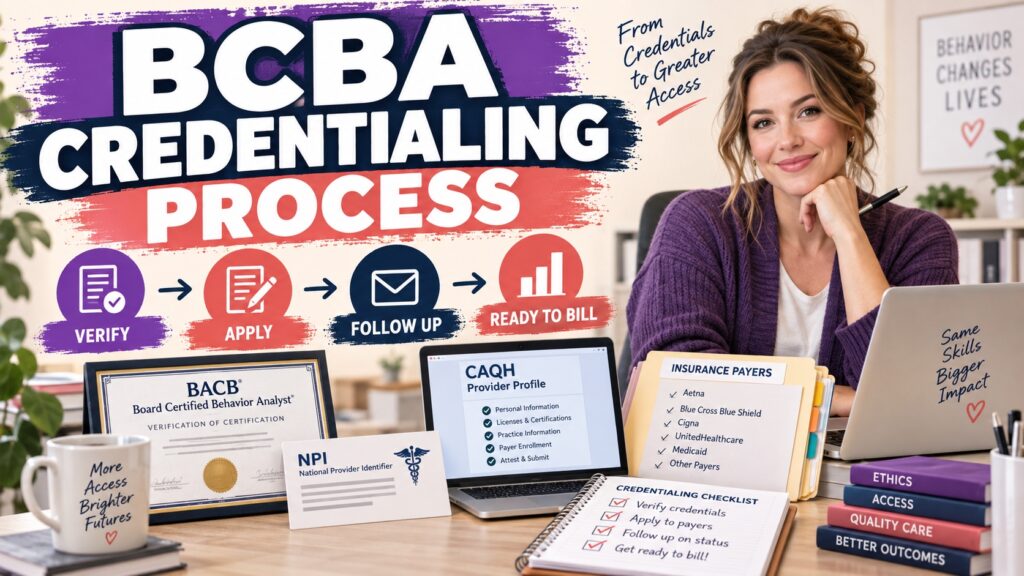
If you are looking for the bcba credentialing process, you are probably asking a payer, clinic, or employer to recognize you as an eligible provider. That is different from earning BCBA certification. The Behavior Analyst Certification Board (BACB) verifies the national credential, a state board may issue a behavior-analyst license, and an insurance plan decides whether you are enrolled or in network for its own billing system.
Table of Contents
- bcba credentialing process: what is the short answer?
- What Is The Difference Between Certification, Licensure, Credentialing, And Enrollment?
- What Should I Complete Before Credentialing?
- Which Documents Should A BCBA Prepare?
- How Does CAQH Fit Into The Process?
- What Happens After The Payer Packet Is Submitted?
- How Can I Track Applications Without Losing The Effective Date?
- Which Status Means I Can Actually Bill?
- What Should BCBAs Recheck For 2027?
- When Does BCBA Exam Practice Belong In The Plan?
- Which Mistakes Cause Delays?
- BCBA Credentialing Process FAQ
- What Should You Do Today?
- Take the Free BCBA Mock Exam
A practical sequence is: confirm BACB certification, confirm the state license that applies to the service location, obtain or update your NPI, complete the current CAQH provider profile when the payer uses it, submit each payer’s enrollment or contracting packet, and wait for written confirmation of the effective date. A completed profile is not the same as an approved payer relationship, and an NPI does not prove that you are licensed or credentialed.
This guide is current-source planning information, not payer-specific legal or billing advice. Payers, Medicaid programs, employer groups, and states can ask for different documents. Use the live payer instructions and your compliance or credentialing contact before billing a client. Table of Contents
bcba credentialing process: what is the short answer?
Credentialing is the payer or organization review that checks whether a provider is qualified and eligible to participate. For an individual BCBA, the process usually has six practical stages:
- Verify current BACB certification and any state behavior-analyst license required where services will be delivered.
- Confirm the correct individual and organization identifiers, including NPI and tax information.
- Complete and maintain a CAQH Provider Data Portal profile when the target payer uses CAQH or its current platform.
- Submit the payer’s provider enrollment, contracting, or network application.
- Answer follow-up questions and provide direct verifications or missing documents.
- Wait for written confirmation of network status and the effective date before treating the payer as active.
The BACB certification verification page says its Certificant Registry is the primary quick source for verifying certification status and reportable disciplinary actions. It also offers verification letters for situations such as employment, funding, or licensure. That verification supports credentialing, but it is only one part of the payer packet.
What Is The Difference Between Certification, Licensure, Credentialing, And Enrollment?
These terms are often used together, but they describe different decisions:
- Certification: BACB recognition that you met the national BCBA eligibility and examination requirements and maintain the credential.
- Licensure: state authorization to practice or use a regulated behavior-analyst title in a particular jurisdiction.
- Credentialing: a payer or organization verifies your qualifications, history, license, and risk information.
- Enrollment: the administrative step that places you in a payer’s billing or provider system.
- Contracting: the agreement that sets network participation, rates, service terms, or group affiliation.
A payer may perform credentialing and enrollment together, or it may send them to different departments. A clinic may credential you under its group contract while the payer still needs your individual NPI and license information. Ask which status you are being told about: application received, credentialing approved, contract signed, rostered, enrollment effective, or directory-listed.
CMS NPI guidance makes the boundary explicit: an NPI identifies a health care provider, but issuance does not ensure or validate that the provider is licensed or credentialed. Treat the NPI as an identifier, not as permission to bill.
What Should I Complete Before Credentialing?
Credentialing is smoother when the professional foundation is already stable. Before opening a payer application, confirm the items that are most likely to create a hard stop:
- your BACB certification is active and the name matches your application;
- the state license or other practice authorization is current for the client and service location;
- your legal name, address, email, and phone number are consistent across documents;
- your individual NPI is active and your taxonomy information is accurate;
- your group or organization NPI, tax ID, and legal entity information are available when applicable;
- your professional liability coverage meets the payer or employer requirement;
- your CV, work history, education, and supervision or practice dates are complete;
- you know whether the application is for an individual, a group, or both.
Do not create a second NPI simply because you joined another clinic. Ask the organization or payer which individual and group identifiers belong in the application. If your legal name or practice address changes, update the authoritative system and keep a record of when the change was made.
Which Documents Should A BCBA Prepare?
Every payer has its own checklist, but a reusable credentialing folder should normally include documents from five categories:
- Identity and certification: BACB ID or registry information, verification letter if required, government identification details, and any name-change record.
- State authorization: current behavior-analyst license, license number, expiration date, verification contact, and any telehealth or client-location authorization that applies.
- Education and practice history: degree, transcript or training record if requested, CV, employment chronology, supervision history, and explanations for gaps.
- Business and billing: individual NPI, group NPI when applicable, tax identification data, W-9, practice address, service locations, and remittance information.
- Risk and compliance: professional liability certificate, sanctions or disciplinary disclosures, malpractice history, background information, and payer-specific attestations.
Use the payer’s requested submission method. Some verifications must arrive directly from a board or registry; an applicant’s screenshot may not be accepted. Keep a source log showing who sent each document, the date sent, the expiration date, and the next renewal date.
When a group practice submits an application for you, read the attestation. Confirm which information the group controls, which profile you can update yourself, and how you will be told about a missing document. Credentialing responsibility can be shared, but inaccurate data can still affect your individual record.
How Does CAQH Fit Into The Process?
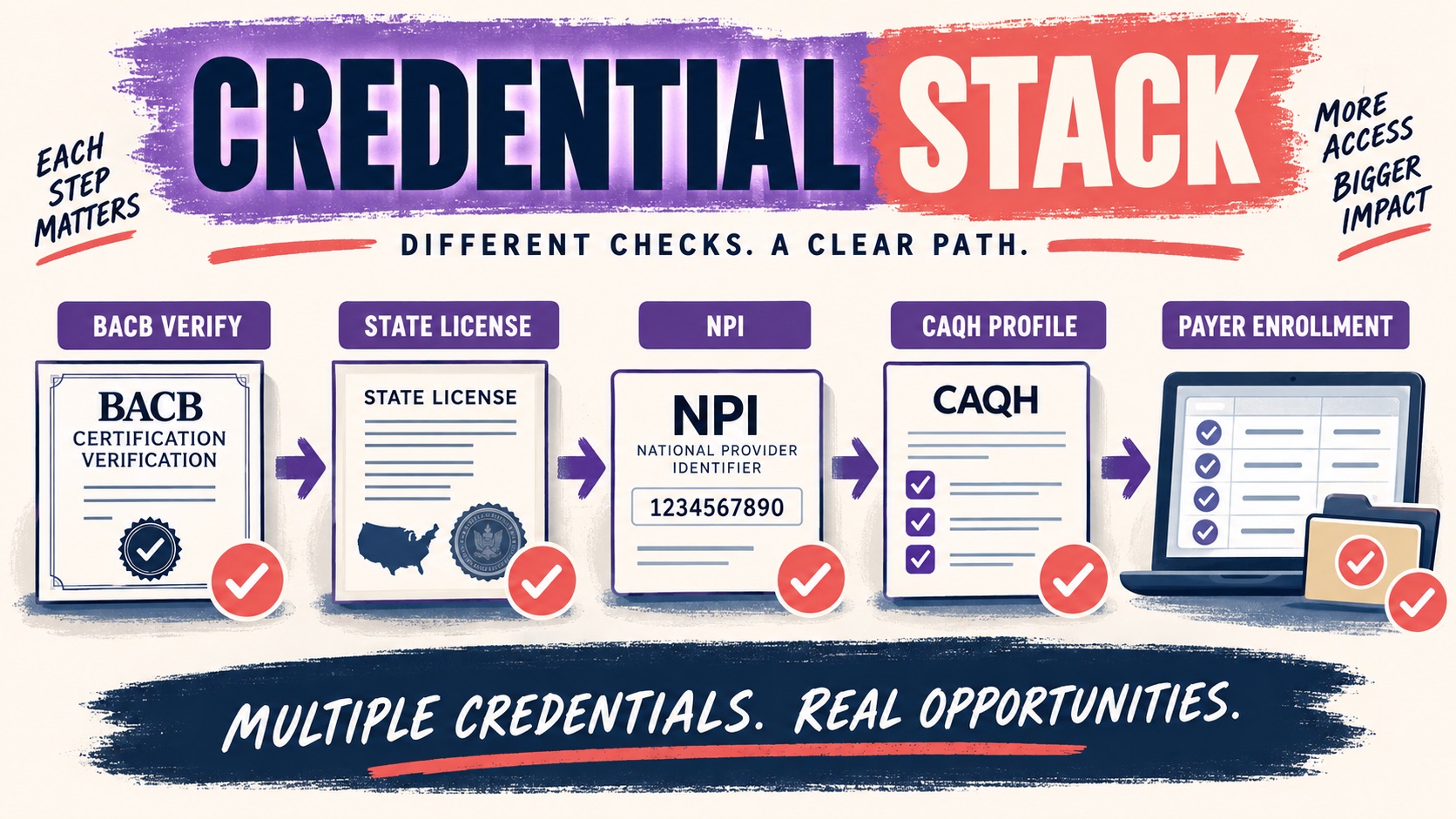
CAQH’s Provider Data Portal is designed to reduce repeated paperwork for organizations that need professional and practice information for claims administration, credentialing, and directory services. A provider creates or maintains a profile, completes the requested sections, uploads or confirms documents, attests to accuracy, and authorizes participating organizations to access the information.
The exact platform name and workflow can change. CAQH currently describes a transition to CAQH Provider Data Portal and CAQH Unity for different users and functions, so follow the live instructions that your payer or practice manager gives you. Do not assume that a complete CAQH profile enrolls you with every payer. Maintain the profile as an ongoing compliance record:
- update addresses, practice locations, phone numbers, and affiliations;
- replace an expired license, liability certificate, or certification document;
- keep work history and disclosure answers consistent with payer applications;
- complete the requested attestation on the platform’s schedule;
- record which payers are authorized to access the profile;
- save confirmation screens and the next re-attestation date.
A stale profile can be just as disruptive as a missing profile. If a payer says that it cannot see a document, compare the payer’s requested field with the current profile and ask whether it needs a direct submission or a new authorization.
What Happens After The Payer Packet Is Submitted?
Submission is the beginning of the review, not the approval. A payer may first check that the packet is complete, then verify credentials and sanctions, review the provider or group contract, decide network participation, and issue an effective date. Some plans use a delegated credentialing organization or a group practice to perform part of the work. Ask for a reference number and identify the owner of the next step. A useful follow-up message states:
- the provider’s legal name and NPI;
- the group name and group NPI if applicable;
- the date and method of submission;
- the application or ticket number;
- the documents already confirmed as received;
- the exact item still needed and the current expected decision step.
Do not infer an effective date from an email that only says “your application is under review.” Do not bill under a payer contract until the payer, group, or compliance team confirms the correct effective date and billing arrangement. If a claim is time-sensitive, ask the payer which date controls and document the answer.
How Can I Track Applications Without Losing The Effective Date?
Use one row per payer and one row per individual or group enrollment. Track the status with exact labels rather than a single “done” checkbox. A basic tracker should include:
| Field | What to record | Why it matters |
|---|---|---|
| Provider identity | Legal name, BACB ID, individual NPI, group NPI, and tax entity | Prevents records from being matched to the wrong provider or group. |
| Submission | Date, portal, contact, ticket number, and documents sent | Creates a clean follow-up trail. |
| Credential status | BACB, license, liability coverage, CAQH, and expiration dates | Shows which document could expire while the payer reviews the packet. |
| Payer status | Incomplete, submitted, credentialing, contracting, approved, effective, or rejected | Separates review from actual enrollment and billing readiness. |
| Next date | Follow-up date, renewal date, re-attestation date, and effective date | Turns a passive application into an accountable workflow. |
Which Status Means I Can Actually Bill?
Status labels vary, so ask for the payer’s definition. As a planning rule:
- Profile complete: your data is present in CAQH or another portal; no payer approval is implied.
- Application received: the payer has the packet; review may not have started.
- Credentialing approved: qualifications passed review; contracting or enrollment may still be open.
- Contract signed: network terms may be accepted; the billing system may still need enrollment.
- Rostered or loaded: the payer has added the provider to a system or directory; confirm the effective date.
- Effective and active: the payer has confirmed the date and arrangement under which claims may be submitted.
CMS also warns that an NPI does not prove licensing or credentialing. A payer portal login, CAQH ID, or directory listing should be treated the same way: useful evidence of a step, not proof of every downstream approval.
What Should BCBAs Recheck For 2027?
The BACB has announced significant changes to BCBA and BCaBA certification requirements beginning January 1, 2027. That can change the certification documents a newly certified provider carries into credentialing, but it does not automatically change a payer’s enrollment form, a state’s license rule, or a group’s contract. Before a 2027 submission or renewal, recheck two source sets:
- BACB: current Handbook, certification status, verification options, renewal or maintenance requirements, and 2027 transition guidance.
- Payer and state: license status, payer application, CAQH or replacement platform instructions, provider roster rules, NPI/taxonomy information, and effective-date policy.
If a payer asks for a document that no longer matches your national pathway, do not guess. Ask the payer’s credentialing contact which current verification it accepts, and keep the written answer with your application record.
When Does BCBA Exam Practice Belong In The Plan?
BCBA exam practice belongs before credentialing when national certification is still your missing gate. It does not replace the certification record, state license, NPI, CAQH profile, payer packet, or contract. Once you are certified, the highest-value task may be document consistency and application tracking rather than more general study. If the exam is still ahead, use a measured loop:
- Take a timed diagnostic aligned with the current BCBA content outline.
- Sort misses into concept, discrimination, application, ethics, calculation, and pacing errors.
- Review the source concept and explain why the best option beats the distractors.
- Retest in a new context and keep the result by error class.
Our free BCBA mock exam practice for the bcba credentialing process is a study checkpoint, not a credentialing approval, payer guarantee, legal opinion, or promise of a passing result.
Which Mistakes Cause Delays?
- Calling a complete CAQH profile a payer approval.
- Assuming an NPI proves licensure or credentialing.
- Using an expired BACB verification, license, liability policy, or CAQH document.
- Mixing an individual NPI with a group NPI or the wrong tax entity.
- Letting the payer discover an address, name, or practice-history mismatch.
- Submitting a screenshot when direct verification is required.
- Failing to record the ticket number and the person responsible for the next step.
- Billing before the payer confirms an effective date.
- Assuming one payer’s network status transfers to another payer.
- Ignoring national or state changes before a 2027 renewal.
BCBA Credentialing Process FAQ
Does BCBA certification automatically credential me with insurance?: No. BACB certification proves the national credential. A payer may still require a state license, NPI, CAQH profile, application, contract, direct verifications, and its own effective-date decision.
Do I need an NPI before applying to an insurance payer?: Many payer applications request an individual NPI and may also request a group NPI. Check the payer’s current instructions and use the correct individual-versus-organization identifier. An NPI is an identifier, not proof of licensure or credentialing.
Is CAQH the same as payer enrollment?: No. CAQH can centralize professional and practice information for participating organizations, but each payer decides whether it uses the profile, what documents it needs, and whether to approve enrollment or network participation.
How long does BCBA credentialing take?: There is no universal timeline. It depends on the payer, state, group arrangement, document completeness, verification response, contracting step, and effective-date process. Track each payer separately and ask for its current service-level expectation. Can I bill while credentialing is pending?: Do not assume so. Confirm the payer’s written policy, group contract, and effective date before submitting claims. A pending application is not the same as active enrollment.
What Should You Do Today?
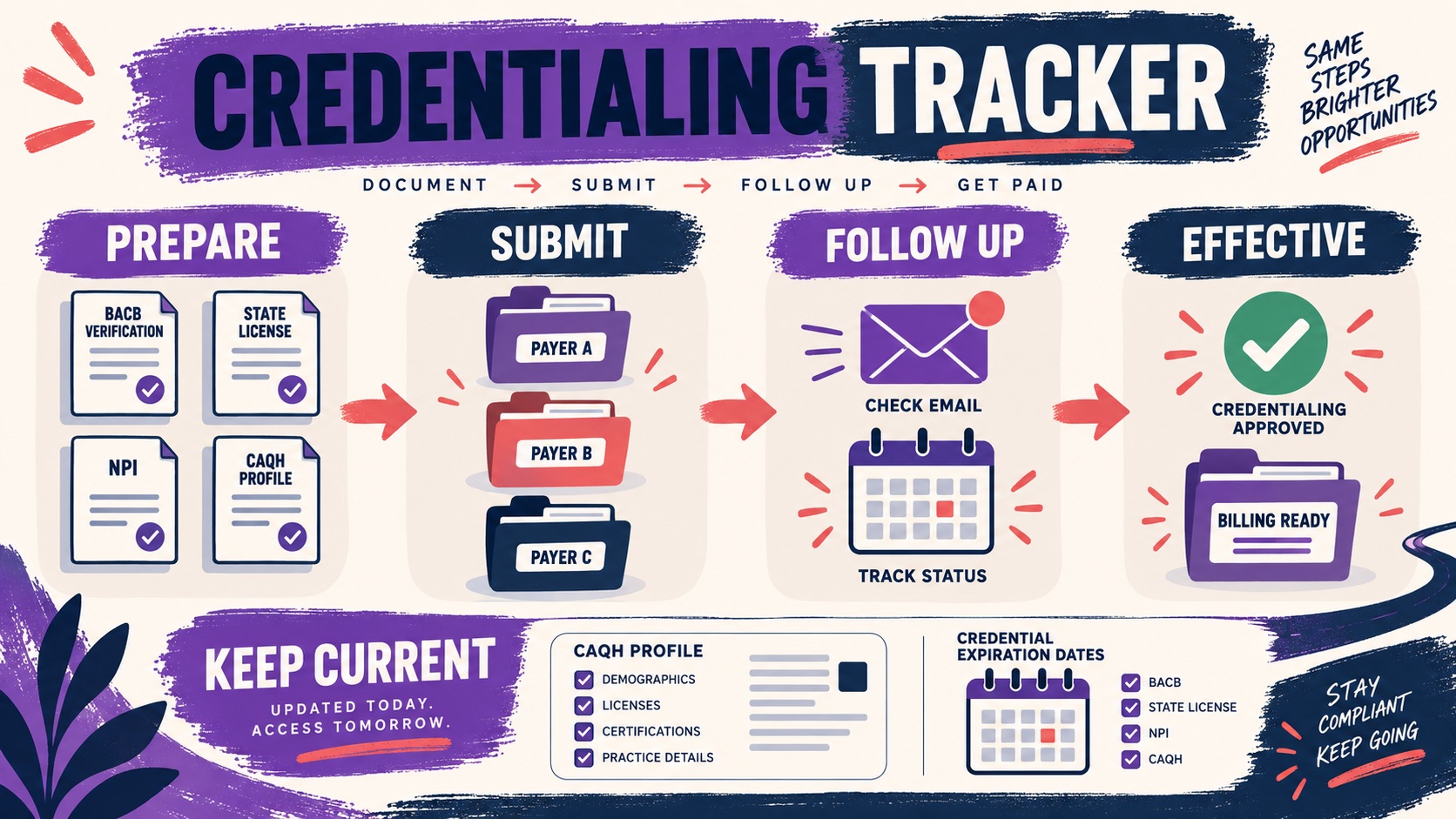
Create one credentialing folder and one tracker. Put BACB verification, state license, NPI, CAQH or provider-data profile, liability coverage, payer applications, ticket numbers, follow-up dates, and effective dates into the system. When a document changes, update the source record first and then notify every payer or group that relies on it.
The strongest BCBA credentialing process is not a single form. It is a chain of verified records with clear ownership and a confirmed effective date. Build that chain before billing, and use official BACB, CMS, CAQH, state, and payer instructions for the part each organization actually controls.
Take the Free BCBA Mock Exam
When you are ready to apply the idea, use the free practice resource below for additional feedback. Take the Free BCBA Mock Exam



