
ABA for toddlers is not one fixed program or one guaranteed number of hours. It is a broad phrase for behavior-analytic support that may use play, daily routines, communication teaching, structured learning opportunities, caregiver coaching, and data-based adjustment. The right goals, format, schedule, and provider fit depend on the individual child and family.
Table of Contents
- What Does ABA for Toddlers Mean?
- What Might a Toddler ABA Session Look Like?
- Which Goals Can ABA for Toddlers Address?
- Is Toddler ABA Play-Based or Structured?
- How Should Family Choice and Assent Fit?
- What Does the Evidence Say About Intensity?
- What Should Parents Ask an ABA Provider?
- What Can BCBA Candidates Learn From This Topic?
- ABA for Toddlers Checklist
- Quick Review Checklist
- Take the Free BCBA Mock Exam
For a toddler, a meaningful plan should focus on useful skills and quality of life: communicating wants and needs, participating in routines, playing in a preferred way, tolerating small changes, learning self-care steps, or safely accessing the community. Those goals should be observable, socially important, and developed with the family—not selected only because they make a child look more compliant.
This article offers general education, not a diagnosis or treatment recommendation. If you are considering services, discuss concerns with qualified professionals who can evaluate the child, explain options, respect family priorities, and review progress over time. Evidence for early behavioral interventions is growing but heterogeneous, so a careful provider should be comfortable explaining uncertainty rather than promising a universal outcome. Table of Contents
What Does ABA for Toddlers Mean?
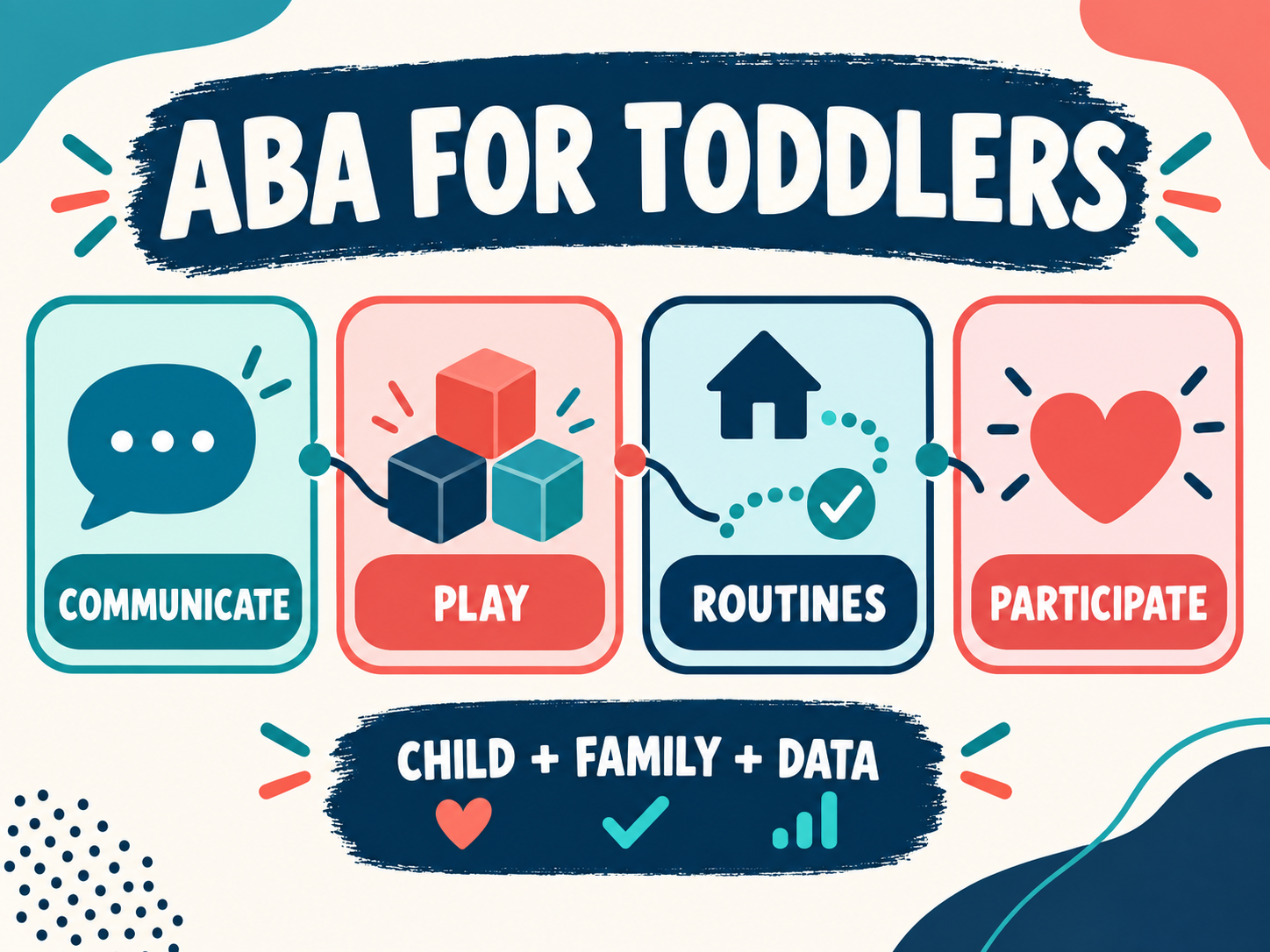
Applied behavior analysis is a science and professional practice that uses principles of learning to understand behavior and support socially meaningful change. For toddlers, ABA-based support may happen in a home, clinic, preschool, or community setting. It can include natural routines and play as well as short, structured teaching opportunities.
The phrase ABA for toddlers describes an age group and a service context, not a single curriculum. One child may need support with functional communication; another may be working on transitions, sleep-related routines, feeding-related skills, or participation in preschool. A qualified team should begin with assessment and family priorities, then define goals and measure progress.
The American Academy of Pediatrics describes ABA-based interventions as ranging from highly structured adult-directed approaches to natural-environment approaches that may be child-led and embedded in play or daily routines. That variation is important: “ABA” does not automatically tell you what a session looks like, and “play-based” does not automatically tell you whether the teaching is well designed.
What Might a Toddler ABA Session Look Like?
Imagine a fictional toddler who often pulls an adult toward a snack cabinet but has few reliable ways to request. During a routine, the practitioner and caregiver arrange choices the toddler already enjoys. The adult pauses at a natural point, models or prompts the agreed communication response only as needed, and responds promptly when the child uses the response. The target might be a gesture, picture, sign, word approximation, or speech-generating-device response, depending on the child’s communication plan.
The example is not “make the toddler perform, then hand over a random prize.” The response has a meaningful purpose: it helps the child access a snack, a turn, help, or a continuation of an activity. The adult also watches for engagement, fatigue, refusal, and changing motivation. A short routine may include several opportunities, but the goal is not to maximize trials at the expense of regulation or a positive relationship.
Later, the team might practice the same communication response during play, dressing, or a community routine. Data could include independent requests, prompts, latency, successful transitions, and caregiver implementation. The exact measures depend on the target; “the child seemed better” is not enough for a data-based decision, while a single percentage without context is not enough to describe meaningful progress.
| Session moment | Family-centered arrangement | Possible data |
|---|---|---|
| Choice | Offer meaningful options and observe what the toddler actually approaches or selects. | Selection, engagement, and changes in motivation. |
| Communication | Create a natural reason to request help, access, continuation, or a break. | Independent response, prompt level, and latency. |
| Routine | Practice within a real snack, play, dressing, or preschool transition. | Participation, transition, and caregiver fidelity. |
| Review | Use data and caregiver feedback to decide what to continue, change, or stop. | Generalization, maintenance, social validity, and safety. |
Which Goals Can ABA for Toddlers Address?
Goals should be individualized and functional rather than chosen from a generic list. A family may prioritize communication because the child is frequently unable to ask for help. Another may prioritize tolerating a short routine change because it affects preschool participation. The clinician should define the behavior in observable terms and explain why the goal matters to the child and family.
| Possible priority | A more useful goal question | What to monitor |
|---|---|---|
| Communication | Can the toddler reliably request a preferred item, help, continuation, or a break in a meaningful routine? | Independent communication across people and settings. |
| Daily living | Which small routine step would make the child more independent or comfortable? | Prompt dependence, safety, and generalization. |
| Play and social participation | What kind of play, joint activity, or shared routine does the toddler choose and enjoy? | Child choice, duration, quality, and social validity. |
| Safety or distress | What environmental change or replacement skill could reduce risk and increase access to support? | Function, assent, safety events, and quality of life—not compliance alone. |
Avoid goals that merely describe looking typical or obeying adults without a clear benefit to the child. A good plan explains the skill’s purpose, how the child can communicate refusal or a break, and how the family will know whether the goal is helping.
Is Toddler ABA Play-Based or Structured?
It can be both. Structured teaching may be useful for a clearly defined skill when the child is ready and the arrangement is acceptable. Naturalistic teaching may fit communication, play, routines, and generalization. The format should follow the assessment and goal rather than a marketing slogan.
Play-based does not mean “anything goes.” The adult can still arrange materials, create response opportunities, prompt carefully, reinforce a related response, and collect data. Structured does not automatically mean harsh or inappropriate; a brief, predictable teaching arrangement can be respectful when it is individualized, motivating, and paired with meaningful outcomes.
Ask how the team balances adult guidance with child choice. A toddler should not have to surrender every preferred activity or communicate only in the adult’s chosen form to receive support. A strong program makes room for functional communication, breaks, preferences, and relationship-building while still teaching measurable skills.
How Should Family Choice and Assent Fit?
Family participation is more than receiving a progress report. Caregivers should understand the goal, what the adult will do, what data will be collected, and how to raise concerns. The plan should fit the family’s routines, language, culture, resources, and priorities. If a recommendation requires more time, equipment, travel, or coordination than the family can sustain, that context belongs in the decision.
Assent is also important for young children. Toddlers may communicate comfort, refusal, fatigue, or distress through words, gestures, movement, or changes in engagement. A provider should explain how those signals are noticed and what happens when a child does not want to continue. Consent paperwork alone does not answer that question.
Ask whether the team will teach a child a practical way to request “break,” “no,” “help,” or “all done.” Respecting communication is part of good teaching and can make sessions safer and more meaningful. If the provider cannot explain how the child’s preferences and refusal will be honored, that is a reasonable concern to discuss before services begin.
What Does the Evidence Say About Intensity?
There is no universally correct number of ABA hours for every toddler. The schedule should reflect the child’s goals, needs, family capacity, setting, other services, and data over time. A provider who promises that one fixed schedule is necessary for every child is skipping important assessment and fit questions.
Evidence reviews also require careful reading. The Cochrane review of early intensive behavioral intervention found some positive findings but characterized the evidence as weak and limited by small samples and study design. A later individual-participant meta-analysis included heterogeneous ABA-based programs and noted serious risk-of-bias concerns in the available studies. A 2025 review of interventions for infancy and early toddlerhood similarly describes a growing literature with different procedures, participants, and outcomes.
That does not mean research is useless. It means families should ask what outcome is being measured, how meaningful it is, how progress will be monitored, and what will happen if the data do not support the current plan. A responsible provider can describe benefits, limitations, alternatives, and uncertainty without turning evidence into a guarantee.
What Should Parents Ask an ABA Provider?
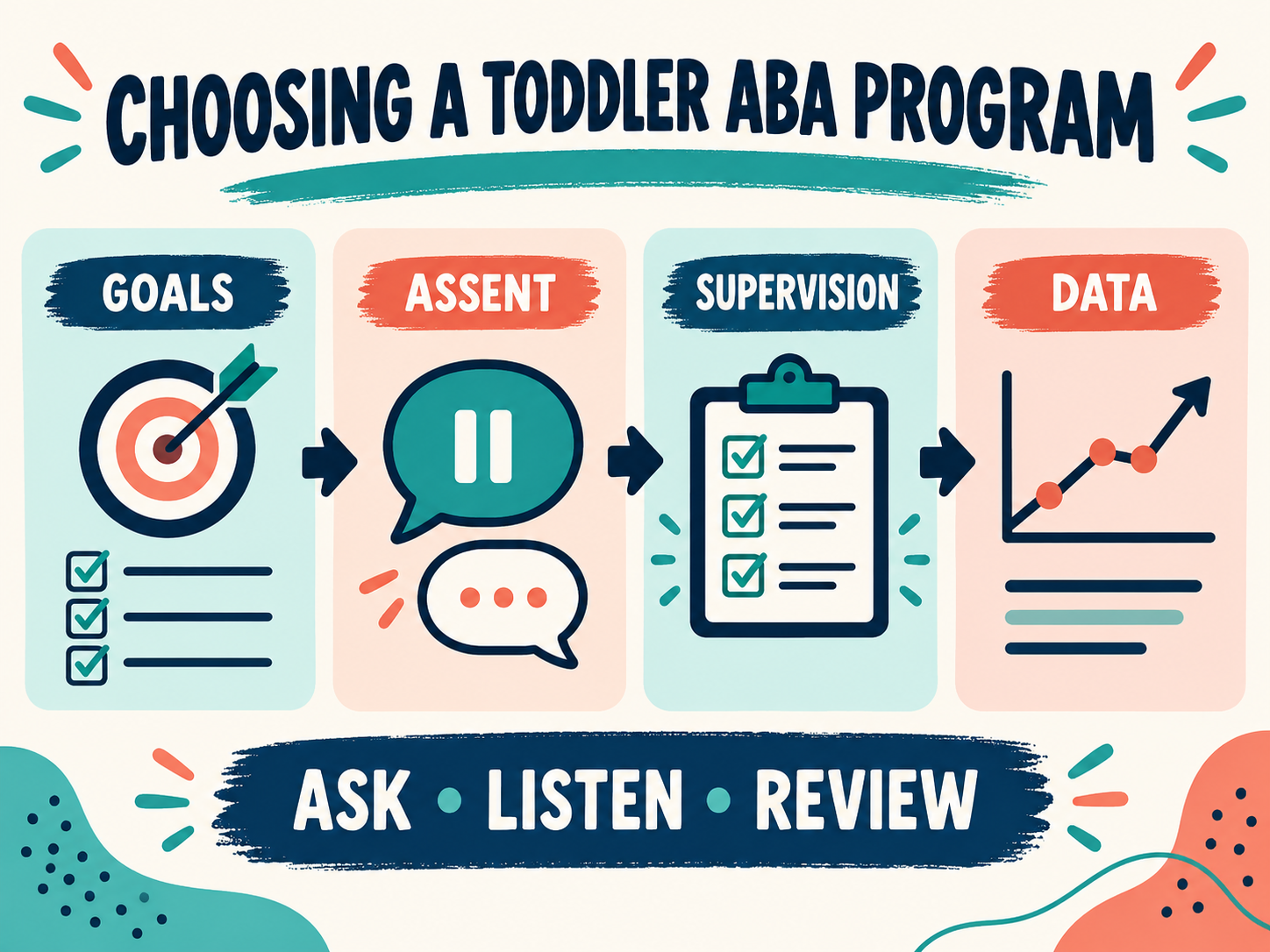
Use a conversation—not a single rating or sales page—to evaluate fit. These questions help reveal whether the program is individualized and transparent:
- What assessment will you complete before selecting goals, and how will you include our priorities and the child’s communication?
- Which goals are being proposed, why do they matter for this child, and how will we define progress?
- How do sessions balance play, routines, structured teaching, child choice, and breaks?
- How will my child communicate “no,” “help,” “break,” or “all done,” and what happens when they do?
- What training and supervision will the people working with my child receive?
- How will you share data, protect privacy, and change the plan when progress stalls or the goal is not meaningful?
- How will you coordinate with speech, occupational, educational, medical, or other professionals when appropriate?
- What schedule do you recommend, what evidence supports that recommendation, and how will family capacity be considered?
The answers should be specific enough for you to understand the plan and flexible enough to change when the child’s needs or data change. You do not need to accept a provider’s recommendation immediately; asking for time to review options is reasonable.
What Can BCBA Candidates Learn From This Topic?
For BCBA candidates, toddler ABA is a useful scenario for connecting assessment, ethics, intervention selection, and social validity. The exam may describe a young learner, a caregiver priority, a communication target, or a routine-based teaching arrangement without using the exact phrase “ABA for toddlers.” Read for the decision being tested:
- Assessment: Is the team identifying strengths, needs, preferences, environmental variables, or a function of behavior?
- Goal selection: Is the target observable, measurable, socially meaningful, client-informed, and culturally responsive?
- Intervention: Does the procedure fit the assessment, evidence, context, family resources, and practitioner competence?
- Ethics: Does the plan respect dignity, communication, assent, privacy, collaboration, and the child’s welfare?
- Data: What evidence would support continuing, modifying, generalizing, or discontinuing the plan?
The current BCBA Test Content Outline emphasizes assessment, ethical practice, contextually fit intervention, and data-based decisions. Those same principles make a parent-facing ABA explanation more trustworthy. If you are studying for the certification exam, the free BCBA mock exam can provide additional scenario practice. It is a study resource, not official BACB guidance and not a substitute for supervised fieldwork.
ABA for Toddlers Checklist
Before choosing or continuing a program, check whether you can answer these questions:
- Are the goals useful to this child and family, not just convenient for adults?
- Can the child communicate a preference, refusal, break, or request for help?
- Does the provider explain both play-based and structured teaching in plain language?
- Are data, caregiver observations, and the child’s behavior used to adjust the plan?
- Is the recommended schedule individualized rather than presented as a universal rule?
- Does the team explain training, supervision, safety, privacy, and coordination with other professionals?
- Are progress and quality of life reviewed together, including the child’s comfort and participation?
The short answer is that ABA for toddlers should be individualized, relationship-aware, measurable, and meaningful. A good program teaches useful skills in ways that respect the child’s communication and the family’s priorities. It leaves room for questions, change, and informed choice.
Quick Review Checklist
Use this final checklist to turn aba for toddlers into exam-ready reasoning. The goal is not to memorize a label in isolation; it is to identify the relevant evidence and explain why the best answer fits the scenario. Key ideas to review:
- State the central definition or decision point for aba for toddlers in your own words.
- Identify the detail that makes aba for toddlers different from its closest related ABA term.
- Separate the observable facts in a scenario from assumptions that are not supported by the facts.
- Write one example and one nonexample so you can recognize the concept in a new setting.
Exam application checks:
- Ask what the question is actually requesting before comparing the answer choices.
- Mark the antecedent, response, consequence, or other evidence that supports the selected answer.
- Look for a distractor that describes a related process but does not answer the specific question.
Final self-check:
- Explain how you would verify the interpretation with clear observations or data.
- Change one detail in the scenario and decide whether your answer should change.
- Give a one-sentence rationale that a supervisor or study partner could evaluate.
Take the Free BCBA Mock Exam
If you want a low-pressure way to check your recall, use the free practice resource below. Take the Free BCBA Mock Exam



