
BCBA terminology and exam application If you are searching for ABA terminology flashcards, the goal is not to collect the largest deck. The useful goal is to move from recognizing a term to distinguishing it from a close neighbor, applying it to a short scenario, and explaining why the distinction matters. A card that only asks for a definition can support first-pass recall, but BCBA-style study also requires discrimination and application.
Table of Contents
- What ABA Terminology Flashcards Should Test
- How to Organize ABA Terminology Flashcards
- How to Write a Stronger Terminology Card
- How to Study Close ABA Terms Together
- How to Use a Terminology Flashcard Loop
- Common Flashcard Mistakes
- A Quick ABA Terminology Flashcard Checklist
- ABA Terminology Flashcards FAQ
- Take the Free BCBA Mock Exam
This guide shows how to build and use a terminology deck around the current BCBA content outline. The official BCBA Test Content Outline should control the scope of exam preparation, while the BCBA Handbook controls the BACB’s guidance about preparation materials and examination policies. Flashcards can organize study; they cannot guarantee a score or replace training, supervision, or the official materials.
What ABA Terminology Flashcards Should Test
A terminology deck is most useful when each card has a job. Some cards establish a clean definition. Others test whether you can identify the term in context, separate it from a similar concept, or predict what evidence would support the answer. Mixing these jobs makes the deck more valuable than repeating the same definition in different colors. Use four levels when you review a card:
- Term: Can you say the term accurately without looking?
- Meaning: Can you state the defining feature in plain language?
- Contrast: Can you explain how it differs from the closest distractor?
- Application: Can you recognize or justify the term in a new scenario?
For example, knowing that stimulus generalization involves responding similarly across stimuli is a starting point. A stronger review asks which stimulus features changed, whether the response stayed the same, and whether the example instead describes response generalization or maintenance. The flashcard should make the discrimination visible.
| Card level | Prompt style | What a correct response shows |
|---|---|---|
| Recall | What is differential reinforcement? | A concise, accurate definition. |
| Discrimination | Which feature separates DRA from DRO? | The response requirement, not just the reward. |
| Application | Which procedure matches the stated behavior and goal? | Selection based on the controlling facts. |
| Explanation | Why is the tempting alternative wrong? | A boundary that would transfer to a new item. |
How to Organize ABA Terminology Flashcards
Organize the deck by relationships, not only by alphabetical order. Alphabetical order is convenient for finding a card, but it does not tell you which terms are commonly confused. A BCBA candidate can learn more from a small contrast set than from a long list of isolated definitions.
Start with the current outline’s content areas, then create subgroups based on the decision a learner must make. One group might contain measurement dimensions and display terms. Another might contain assessment types. A third might contain reinforcement, punishment, extinction, motivating operations, and stimulus control. Keep the group small enough that every card has a clear neighbor or example.
- Foundations: behaviorism, selection by consequences, private events, and radical behaviorism.
- Concepts and principles: reinforcement, punishment, extinction, motivating operations, stimulus control, and generalization.
- Measurement and data: frequency, rate, duration, latency, interresponse time, interval recording, and graph interpretation.
- Assessment: indirect assessment, descriptive assessment, functional analysis, preference assessment, and skill assessment.
- Intervention: prompting, fading, shaping, chaining, differential reinforcement, behavior contracts, and generalization planning.
- Professional practice: consent, confidentiality, cultural responsiveness, scope of competence, supervision, and documentation.
Do not treat that list as an official replacement for the outline. It is a filing system for your deck. Before you add a card, identify the relevant task or domain in the current BACB source. That habit protects the deck from drifting toward whichever terms happen to be easiest to memorize.
How to Write a Stronger Terminology Card
A strong card is short on the front and precise on the back. The front should force retrieval, not provide so many clues that the answer is visible. The back should include the defining feature, one boundary, and one example. If the term is often confused with another term, name that contrast explicitly. Use this card blueprint:
- Write one target term and one question on the front.
- State the answer in one or two sentences on the back.
- Add the feature that makes the term different from its nearest neighbor.
- Add a neutral, original example that changes the surface details.
- Record the source or outline task used to check the wording.
Here is a mini-example. Front: “A learner receives reinforcement for completing a functional communication response instead of engaging in the target problem behavior. Which differential-reinforcement arrangement is being described?” Back: “DRA, if reinforcement is delivered for an alternative response and the defining alternative-response condition is met. Do not label it DRO merely because the problem behavior is absent; DRO depends on the absence criterion.” The value is not the acronym alone. The value is the decision rule.
Avoid stuffing multiple unrelated terms onto one card. “Define reinforcement, punishment, extinction, motivating operation, and stimulus control” is a review sheet, not a retrieval prompt. Split it into cards, then add a separate comparison card after the individual terms are stable.
How to Study Close ABA Terms Together
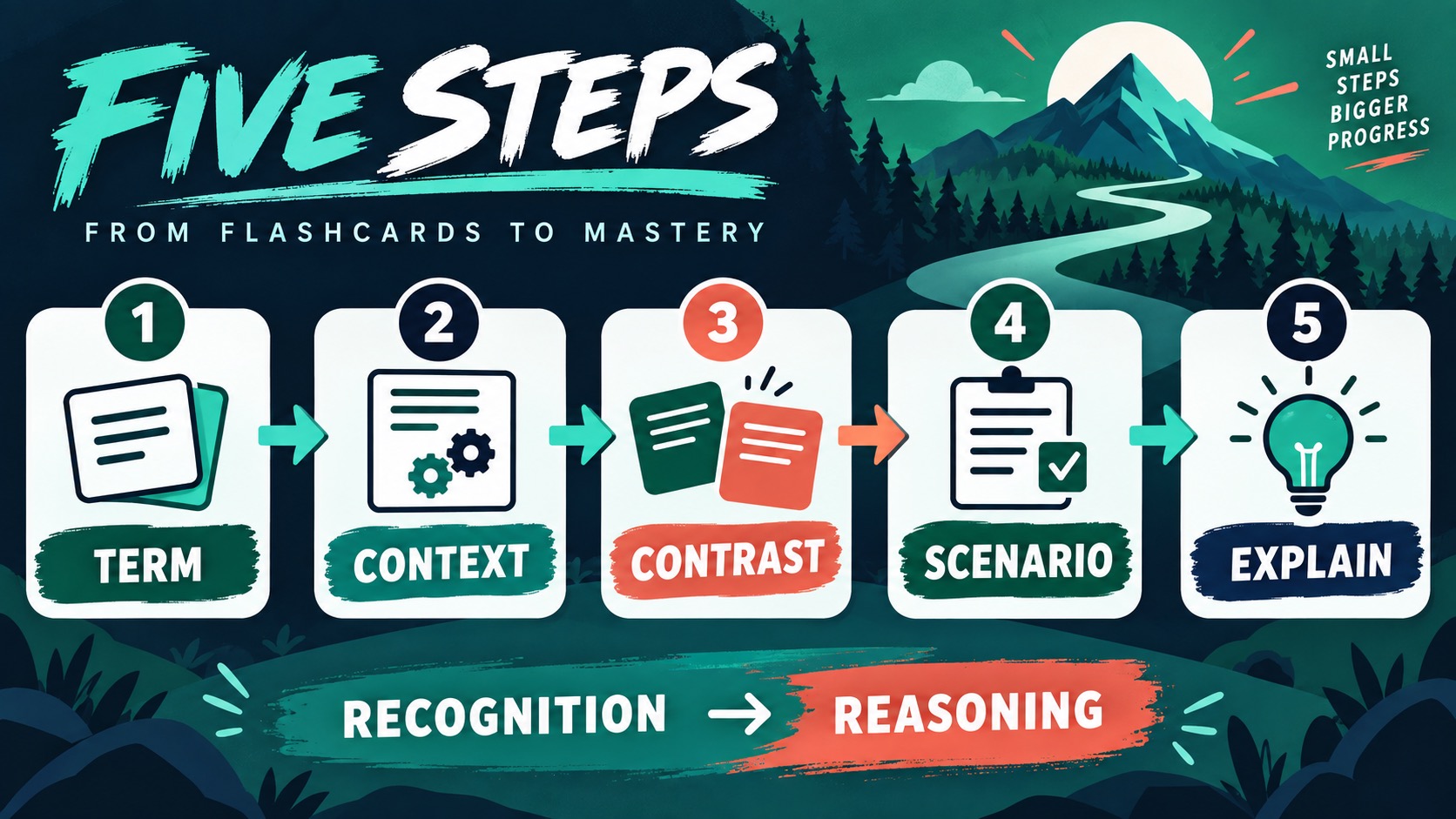
Contrast practice is where terminology flashcards begin to resemble exam reasoning. Put two or three related cards next to each other only after you can state each definition separately. Then ask a question that changes one controlling detail at a time.
| Contrast set | Controlling question | Study move |
|---|---|---|
| Frequency vs. rate | Is time included in the measure? | Rewrite one example with a fixed observation period. |
| Latency vs. duration | Are you measuring time before an action or time during it? | Circle the event that starts and ends the measurement. |
| Stimulus vs. response generalization | Did the stimulus change, the response change, or both? | Change one dimension and keep the other constant. |
| MO vs. stimulus control | Is the variable changing the value of a consequence or signaling its availability? | Write the value-changing clue and the signal separately. |
When you miss a contrast card, do not simply mark the whole topic as weak. Write the exact feature you missed. “I confused latency and duration because I ignored the start event” is useful. “I need to study measurement” is too broad to guide the next card.
How to Use a Terminology Flashcard Loop
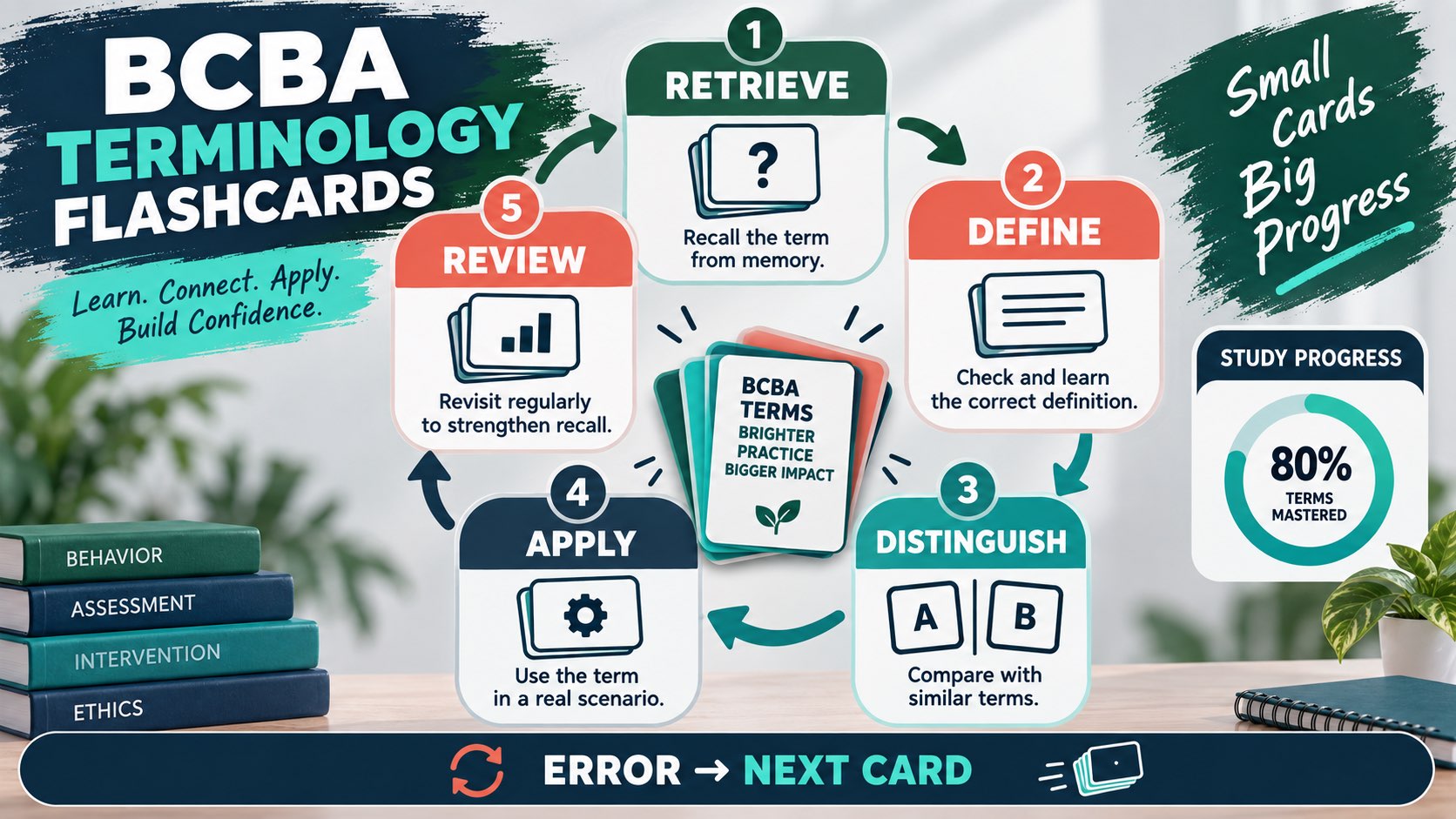
Use a short loop that turns every error into a new decision. A practical session can begin with retrieval, move into definition and discrimination, then end with an application example. The loop should be repeatable enough to use on busy days and specific enough to show what changed.
- Retrieve: answer the front before looking at the back.
- Define: say the defining feature in plain language.
- Distinguish: name the closest distractor and the boundary between them.
- Apply: solve one original scenario with changed surface details.
- Review: schedule the missed card and write the next study action.
Keep a small error log with columns for term, error type, controlling clue, and next review date. Error types can include incomplete definition, wrong contrast, missed measurement dimension, rushed reading, or correct answer with weak explanation. This makes the deck responsive to your performance instead of turning every missed card into more passive reading.
Use spaced review, but do not confuse time intervals with mastery. A card that is correct after a long pause may still fail when the scenario changes. Add a second example, reverse the question, or place the term beside a new distractor. The aim is flexible retrieval, not recognition of the same sentence.
Common Flashcard Mistakes
- Measuring deck size: the number of cards does not show whether you can apply the concepts.
- Copying long definitions: a paragraph on the back can hide the one feature you actually need to retrieve.
- Using only one example: you may memorize the surface details instead of the functional distinction.
- Mixing certification rules with vocabulary: keep current BACB requirements linked to official sources and dated notes.
- Ignoring near neighbors: many errors occur between terms that sound familiar, not between a term and a random concept.
- Studying only when confident: use the error log to decide what returns to the deck.
A Quick ABA Terminology Flashcard Checklist
Before you keep a card, ask:
- Does the front require retrieval rather than recognition?
- Is there one clear target term?
- Does the back state the defining feature?
- Does it name the closest contrast when confusion is likely?
- Can the example be changed without changing the concept?
- Is the wording checked against the current study source?
- What error will send this card back into review?
After your terminology session, take the free BCBA mock exam for ABA terminology flashcards practice to test whether recall transfers to mixed scenarios. Treat the result as a study signal, not as proof of eligibility, competency, or a passing score. Review the missed item by identifying the controlling clue, then add or revise one card that targets that exact distinction.
ABA Terminology Flashcards FAQ
How many ABA terminology flashcards should I make?: Make enough cards to cover the relevant outline tasks and the distinctions you actually miss. A smaller deck with clear contrasts and changed scenarios is usually more useful than a large deck of duplicate definitions. Add cards when an error reveals a missing decision rule.
Should flashcards include every BCBA definition?: No. Use the current BCBA Test Content Outline to define scope, then prioritize terms that support discrimination, interpretation, and application. Flashcards are a study tool, not a replacement for coursework, training, ethical guidance, or the current BACB Handbook.
Why do I know the term but miss the question?: You may have recall without discrimination or application. Add a closest-distractor prompt, underline the controlling fact in a new scenario, and explain why the tempting alternative does not fit. That turns a missed question into a targeted next card.
Take the Free BCBA Mock Exam
When you are ready to apply the idea, use the free practice resource below for additional feedback. Take the Free BCBA Mock Exam



